

Project success rates remain stubbornly low across industries. Only 31% of projects achieve full success, meaning the majority of effort, budget, and team capacity is lost to misalignment, poor resourcing, or inadequate governance. For project managers and PMO leaders, this is not just a statistic to note. It is a performance gap to close. The strategies covered here are evidence-backed, AI-augmented, and immediately actionable, giving you a direct path to stronger delivery outcomes and smarter resource allocation.
Table of Contents
- Clarify objectives and success metrics first
- Build a robust resource management plan
- Adopt hybrid delivery methodologies
- Leverage AI to boost reporting and workflow efficiency
- Control flow: Limit WIP and sequence deliverables
- Why AI alone is not enough and how to outpace your peers
- Accelerate project delivery with a dedicated PMO platform
- Frequently asked questions
Key Takeaways
| Point | Details |
|---|---|
| Define clear KPIs | Project delivery excels when you clarify multiple goals and measure more than just time, cost, and scope. |
| Adopt hybrid methods | Hybrid methodologies help PMOs balance flexibility and control for greater success across varied projects. |
| Use AI for efficiency | AI automation cuts admin workload and lifts success rates, but discipline and structure still matter most. |
| Control flow proactively | Limiting work-in-progress and sequencing tasks reduces delays and keeps project delivery predictable. |
| Integrate tool and process | The smartest teams combine AI with proven PM frameworks rather than relying on tools alone. |
Clarify objectives and success metrics first
Building on the need for evidence-backed improvement, let's start with foundational clarity. Vague objectives are one of the most persistent causes of project failure. When teams do not share a precise understanding of what success looks like, every subsequent decision, resource request, and status report is built on unstable ground.
The best-performing PMOs do not track delivery against just three variables. Targeting multiple KPIs beyond the classic triple constraint of time, cost, and scope drives measurably stronger delivery. Leading organisations monitor nine or more success factors, including:
- Stakeholder satisfaction scores captured at key milestones
- Benefits realisation rate, measuring whether the business case outcomes are actually achieved
- Adoption rates for new processes, tools, or systems introduced by the project
- ROI achieved versus planned, tracked post-delivery rather than just at closure
- Team wellbeing and retention, which flags unsustainable workloads before they cause attrition
Each of these factors gives you a different signal. Stakeholder satisfaction tells you whether the right relationships are being maintained. Adoption rates tell you whether the project output will actually be used. ROI tracked over time tells you whether the business case was realistic. Taken together, they give you a far richer picture of delivery health than schedule variance alone.
Defining these metrics should happen at project initiation, not retrospectively. Engage your sponsors and key stakeholders to agree what good looks like before a single task is assigned. Document those definitions in a success criteria register and revisit them at each stage gate. Establishing clear project requirements at the outset prevents costly scope misinterpretations later.
"What gets measured gets managed. If your PMO is only measuring schedule, budget, and scope, you are only managing a third of your delivery risk."
Pro Tip: Use AI tools to run live goal alignment checks across your portfolio. Automated comparison of current project outputs against agreed success criteria flags drift before it becomes a crisis, allowing you to course-correct while there is still time and budget to do so.
Build a robust resource management plan
With clear objectives established, the next step is ensuring your resources are poised for delivery. Resource mismanagement is consistently cited as a primary cause of project delays, yet many PMOs still rely on spreadsheets and informal conversations to allocate their most valuable asset: people.
PMBOK 8th Edition treats resource management as a dedicated performance domain, encompassing acquisition, skills development, performance management, and conflict resolution. This is not simply a list of who is assigned to which task. It is a structured approach to ensuring your team has the right capability at the right time, with the right level of accountability.
A practical starting point is the RACI matrix, which defines four role types for every workstream:
- Responsible: The person who does the work
- Accountable: The single owner who answers for the outcome
- Consulted: Subject matter experts whose input is needed
- Informed: Stakeholders who need to be kept up to date
RACI matrices prevent the two most common resource failures: unclear ownership and overloaded individuals. When everyone knows precisely where their accountability starts and ends, decisions are made faster and escalations are reduced.
AI scenario modelling takes resource planning significantly further. Rather than assigning resources based on availability alone, resource optimisation with AI allows you to simulate different allocation strategies before committing. The table below illustrates how conventional and AI-optimised assignment compare in practice:
| Factor | Conventional assignment | AI-optimised assignment |
|---|---|---|
| Allocation basis | Availability and manager preference | Skills match, capacity, and risk profile |
| Overallocation detection | Identified reactively | Flagged proactively before assignment |
| Scenario testing | Manual and time-consuming | Automated multi-variable simulation |
| Conflict resolution | Escalated to management | Suggested reallocation with impact score |
| Utilisation rate | Typically 60–70% | Typically 80–90% |
The performance differential is clear. AI-assisted planning does not remove the need for experienced judgement. It removes the noise and guesswork that slow decision-making and erode utilisation rates.
Adopt hybrid delivery methodologies
Once resources are managed, selecting the right delivery approach determines execution efficiency. Many PMOs default to a single methodology, either because it is what they know or because it is mandated from above. This rigidity costs you.
Pure agile methodologies offer rapid iteration and strong stakeholder feedback loops, but they can struggle in environments with fixed regulatory requirements, third-party dependencies, or complex multi-team governance. Purely predictive approaches, sometimes called waterfall, offer structure and control but can become brittle when requirements evolve or market conditions shift mid-project.
Hybrid approaches blend the strengths of both, giving PMOs the governance rigour of predictive planning alongside the adaptive capacity of agile execution. This is not a compromise. It is a deliberate design choice that allows you to apply the right level of control to each phase, workstream, or workpackage.

The data supports this approach strongly. 89% of high-performing organisations now prefer hybrid project management, recognising that no single methodology is universally superior. The comparison below outlines the key characteristics of each approach:
| Characteristic | Agile | Predictive | Hybrid |
|---|---|---|---|
| Planning horizon | Short sprints | Full lifecycle upfront | Phased with adaptive cycles |
| Change tolerance | High | Low | Moderate to high |
| Governance overhead | Low | High | Calibrated to risk |
| Best suited for | Evolving digital products | Fixed-scope infrastructure | Complex or regulated environments |
| Stakeholder engagement | Continuous | Milestone-based | Structured with regular touchpoints |
Understanding finding the best-fit PMO model for your organisational context is the essential first step before committing to any methodology.
Pro Tip: Before selecting a delivery method, assess your environment across three dimensions: requirement volatility (how much is likely to change?), regulatory constraint (how much is non-negotiable?), and stakeholder engagement capacity (how much time can sponsors give you?). The answers will point you clearly toward the most appropriate approach.
Leverage AI to boost reporting and workflow efficiency
To operationalise your methodology, use AI-enhanced reporting and workflow automation. Manual status reporting is one of the most significant hidden costs in project management. PMO leaders frequently spend two to four hours per project per week assembling updates that could be generated automatically, time that would deliver far greater value applied to risk management or stakeholder engagement.
AI-driven tools deliver 28 to 42% greater project success rates and 60 to 80% reduction in manual reporting workload. These are not theoretical gains. They are measurable outcomes from organisations that have deployed AI within structured project frameworks. The practical use cases are broad:
- Automated risk flagging: AI monitors project data continuously and alerts you when indicators suggest a risk is escalating beyond acceptable thresholds.
- Auto-generated status reports: Draft reports are produced from live project data, requiring only a review and sign-off rather than manual compilation.
- Scenario modelling for decisions: When a change request lands, AI can model its impact on schedule, cost, and resource availability before you accept or reject it.
- Dependency tracking: AI identifies cross-project dependencies in multi-project environments and flags conflicts before they cause delays.
- Timesaving automations: Routine tasks such as meeting reminders, approval routing, and document versioning are handled automatically, reducing administrative noise.
One documented example involves a portfolio management team that implemented AI-assisted reporting across a programme of 14 concurrent projects. The result was a saving of over 3,200 hours annually and a 60% reduction in reporting administration, freeing senior project managers to focus on governance and stakeholder relationships.
Explore how AI project tracking strategies and AI and smart reporting can reshape your PMO's operational capacity.
"AI implementation should augment process discipline, not replace it. The organisations that gain the most are those that apply AI within a structured governance framework, not those that expect the technology to compensate for absent processes."
The critical caveat here is that AI amplifies what is already in place. Strong processes become stronger. Weak processes become visibly weak, faster. If your reporting structure is inconsistent or your data quality is poor, AI will surface those issues quickly, which is useful, but only if you are prepared to act on the findings.
Control flow: Limit WIP and sequence deliverables
With data-driven efficiency gains in place, ensure work is sequenced and scope focused using flow control practices. Work-in-progress, known as WIP, refers to the total number of active tasks or deliverables being worked on at any one time. When WIP is uncontrolled, teams juggle too many priorities simultaneously, context-switching increases, and throughput drops.
Flow control tactics such as limiting WIP and sequencing work to match resource availability and site priorities prevent costly delays, particularly in engineering, procurement, and construction contexts where resource conflicts cascade rapidly across workstreams.
The practical steps for implementing flow control are as follows:
- Set WIP limits per team or workstream: Define the maximum number of active items a team can carry at one time. A limit of three to five active tasks per person is a common starting point.
- Sequence deliverables by dependency and resource signal: Identify which outputs must be completed before others can begin, and align sequencing with when the required resources will be available rather than when work could theoretically start.
- Use visual boards to make flow visible: Kanban-style boards, whether physical or digital, give the whole team a real-time view of what is in progress, what is blocked, and what is queued.
- Review WIP limits regularly: As team capacity or project complexity changes, revisit your limits. Static limits become counterproductive when circumstances shift.
Pro Tip: Adopt a token-based assignment model for high-priority deliverables. Assign a visible "priority token" to the single most critical item in each workstream. Team members understand that the token item takes precedence over everything else until it is complete, eliminating the ambiguity that causes priority conflicts.
Effective flow control is especially important in multi-project delivery environments, where resource contention across projects can stall progress without any individual project appearing obviously at risk.
Why AI alone is not enough and how to outpace your peers
After reviewing actionable project delivery strategies, let's consider what actually separates top performers from the rest. The honest answer is uncomfortable for technology advocates: most project failures are not caused by inadequate tools. They are caused by absent or inconsistently applied structure.
We have seen organisations invest significantly in AI platforms and still deliver projects late and over budget. The reason is consistent. AI was deployed without the governance scaffolding needed to make its outputs actionable. Reports were generated, risks were flagged, and dashboards were populated. But without structured escalation paths, defined decision rights, and disciplined objective-setting, those insights sat unread or were ignored.
Prioritising AI for resource optimisation while integrating structured PMBOK planning and hybrid methods gives you the edge that pure technology adoption cannot. The competitive advantage belongs to PMOs that pair AI capability with proven governance frameworks, not those that rely on AI to compensate for structural gaps.
The organisations that outperform consistently share three characteristics. First, they define and track multiple KPIs from day one, as covered earlier, so they know what winning looks like at every stage. Second, they select delivery methodologies deliberately, matching method to context rather than defaulting to organisational habit. Third, they use AI to accelerate decision-making within a framework, not as a substitute for one.
Strong project governance is the architecture that makes every other strategy in this article work reliably. Without it, the best tools and methods will underdeliver. With it, even a modestly resourced PMO can outperform peers with larger teams and bigger budgets. That is the real performance differentiator.
Accelerate project delivery with a dedicated PMO platform
If you are ready to turn these strategies into operational advantage, Pocket PMO is built precisely for this purpose. The platform operationalises delivery best practices from day one, giving your team ready-to-use resource management structures, automated reporting workflows, and AI-driven risk analysis without the overhead of building a PMO from scratch.
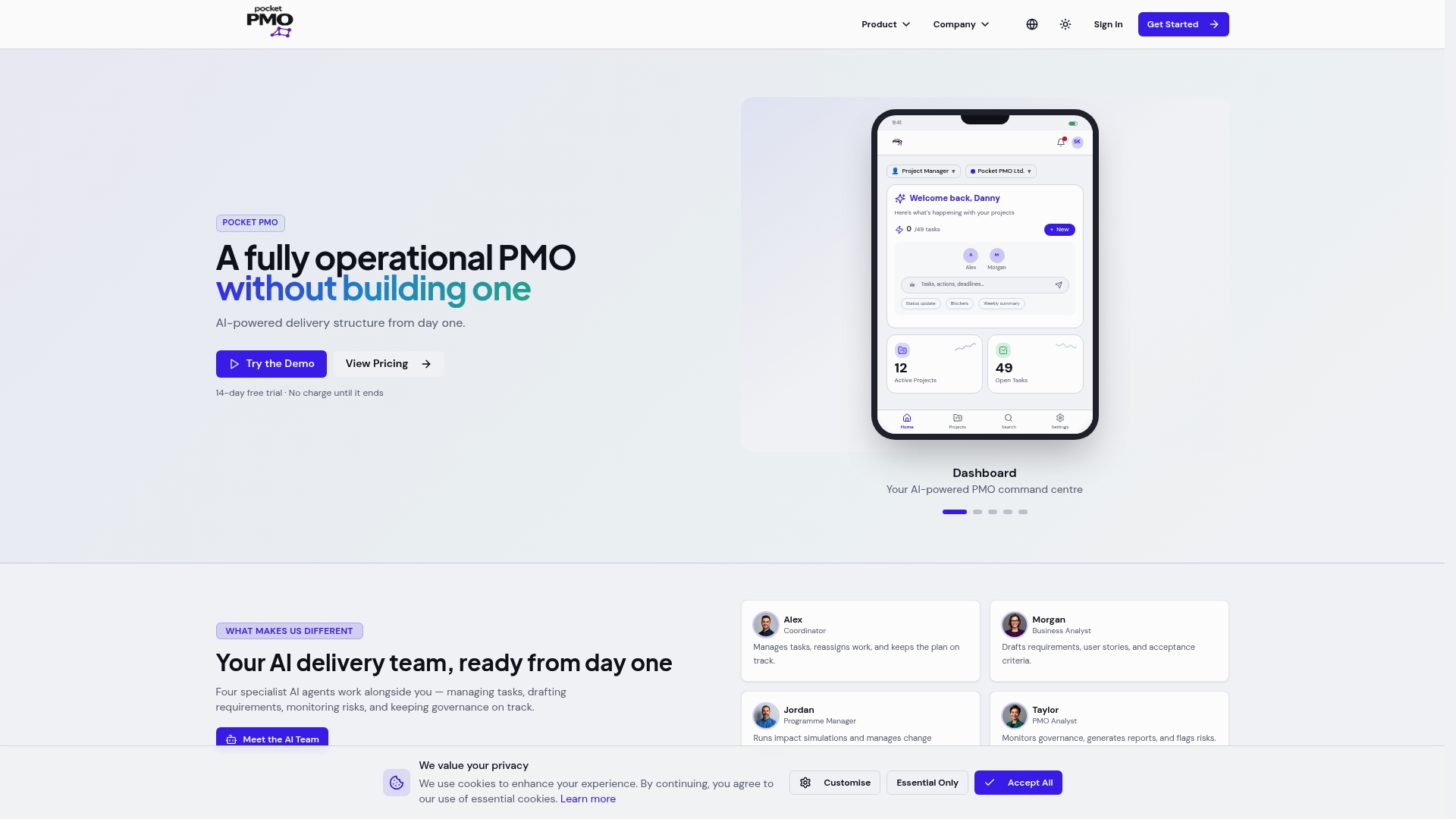
The Pocket PMO platform integrates real-time dashboards, intelligent workflow automation, and predictive analytics across your entire portfolio. You get portfolio management, change request workflows, RAID management, and AI-powered status reporting in a single environment. Whether you are managing a single complex programme or a portfolio of concurrent projects, the platform adapts to your governance model and scales with your delivery needs. Ready to see it in action? Launch your PMO today, or explore how Pocket PMO compares as an alternative in our Pocket PMO vs Monday.com breakdown.
Frequently asked questions
What are the top project delivery KPIs beyond schedule and budget?
Top KPIs include stakeholder satisfaction, benefits realisation rate, adoption rates, and resource utilisation. Tracking multiple KPIs beyond time, cost, and scope consistently drives stronger delivery performance across project portfolios.
How much can AI boost project delivery success rates?
AI tools deliver a 28 to 42% improvement in project success rates alongside a 60 to 80% reduction in manual reporting admin, freeing your team for higher-value governance and stakeholder management activities.
Are hybrid project management methods superior to agile?
No single method is universally superior. 89% of high-performing organisations choose hybrid approaches because they balance governance and flexibility, selecting the appropriate elements of agile and predictive delivery based on project context.
What is flow control in project delivery?
Flow control means limiting WIP and sequencing deliverables based on resource availability and priority to prevent interruptions, bottlenecks, and cascading delays across project workstreams.
What does the PMBOK resource management plan include?
PMBOK 8th Edition specifies that resource management covers acquisition, development, conflict resolution, performance management, and accountability structures such as RACI matrices to clarify roles across the full delivery lifecycle.