

Most senior leaders would never describe their PMO as a strategic asset. They think of it as a reporting engine, a gate-keeping function, or, at worst, an administrative layer that slows delivery teams down. That perception is both common and costly. Strategic PMOs translate strategy into execution, monitor benefits realisation, and provide executive insights that traditional, compliance-focused PMOs simply cannot offer. The difference between a PMO that adds measurable business value and one that quietly fades into irrelevance is almost entirely about strategic positioning, not process design.
Table of Contents
- Defining the modern PMO in operational strategy
- How high-performing PMOs drive strategic execution
- AI-driven PMOs: Transforming value delivery
- Embedding the PMO in your operational strategy: Steps for executive leaders
- Rethinking PMO: Why value orchestration beats process control
- How to achieve PMO excellence with the right solutions
- Frequently asked questions
Key Takeaways
| Point | Details |
|---|---|
| PMO as strategy enabler | A modern PMO drives strategy execution, not just compliance oversight. |
| AI integration multiplies value | AI-driven PMOs improve prediction, outcomes, and efficiency while requiring human judgment. |
| Executive alignment is critical | Direct reporting to strategic leadership ensures PMO longevity and business impact. |
| Quantifiable business results | High-performing PMOs deliver superior revenue growth and customer satisfaction. |
| Focus on outcomes, not process | PMOs thrive by orchestrating value, not getting trapped in administrative routines. |
Defining the modern PMO in operational strategy
With the myth addressed, let us clarify what a PMO must actually deliver in today's operational landscape.
The word "PMO" carries a great deal of baggage. For many executives, it conjures images of status reports, RAG ratings, and governance checklists. That version of the PMO still exists, and it tends to struggle. Traditional PMOs risk bureaucracy and carry an average lifespan of just two years, while strategic PMOs that report to a Chief Strategy Officer or equivalent succeed by focusing relentlessly on outcomes rather than outputs.
The distinction matters enormously at the executive level. A traditional PMO asks: "Are our projects on time and on budget?" A strategic PMO asks: "Are our projects delivering the outcomes we committed to the board?" That is a fundamentally different question, and it changes everything about how the function operates.
| Dimension | Traditional PMO | Strategic PMO |
|---|---|---|
| Primary focus | Process compliance | Outcome delivery |
| Reporting line | Operations or IT | CSO or Executive board |
| Value measure | On-time/on-budget | Benefits realised |
| Risk approach | Reactive reporting | Proactive anticipation |
| Lifespan (average) | ~2 years | Long-term and sustained |
| Strategic integration | Low | High |
The core capabilities of a modern, strategic PMO include:
- Portfolio prioritisation aligned with organisational objectives
- Benefits realisation tracking from initiation through to post-delivery
- Executive insight generation that informs boardroom decisions
- Cross-functional governance that enables, rather than constrains, delivery teams
- Adaptive planning that responds to changing market and operational conditions
"A PMO that reports to strategy leadership rather than operations is structurally positioned to challenge misaligned investment decisions before they become expensive mistakes."
You can explore more on building effective governance structures in the Pocket PMO blog, where operational PMO frameworks are covered in practical depth.
How high-performing PMOs drive strategic execution
Having outlined the PMO's strategic dimensions, we can explore their direct impact on organisational performance.
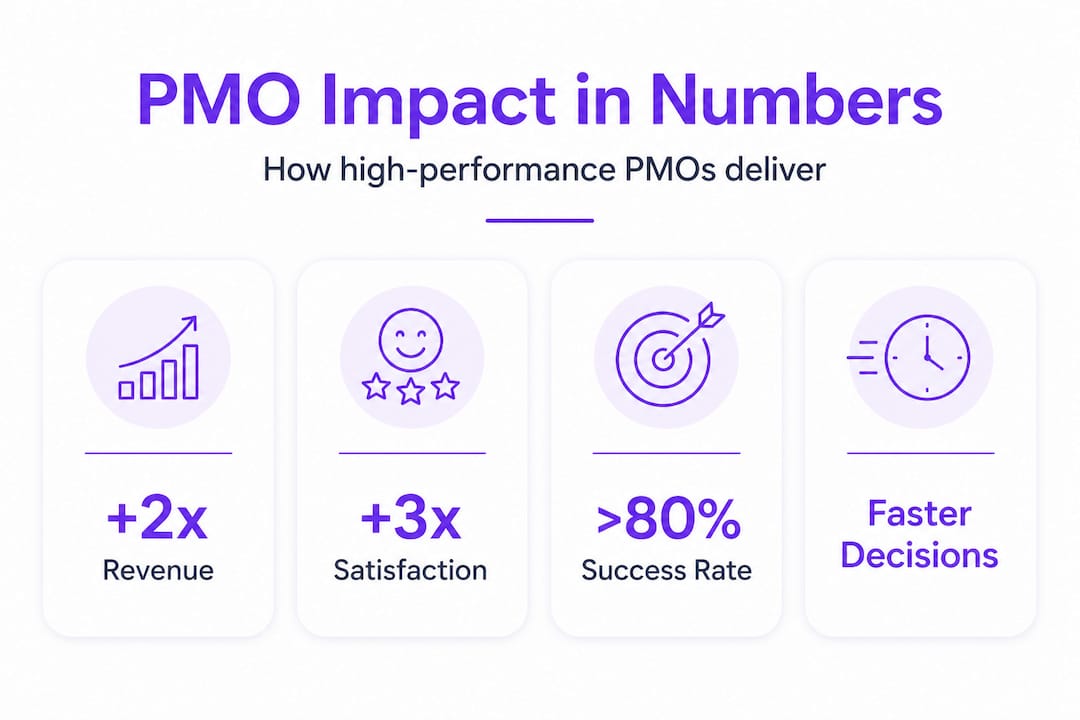
The business case for investing in PMO maturity is not theoretical. The numbers are striking. High-performing PMOs achieve twice the revenue growth and three times the customer satisfaction of their lower-performing peers, according to research from PMI. The top 10% of PMOs are not simply better at project management. They are better at connecting project delivery to the outcomes that matter to customers, investors, and the wider business.
| PMO performance tier | Revenue growth (relative) | Customer satisfaction (relative) | Project success rate |
|---|---|---|---|
| Top 10% | 2x average | 3x average | Significantly higher |
| Mid-tier | Average | Average | Moderate |
| Low-performing | Below average | Below average | Low |
What separates top-performing PMOs from the rest? The practices are consistent and replicable:
- Define success metrics before a project starts. High-performing PMOs agree on what "done" looks like in business terms, not just delivery terms, at project initiation. This prevents post-delivery disputes about value.
- Monitor benefits realisation actively. Rather than closing a project at go-live, leading PMOs track whether the intended benefits are materialising over a defined period, typically six to twelve months post-delivery.
- Generate executive-level insight. The best PMOs synthesise portfolio data into clear, actionable insight for leadership. They do not just report status. They surface patterns, risks, and strategic recommendations.
- Prioritise ruthlessly. When resources are constrained, top PMOs maintain a live, ranked view of portfolio priorities and use it to make fast, defensible decisions about where effort goes.
- Integrate with the multi-project management process to ensure cross-project dependencies are visible and managed proactively.
Pro Tip: Establish your PMO's success metrics in the same boardroom conversation where strategic objectives are set. If the PMO's KPIs are not derived directly from organisational goals, they will drift towards operational proxy measures that obscure real performance.
Organisations that treat the PMO as a strategic execution engine consistently outperform those that treat it as a reporting function. The revenue and satisfaction data make the case clearly. The question for executive leaders is not whether this matters, but whether your current PMO is configured to capture this value.
AI-driven PMOs: Transforming value delivery
With clear proof of PMO impact, let us examine how digital transformation and AI push PMO value even further.
The integration of artificial intelligence into PMO functions is not a future scenario. It is already reshaping what high-performing PMOs can do today. AI-driven PMOs shift from administration to value orchestration, using hybrid human and AI environments to excel in prediction while retaining human judgement for ethics and stakeholder nuance. The administrative burden that once consumed PMO capacity, status updates, risk logging, resource tracking, is being automated. That frees PMO professionals to focus on interpretation, strategy, and influence.
The technology gap between high and low-performing PMOs is widening rapidly. High-performers use technology at 80% adoption compared to just 32% in lower-performing counterparts, and PMO roles explain 73% of the variance in strategic plan execution. In practical terms, the organisations embedding AI into their PMO functions are pulling significantly ahead on execution quality.
What does an AI-enabled PMO actually do differently?
- Predictive risk analysis. Rather than waiting for risks to become issues, AI models surface early warning signals from project data, resource patterns, and external indicators. Your PMO acts on risk before it crystallises.
- Real-time portfolio dashboards. Live data replaces static weekly reports. Executives see an accurate picture of portfolio health at any moment, not a snapshot from three days ago.
- Automated status reporting. AI aggregates and formats project status updates, reducing the manual burden on project managers and improving data consistency across the portfolio.
- Intelligent resource optimisation. AI tools identify over-allocation, conflicts, and gaps across projects, enabling PMO leaders to rebalance workloads before teams reach breaking point.
- Pattern recognition across projects. Over time, AI learns which project characteristics correlate with success or failure in your specific organisational context, improving planning accuracy with each cycle.
Learning how to leverage project tracking with AI is one of the most direct routes to improving PMO performance in the near term. Similarly, applying AI to manage project requirements effectively reduces scope creep and improves delivery predictability.
"The most capable AI-enabled PMOs do not replace human judgement. They amplify it. Human professionals remain essential for navigating politics, managing stakeholder relationships, and making ethical trade-offs that algorithms cannot resolve."
Pro Tip: When introducing AI tools into your PMO, start with one high-visibility use case, such as automated risk reporting, and build internal confidence before expanding. Adoption succeeds fastest when early results are tangible and easy to communicate to sceptical stakeholders.
The caveat worth stating plainly: technology is an enabler, not a strategy. PMOs that automate poor processes simply produce poor results faster. The strategic foundation must come first. AI then accelerates and amplifies what is already working.
Embedding the PMO in your operational strategy: Steps for executive leaders
With digital, AI, and human factors considered, here is how leaders can make the PMO a true engine of operational strategy.
Many PMOs are technically functional but strategically disconnected. They track projects but do not influence portfolio decisions. They report upward but do not shape executive thinking. Closing that gap requires deliberate action from the top. Strategic PMOs translate strategy into execution, but only when leadership actively positions them to do so.
Follow this sequence to embed your PMO properly:
- Set the strategic vision first. Before adjusting PMO structure or tooling, confirm what your organisational strategy requires over the next two to three years. The PMO's mandate must be derived from that vision, not inherited from historical practice.
- Align the PMO's mandate to strategic objectives. Rewrite the PMO's charter to reflect outcome delivery, benefits realisation, and portfolio alignment. Remove language about compliance and gate-keeping where it does not serve strategic goals.
- Establish executive sponsorship at the right level. The PMO leader should have a direct reporting line to a Chief Strategy Officer, Chief Operating Officer, or equivalent. High-performers use technology at 80% and are structurally positioned closer to strategic leadership, which is not a coincidence.
- Embed technology for real-time visibility. Invest in tools that provide live portfolio dashboards, automated risk flags, and integrated reporting. Manual processes cannot sustain the data quality that strategic decision-making requires.
- Define measurement frameworks before projects begin. Establish what benefits will be tracked, how, and over what timeframe. This prevents post-delivery disputes and creates accountability that drives performance.
- Build in structured course correction. Schedule quarterly portfolio reviews where the PMO presents strategic alignment assessments, not just status summaries. Use these sessions to reallocate resources and reprioritise actively.
You can review practical PMO use cases to see how other organisations have structured these integrations effectively. When initiating new projects within the realigned PMO, a well-structured project proposal template ensures strategic alignment is captured from the first conversation.
Key principles to maintain as you embed the PMO:
- Prioritise agility over bureaucracy. Governance exists to protect strategic investment, not to slow delivery. If a process is creating friction without adding value, remove it.
- Keep the portfolio view live and visible. Static reporting cycles create dangerous blind spots. Real-time visibility enables faster, better decisions.
- Invest in PMO capability, not just tooling. Technology is a multiplier. The analytical, communication, and strategic skills of your PMO team determine how effectively that multiplication works.
Pro Tip: Avoid the common trap of over-engineering your PMO governance framework at launch. Start with the minimum viable set of processes that deliver strategic visibility and accountability. Complexity can be added incrementally as the PMO matures and earns trust across the organisation.
Rethinking PMO: Why value orchestration beats process control
Practical steps are only part of the picture. The harder question is whether your mental model of PMO value is holding you back.
Here is an uncomfortable observation. Many organisations invest in PMO maturity programmes, adopt new tools, and redesign governance frameworks, yet still end up with a PMO that feels like an overhead rather than an asset. The reason is almost always the same: leadership continues to measure the PMO on process indicators rather than value delivery.
Process control is seductive because it is measurable in simple, familiar terms. Gate reviews completed. Reports submitted on time. Change requests logged. These metrics feel like accountability, but they measure activity, not impact. A PMO can achieve perfect scores on every process metric while the portfolio quietly underdelivers on strategic objectives.
Value orchestration requires a different posture entirely. It means the PMO is actively shaping which initiatives receive investment, how trade-offs are made across the portfolio, and whether delivered projects are genuinely moving the strategic needle. This requires a PMO that operates across organisational silos, not one that sits inside a single function and waits for projects to be handed to it.
The structural argument reinforces this. Traditional PMOs risk a lifespan of just two years when they focus on bureaucracy and compliance. Strategic PMOs that report to the CSO or equivalent and focus on outcomes sustain far longer and deliver far more. The evidence points clearly in one direction.
What top executives most commonly get wrong is treating the PMO as a permanent fixture that will manage itself once established. In reality, the PMO requires ongoing executive sponsorship, regular mandate renewal, and active reinforcement that its role is strategic, not administrative. Without that, even the best-designed PMO will drift towards process compliance simply because that is where the path of least resistance leads.
The organisations that benefit most from their PMO function tend to have one thing in common: executive leadership that understands the difference between a PMO that controls process and one that orchestrates value, and actively chooses the latter. You can explore real-world PMO use cases to see how that choice plays out in practice.
How to achieve PMO excellence with the right solutions
For leaders ready to act, the practical next step is evaluating whether your current PMO structure is configured for strategic impact or operational administration. That assessment rarely requires months of consultancy work. The signs are usually visible quickly: are your PMO's KPIs tied to strategic outcomes or process metrics? Does your PMO have a seat at the portfolio investment table? Can you see live portfolio health without waiting for a weekly report?
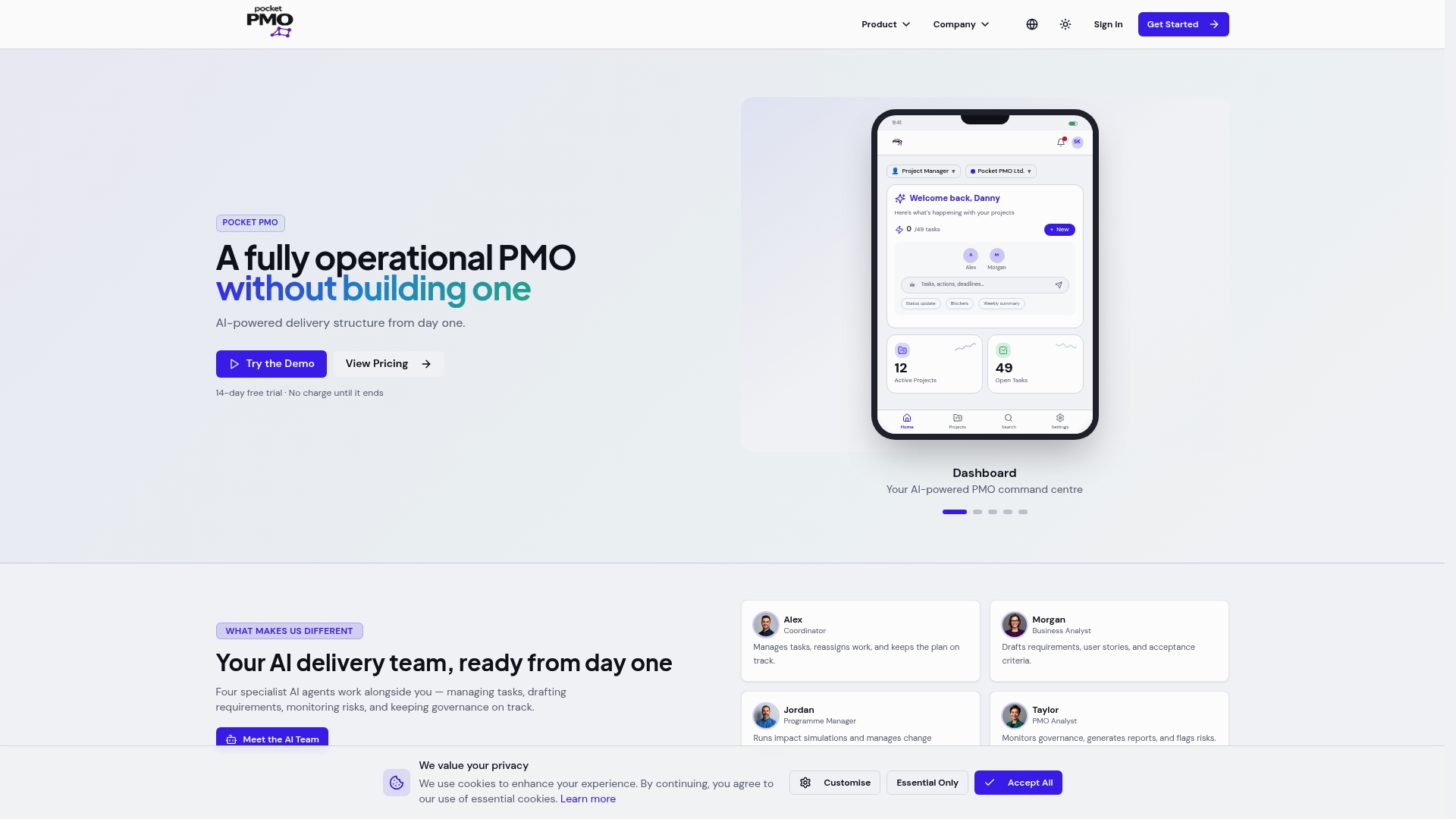
Pocket PMO is built specifically for organisations that want the benefits of an AI-powered, strategically integrated PMO without the time and cost of building one from scratch. From instant PMO setup to a full suite of PMO installation features, the platform deploys a dedicated AI-powered delivery team that manages tasks, risks, and requirements from day one. Real-time dashboards, predictive risk analysis, automated status reporting, and portfolio management tools are available immediately. Explore the full range of PMO system features and book a demo to see how Pocket PMO can make your PMO a genuine engine of operational strategy.
Frequently asked questions
How does a PMO directly contribute to operational strategy?
A PMO bridges strategy and execution by prioritising initiatives, monitoring benefits, and ensuring portfolio alignment with organisational objectives. Strategic PMOs translate strategy into execution and provide executive insights that drive informed decision-making.
What measurable impact do high-performing PMOs deliver?
Top PMOs significantly boost project success rates while delivering twice the revenue growth and three times the customer satisfaction compared to lower-performing peers. These are not marginal gains; they represent a fundamental performance advantage.
Why integrate AI within the PMO?
AI enables advanced prediction, efficient resource allocation, and real-time insights that manual processes cannot match. AI-driven PMOs shift to value orchestration, though human oversight remains essential for ethics and stakeholder engagement.
How should the PMO be aligned within executive teams?
PMOs that report to a Chief Strategy Officer or equivalent consistently outperform those positioned under operations, because structural placement determines strategic influence. Strategic PMOs reporting to CSO/OSM succeed by keeping the focus on outcomes over outputs.
What common pitfalls should be avoided when implementing a PMO?
Avoid anchoring the PMO in process compliance and administrative reporting, as traditional PMOs focused on bureaucracy average just two years before dissolving. Agility, outcome focus, and executive alignment are the foundations of a PMO built to last.