

Most organisations assume project tracking is simply about updating Gantt charts and sending weekly status reports. That assumption is expensive. Empirical benchmarks across 200 AI deployments reveal a median ROI of 159.8%, alongside 20 to 30% time savings and a 42% productivity increase in agency settings. These are not aspirational figures. They reflect what happens when AI genuinely transforms how teams monitor, analyse, and act on project data. This article unpacks what AI-powered project tracking actually means, which frameworks deliver results across complex multi-project environments, where the risks lie, and how to implement it with confidence.
Table of Contents
-
Implementing AI project tracking: best practices and strategic gains
-
Why most project tracking fails (and how AI can change that))
Key Takeaways
| Point | Details |
|---|---|
| AI transforms project tracking | Adopting AI enables significant time savings, productivity boosts, and better project outcomes. |
| Frameworks and metrics matter | Choosing the right strategy and clear benchmarks ensures sustainable project improvement. |
| Manage AI limitations | Continuous monitoring and human oversight are vital to safely leverage AI’s full potential. |
| Start small, scale up | Pilot with manageable projects and expand as your team proves ROI and gains confidence. |
Decoding AI-powered project tracking
Project tracking, at its core, is the practice of monitoring progress, resources, risks, and outcomes across one or more projects. Traditional tracking relies heavily on manual input: spreadsheets, status meetings, and periodic reports that are often outdated before they reach stakeholders. AI changes this fundamentally.
AI-powered project tracking uses machine learning, predictive analytics, and intelligent automation to continuously monitor project data, surface risks before they escalate, and generate insights without human prompting. The shift is from reactive reporting to proactive management. Instead of discovering a budget overrun at month-end, AI flags the trajectory early enough to act.
Key features you should expect from a capable AI tracking tool include:
-
Real-time dashboards that aggregate data across all active projects
-
Predictive risk alerts that identify issues before they become blockers
-
Automated status reporting that reduces manual reporting by 70 to 80%
-
Resource utilisation tracking across teams and workstreams
-
Change impact analysis that models the downstream effects of scope adjustments
-
AI-driven requirement management that keeps project requirements aligned with delivery
The ROI case is compelling. A median return of 159.8% across 200 AI deployments demonstrates that the value is measurable and repeatable. The productivity gains are not incidental. They come from removing the administrative burden that consumes project managers’ time and replacing it with intelligent automation.
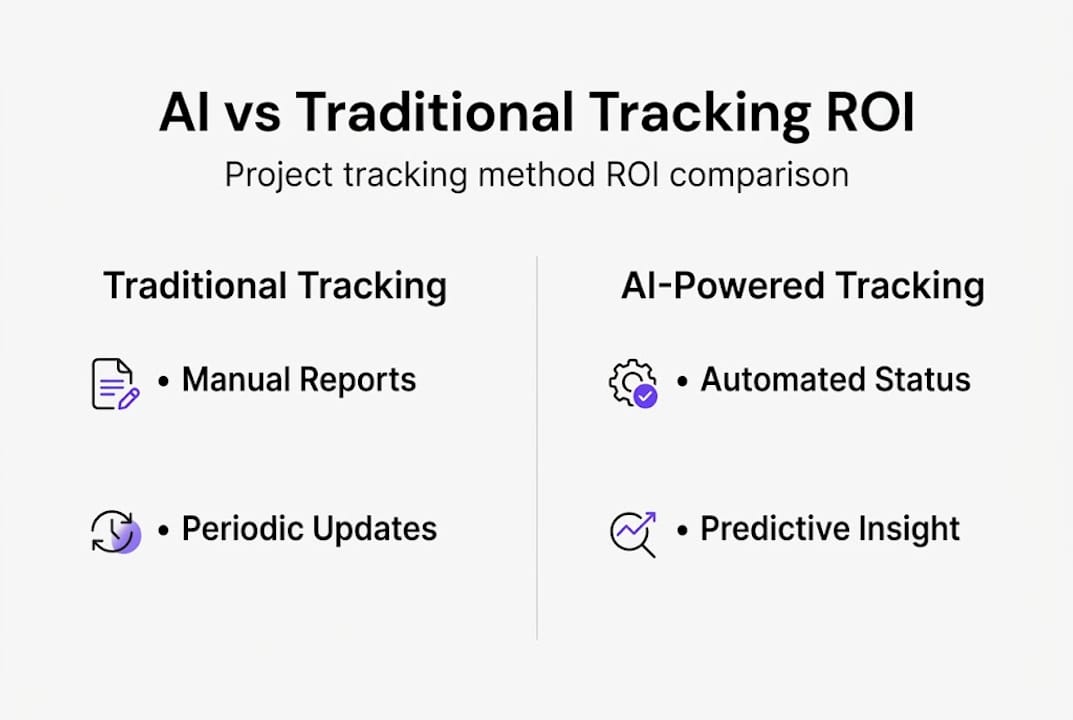
Here is a snapshot of what AI tracking delivers compared to traditional methods:
| Capability | Traditional tracking | AI-powered tracking |
|---|---|---|
| Status reporting | Manual, periodic | Automated, real-time |
| Risk identification | Reactive | Predictive |
| Resource visibility | Partial, delayed | Continuous, cross-project |
| Reporting time | High | Reduced by 70 to 80% |
| ROI potential | Baseline | Up to 159.8% median return |
Explore the full range of AI tracking features to understand what modern project management platforms can deliver today.
Essential frameworks and metrics for multi-project success
Knowing what AI tracking can do is one thing. Knowing which frameworks to apply across a complex portfolio is another. The methodology you choose shapes how AI overlays onto your delivery process.
Waterfall suits projects with fixed scope and sequential phases. AI adds value here through automated milestone tracking and early warning on phase delays. Agile benefits from AI-assisted sprint velocity analysis, backlog prioritisation, and burndown forecasting. Hybrid approaches, increasingly common in large organisations, combine structured governance with iterative delivery. AI is particularly powerful in hybrid environments because it can reconcile data from multiple workstreams with different cadences.
Regardless of methodology, the following metrics are non-negotiable for multi-project tracking:
-
Schedule performance index (SPI): Measures delivery pace against the baseline plan
-
Cost performance index (CPI): Tracks budget efficiency in real time
-
Risk exposure score: Aggregates open risks weighted by probability and impact
-
Resource utilisation rate: Identifies over-allocation and capacity gaps
-
Change request volume and resolution time: Signals scope stability and governance health
-
Stakeholder satisfaction score: Captures perception of delivery quality
The evidence supports investment in structured tracking. Organisations using AI-assisted PMO approaches report 28% better project outcomes and a 42% productivity increase in agency settings. These gains do not happen by accident. They come from consistent measurement against defined metrics.

Pro Tip: Before deploying AI tracking, establish a clean baseline dataset for at least one completed project cycle. AI models learn from historical data. The richer your baseline, the more accurate your predictive outputs will be from day one.
For a structured approach to managing complexity, the multi-project management process is worth reviewing alongside your framework selection. You can also browse the project tracking blog for practical examples across different sectors and team sizes.
Navigating edge cases and AI limitations
AI project tracking is powerful, but it is not infallible. Understanding where it can fail is as important as knowing where it excels. Edge cases are scenarios that fall outside the normal patterns your AI model was trained on. At scale, these multiply quickly.
Common edge cases and risks in AI project tracking include:
-
Data drift: Project conditions change over time, and models trained on historical data can become misaligned with current reality
-
Edge-case explosion: As AI scaling breaks under multiplying edge cases, the number of exceptions grows faster than the model can accommodate
-
AI project drift: Requirement changes mid-project can cause the AI’s understanding of scope to lag behind actual delivery intent
-
Non-determinism: AI outputs are not always consistent, and compounded errors across a portfolio can distort reporting
-
Algorithmic bias: Models trained on biased historical data reproduce those biases in risk scoring and resource recommendations
“Success requires upfront data quality, continuous monitoring for drift, atomic task decomposition to mitigate drift, and evals beyond demos. Avoid over-trust in AI for high-stakes decisions.” How to manage AI projects without losing your mind
Mitigation is practical. Decompose large tasks into atomic units so AI has granular, accurate data to work with. Set regular model evaluation checkpoints rather than relying on initial demos. Build human review gates into high-stakes decisions such as budget releases, resource reallocation, and risk escalation.
Pro Tip: Treat your AI tracking system as a team member that needs onboarding. Feed it clean, structured data from the start, review its outputs regularly, and correct it when it drifts. The discipline you apply to managing AI edge cases in requirements management applies equally to tracking.
Review Pocket PMO’s AI policy for edge cases to understand how responsible AI governance is built into the platform. Pair this with continuous monitoring methods to keep your tracking environment reliable.
Implementing AI project tracking: best practices and strategic gains
Once you understand the risks, implementation becomes a structured exercise in prioritisation and measurement. The most common mistake organisations make is attempting to automate everything at once. Start focused.
Follow these steps to implement AI project tracking effectively:
-
Select a pilot project: Choose a high-volume, low-risk process where AI can demonstrate value quickly without exposing the organisation to significant downside
-
Define success metrics upfront: Agree on what good looks like before you begin. Productivity hours saved, reporting time reduced, and risk identification rate are strong starting points
-
Clean your data: AI is only as reliable as the data it processes. Audit your project data before onboarding any AI tool
-
Phase your rollout: Expand from pilot to portfolio in stages, applying lessons learned at each phase
-
Build feedback loops: Create structured checkpoints where project managers review AI outputs and flag inaccuracies
-
Train your teams: AI adoption fails when teams do not trust or understand the outputs. Invest in capability building alongside the technology
Statistic to note: Operational efficiency gains are proven, but implementation risks are high when organisations skip the pilot phase. Starting small with measurable goals is the proven path to sustainable ROI.
The AI project tracking use cases on the Pocket PMO platform illustrate how organisations across different sectors have phased their adoption and measured outcomes. If you want to see the technology in action before committing, the AI tracking demo provides a practical starting point.
ROI assessment should be ongoing, not a one-time exercise. Track productivity hours saved per sprint, monitor the reduction in escalated risks, and compare project outcome rates before and after AI adoption. The data will tell you clearly whether to scale or adjust.
Why most project tracking fails (and how AI can change that)
Here is what experience consistently shows: most project tracking failures are not technology failures. They are process failures that technology exposes.
Organisations invest in AI tracking tools and expect immediate transformation. What they often find instead is that their underlying data is inconsistent, their teams report differently across projects, and their governance structures are too loose to support automated oversight. The tool surfaces the chaos rather than fixing it.
The uncomfortable truth is that AI amplifies what is already there. Strong processes become more efficient. Weak processes become more visibly broken. Avoiding over-trust in AI for high-stakes decisions is not just a risk management principle. It is an acknowledgement that AI works best as an enhancer of disciplined human judgement, not a substitute for it.
The organisations that achieve sustained gains treat AI as a capability that requires the same rigour as any other project resource. They invest in data quality, they monitor outputs, and they iterate. The multi-project insights that emerge from this approach are genuinely strategic. They inform portfolio decisions, not just task lists. That is the difference between using AI as a reporting tool and using it as a management advantage.
Next steps: transform your project tracking with AI
You now have a clear picture of what AI-powered project tracking delivers, which frameworks support it, and how to implement it responsibly. The next step is finding a platform that brings all of this together without requiring you to build it from scratch.
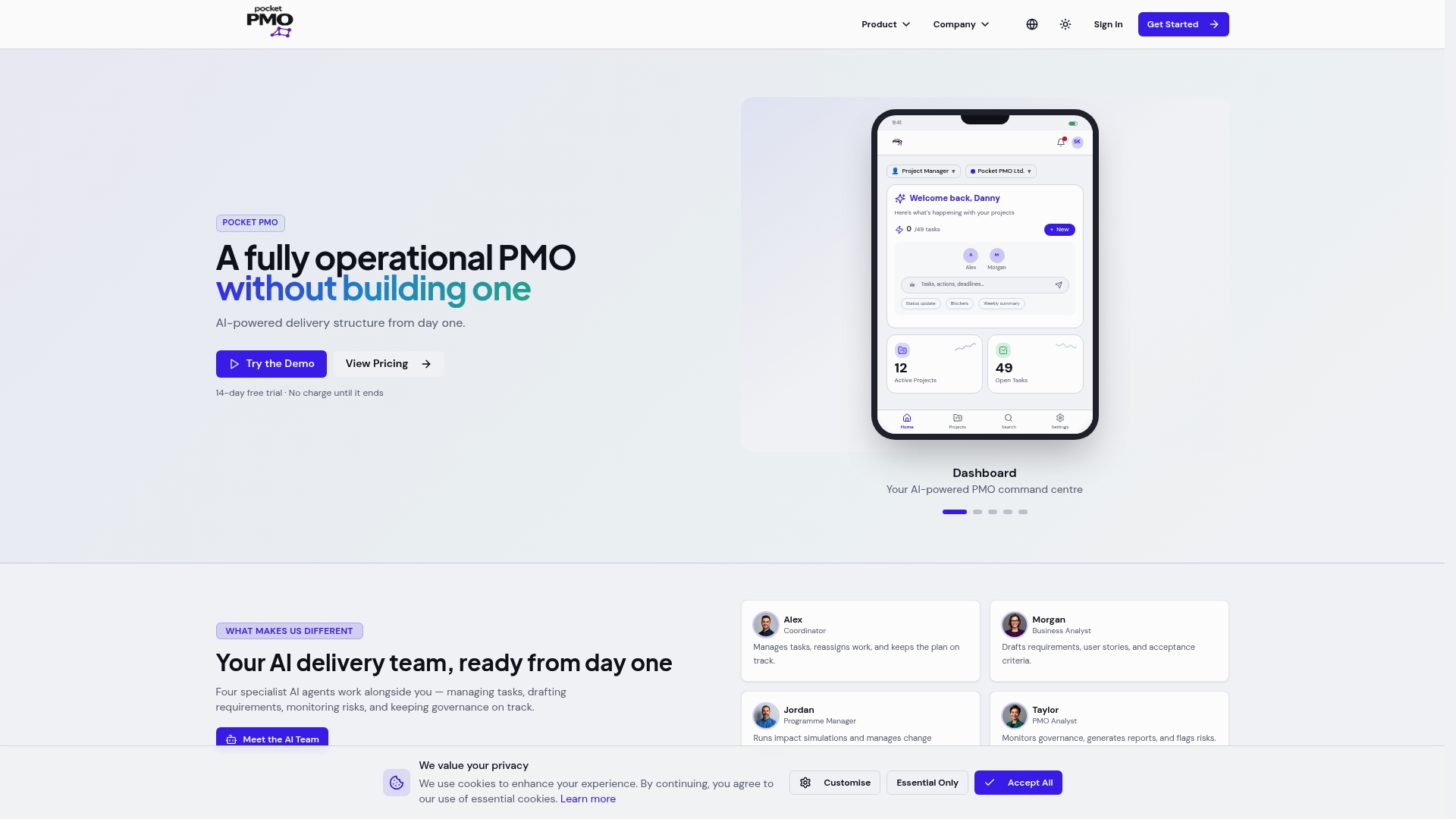
Pocket PMO is built specifically for organisations managing complex, multi-project environments. It combines real-time dashboards, predictive risk analysis, automated reporting, and a dedicated AI delivery team in a single platform. You can see the platform features in detail or go straight to launching your first project with AI-powered support from day one. The tools are ready. The question is whether your organisation is ready to use them.
Frequently asked questions
What is the difference between AI project tracking and traditional project tracking?
AI project tracking automates monitoring, delivers predictive analytics, and adapts to changes in real time, while traditional methods rely on manual input and offer limited visibility. AI deployment results consistently show 20 to 30% time savings over manual approaches.
How can I measure real ROI from AI-powered project tracking?
Track productivity hours saved, improved project outcomes, and reduction in manual reporting against your pre-AI baseline. Benchmarks show a median ROI of nearly 160% and a 70 to 80% reduction in manual reporting effort.
What are common risks in AI project tracking?
The primary risks are data drift, edge-case errors, and algorithmic bias, all of which require ongoing monitoring and human oversight to manage effectively. Edge cases in AI tracking involving requirement changes and non-determinism can compound across a portfolio if left unchecked.
How should organisations start implementing AI project tracking?
Begin with a high-volume, low-risk project, define measurable success criteria, and monitor progress before scaling. Starting small and measuring ROI before expanding is the approach that consistently delivers sustainable efficiency gains.