

Poorly managed requirements sit behind more project failures than most leaders care to admit. When requirements are vague, inconsistent, or left untracked, even the most capable AI-driven project management solution cannot compensate. The result is scope creep, wasted budget, and missed delivery targets. This guide clarifies what requirement management actually means in modern, AI-driven environments, outlines the real risks of getting it wrong, and gives you practical strategies to raise the standard across your projects. Whether you are evaluating new tools or improving existing processes, these insights will help you lead with confidence.
Table of Contents
-
Best practices for leaders managing requirements in AI projects
-
Our perspective: Bridging the leadership gap in AI-powered requirement management
-
How Pocket PMO supports robust AI-driven requirement management
Key Takeaways
| Point | Details |
|---|---|
| Reduces costly rework | Good requirement management backed by AI can cut project rework by over 40%. |
| Boosts project success | Managing requirements properly leads to more predictable and successful outcomes. |
| Enables AI-driven efficiency | AI tools automate, prioritise, and trace requirements with greater accuracy. |
| Supports compliance and risk | Traceability and AI analytics help manage regulatory and edge case risks effectively. |
What is requirement management in modern projects?
Requirement management is the process of capturing, organising, tracking, and validating what a project must deliver. It covers everything from high-level business goals down to specific functional and technical specifications. Done well, it keeps every stakeholder aligned and every deliverable traceable back to a clear need.
In modern projects, requirements fall into several distinct categories:
-
Functional requirements: What the system or solution must do (features, workflows, outputs)
-
Non-functional requirements: How it must perform (speed, reliability, security)
-
Regulatory requirements: What standards or legislation it must comply with
-
Stakeholder requirements: What specific groups need from the outcome
-
Transition requirements: What is needed to move from the current state to the future state
Traditionally, teams captured requirements in static documents, updated them manually, and relied on human review to catch gaps. This worked adequately for simpler projects, but it breaks down fast in complex, multi-workstream environments.
AI changes this picture significantly. As explored in AI in requirements management, modern AI platforms can automate traceability, flag conflicts between requirements, and support faster, more consistent decision-making. AI automates user stories, prioritisation, gap detection, and conflict resolution, reducing the manual overhead that has historically slowed teams down.
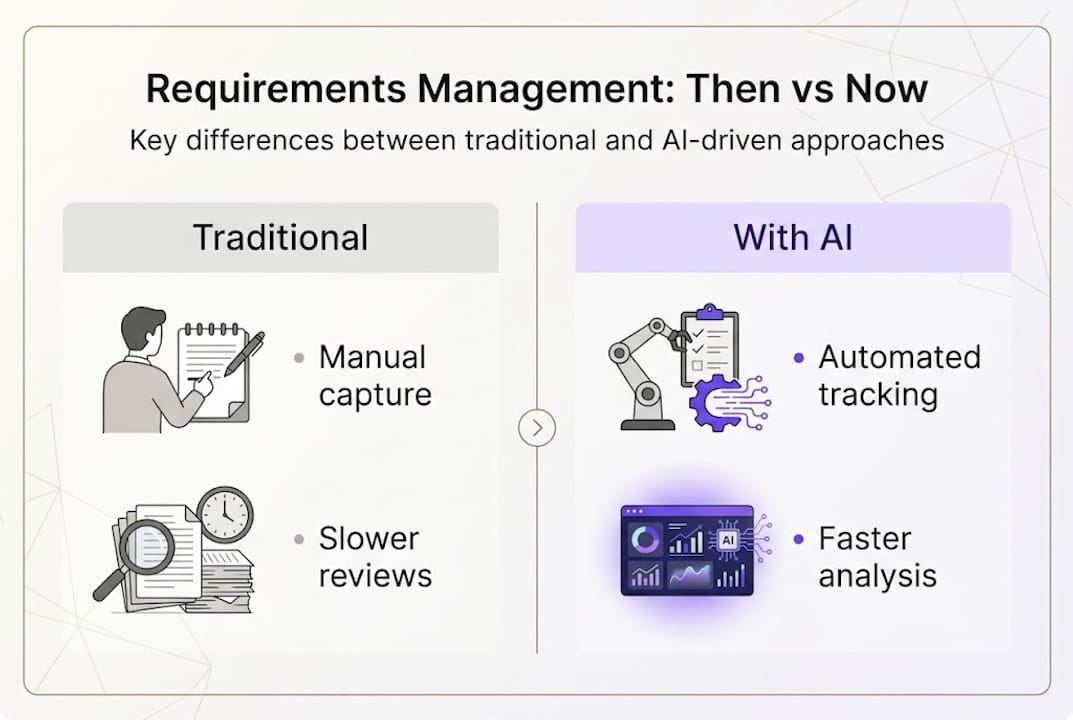
The table below illustrates how the shift from traditional to AI-driven approaches changes day-to-day requirement management:
| Aspect | Traditional approach | AI-driven approach |
|---|---|---|
| Requirement capture | Manual workshops and documents | Automated elicitation and structuring |
| Traceability | Spreadsheets, updated manually | Real-time, automated traceability matrices |
| Gap detection | Periodic human review | Continuous automated scanning |
| Change impact analysis | Slow, often missed | Instant, AI-generated impact reports |
| Prioritisation | Subjective stakeholder input | Data-driven, AI-assisted ranking |
| Compliance monitoring | Reactive, audit-driven | Proactive, ongoing AI surveillance |
The practical implication for you as a project leader is clear. AI does not just speed up existing processes. It fundamentally raises the quality and reliability of requirement management across the board. With a foundation established, we now explore why requirement management is fundamentally important.
The risks of weak or unmanaged requirements
When requirement management is weak, the consequences are rarely subtle. Projects drift. Budgets overrun. Teams rebuild work they have already completed. For leaders overseeing AI-driven solutions, the risks are even sharper because AI systems can amplify errors at scale.
The most common risks from poor requirement management include:
-
Scope creep: Undefined or loosely defined requirements invite constant additions, pushing timelines and costs beyond original estimates
-
Compliance failures: Missing regulatory requirements can result in fines, rework, or project cancellation
-
Wasted spend: Teams build features or capabilities that do not match actual stakeholder needs
-
Excessive rework: Errors caught late in delivery cost significantly more to fix than those caught early
-
Stakeholder misalignment: Without clear requirements, different groups interpret goals differently, creating conflict
For AI-driven projects specifically, additional risks emerge. An AI model trained or configured against poorly defined requirements may introduce bias, miss critical edge cases, or automate the wrong outcomes entirely. These are not theoretical concerns. They are documented failure patterns in AI implementations across industries.
Leaders who prioritise AI for requirements elicitation, traceability, and change impact analysis can reduce rework by 40% or more and significantly improve project outcomes.
The financial case alone is compelling. Rework typically accounts for 20 to 40 percent of total project cost in poorly managed environments. Cutting that by 40 percent or more through better requirement management and AI-enhanced requirement management tools represents a substantial return on investment.

Regulatory risk deserves particular attention. In sectors such as financial services, healthcare, and infrastructure, compliance requirements are non-negotiable. Missing them early creates expensive late-stage surprises. Reviewing requirement management use cases across regulated industries shows a consistent pattern: teams that embed compliance requirements from the start avoid the costly scramble at delivery.
Pro Tip: Use AI-driven traceability from day one to map every requirement to a regulatory obligation. This makes compliance audits faster and catches gaps before they become project-stopping problems.
Having shown the risks, we focus next on how AI makes requirement management more robust.
How AI transforms requirement management today
AI brings a set of capabilities to requirement management that were simply not practical at scale before. For project leaders, understanding these capabilities helps you ask the right questions when evaluating tools and set realistic expectations for what AI can deliver.
The core AI capabilities that matter most include:
-
Rapid user story generation: AI can convert high-level stakeholder inputs into structured user stories within minutes, maintaining consistency and completeness across large requirement sets
-
Automated gap detection: AI continuously scans requirement sets to identify missing coverage, contradictions, or ambiguities before they reach development
-
Intelligent prioritisation: AI analyses dependencies, business value, and risk to suggest requirement prioritisation, reducing the subjectivity that often derails planning sessions
-
Conflict resolution support: When requirements contradict each other, AI flags the conflict and presents options for resolution rather than leaving it to surface later
-
Change impact analysis: When a requirement changes, AI instantly maps the downstream impact across related requirements, tasks, and deliverables
AI automates gap detection, conflict resolution, and prioritisation, giving your team a level of consistency and speed that manual processes cannot match.
Here is how an AI-driven tool typically handles a change request in practice:
-
A stakeholder submits a change request through the platform
-
The AI parses the request and maps it against existing requirements
-
Impacted requirements, tasks, and dependencies are automatically identified
-
A risk and effort assessment is generated for review
-
The project leader approves or rejects the change with full context available
-
Approved changes are automatically propagated through the requirement set and project plan
The outcome is faster decisions, fewer surprises, and a complete audit trail. You can explore this in action through the AI team demonstration or review the full set of AI-driven features available to project leaders.
| Outcome | Manual management | AI-driven management |
|---|---|---|
| Time to detect gaps | Days to weeks | Minutes |
| Rework rate | High (20 to 40% of project cost) | Reduced by 40%+ |
| Change impact clarity | Low, often missed | High, automated |
| Compliance coverage | Reactive | Proactive |
| Stakeholder alignment | Inconsistent | Structured and traceable |
Understanding these shifts, leaders must also recognise that real-world projects present messy challenges. Let us examine best practices.
Best practices for leaders managing requirements in AI projects
Knowing what AI can do is one thing. Applying it effectively across your organisation requires deliberate leadership choices. These best practices will help you get the most from AI-driven requirement management.
-
Choose tools with built-in traceability: Traceability is the backbone of effective requirement management. Every requirement should link to a business objective, a test case, and a deliverable. Ensure your chosen platform supports this automatically, not as an afterthought.
-
Enforce a change control discipline from the start: AI can analyse change impact instantly, but only if your team submits changes through the right channels. Establish a clear change request process and make it non-negotiable from project initiation.
-
Invest in change impact analysis capability: This is the single most valuable AI feature for reducing rework. When evaluating platforms, test how quickly and accurately they map the downstream effects of a requirement change.
-
Make compliance requirements explicit and early: Manage edge cases like regulatory compliance via traceability and AI risk assessment to achieve predictable outcomes. Do not treat compliance as a final-stage checklist. Embed it into your requirement structure from the outset.
-
Train your team to trust and use AI outputs: AI-generated insights are only valuable if your team acts on them. Invest time in onboarding and building confidence in the tool’s recommendations.
-
Review AI-generated requirements with domain experts: AI accelerates creation, but human expertise validates accuracy. Schedule structured reviews with subject matter experts to confirm that auto-generated requirements reflect real business needs.
-
Monitor requirement coverage metrics regularly: Use your platform’s dashboards to track how many requirements are fully traced, how many are flagged for review, and how change volumes are trending. This gives you early warning of emerging risk.
Pro Tip: When selecting an AI project management platform, ask specifically how it handles change impact analysis across linked requirements. Platforms that do this well will save you more time and cost than any other single feature.
Reviewing AI policy and compliance guidance is also worthwhile, particularly for projects in regulated sectors where governance expectations are high. With these best practices, you are prepared to make informed, confident decisions.
Our perspective: Bridging the leadership gap in AI-powered requirement management
Most leaders focus heavily on selecting the right AI tool and far too little on the organisational shift required to use it well. The technology is rarely the limiting factor. Culture and adoption almost always are.
We see this pattern repeatedly. A team implements an AI-driven platform, ticks the box on requirement management, and then continues working the way they always have. The AI sits underused. The traceability matrices go unmaintained. The gap detection alerts get ignored.
Real value comes when your team genuinely trusts and builds on AI-driven transparency. That means leaders must champion the change, not just commission the tool. It means celebrating when AI catches a compliance gap early, not treating it as an inconvenience. It means reviewing insights on project management change and applying them to how your team actually behaves day to day.
Box-ticking compliance will not deliver the 40 percent rework reduction the research points to. Genuine adoption will. The leadership gap in AI-powered requirement management is not technical. It is human.
How Pocket PMO supports robust AI-driven requirement management
The principles covered in this guide are built directly into how Pocket PMO works. From automated traceability to real-time compliance monitoring, the platform gives project leaders the tools to manage requirements with confidence across complex, multi-project environments.
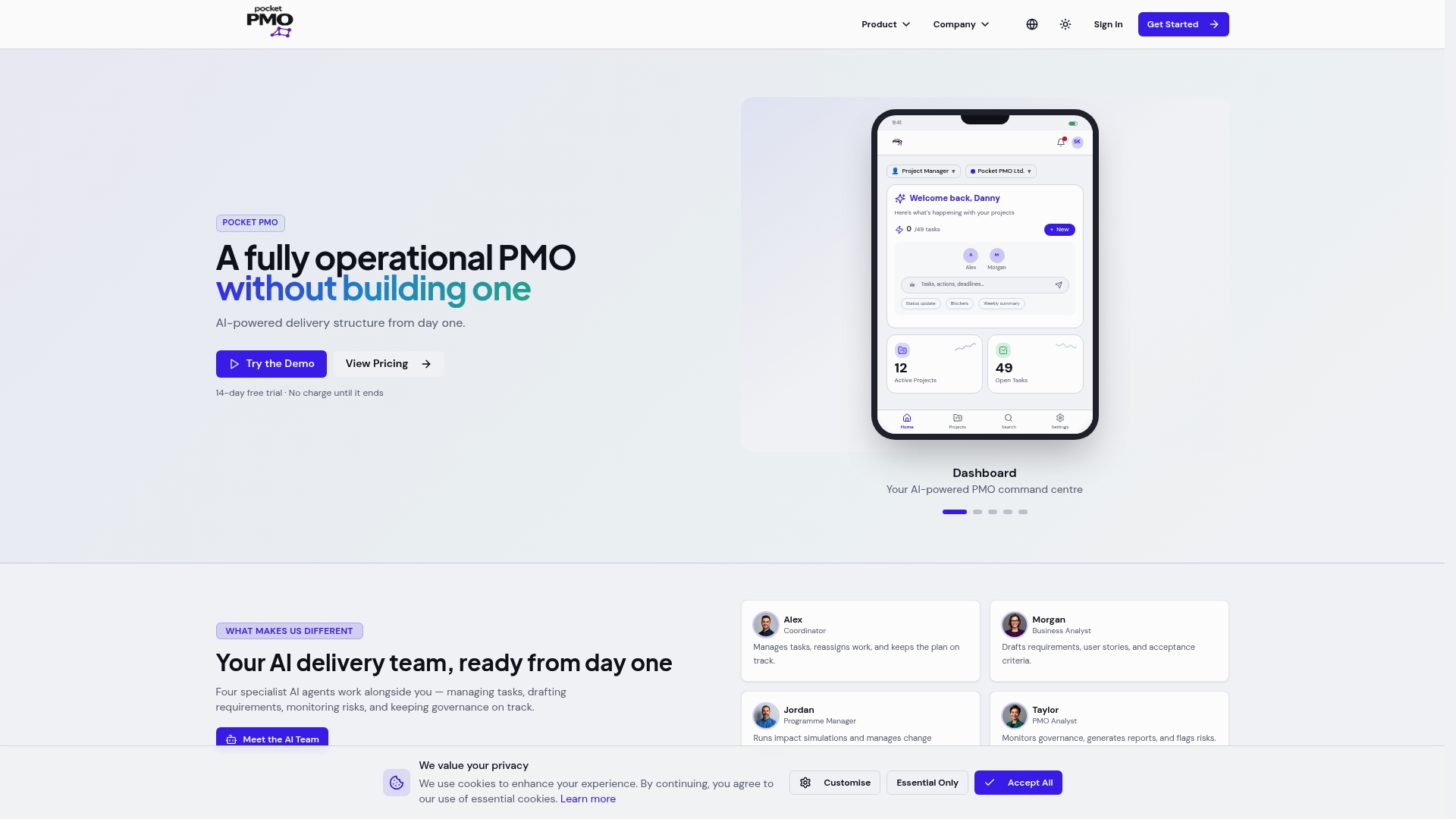
When you launch Pocket PMO, you get a dedicated AI-powered delivery team ready to manage tasks, requirements, and risks from day one. Explore the full range of AI-powered features or review real-world use cases to see how organisations like yours are already improving project outcomes through smarter requirement management.
Frequently asked questions
What is the main benefit of managing project requirements?
Effective requirement management reduces rework by 40% or more and significantly increases the likelihood of successful project outcomes by keeping every deliverable aligned to a validated need.
How does AI make requirement management better?
AI automates user story generation, gap detection, and conflict resolution, giving project leaders faster, more consistent, and more reliable requirement management than manual processes allow.
What should leaders watch out for when using AI in requirement management?
Leaders must manage regulatory compliance and external dependencies proactively, using AI-driven traceability and risk assessment to surface edge cases before they disrupt delivery.
Are AI tools suitable for all types of projects?
Most modern projects benefit from AI-driven requirement management tools, but leaders should evaluate each platform against their project’s specific complexity, regulatory context, and team capability before committing.