

Balancing AI-driven efficiency with robust governance is one of the defining challenges facing PMO leaders right now. Delivery models are shifting. Hybrid approaches, intelligent automation, and predictive analytics are reshaping how projects are planned, tracked, and governed. Yet many PMOs are still operating with frameworks built for a slower, more predictable world. This article sets out clear, evidence-based best practices to help you standardise delivery, assess maturity, clarify roles, and harness AI effectively. Whether you lead a large enterprise PMO or operate as a team of one, these strategies will help you deliver measurable value.
Table of Contents
- Frameworks for standardisation and reporting
- Assessing PMO maturity and integration
- Clarifying roles and managing capacity
- Harnessing AI for enhanced project management
- A fresh perspective: The future-proof PMO isn't what you expect
- Next steps: Optimise your PMO outcomes
- Frequently asked questions
Key Takeaways
| Point | Details |
|---|---|
| Flexible frameworks | Principle-driven standardisation supports diverse project delivery models and improves efficiency. |
| Benchmarking maturity | Regularly assess PMO maturity and integration to reveal governance gaps and guide improvement. |
| Role clarity | Defining clear PMO roles and capacity ensures sustainable value and protects against reporting overload. |
| AI integration | AI tools automate administration, enabling PMO staff to focus on judgement and strategic governance. |
| Continuous optimisation | Best practice adoption should be revisited regularly as project technologies and organisational needs evolve. |
Frameworks for standardisation and reporting
Standardisation is often misunderstood. Many PMO leaders conflate it with rigidity, creating mandatory templates that frustrate agile teams or alienate hybrid delivery units. The reality is quite different. Effective standardisation means establishing principles, governance gates, and reporting structures that work across diverse project types, not a single mandated methodology applied universally.
Standardised delivery and reporting should support multiple methods and must avoid a one-size mandate. That distinction is critical. A principle-driven approach gives project managers the freedom to choose the right delivery method, whether waterfall, agile, or hybrid, while still meeting organisational governance expectations.
Here is what a modern, principle-driven standardisation framework should include:
- Governance gates: Clear decision points at each project phase, with defined entry and exit criteria that apply regardless of delivery method
- Adaptable templates: A library of reusable documents, from business cases to risk registers, that teams can tailor rather than start from scratch. Explore PMO feature templates to see what a ready-built library looks like in practice
- Reporting cadences: Regular, structured status reporting that feeds portfolio-level visibility without creating unnecessary admin burden
- Continuous improvement loops: Lessons learnt reviews and retrospectives that feed back into updated templates and governance guidance
- Hybrid-ready delivery standards: Governance that explicitly accommodates agile sprints, waterfall milestones, and mixed approaches within the same portfolio
Reporting deserves particular attention here. Too many PMOs treat reporting as a compliance exercise rather than a strategic tool. When you treat each reporting cycle as an opportunity to surface trends, flag risks early, and validate delivery assumptions, reporting becomes a continuous improvement lever rather than a bureaucratic chore.
Pro Tip: Before building or updating your framework, map the actual delivery methods in use across your portfolio. This gives you a realistic baseline for which templates and governance gates are genuinely needed, rather than what looks good on paper.
A strong starting point is reviewing your existing proposal template tips to ensure your intake process aligns with your governance framework from day one. Getting the front end of project delivery right reduces rework significantly downstream.
Standardisation also plays a critical role when AI tools enter the mix. When your reporting data is consistent and well-structured, AI-driven analytics can generate far more accurate insights. Inconsistent data, by contrast, produces unreliable forecasts, regardless of how sophisticated the AI model behind them may be.
Assessing PMO maturity and integration
With standardisation frameworks established, PMOs must assess their maturity and readiness for governance and AI integration. Without an honest maturity assessment, it is easy to invest in the wrong areas, adding tooling or headcount when the underlying processes are not yet stable.
The most widely used framework for this is P3M3 (Portfolio, Programme and Project Management Maturity Model). P3M3 evaluates seven process perspectives across five maturity levels, from ad hoc project management at level one through to continuous optimisation at level five. It gives you a structured benchmark against which to measure your PMO's current state and set realistic improvement targets.
Recent research paints a sobering picture of where most PMOs currently stand. A 2025 public sector study found that most PMOs are at early maturity stages with weak governance integration. This is not unique to any single region or sector; it reflects a global pattern of PMOs that have grown reactively rather than by design.
Key maturity dimensions to assess include:
- Governance: Are decision-making authorities clearly defined? Are escalation paths documented and followed?
- Risk management: Is risk identification and mitigation integrated into delivery, or treated as a separate exercise?
- Resource management: Do you have visibility of capacity across the portfolio, or only at project level?
- Benefits realisation: Are you tracking whether completed projects actually deliver their intended outcomes?
- Stakeholder engagement: Is there a consistent approach to stakeholder communication and expectations management?
| Maturity level | Description | Common PMO characteristic |
|---|---|---|
| Level 1 | Ad hoc | No consistent processes; projects managed individually |
| Level 2 | Repeatable | Basic templates in use; governance inconsistent |
| Level 3 | Defined | Standardised processes; governance gates in place |
| Level 4 | Managed | Metrics-driven decision-making; portfolio visibility |
| Level 5 | Optimised | Continuous improvement; AI-augmented governance |
Most PMOs cluster at levels two and three. The jump to level four requires a genuine shift toward data-driven management, which is where AI project tracking strategies become genuinely transformative rather than simply incremental.
One of the most frequently overlooked gaps is training and institutionalisation. A PMO may have excellent frameworks on paper, but if project managers and sponsors have not been trained on them, or if those frameworks are not embedded in day-to-day workflows, maturity stalls. Alignment gaps between the PMO and the wider business are equally damaging, particularly when business units perceive the PMO as an administrative overhead rather than a strategic partner.
Integrating AI tools is both a maturity accelerator and a test of existing foundations. AI can surface patterns in your portfolio data that manual analysis would miss entirely. But those insights are only as reliable as the data quality and governance processes underpinning them.
Clarifying roles and managing capacity
After evaluating maturity, PMOs must tackle structural and role challenges to sustain credibility and value. Role ambiguity is one of the most consistent sources of PMO dysfunction, and it tends to worsen under pressure.
The risks of a PMO of One are well documented. Role clarity, capacity limits, and governance overload are ongoing PMO challenges for solo operators and overextended teams alike. When one person is responsible for governance, reporting, risk management, stakeholder communication, and continuous improvement simultaneously, something inevitably gives. Usually, it is strategic thinking that suffers first.
Here is a practical approach to managing roles and capacity effectively:
- Map actual time allocation: Track how PMO time is currently spent across governance, reporting, administration, and strategic activities. Most PMOs are surprised by how much time reporting alone consumes.
- Define role boundaries explicitly: Document what the PMO owns, what it supports, and what sits with project managers or sponsors. Ambiguity in these boundaries leads to either overreach or gaps.
- Set governance thresholds: Not every project needs the same governance intensity. Create tiered governance models based on project size, risk, and strategic importance.
- Build in capacity buffers: If your PMO is always operating at full capacity, it cannot respond effectively to escalations or strategic requests. Build slack deliberately into resource planning.
- Automate repeatable tasks: Status report generation, RAID log updates, and portfolio dashboards are prime candidates for automation, freeing capacity for higher-value work.
"A PMO that spends most of its time on reporting has already lost the argument for strategic relevance. Credibility comes from decisions influenced, not documents produced."
For PMOs managing multiple concurrent projects, the multi-project management process becomes critical. Without clear prioritisation mechanisms, resource conflicts escalate quickly and the PMO ends up firefighting rather than governing.
Pro Tip: Conduct a quarterly capacity review that maps PMO workload against portfolio demand. This gives you evidence-based conversations with leadership about resourcing, rather than reactive requests when the team is already overloaded.
The strategic value of a PMO is most visible when it is operating with enough headroom to provide genuine insight and challenge. When the PMO is buried in administration, it defaults to a reporting function, which is both a waste of capability and a risk to organisational governance. Explore PMO use cases to see how structured approaches help PMOs reclaim strategic capacity.
Harnessing AI for enhanced project management
With foundational roles defined, the next frontier is effectively adopting AI to streamline operations and focus on strategic tasks. This is where the opportunity is greatest, and where the risks of getting it wrong are most significant.

AI is beginning to do something genuinely disruptive to the PMO function. Research suggests that AI tools may unbundle administrative functions, leaving humans primarily for judgment-based governance. That is a meaningful shift. Tasks like status report generation, risk identification, dependency mapping, and resource forecasting are increasingly within the reach of well-configured AI tools.
| Task | AI-driven approach | Human judgment required |
|---|---|---|
| Status reporting | Auto-generated from project data | Narrative interpretation and context |
| Risk identification | Pattern recognition across portfolio | Escalation decisions and mitigation strategy |
| Resource forecasting | Demand modelling and scenario planning | Final allocation and stakeholder negotiation |
| Benefits tracking | Automated outcome measurement | Strategic alignment and reframing |
| Change request triage | Automated impact analysis | Approval authority and prioritisation |
The practical best practices for integrating AI into PMO processes include:
- Start with data quality: AI tools are only as good as the data they process. Audit your project data before deploying AI-driven analytics.
- Define what judgment means in your context: Be explicit about which decisions must remain with humans and why. This prevents over-reliance on AI recommendations.
- Pilot before scaling: Test AI tools on a subset of your portfolio before applying them broadly. Governance decisions made on poor AI recommendations can be costly.
- Train your team on AI outputs: Your project managers and sponsors need to understand what AI-generated insights mean and where their limitations lie.
- Use AI to surface blind spots: AI is particularly valuable for identifying patterns that humans miss due to cognitive bias or information overload.
Effective AI requirements management is a strong starting point for PMOs new to AI integration. Managing requirements effectively with AI reduces scope creep, improves traceability, and gives delivery teams a cleaner foundation for execution.
The risk of not adopting AI is just as real as the risk of adopting it poorly. PMOs that remain purely manual in their operations will struggle to provide the speed and quality of insight that leadership increasingly expects. Visit the PMO blog resources for ongoing guidance on integrating AI across your delivery function.
A fresh perspective: The future-proof PMO isn't what you expect
Most conversations about PMO best practices focus on processes, tools, and governance frameworks. Those things matter. But the PMOs that will genuinely thrive over the next five years are not the ones with the most sophisticated tooling. They are the ones that have built the organisational trust to be heard when it matters.
Here is the uncomfortable truth: rigid standardisation and comprehensive reporting can actually undermine PMO value if they are not paired with genuine relationship capital. A tailored PMO approach that adapts to the organisation's current context will always outperform a theoretically perfect framework that nobody follows.
AI adoption accelerates this dynamic. As administrative tasks become automated, the PMO's value proposition shifts almost entirely to human judgment, organisational navigation, and scenario-based thinking. The PMOs investing now in stakeholder relationships, strategic acumen, and adaptable governance will be the ones leading transformation rather than scrambling to justify their existence. The framework is the foundation. Trust is the structure built on top of it.
Next steps: Optimise your PMO outcomes
If these best practices resonate, the next step is putting them into practice with tools built specifically for the AI-driven PMO. Pocket PMO gives you ready-built governance frameworks, intelligent automation, and real-time portfolio visibility from day one, without the overhead of building your own PMO infrastructure.
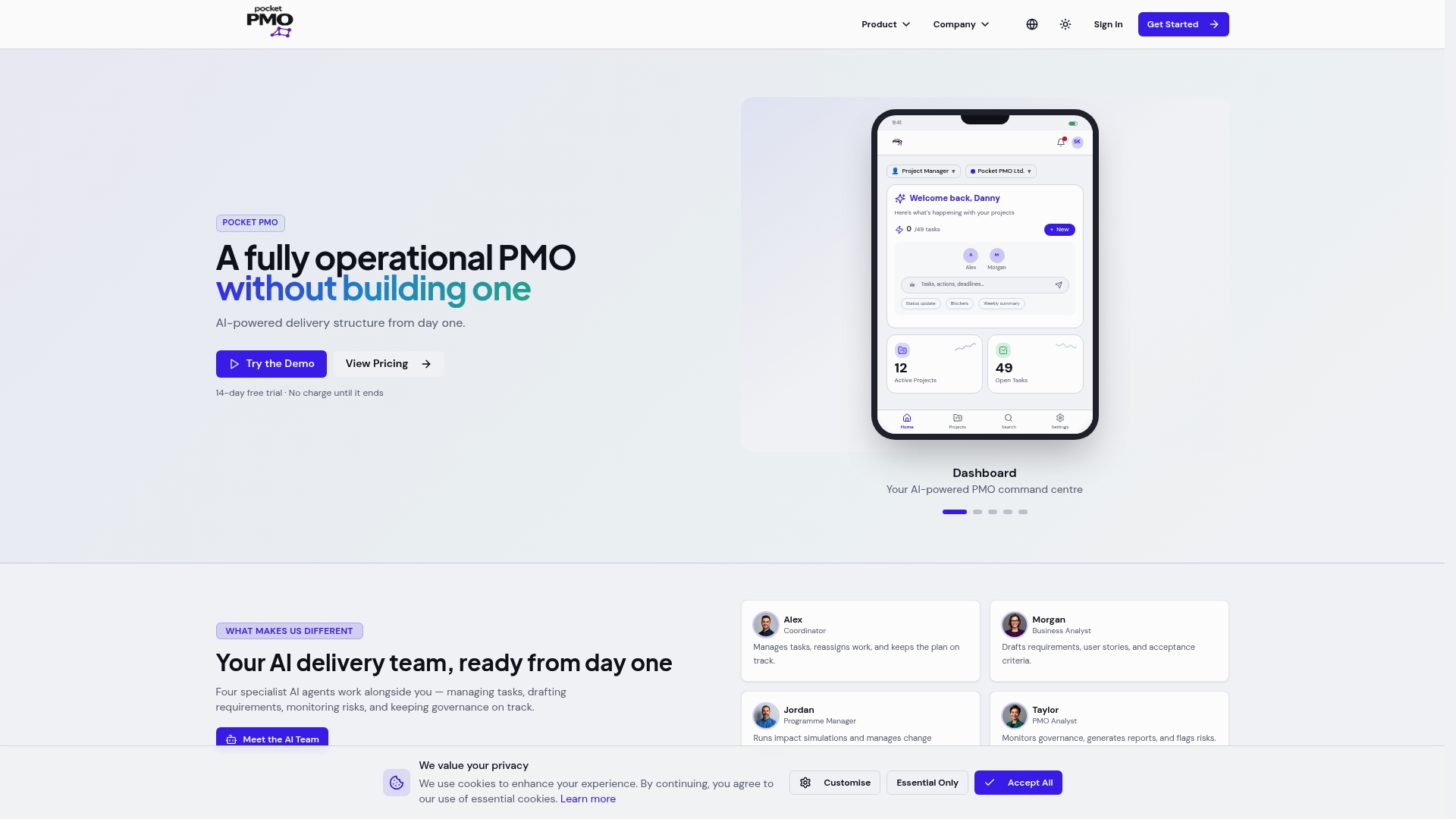
Whether you are looking to standardise reporting, strengthen governance, or integrate AI-driven risk analysis across your portfolio, Pocket PMO has the features to support your goals. From automated status reporting to predictive risk identification, the platform is designed to help PMO leaders move from administration to strategy. Launch your PMO today, or explore the full range of PMO features to see how Pocket PMO can accelerate your outcomes.
Frequently asked questions
What is the most critical best practice for modern PMOs managing AI projects?
Principle-driven standardisation is the most critical practice, as it supports multiple delivery methods and allows governance to flex across waterfall, agile, and hybrid projects without imposing a single mandate.
How do maturity models help PMOs improve governance?
Maturity models such as P3M3 benchmark governance gaps across multiple process dimensions, giving PMO leaders a structured view of where to invest in capability improvement and what good governance actually looks like at each level.
What are the risks of a PMO of One?
A PMO of One faces structural overload, weak governance, and the risk of reporting consuming all available capacity, which undermines strategic credibility and reduces the PMO's ability to influence decisions.
How is AI changing PMO administration?
AI is automating administrative functions such as status reporting and risk identification, shifting the human PMO role toward judgment-based governance, stakeholder management, and strategic oversight.
How can PMOs balance standardisation with flexibility?
By building adaptable templates and principles that support diverse delivery models, PMOs can maintain governance consistency without forcing teams into a single methodology, which is essential for managing hybrid and AI-enabled project portfolios.