

Choosing the right PMO model has always required careful thought, but AI integration has raised the stakes considerably. With 80% of PMOs expected to use AI for decision-making by 2026, project management leaders face a landscape that is evolving faster than most governance frameworks can keep pace with. The abundance of models, ranging from directive to supportive to AI-enhanced hybrids, can feel overwhelming. This article cuts through that complexity. You will learn what makes each PMO type distinct, how AI is reshaping their boundaries, and how to select the model that genuinely fits your organisation's goals and maturity level.
Table of Contents
- How to assess your PMO needs and selection criteria
- Directive, supportive, and controlling: core PMO model types
- How AI is transforming PMO models in 2026
- Comparing PMO models: which is best for your organisation?
- Why most organisations rethink their PMO model (and what actually works)
- Next steps: deploying the right PMO model with AI advantages
- Frequently asked questions
Key Takeaways
| Point | Details |
|---|---|
| Understand PMO types | Each PMO model—directive, supportive, or controlling—offers distinct benefits for different project environments. |
| AI boosts PMO impact | Organisations using AI-enabled PMOs see a notable rise in project success and efficiency. |
| Assess fit before adopting | Carefully match your organisational needs and maturity to the right PMO model for best results. |
| Comparison clarifies choice | Side-by-side comparisons help project leaders prioritise features and avoid costly mismatches. |
How to assess your PMO needs and selection criteria
Before comparing models, you need clarity on what your organisation actually requires. Jumping straight to a PMO type without first assessing your context is one of the most common and costly mistakes project leaders make.
Here is a structured approach to guide your assessment:
- Define your business goals first. What outcomes do you need your PMO to drive? Cost efficiency, faster delivery, better governance, or improved strategic alignment? Your goals will filter out models that simply do not fit.
- Assess your PMO maturity level. PMO maturity models progress from ad-hoc at Level 1 to optimised and value-led at Level 5. Knowing where your organisation sits prevents you from adopting a model that is either too rigid or too loose for your current capabilities.
- Evaluate your AI-readiness. Do you have the data infrastructure, tooling, and team capability to support AI integration in project management? This is no longer optional for forward-looking PMOs.
- Consider organisational size and complexity. A 20-person consultancy and a 2,000-person enterprise have vastly different needs. Project complexity, portfolio size, and risk appetite all influence which model delivers real value.
- Audit your existing tech stack. Compatibility between your chosen PMO model and your current tools matters. Gaps in data flow or reporting capability will undermine even the best-designed governance structure.
Think also about how requirements are currently captured and managed. Leveraging AI for managing project requirements can meaningfully inform which PMO model will give you the most traction from day one.
"The right PMO model is not the most sophisticated one available. It is the one your organisation can actually execute well, given its culture, capability, and strategic ambition."
Pro Tip: Run a brief internal survey with project managers and senior stakeholders before finalising your PMO model selection. Their day-to-day pain points often reveal maturity gaps that formal assessments miss.
Directive, supportive, and controlling: core PMO model types
With solid criteria in place, it is time to examine the three foundational PMO types and how they function in practice.
Directive PMO
A directive PMO directly manages projects, assigns project managers, and holds full authority over execution. This is the highest-control model. It works well in complex, high-stakes environments where consistency and accountability are non-negotiable, such as large infrastructure programmes or regulated industries.
- Direct ownership of project delivery
- Standardised methodologies enforced across all projects
- Reduced autonomy for individual project teams
- Well suited to directive PMO for consulting projects and enterprise-scale programmes
Supportive PMO
A supportive PMO takes an advisory role. It provides templates, training, access to best practices, and shared resources, but does not dictate how projects are run. Teams retain significant autonomy. This model suits organisations where project managers are experienced and self-directed, and where culture resists top-down governance.
- Low control, high flexibility
- Focuses on knowledge sharing and standardisation through guidance
- Ideal for creative, research, or innovation-led environments
Controlling PMO
Sitting between directive and supportive, a controlling PMO sets standards and monitors compliance without directly managing delivery. It enforces methodology, tracks metrics, and requires adherence to approved frameworks, but leaves execution to individual teams.
- Moderate authority with clear compliance requirements
- Suitable for regulated sectors needing audit trails without central project ownership
- Balances governance with team-level flexibility
"Choosing between these models is not just a governance decision. It reflects how much your organisation trusts its project teams and how much risk it is willing to carry at the delivery level."
Pro Tip: If your organisation is scaling rapidly, start with a controlling PMO. It builds governance discipline without the full overhead of a directive model, giving you room to grow into greater structure as needed.
How AI is transforming PMO models in 2026
Now that we have covered the types of PMOs, let us look at how AI is revolutionising their operation and impact.

The boundaries between directive, supportive, and controlling PMOs are becoming less rigid. AI capabilities are being layered onto all three models, enhancing what each can deliver without requiring a wholesale restructural change.
Key ways AI is reshaping PMOs:
- Predictive analytics enable PMOs to forecast delivery risks weeks before they materialise, rather than reacting after the fact
- Automated reporting removes manual status updates, freeing project managers to focus on decisions rather than data entry
- Risk assessment tools surface RAID items intelligently, prioritising what needs attention based on live project data
- Resource optimisation algorithms identify capacity constraints across portfolios in real time
The performance case for AI adoption is compelling. Organisations with PMOs using AI see a 17-point increase in project success rates compared to those without. And with 72% expecting PMO strategic role expansion in the coming period, the shift from administrative function to strategic enabler is already well underway.
You can explore how AI project tracking and AI in multi-project management are delivering real-world gains across portfolio environments.
| Feature | Classic PMO | AI-enhanced PMO |
|---|---|---|
| Reporting | Manual, periodic | Automated, real-time |
| Risk management | Reactive identification | Predictive forecasting |
| Resource allocation | Spreadsheet-driven | Algorithm-optimised |
| Decision support | Experience-based | Data and analytics-driven |
| Governance compliance | Manual audits | Continuous monitoring |
The organisations gaining the most from AI are those applying it to strengthen their existing PMO model rather than replacing it entirely. Structure and intelligence work best together.
Comparing PMO models: which is best for your organisation?
With both classic and AI-powered PMOs in mind, let us directly compare the models to help you choose more confidently.
| PMO model | Strengths | Weaknesses | AI compatibility |
|---|---|---|---|
| Directive | High control, consistent delivery | Less team autonomy, resource-intensive | Strong: AI automates enforcement and reporting |
| Supportive | Flexible, low overhead | Inconsistent standards, hard to measure | Moderate: AI enhances knowledge sharing |
| Controlling | Balanced governance | Can feel bureaucratic without clear value | Strong: AI simplifies compliance tracking |
Your PMO maturity level should anchor this decision. A Level 1 or 2 organisation will struggle to sustain a directive model without first building foundational governance capability.
Here is a practical shortlisting process:
- Match model to maturity. Lower maturity organisations benefit from supportive models that build capability without overloading teams.
- Factor in regulatory requirements. Controlling or directive models suit industries where compliance is audited externally.
- Assess AI capability now and planned. If you are actively investing in AI tooling, choose a model that can accommodate it without structural rework.
- Pilot before committing. Test your shortlisted model on one programme or portfolio before rolling out organisation-wide.
- Review and iterate. PMO models are not permanent. Revisit your selection annually as your mature PMO practices evolve.
To fully leverage your chosen model, ensure your tooling matches its demands. Explore the advanced PMO features available to support directive, controlling, and AI-enhanced operating models.
Pro Tip: Document your model selection rationale formally. When leadership changes or priorities shift, having a clear record of why you chose your PMO model helps prevent unnecessary and costly restructuring.
Why most organisations rethink their PMO model (and what actually works)
Here is an uncomfortable truth. Most PMO model failures are not caused by choosing the wrong type. They are caused by choosing based on trend rather than fit.
We see this repeatedly. An organisation reads about AI-enhanced PMOs delivering extraordinary results elsewhere, moves quickly to replicate the model, and then wonders why adoption is sluggish and value is elusive. The model was right for someone else's culture, maturity level, and delivery context. It was not right for theirs.
AI enhances PMOs via predictive analytics, automation, and risk assessment, but those gains only materialise when the underlying governance structure is sound. AI amplifies what is already working. It does not fix what is broken.
What actually works is straightforward. Start small. Pilot your chosen model on a contained programme. Build AI capabilities incrementally rather than deploying everything at once. Measure what changes. Adjust before scaling.
The organisations succeeding with AI integration in project delivery are not always the ones with the most advanced tools. They are the ones with the clearest alignment between their PMO model, their organisational culture, and their delivery approach. That alignment is what you should optimise for first.
Next steps: deploying the right PMO model with AI advantages
You now have a clear framework: assess your needs, understand the model options, factor in AI capability, and match your selection to your organisational context.
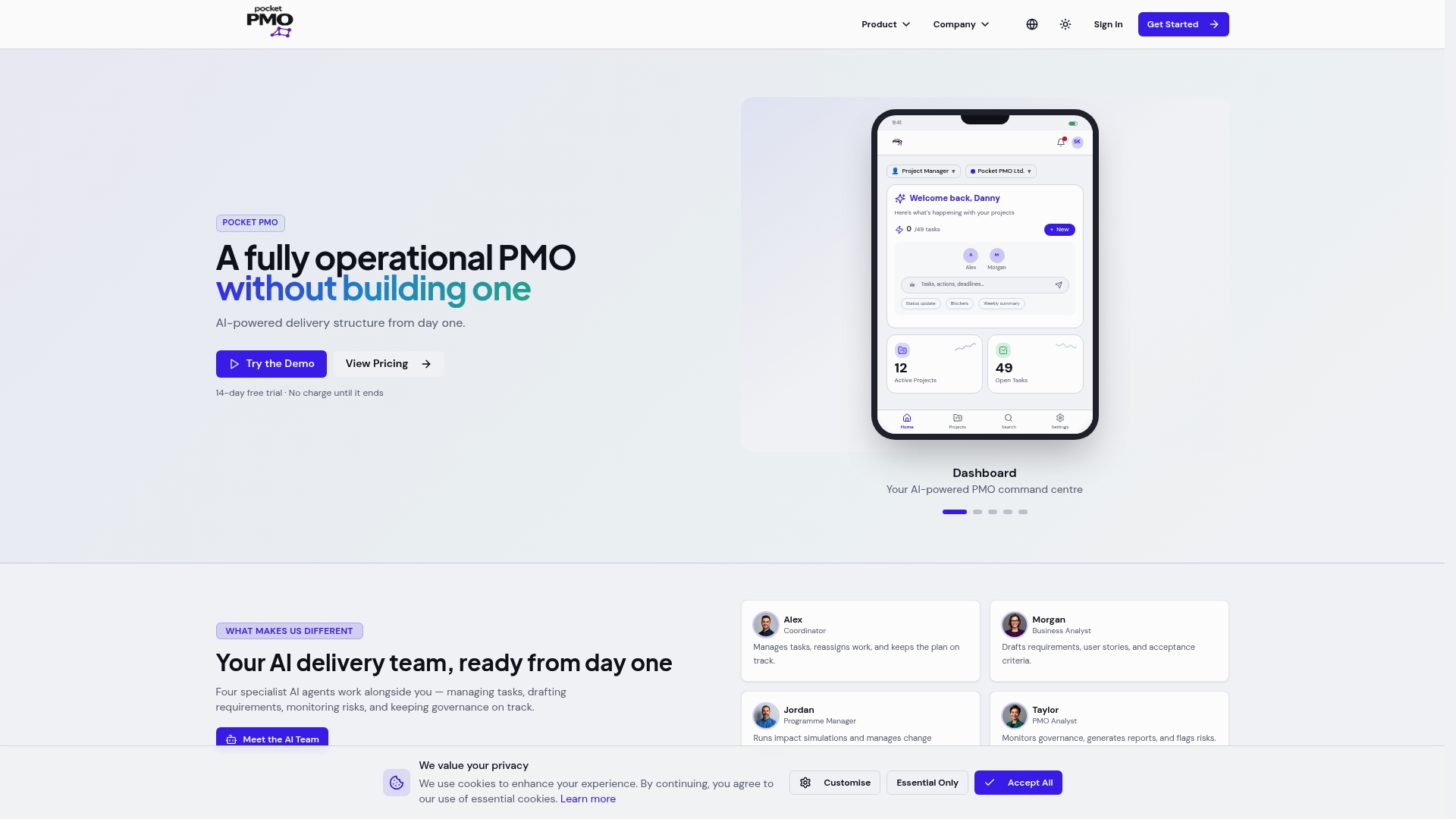
Pocket PMO makes that next step straightforward. Our AI-driven PMO solution gives you real-time dashboards, predictive risk analysis, intelligent automation, and portfolio management capabilities, all available from day one without the cost or time of building your own PMO infrastructure. Whether you are operating a directive, controlling, or supportive model, our platform adapts to your workflow. Explore our core PMO features and see how quickly your team can move from selection to delivery with AI working alongside you.
Frequently asked questions
What is the main difference between directive and supportive PMOs?
A directive PMO directly manages projects and assigns managers with full execution authority, while a supportive PMO provides guidance, templates, and resources without direct control over delivery teams.
How does AI improve PMO effectiveness?
AI enhances PMOs through predictive analytics, automated risk assessment, and intelligent reporting, enabling project leaders to make faster, more confident decisions and consistently improve project outcomes.
Which PMO model suits highly regulated industries?
A controlling PMO is typically the strongest fit for regulated sectors, as it enforces defined standards and maintains compliance audit trails without requiring central ownership of every project.
What percentage of PMOs use AI for decision-making in 2026?
Around 80% of PMOs are expected to use AI for decision-making by 2026, reflecting a rapid shift towards data-driven governance across the project management profession.