

Most project leaders use "PMO" and "delivery team" interchangeably. That single confusion costs organisations more than they realise. Organisations with delivery teams in PMOs achieve up to 97% project success rates, yet many enterprises still operate without a clear boundary between governance and execution. When these two functions blur together, accountability gaps form, projects stall, and strategic objectives lose their connection to day-to-day delivery. This guide draws a precise line between PMO oversight and delivery team execution, unpacks the core responsibilities each carries, and shows you the evidence-backed impact that clarity delivers.
Table of Contents
- What is a delivery team in a PMO?
- Core responsibilities of a delivery team
- How delivery teams drive project success
- Navigating challenges: governance versus agility
- Why delivery teams are the engine, not the bureaucracy, of enterprise PMOs
- Bring operational excellence to your PMO
- Frequently asked questions
Key Takeaways
| Point | Details |
|---|---|
| Delivery teams enable execution | They bridge the gap between PMO strategy and actual project delivery. |
| Dramatic outcome gains | Organisations see on-time delivery jump by over 80% with delivery teams in PMOs. |
| Balanced governance is critical | Success depends on combining standardisation with the agility needed to execute rapidly. |
| Hybrid methods can work | Delivery teams excel by navigating both Agile and Waterfall, not just picking one. |
What is a delivery team in a PMO?
With that context established, let's define exactly what a delivery team is and how it fits within the PMO structure.
A delivery team in a PMO is the group responsible for executing approved projects and programmes against the governance frameworks the PMO sets. The PMO defines how work should be done: standards, methods, reporting protocols, and portfolio priorities. The delivery team decides that the work gets done: planning, resourcing, tracking, and closing out each project deliverable.
Think of it this way. The PMO is the rulebook and the scoreboard. The delivery team is on the pitch, accountable for every pass and every result. As governance and delivery are kept structurally separate, organisations avoid the classic trap of the governance body becoming the bottleneck.
This is fundamentally different from a traditional project manager working alone, or a functional team assigned to project tasks without PMO alignment. A delivery team operates within an established governance context, using PMO-defined tools and processes, while maintaining the operational autonomy to adapt delivery approaches as conditions change.
Why does this separation matter? Because it creates clear ownership. When the PMO owns governance and the delivery team owns execution, escalation paths are clean, performance is measurable, and continuous improvement becomes systematic rather than accidental.
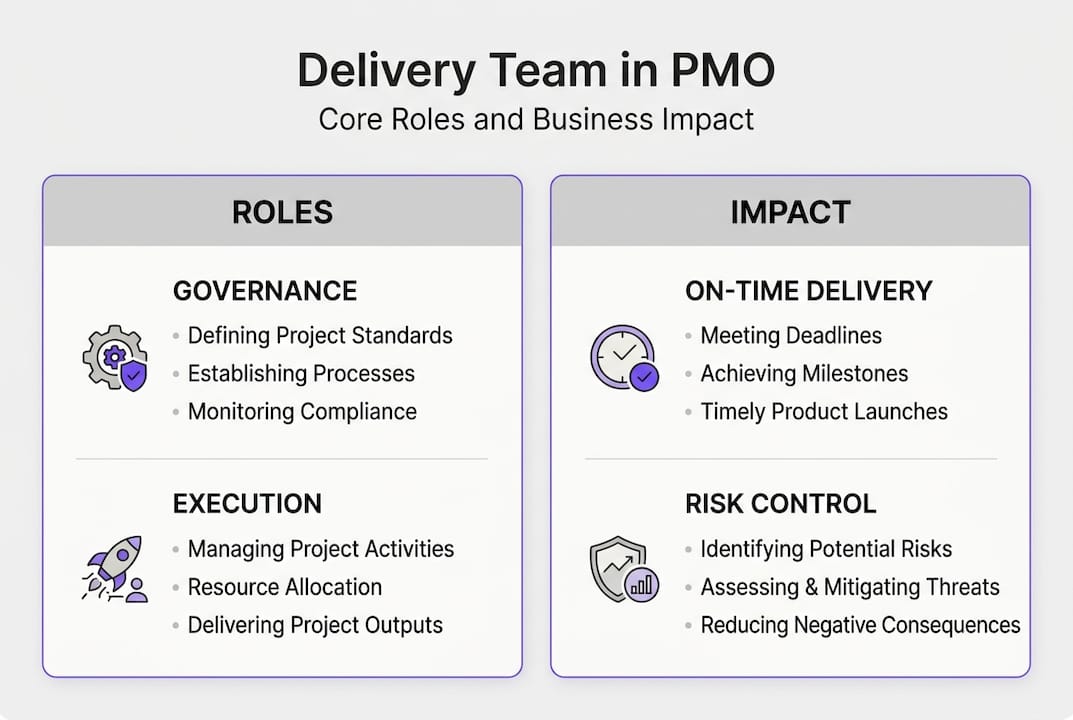
You can explore use cases for delivery teams across different organisational models to see how this separation plays out in practice.
| Dimension | PMO | Delivery team |
|---|---|---|
| Primary focus | Governance and standards | Project execution and outcomes |
| Accountability | Portfolio performance | Individual project delivery |
| Key output | Frameworks, reporting, policies | Delivered scope, milestones, benefits |
| Decision authority | Strategic prioritisation | Operational and tactical decisions |
| Success metric | Portfolio health | On-time, on-budget delivery |
"The PMO and the delivery team serve different masters: one serves the portfolio, the other serves the project. Getting both right is what separates high-performing enterprises from the rest."
Organisations that invest in separating these functions, and equip each with the right delivery team features, consistently outperform those that conflate the two roles. The structure is not bureaucratic overhead. It is the mechanism that turns strategy into shipped outcomes.
Core responsibilities of a delivery team
Now that their context is clear, let's dig into the distinct accountabilities that delivery teams shoulder in the PMO environment.
Delivery teams carry a wide remit. Their responsibilities span the full project lifecycle, from initial scoping through to benefit realisation. The role is far more than task management. It requires governance literacy, stakeholder fluency, and the ability to hold accountability across complex, multi-workstream environments.
Core delivery team accountabilities include:
- Project governance: Operating within PMO-defined frameworks and ensuring projects meet agreed standards at every stage gate
- Methodology standardisation: Applying consistent delivery approaches, whether Waterfall, Agile, or hybrid, so performance is comparable across projects
- Performance monitoring: Tracking progress against baseline plans, flagging deviations early, and driving corrective action
- Resource management: Allocating team capacity, resolving conflicts between competing priorities, and forecasting demand
- Risk mitigation: Identifying, logging, and actively managing risks and issues throughout the project lifecycle
- Status reporting: Producing accurate, timely reports for PMO and senior stakeholders to support informed decision-making
- Continuous improvement: Capturing lessons learned and feeding them back into PMO standards and future delivery approaches
These responsibilities include project governance, methodology standardisation, performance monitoring, resource management, risk mitigation, reporting, and continuous improvement across the full delivery cycle.
For a real-world example: on a large technology transformation programme, the delivery team manages sprint planning within an Agile framework, coordinates with third-party vendors under Waterfall contracts, reports weekly RAID (Risks, Assumptions, Issues, Dependencies) status to the PMO, and tracks benefit realisation against the original business case. This is precisely what multi-project management success looks like when roles are clearly defined.

Strong risk management strategies are embedded in delivery team practice, not treated as a PMO-only concern.
Pro Tip: The most overlooked delivery team responsibility is benefit realisation tracking. Most teams close out a project once scope is delivered. High-performing delivery teams stay accountable for whether the intended business benefits actually land, months after go-live.
Statistic to note: Organisations with structured delivery teams see project on-time delivery improve by up to 83%, directly linked to formalised performance monitoring and risk management practices.
How delivery teams drive project success
But what is the real-world impact? Evidence-backed results reveal just how much delivery teams matter.
The data on delivery team performance is striking. When PMO delivery teams operate with clearly defined responsibilities and the right tools, the improvement in project outcomes is not marginal. It is transformational.
PMO delivery teams improve on-time delivery by 83%, reduce delays by 20%, cut costs by 48%, and raise project success rates to 97%.
Here is how those improvements connect to specific delivery team activities:
- Structured governance removes ambiguity from decision-making, accelerating approvals and reducing rework
- Proactive risk management catches issues before they escalate into schedule or budget variances
- Standardised reporting gives senior stakeholders real-time visibility, reducing reactive interventions
- Resource optimisation prevents the over-allocation bottlenecks that stall delivery
- Benefit tracking ensures the project's original value case remains visible and accountable beyond go-live
| Project metric | Without structured delivery team | With structured delivery team |
|---|---|---|
| On-time delivery rate | Variable, often below 60% | Up to 83% improvement |
| Project success rate | Typically 50-70% | Up to 97% |
| Cost overrun frequency | High | Reduced by up to 48% |
| Delay incidence | Common | Reduced by up to 20% |
A compelling PMO turnaround in 90 days case study demonstrates that embedding a structured delivery team within a failing PMO can reverse poor performance rapidly. The key lever was not adding more resources. It was clarifying roles and restoring accountability between governance and execution.
"When delivery teams know exactly what they own, projects move faster. Accountability is not a constraint. It is the accelerant."
If you want to see how these principles translate into platform capability, explore how PMO delivery works in a modern AI-powered environment. The shift from reactive to proactive management is where enterprises gain the most ground.
Navigating challenges: governance versus agility
Of course, theory is often messier in practice. Operating between best practice and on-the-ground realities is where challenges emerge.
Delivery teams in enterprise PMOs rarely operate in clean, controlled conditions. Three challenges surface repeatedly: resource scarcity, stakeholder misalignment, and conflicting methodologies.
Resource scarcity is the most common. Competing project priorities pull the same people in multiple directions. Without centralised visibility, delivery leads make resourcing decisions in silos, creating hidden conflicts that surface too late.
Stakeholder misalignment compounds this. When project sponsors, PMO leads, and delivery teams hold different definitions of success, decision-making slows and scope creep follows.
Conflicting methodologies are particularly acute in hybrid PMO environments, where the tension between flexibility and standardisation challenges delivery teams operating across Agile and Waterfall workstreams simultaneously.
Practical solutions that high-performing delivery teams use:
- Establish a single source of truth for project status, accessible to PMO, delivery leads, and sponsors
- Define methodology decision criteria upfront, so teams know when to apply Agile versus Waterfall without escalating every choice
- Implement rolling resource reviews at portfolio level, rather than waiting for conflicts to materialise
- Use centralised dashboards to surface capacity gaps and alignment issues in real time
- Build change control habits early, so scope changes are assessed for resource and schedule impact before approval
Centralised dashboards and resource planning tools can mitigate alignment and scarcity problems at portfolio scale, reducing the reactive firefighting that consumes delivery team capacity.
Pro Tip: Do not wait for the PMO to mandate a methodology. Proactively document your delivery team's hybrid approach and socialise it with PMO leads early. Teams that drive methodology clarity from the bottom up spend far less time managing exceptions.
Exploring hybrid PMO approaches that support both governance and agility will help you structure your delivery team for resilience, not just efficiency.
Why delivery teams are the engine, not the bureaucracy, of enterprise PMOs
Stepping back, the prevailing wisdom about PMOs and delivery teams deserves a challenge.
There is a persistent narrative in enterprise circles that PMOs breed bureaucracy. That delivery teams are just governance theatre. That the layers of reporting, methodology, and oversight slow execution rather than accelerate it. We disagree with that view, and the data backs us up.
The organisations that treat delivery teams as administrative overhead are the same ones posting 50% project success rates. The ones that invest in clear delivery team structures, with real accountability and the right tools, are hitting 97%.
The truth is that delivery teams remove bottlenecks when they are focused on value, not just process compliance. A delivery team that understands why the PMO's standards exist will apply them intelligently. One that treats them as box-ticking exercises will generate the bureaucracy everyone fears.
The difference is leadership clarity. When enterprise leaders define what the delivery team owns, equip them with tools that surface real-time intelligence, and trust them to act on it, the PMO becomes a competitive advantage. Structured thinking around streamlining project proposals is one practical entry point to building that culture. Governance and speed are not opposites. When delivery teams are positioned correctly, they are the same thing.
Bring operational excellence to your PMO
If you want to put these principles into practice, consider how to bridge strategy and execution without the usual build-out cost.
Pocket PMO gives you an AI-powered delivery team and PMO infrastructure from day one. No lengthy configuration. No internal build-out. Just real-time dashboards, intelligent automation, and predictive risk management built to support delivery teams operating across complex, multi-project environments.
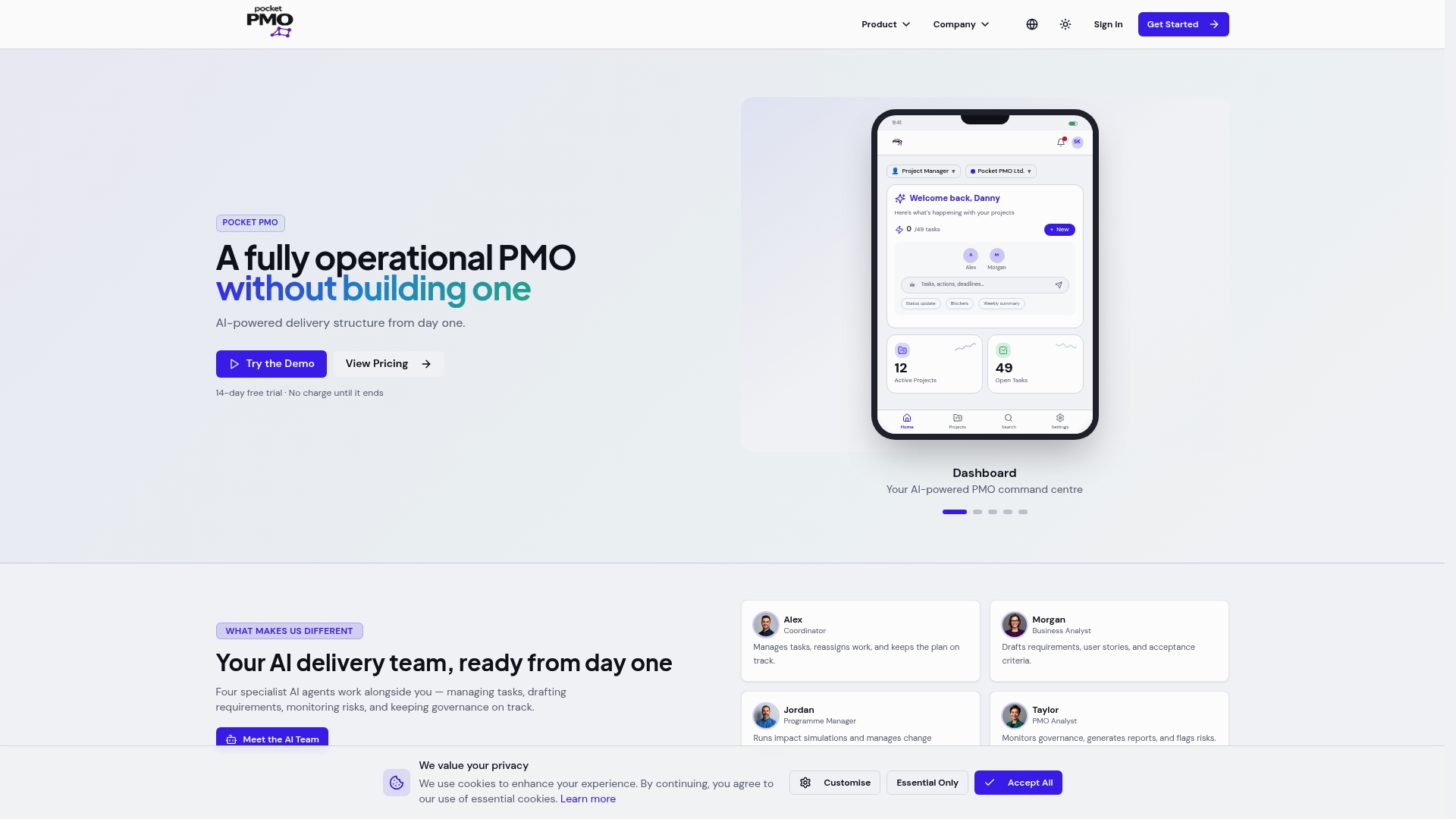
Whether you are establishing governance standards, managing hybrid delivery approaches, or seeking portfolio-level visibility, Pocket PMO embeds best practice at every layer. Launch a modern PMO in days, not months, and explore PMO features designed to make your delivery team faster, smarter, and more accountable from the start.
Frequently asked questions
How does a delivery team in a PMO differ from a project team?
A delivery team executes project outcomes within PMO governance standards, maintaining accountability across the full lifecycle. A project team vs delivery team distinction lies in that structural alignment to PMO frameworks, not just tactical task completion.
What key metrics do PMO delivery teams improve?
PMO delivery teams improve on-time delivery, reduce delays and cost overruns, and raise overall project success rates significantly above industry averages.
How do delivery teams handle hybrid Agile and Waterfall methods?
Delivery teams balance governance with flexibility by defining clear methodology criteria upfront and using centralised tools to coordinate Agile and Waterfall workstreams without creating conflicting reporting structures.
Why do some PMOs struggle with resource allocation?
Resource scarcity and shifting priorities create alignment challenges across portfolios. Centralised planning tools provide the visibility needed to resolve conflicts before they affect delivery timelines.
Recommended
- Pocket PMO | A fully operational PMO without building one
- Pocket PMO | A fully operational PMO without building one
- Pocket PMO | A fully operational PMO without building one
- Pocket PMO | A fully operational PMO without building one
- Project management in creative agencies: workflows and methods | AMW Media