

Most executives assume their organisation has solid PMO governance because they have a PMO. That assumption is one of the most expensive mistakes in project management. Governance frameworks that exist only on paper, where authority is vague and escalation paths are undefined, consistently produce cost overruns, missed deadlines, and strategic misalignment. This article cuts through the confusion, defines what robust PMO governance actually looks like, explains how AI integration changes the equation, and gives you practical steps to build governance that delivers real enterprise control.
Table of Contents
- What is PMO governance?
- The mechanics of effective PMO governance
- How AI is changing PMO governance
- Building a PMO governance model for visibility and efficiency
- Why most PMO governance fails—and what actually works
- Explore solutions to unlock your PMO governance
- Frequently asked questions
Key Takeaways
| Point | Details |
|---|---|
| Define decision rights | Clear authority structures prevent project drift and inefficient escalation. |
| Set up escalation pathways | Structured escalation ensures issues are resolved and responsibilities are clear. |
| Leverage AI for visibility | AI-powered reporting enhances real-time oversight and decision-making. |
| Avoid symbolic governance | True governance requires actionable frameworks, not just documentation. |
| Adopt digital PMO solutions | Platforms like Pocket PMO simplify implementing robust, AI-enabled governance. |
What is PMO governance?
PMO governance is far more than a set of templates or a weekly status meeting. PMO governance refers to the decision rights, processes, oversight mechanisms, and governance structures that determine how projects and programmes are initiated, approved, monitored, escalated, and evaluated under a PMO. That is a broad mandate, and it is worth unpacking each component carefully.
The essential building blocks of PMO governance include:
- Authority hierarchy: Who has the power to approve project initiation, changes in scope, or budget increases? Without a documented hierarchy, these decisions default to whoever shouts loudest.
- Governance bodies: Steering committees, project boards, and portfolio review groups that provide structured oversight at regular intervals.
- Decision gates: Formal checkpoints across the project lifecycle where work is assessed before it can proceed to the next phase.
- Escalation paths: Defined routes for issues that cannot be resolved at the project level, ensuring problems reach the right decision-maker quickly.
- Reporting infrastructure: Standardised status reports, dashboards, and metrics that give leadership accurate, timely visibility across the portfolio.
The critical distinction here is between symbolic governance and true governance. Symbolic governance looks credible. You have a governance framework document, a project board, and a RAID log. But if no one enforces the decision gates, if escalation paths are unclear, and if authority is assumed rather than assigned, you have the appearance of control without the substance of it.
"True PMO governance is not about the volume of documentation. It is about whether the right people are making the right decisions at the right time, with accurate information."
Understanding PMO governance and AI efficiency together helps you see why the two are increasingly inseparable. Good governance creates the structure; AI provides the intelligence to keep that structure functioning in real time. Meanwhile, aligning your project governance frameworks with business strategy ensures that governance serves outcomes rather than processes.
The mechanics of effective PMO governance
Now that PMO governance is defined, let us explore how it works in practice. Governance is only as effective as its mechanics, and there are three core mechanisms that separate functional governance from decorative governance.

1. Decision gates across the lifecycle
Decision gates are formal review points at which a project must demonstrate it meets specific criteria before progressing. They typically appear at initiation, planning completion, mid-execution, and project close. Each gate has defined entry and exit criteria, meaning stakeholders know exactly what evidence is required to move forward. Projects that fail to meet criteria are either paused, redirected, or terminated. This prevents poor-performing projects from consuming resources long past the point where they should have been stopped.
2. Explicit escalation pathways
Escalation paths need to be documented, communicated, and rehearsed. A well-structured escalation path moves issues from project level to programme level to executive level in a structured sequence, with defined timeframes at each tier. Without this, issues fester at project level because no one is sure who should own them, or they jump straight to executive level unnecessarily, wasting leadership time and creating noise.
3. A defined authority and decision-rights matrix
The authority matrix answers one simple question: who can decide what? It assigns specific types of decisions (budget changes, scope alterations, resource reallocation, risk acceptance) to specific roles. This removes ambiguity, speeds up decision-making, and prevents the paralysis that comes when multiple stakeholders believe they each have veto power.
The consequences of skipping these mechanics are significant. If governance is undefined, programmes can drift and decisions can escalate without structure, turning project management into administrative coordination rather than enterprise control. Put simply, your PMO becomes a reporting service rather than a strategic function.
| Governance element | Without it | With it |
|---|---|---|
| Decision gates | Projects continue regardless of performance | Resources are protected; poor projects stopped early |
| Escalation pathways | Issues stall or bypass leadership | Problems reach the right decision-maker, on time |
| Authority matrix | Decisions are delayed or contested | Clear accountability accelerates decision-making |
| Reporting infrastructure | Leadership operates on outdated data | Real-time visibility supports confident decisions |
Pro Tip: When building your authority matrix, map decisions by financial threshold as well as type. A project manager might own scope changes below a defined cost impact, but anything above that threshold requires sponsor approval. This prevents both micromanagement and unauthorised commitments.
Streamlining PMO decisions through structured governance mechanics reduces the cognitive load on senior leadership and frees them to focus on strategic direction rather than operational firefighting. It also supports strategic PMO change management by ensuring that governance evolves alongside the organisation rather than becoming a rigid constraint.
How AI is changing PMO governance
Understanding governance mechanics sets the stage for examining how AI alters these processes. AI integration is reshaping several aspects of PMO governance, though it is worth being precise about what the evidence actually supports.
AI tools are currently delivering value in three specific areas within PMO governance:
- Real-time reporting and dashboards: AI-enabled platforms can aggregate data from multiple project streams, auto-generate status reports, and surface risks or anomalies that would take a human analyst hours to identify. This dramatically improves the quality and timeliness of the reporting infrastructure that underpins governance.
- Streamlined escalation: Intelligent systems can monitor project metrics, detect threshold breaches, and trigger escalation alerts automatically. Rather than waiting for a project manager to notice a problem and manually raise it, the system surfaces the issue proactively.
- Predictive risk analysis: AI models can analyse historical project data to flag patterns that correlate with delivery failure, giving governance bodies early warning rather than post-mortem reports.
However, it is important to acknowledge what the research actually shows. Empirical evidence on AI-enabled PMO governance is still limited; available literature is largely suggestive through surveys and case reports, while peer-reviewed comparative efficiency evidence remains scarce. This does not mean AI integration is ineffective. It means organisations should adopt AI tools with clear objectives and measurement frameworks rather than assuming benefits will materialise automatically.
| Aspect | Traditional PMO governance | AI-enhanced PMO governance |
|---|---|---|
| Status reporting | Manual, periodic, often delayed | Automated, real-time, consistently formatted |
| Risk identification | Retrospective, human-dependent | Predictive, pattern-based, proactive |
| Escalation triggers | Manual observation and judgement | Threshold-based, automated alerts |
| Decision support | Historical reports, spreadsheets | Live dashboards, AI-generated insights |
Common challenges when integrating AI into governance include data quality issues (AI is only as good as the data it receives), change resistance from teams accustomed to manual processes, and the risk of over-relying on automated outputs without human judgement. The most effective approach treats AI as an augmentation of governance structures rather than a replacement for them.
Explore how optimising AI project management requires a strong governance foundation, why AI smart reporting transforms what leadership can see and act on, and how different AI-driven PMO models fit different organisational contexts.
Building a PMO governance model for visibility and efficiency
With an understanding of AI's potential, let us outline actionable steps for building effective PMO governance that supports visibility, risk management, and operational efficiency.
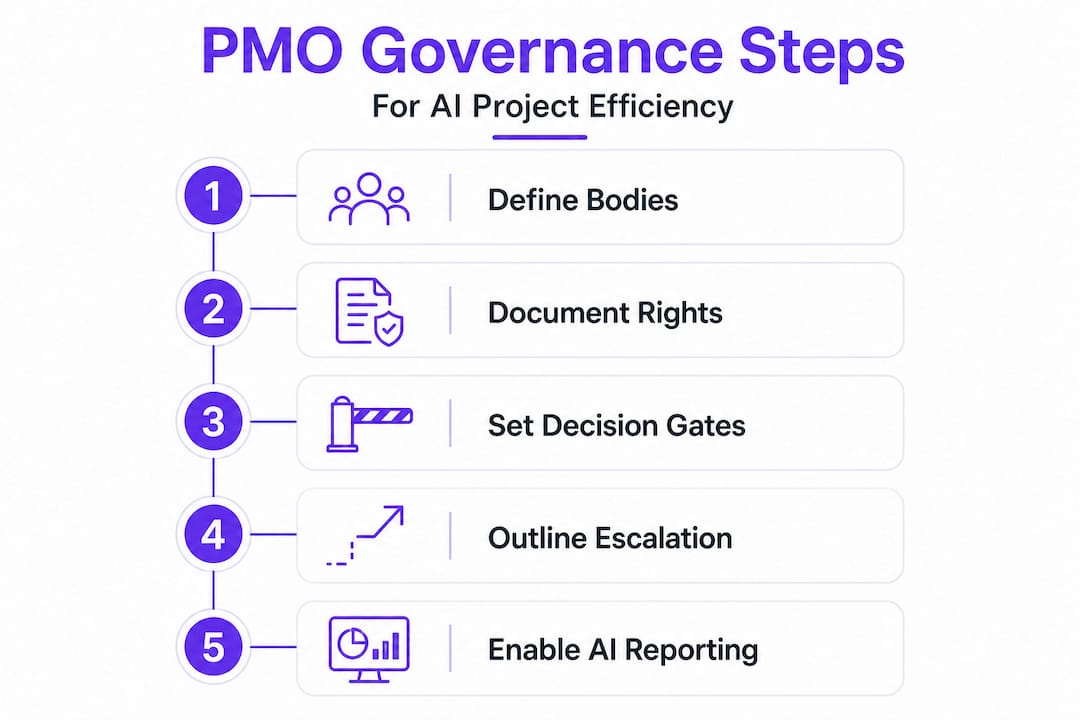
Step 1: Define your governance bodies and hierarchy
Start by mapping who needs to participate in governance at each tier: project, programme, and portfolio. Assign named roles to steering committees and project boards. Establish meeting cadences, quorums, and decision-making protocols for each body. Avoid the trap of creating too many governance layers; every layer adds overhead, so each one must have a clear and distinct purpose.
Step 2: Document decision rights explicitly
Create an authority matrix that covers budget approvals, scope changes, resource decisions, risk acceptance, and change requests. Assign each decision type to a role, not a committee, so accountability is unambiguous. Publish this matrix and make it accessible to all project stakeholders.
Step 3: Define and enforce decision gates
Map your standard project lifecycle and identify the natural points where a go or no-go decision is required. Document the entry and exit criteria for each gate. Assign a governance body to own each gate review. Critically, enforce the gates: a governance process that allows projects to skip reviews is not a governance process.
Step 4: Establish escalation pathways with timeframes
For each tier of governance, define what types of issues should be escalated, within what timeframe, and to whom. Train project managers on the pathways so escalation becomes a professional and expected practice rather than an admission of failure. Clear reporting infrastructure and escalation pathways are foundational to any governance model that delivers genuine oversight.
Step 5: Implement AI-enabled reporting for real-time visibility
Once the structural governance framework is in place, layer in AI-enabled reporting tools. Configure dashboards that reflect your governance KPIs: schedule performance index, budget variance, risk counts, issue ageing, and change request volumes. Set automated alerts for threshold breaches so escalation is triggered before problems become crises.
Pro Tip: Treat your governance model as a living document. Schedule a quarterly review of your authority matrix, decision gates, and escalation paths. Organisations change, and governance that fitted a 20-person PMO will not serve a 200-person portfolio without adaptation.
Aligning governance design with PMO operational strategy ensures that governance supports the organisation's broader strategic objectives rather than becoming an isolated compliance exercise.
Why most PMO governance fails—and what actually works
Here is the uncomfortable truth: most PMO governance fails not because organisations lack frameworks but because they lack enforcement. Governance documents are created during PMO setup, approved by leadership, and then quietly ignored when project pressure mounts. Decision gates get bypassed because the programme is behind schedule. Escalation paths are skipped because the project sponsor prefers to handle things informally. The authority matrix is overridden because a senior stakeholder simply makes a decision outside the defined process.
This is the core problem. Governance is treated as a risk management formality rather than a genuine mechanism of enterprise control. When governance is undefined or unenforced, programmes drift and decisions escalate without structure, and the PMO reverts to being an administrative function with no strategic authority.
What actually works is creating governance that is genuinely embedded in how the organisation operates. This means leadership visibly uses the governance process themselves, rather than treating it as something that applies only to project managers. It means governance metrics, such as the percentage of projects passing decision gates on first review or the average time to escalate critical issues, are tracked and reported at board level. It means the PMO has the authority to enforce its own framework rather than relying on goodwill.
Organisations that are succeeding with AI-enhanced governance share a consistent characteristic: they got the structural governance right first, then used AI to amplify its effectiveness. AI tools provided automation for reporting and escalation alerts, but the underlying decision rights, escalation pathways, and authority structures were already functioning. AI did not fix their governance; it made good governance faster and more precise.
The organisations that struggle with AI integration are those that expected technology to substitute for governance design. Streamlining PMO decision-making requires both clear governance structures and the right tools working together. Neither alone is sufficient.
The practical lesson is this: before investing in any AI-powered PMO tool, audit your existing governance framework for the three core mechanics outlined earlier. If your decision gates are not enforced, if your escalation paths are ambiguous, and if your authority matrix is missing, fix those first. Then use AI to operate your governance model at scale and speed that would be impossible manually.
Explore solutions to unlock your PMO governance
Identifying the right governance structure is only the first step. Putting it into practice, consistently, across multiple projects and teams, is where organisations often need support.
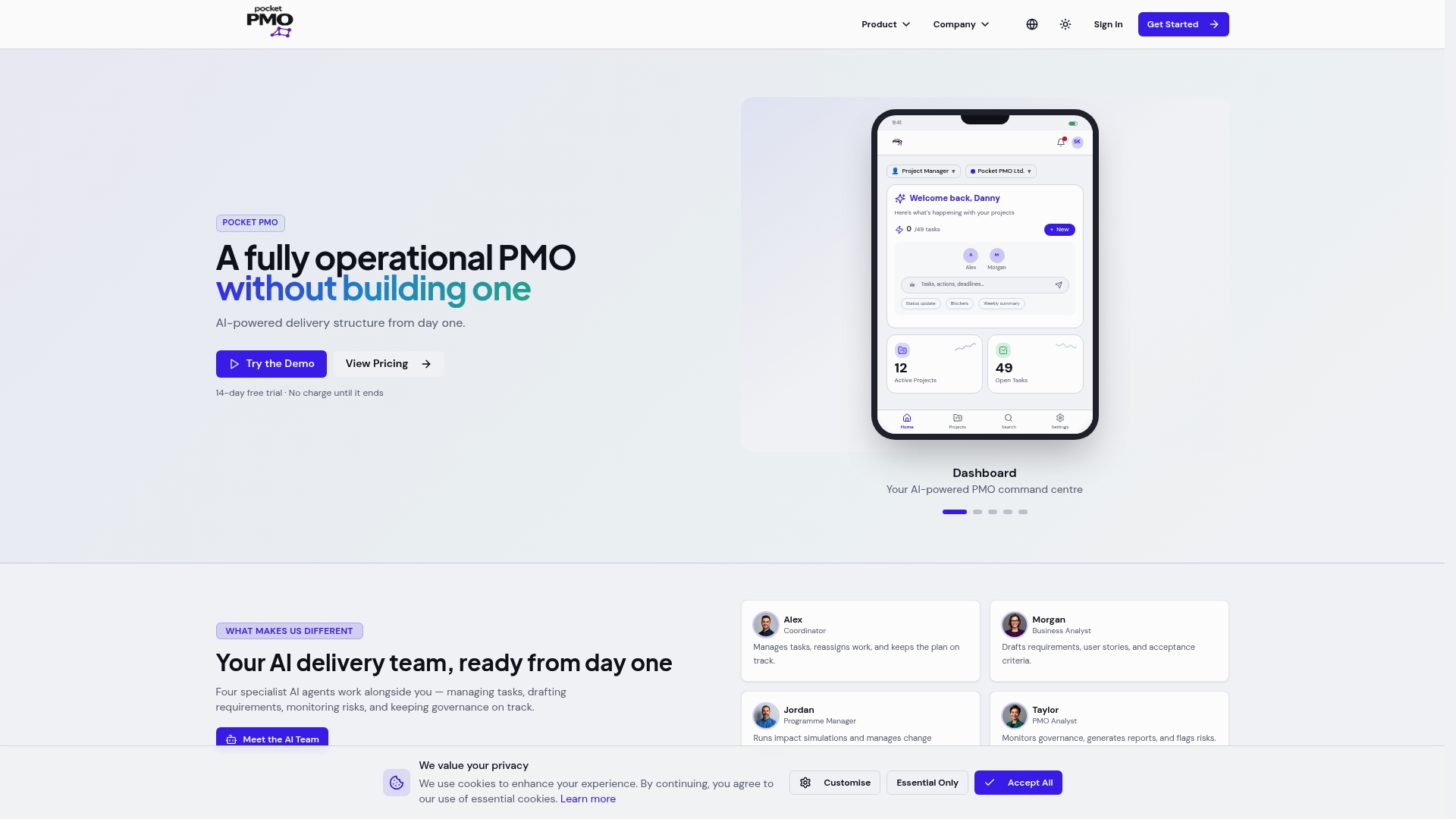
The Pocket PMO platform is built to deliver exactly that. It provides real-time dashboards, AI-driven risk analysis, automated status reporting, and change request workflows that align directly with the governance mechanics described in this article. You get a fully operational, AI-powered PMO from day one, without the overhead of building one from scratch. Explore the full range of Pocket PMO features to see how governance is built into every workflow. If you are currently using other platforms, you can also compare Pocket PMO vs Microsoft Project or review Pocket PMO vs Monday.com to understand where AI-powered governance makes the difference.
Frequently asked questions
What are the key pillars of PMO governance?
PMO governance refers to the decision rights, processes, oversight mechanisms, and governance structures that guide how projects are managed, making decision rights, oversight, escalation mechanisms, and reporting infrastructure the four core pillars.
How does AI integration enhance PMO governance?
AI improves governance through real-time reporting, automated escalation alerts, and predictive risk analysis, though it is important to note that empirical evidence on AI-enabled PMO governance is still limited and organisations should set clear objectives for AI adoption.
What happens if PMO governance is not properly defined?
If governance is undefined, programmes can drift and decisions can escalate without structure, reducing the PMO to an administrative function rather than a strategic control mechanism.
Which industries benefit the most from robust PMO governance?
Industries managing large, complex, or regulated projects, including IT, construction, financial services, and healthcare, see the greatest benefits because the cost of governance failure in these sectors is highest.
Is there a ready-made PMO solution for organisations seeking fast setup?
Digital PMO platforms like Pocket PMO enable organisations to implement robust governance frameworks, AI-driven reporting, and escalation workflows quickly, without the time and cost of building a bespoke PMO function internally.