

Poor PMO decision-making is one of the most persistent drains on project performance. When authority is unclear, escalation paths are undefined, and decisions are reactive rather than planned, projects overrun, accountability evaporates, and senior stakeholders lose confidence. PMO governance framework research confirms that structured governance, with clear authority hierarchies and decision gates, is the foundation of strategic alignment. This guide walks you through the governance essentials, the right tools and methodologies, common pitfalls to avoid, and a practical roadmap for embedding AI-driven decision-making across your PMO.
Table of Contents
- Understanding governance and authority in the PMO
- Tools and methodologies: From PRINCE2 to AI-driven decision support
- Managing constraints, dependencies and common decision pitfalls
- Implementing and scaling AI-driven PMO decision-making
- Why the best PMO decision-making blends AI and human judgement
- Unlock PMO transformation with AI-powered solutions
- Frequently asked questions
Key Takeaways
| Point | Details |
|---|---|
| Structured governance is essential | Clear frameworks and defined authority speed up and improve PMO decisions. |
| AI tools drive better results | Using dashboards, predictive analytics and PPM tools elevates decision quality and reduces bias. |
| Mitigating pitfalls requires maturity | Identifying and addressing common issues like estimation errors makes PMO outcomes more reliable. |
| AI and human judgement work together | Combining data with experience gives the best balance for strategic project decisions. |
Understanding governance and authority in the PMO
Governance is not a bureaucratic formality. It is the operating system of your PMO, defining who decides what, at what level, and when. Without it, you get duplication, delay, and decisions made by whoever shouts loudest.
Four terms are worth defining clearly from the outset. A governance framework sets the rules, roles, and processes that guide how decisions are made and monitored. An authority hierarchy maps decision-making power across project, programme, and portfolio levels. Decision gates are formal review points where projects must meet defined criteria to proceed. Escalation pathways are the documented routes by which unresolved issues move to the appropriate authority level.
PMO governance frameworks rely on these four elements working in concert to ensure strategic alignment and accountability across every project in your portfolio.
Typical PMO governance model structure
| Level | Role | Primary decision type |
|---|---|---|
| Portfolio board | Sponsors, C-suite | Investment approval, strategic direction |
| Programme manager | Senior PM or PMO lead | Resource allocation, dependency management |
| Project manager | Delivery lead | Day-to-day scope, risk, and change decisions |
| Team lead | Work stream owner | Task prioritisation and issue resolution |
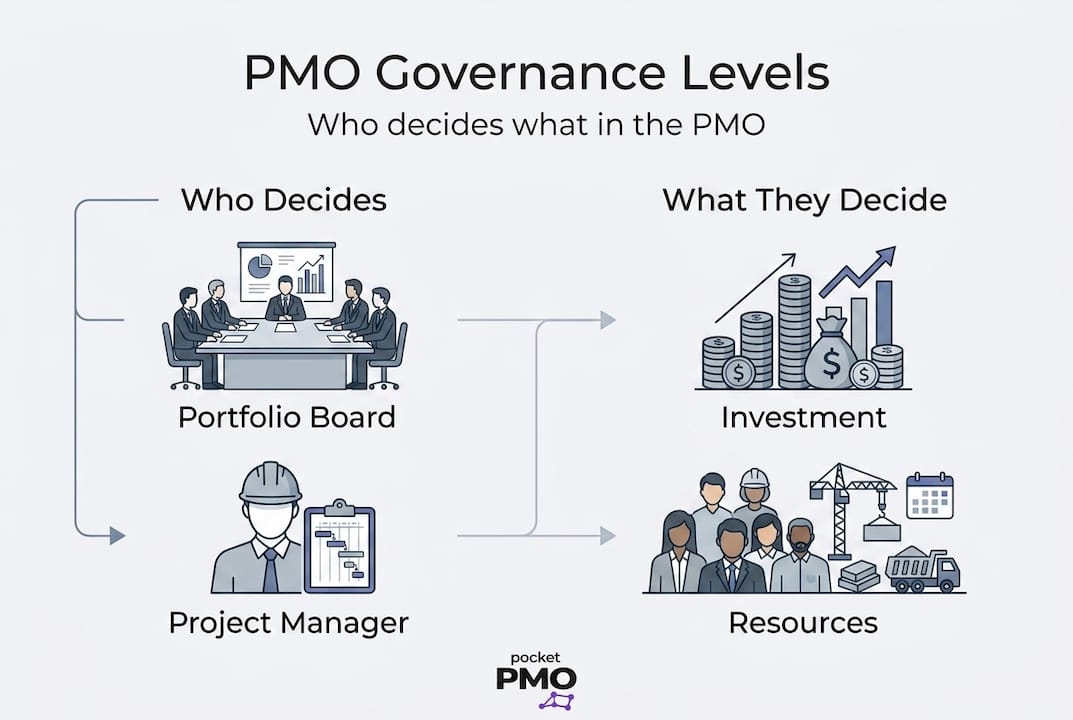
A well-designed governance model gives every level the authority it needs without creating bottlenecks at the top.
Core elements required for robust governance include:
- Clear role definitions with documented decision rights
- Approved tolerances so teams can act without constant escalation
- Structured change control and change request workflows
- Defined decision gates with entry and exit criteria
- Escalation pathways that are tested, not just documented
- Integration with risk management service frameworks to reinforce decision quality
Role clarity directly accelerates decisions. When team members know the boundary of their authority, they act within it confidently. When that boundary is breached, they escalate correctly rather than guess or stall.
For those clarifying PMO authority within their organisations, start with a decision rights matrix. Map every significant decision type to a role, set the tolerance thresholds, and review quarterly.
Pro Tip: Document your escalation pathways in a single, version-controlled artefact and share it across all project teams. An untested escalation path is as good as no path at all.
Strategic PMO decision alignment becomes significantly easier once governance roles are visible and agreed upon. Governance is not the finish line, but nothing else works well without it.
Tools and methodologies: From PRINCE2 to AI-driven decision support
Once governance is in place, choosing the right methodologies and tools becomes critical. The two do not compete with each other. They work in sequence.
PRINCE2 (Projects in Controlled Environments) remains one of the most widely used structured project management methods globally. Its Directing a Project process sits at board level, providing a formal mechanism for sponsors and steering committees to authorise stages, review exceptions, and close projects. Paired with stage gates, PRINCE2 creates a rhythm of structured decision-making that prevents scope creep and ensures each phase earns the right to continue.
PRINCE2 processes and stage gates provide board-level governance and approval structures, while data-driven approaches using PPM tools, dashboards, and predictive analytics sharpen the quality of those decisions.
Key steps in a modern, data-driven approval process:
- Collect baseline data from your PPM tool before each stage gate
- Run predictive analytics to flag risks and resource gaps
- Present a dashboard summary to the decision authority, not raw data
- Record the decision, rationale, and any approved tolerances
- Assign owners for any conditions attached to approval
- Schedule the next gate with pre-agreed success criteria
Traditional vs AI-driven tools
| Tool type | Strengths | Limitations | Best use case |
|---|---|---|---|
| PRINCE2 / stage gates | Structured, auditable, widely understood | Slower cadence, manual reporting | Regulated industries, large programmes |
| PPM dashboards | Real-time visibility, cross-project view | Requires clean data inputs | Portfolio-level oversight |
| AI predictive analytics | Proactive risk signals, pattern recognition | Needs historical data to train | Ongoing delivery and risk decisions |
| Manual status reports | Familiar, low-tech barrier | Prone to bias, time-consuming | Small teams, early-stage PMOs |
The most effective PMOs do not choose one approach. They layer AI analytics over structured methodologies. Dashboards surface the signals; PRINCE2 provides the framework to act on them.
PMO dashboard features now include AI-generated status summaries, risk heatmaps, and dependency tracking, removing hours of manual compilation from your governance cycle.

Pro Tip: Before your next stage gate, build a one-page dashboard view that maps schedule variance, open risks, and resource utilisation side by side. Decision-makers absorb visual data faster than narrative reports.
For teams exploring AI project tracking strategies, the key is integrating AI outputs into existing governance gates rather than creating parallel processes. PPM tool implementation works best when it mirrors your current approval rhythm and enhances it, not replaces it.
Managing constraints, dependencies and common decision pitfalls
The right methodologies can strengthen decisions, but avoiding common pitfalls is equally important. Most PMO failures are not caused by lack of process. They are caused by predictable, preventable errors that repeat across organisations.
Common pitfalls in PMO decision-making include:
- Overcommitment: Approving more projects than available capacity can deliver, creating resource contention across the portfolio
- Estimation errors: Inaccurate time and cost forecasts that compound across phases and erode stakeholder trust
- Reactive decisions: Responding to issues only after they escalate rather than identifying risks early enough to act proactively
- Symbolic governance: Having governance documents and committees in place but bypassing them when speed is demanded
- Dependency blindness: Approving project decisions in isolation without mapping the impact on interconnected workstreams
Estimation errors ranging 10 to 25% are among the most common causes of project overruns, and they compound when multiple projects share the same constrained resources.
Maturity models help by benchmarking your PMO's current capability and identifying which governance or planning practices are missing. A PMO at maturity level two, for example, may have processes defined but not consistently applied. Moving to level three requires measurable, repeatable execution, and that is where AI-driven tools accelerate progress.
AI algorithms analyse historical project data to identify patterns in estimation error, flag dependencies that human planners miss, and surface resource conflicts before they become crises. This shifts decision-making from reactive to anticipatory.
For PMOs managing multi-project environments, dependency mapping is especially critical. A decision made in isolation on one project can destabilise three others. AI-powered algorithm-driven planning tools model these interdependencies automatically, giving you the full picture before you commit.
Pro Tip: Run an AI-driven risk and dependency analysis at the start of every new project phase, not just at initiation. Constraints shift over time, and early detection is always cheaper than late intervention.
Effective requirement management with AI also reduces scope-driven estimation errors by ensuring requirements are stable and agreed before detailed planning begins.
Implementing and scaling AI-driven PMO decision-making
With challenges addressed, use this roadmap for embedding and scaling AI-driven decision-making in your PMO.
Step-by-step from pilot to scaled AI in PMO decisions:
- Select one active project as a pilot and connect it to your chosen PPM and AI platform
- Define the key decision points in that project where AI outputs will inform governance gate reviews
- Train the relevant stakeholders on interpreting AI-generated risk scores and dashboard signals
- Run two full governance cycles using AI-augmented reporting and capture lessons learned
- Evaluate against baseline metrics: decision speed, escalation frequency, and forecast accuracy
- Expand to a second cohort of projects, applying lessons from the pilot
- Standardise AI-augmented templates and workflows across the full portfolio
- Review governance structures to ensure authority hierarchies reflect the new data-driven cadence
Scaling requires more than technology. It requires buy-in from project sponsors, consistent data discipline, and governance structures that formally recognise AI outputs as valid inputs to decisions.
Success criteria for sustained improvement include:
- Decision cycle time decreasing by a measurable percentage quarter on quarter
- Escalation frequency reducing as teams gain confidence in their authority boundaries
- Forecast accuracy improving as AI refines its models with more historical data
- Stakeholder satisfaction with governance reporting increasing across the portfolio
- Stage gate approval rates stabilising, indicating better pre-gate preparation
Stage gates and predictive analytics together create the measurable, repeatable decision environment that scaling demands.
Linking your dashboards directly to strategic value delivery is the final step. Every metric you track should connect to an outcome that matters at portfolio or organisational level. Explore real-world PMO AI use cases to see how other organisations have made that connection at scale.
Why the best PMO decision-making blends AI and human judgement
There is a temptation, particularly among technology-forward PMOs, to treat AI as the answer rather than a tool. We have seen consultancies implement sophisticated analytics platforms and then wonder why governance quality has not improved. The data was there. The insight was not acted upon.
AI is exceptionally good at pattern recognition, anomaly detection, and processing volumes of data that no human team can match. What it cannot do is understand the political context of a resourcing decision, read the room in a steering committee, or weigh the reputational stakes of a delayed milestone for a key client.
The organisations that get the most from AI and human project tracking are those that treat AI as an adviser, not an authority. They use it to surface what matters, then apply experienced judgement to decide what to do. That combination, data precision paired with contextual wisdom, is what drives genuinely excellent PMO governance.
Unlock PMO transformation with AI-powered solutions
If you are ready to move from reactive governance to proactive, data-driven decision-making, the right platform makes all the difference. Pocket PMO delivers a ready-to-launch AI-powered PMO platform that brings together governance workflows, real-time dashboards, predictive analytics, and intelligent risk management from day one.
You do not need to build your own PMO infrastructure from scratch. With essential PMO features including portfolio management, change request workflows, RAID tracking, and AI-driven status reporting, your team gains full project visibility immediately. Book an AI team demo and see how Pocket PMO can transform your project governance in practice.
Frequently asked questions
What is the main benefit of using AI in PMO decision-making?
AI speeds up decisions, reduces human bias, and provides predictive analytics for better project outcomes, enabling PMO leaders to act on evidence rather than assumption.
How do escalation pathways improve PMO governance?
Clear escalation pathways ensure the right stakeholders resolve complex issues quickly, preserving accountability and preventing decisions from stalling at the wrong level.
What is a common pitfall in PMO decision-making?
Estimation errors are among the most frequent issues, with deviations of 10 to 25% from planned outcomes causing significant overruns when left unchecked across a portfolio.
Can an AI-driven PMO framework scale to large organisations?
Yes. With stepwise implementation and the right tooling, PPM tools and dashboards enable AI-driven governance to scale efficiently across large, complex portfolios without losing consistency or control.