

Without strong governance, every $1 billion invested wastes roughly $122 million, and project success rates languish around 31% compared to 77% or higher in high-maturity organisations. That gap is not down to talent or technology alone. It comes down to structure: who decides what, when, and how. Project governance is the framework that answers those questions before a crisis forces the issue. This article breaks down the core concepts, explains the PMO's role in making governance work, explores the specific challenges of complex multi-project environments, and shows how AI and automation are reshaping what good governance looks like in practice.
Table of Contents
- What is project governance? Core concepts explained
- The role of the PMO in project governance
- Project governance in complex and multi-project environments
- How AI and automation are transforming project governance
- Why effective project governance must be adaptive and tech-enabled
- Take your governance to the next level with Pocket PMO
- Frequently asked questions
Key Takeaways
| Point | Details |
|---|---|
| Governance sets the rules | Clear project governance defines who is accountable and drives project success. |
| PMOs enable consistency | PMOs turn governance frameworks into daily practice and streamlined reporting. |
| Complex projects need flexibility | Adaptive governance is vital for large or multi-project environments. |
| AI drives better decisions | Automation and analytics help modern PMOs predict risks and improve outcomes. |
What is project governance? Core concepts explained
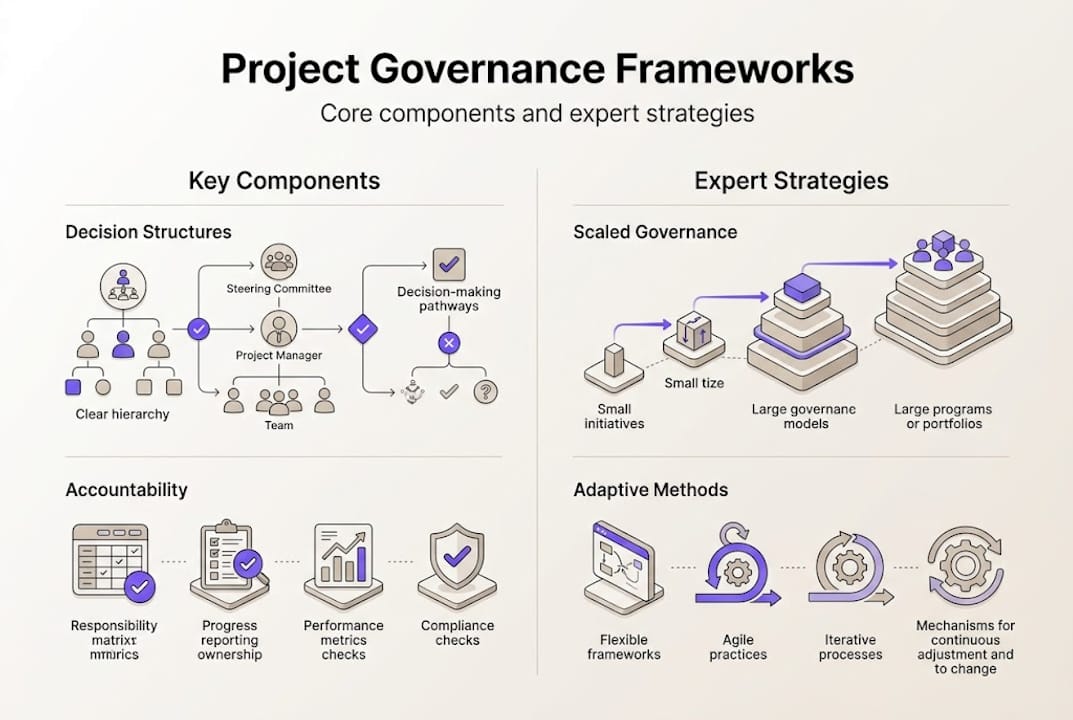
Project governance is the formal system that defines decision-making authority, accountability, and oversight across a project or portfolio. It is not the same as project management. Where project management focuses on executing tasks and delivering outputs, governance determines the rules of the game: who approves scope changes, who escalates risks, and who holds ultimate accountability for outcomes.
At its core, governance answers three questions: Who has authority? Over what decisions? Through what process? Without clear answers, even experienced teams default to informal negotiations, which is where governance quietly collapses.
Key components of a governance framework:
- Governance structure: Steering committee, project sponsor, and project manager roles with defined boundaries
- Decision rights and gates: Formal stage gates that control progression and resource release
- Change control: A structured process for evaluating and approving scope, budget, or timeline changes
- Risk management: Defined ownership and escalation paths for risks and issues
- Standardised reporting: Consistent status updates that give decision-makers accurate, timely information
- Escalation protocols: Clear triggers and routes for elevating issues beyond the project team
These key governance mechanics work together as an integrated system, not a checklist. Removing one weakens the others.
| Governance component | Primary purpose | Who owns it |
|---|---|---|
| Steering committee | Strategic decisions and oversight | Executive sponsor |
| Decision gates | Control progression and funding | PMO and sponsor |
| Change control | Manage scope and budget changes | PM and governance board |
| Risk escalation | Surface and resolve critical risks | PM, PMO, sponsor |
| Status reporting | Maintain visibility and accountability | PM and PMO |
You can explore practical project governance use cases to see how these components play out across different organisation types. If you are starting from scratch, a project proposal template can help you embed governance thinking from the very first document.
Pro Tip: Start with a simple one-page governance map that names the decision-makers and their boundaries. You can refine it as the project scales. Over-engineering governance at the outset is one of the most common mistakes teams make.
The role of the PMO in project governance
Understanding governance as a framework is one thing. Making it work in practice requires a dedicated function to implement, maintain, and enforce it. That is where the PMO comes in.
The PMO acts as the operational bridge between governance policies and day-to-day project delivery. It translates high-level accountability structures into practical standards, templates, and workflows that project teams can actually follow. Governance sets the framework and accountability at the organisational level, while the PMO implements the standards and methodologies that bring it to life.
Governance vs. PMO functions:
| Function | Governance | PMO |
|---|---|---|
| Sets accountability | Yes | No |
| Defines decision rights | Yes | Supports |
| Implements standards | No | Yes |
| Produces reporting | No | Yes |
| Manages escalation paths | Defines | Executes |
| Monitors compliance | Oversight | Operational |
The PMO's responsibilities within a governance model typically include:
- Establishing standards: Defining project templates, methodologies, and reporting formats that align with governance requirements
- Onboarding projects: Ensuring new projects are set up with the correct governance structures from day one
- Monitoring compliance: Tracking whether projects are following approved processes and flagging deviations early
- Supporting risk and escalation: Providing the infrastructure for teams to raise and resolve issues within defined boundaries
- Disseminating policy: Communicating governance updates and changes across all active projects and stakeholders
- Reporting upwards: Aggregating project data into portfolio-level views for senior decision-makers
For organisations running multiple concurrent projects, the PMO becomes indispensable. Without it, governance policies exist on paper but rarely translate into consistent practice. You can see how this plays out across different organisation types in these PMO use cases.
Project governance in complex and multi-project environments
Single-project governance is challenging enough. Across a portfolio of ten, twenty, or fifty concurrent projects, the complexity multiplies fast. Boundaries blur, priorities conflict, and informal workarounds become the norm.
Governance collapse in complex environments rarely happens dramatically. It tends to creep in through small informal decisions, undocumented scope changes, and escalation paths that nobody follows. By the time leadership notices, the damage is already done.
Top five governance pitfalls in complex portfolios:
- Scope creep: Changes accumulate without formal approval, eroding baselines and budgets
- Unclear escalation: Teams do not know when or how to escalate, so issues fester at project level
- Ad hoc decisions: Informal agreements between project managers and stakeholders bypass governance entirely
- Reporting failures: Inconsistent or incomplete status updates leave decision-makers operating on incomplete information
- Over-control: Governance so rigid that it creates bottlenecks, slowing delivery and incentivising workarounds
"Effective governance is invisible when it works. You only notice it when it's gone." The most successful portfolios are those where governance feels like a natural part of how work gets done, not an external constraint imposed on delivery teams.
The solution is not more governance. It is right-sized governance. A high-risk, long-duration infrastructure programme needs formal stage gates and a fully constituted steering committee. A short-cycle digital sprint needs lightweight checkpoints and fast escalation routes. Matching governance intensity to project risk and complexity is the skill most organisations underinvest in.
Pro Tip: For Agile or volatile project environments, replace rigid phase gates with lightweight sprint-level checkpoints. These maintain oversight without slowing delivery, and they surface issues before they become blockers.
Exploring proven multi-project management strategies can help you design governance models that scale with your portfolio rather than against it.
How AI and automation are transforming project governance
Traditional governance relies on humans to collect data, spot patterns, and trigger escalations. In a fast-moving portfolio, that model breaks down. By the time a weekly status report surfaces a risk, the window for early intervention has often closed.
AI changes that dynamic fundamentally. AI-driven PMOs can enhance governance through predictive analytics, automated reporting, and dynamic prioritisation, directly addressing the volatility and complexity that manual models struggle with. The result is governance that is always on, not just active during review cycles.
Organisations with mature governance and PMOs achieve 38% higher project success rates than the industry average. AI accelerates the path to that maturity by removing the manual overhead that typically slows governance adoption.
Traditional vs. AI-enabled governance:
| Governance process | Traditional approach | AI-enabled approach |
|---|---|---|
| Risk identification | Manual review in weekly meetings | Continuous monitoring with predictive alerts |
| Status reporting | PM-authored weekly updates | Auto-generated from live project data |
| Escalation triggers | Human judgement and intuition | Rule-based and pattern-driven automation |
| Portfolio visibility | Aggregated spreadsheets | Real-time dashboards with drill-down |
| Change control | Paper-based or email approvals | Automated workflows with audit trails |
How to leverage AI in practical governance:
- Deploy predictive risk analysis: Use AI to scan project data continuously and flag risks before they breach thresholds
- Automate status reporting: Connect project tools to auto-generate consistent, accurate reports without manual input
- Set escalation rules: Define triggers that automatically route issues to the right decision-maker based on risk type and severity
- Enable portfolio dashboards: Give senior stakeholders real-time visibility across all active projects without waiting for manual aggregation
- Use AI for change impact analysis: Assess the downstream effects of proposed scope or budget changes instantly, supporting faster and better-informed decisions
You can explore AI-driven project governance in practice, and see how AI project tracking strategies and AI project requirements management support each stage of the delivery lifecycle.
Why effective project governance must be adaptive and tech-enabled
Most governance frameworks are designed for the project that was planned, not the project that actually unfolds. That is the uncomfortable truth most governance guides avoid. Rigid frameworks feel reassuring at the start. Six months in, they become obstacles that teams route around rather than work within.
The organisations that consistently deliver well are not those with the most detailed governance documentation. They are the ones that treat governance as a living system, one that adjusts to changing risk profiles, team maturity, and delivery context. That requires both the right mindset and the right tools.
AI is not just an efficiency upgrade here. It is the sensing layer that makes adaptive governance possible. Without real-time data and automated pattern recognition, you cannot know when your governance model needs to flex. You are always reacting, never anticipating.
What most guides also miss is that governance does not need to be perfect. It needs to be honest and responsive. A governance model that surfaces the truth quickly, even uncomfortable truths, and enables fast decisions at the right level is worth far more than a polished framework that nobody follows. Investing in advanced multi-project management capabilities is how you build that kind of governance, one that learns and improves with every project cycle.
Take your governance to the next level with Pocket PMO
If you are managing multiple projects and want governance that actually works in practice, not just on paper, Pocket PMO gives you a ready-to-deploy AI-powered PMO from day one.
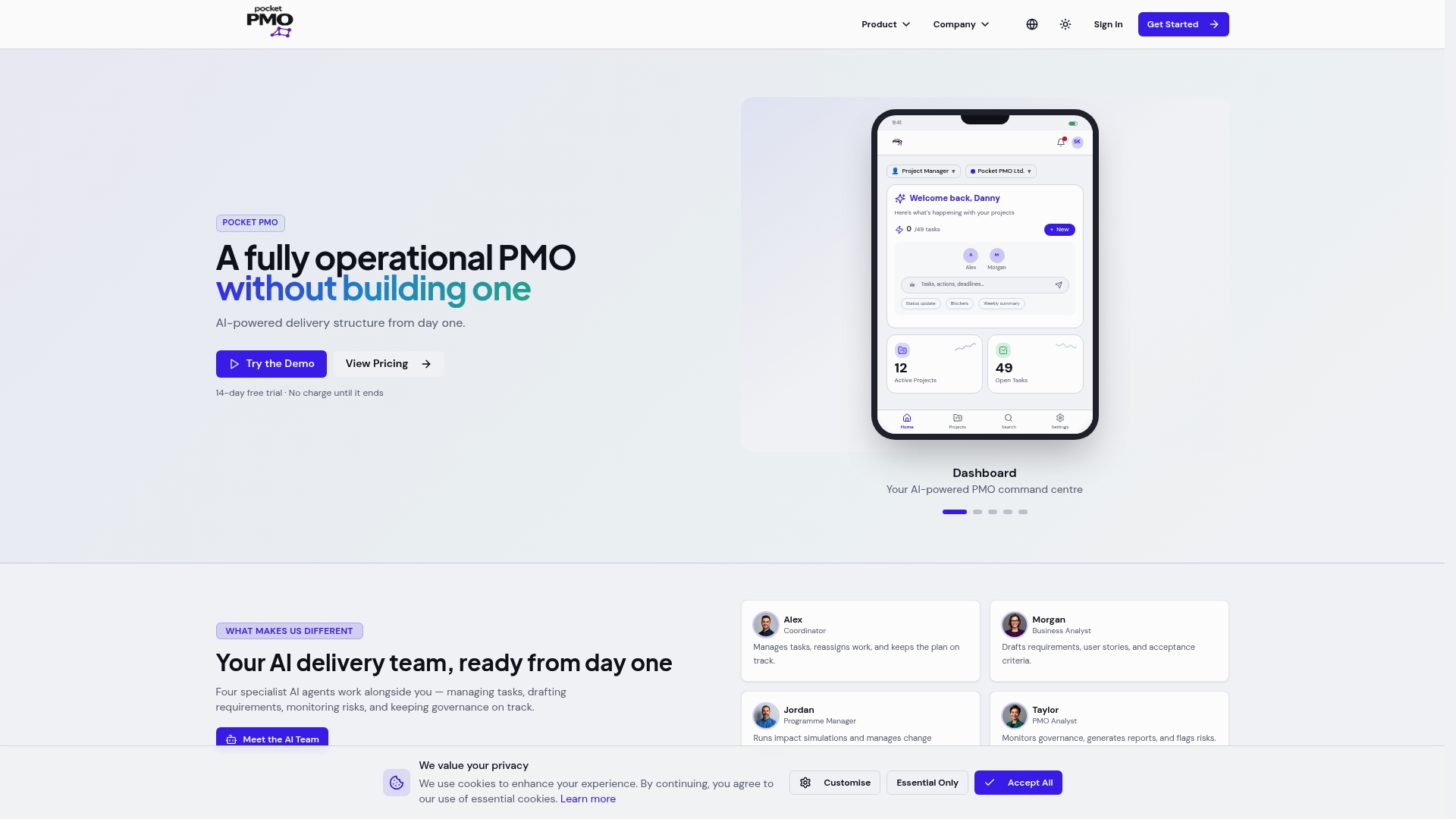
With real-time dashboards, automated risk analysis, change request workflows, and standardised reporting built in, you get the structure and visibility your portfolio needs without the overhead of building it yourself. Onboarding is fast, and the platform adapts to your existing workflows and governance requirements. Explore the Pocket PMO launch platform to see how quickly you can get started, or review the full set of PMO features to find the right fit for your organisation.
Frequently asked questions
What are the main components of project governance?
Project governance includes decision structures, clear accountability, risk management, change control, and standardised reporting. These components work together to maintain oversight and enable consistent, informed decision-making.
How does project governance differ from project management?
Governance sets the framework and accountability at the organisational level, while project management executes the work within those boundaries. Governance defines the rules; project management plays within them.
Why does project governance often fail in large or complex projects?
Failure usually stems from informal negotiations and unclear escalation paths, or from governance that is either too rigid or too lax for the project's actual complexity. Both extremes undermine delivery.
How does AI improve project governance today?
AI-driven PMOs enhance governance through predictive analytics, automated reporting, and dynamic controls that help teams handle risk, escalation, and data accuracy without manual overhead.
Recommended
- Streamline projects with the perfect proposal template
- Pocket PMO | A fully operational PMO without building one
- Master the multi-project management process: boost success
- Project tracking with AI: strategies for better results
- Gestion de projet TPE/PME : guide complet 2026
- Governance della sicurezza: guida per PMI e ISO - Security Hub