

Many organisations treat the PMO and change management as natural partners, yet the reality is more complicated. The PMO is built around control: deadlines, budgets, governance, and structured reporting. Change management is built around people: adoption, resistance, communication, and emotional readiness. Forcing one to report to the other almost always creates friction, dilutes both functions, and puts transformation at risk. The good news is that AI-driven PMO solutions are changing this dynamic, offering leaders a practical way to align delivery rigour with human-centred change so that both functions can perform at their best.
Table of Contents
- Understanding the PMO and change management divide
- Why collaboration, not control, drives transformation
- Leveraging AI-driven PMO solutions for integrated change
- Practical frameworks for aligning PMO and change management
- Why matching PMO and change management requires a new mindset
- Advance your change management with a strategic PMO
- Frequently asked questions
Key Takeaways
| Point | Details |
|---|---|
| Peer collaboration | PMOs and change teams must work as peers, not subordinates, for successful change. |
| Dual metrics approach | Track project delivery and change adoption to measure real outcomes. |
| AI-powered integration | AI-driven PMO solutions enhance visibility and alignment across teams. |
| Flexible frameworks | Avoid rigid templates—focus on adaptable processes suited to human change. |
| Mindset shift | Organisational leaders must embrace new ways of aligning delivery with people to drive transformation. |
Understanding the PMO and change management divide
With misconceptions in mind, let's break down what truly separates PMO from change management and why that separation matters.
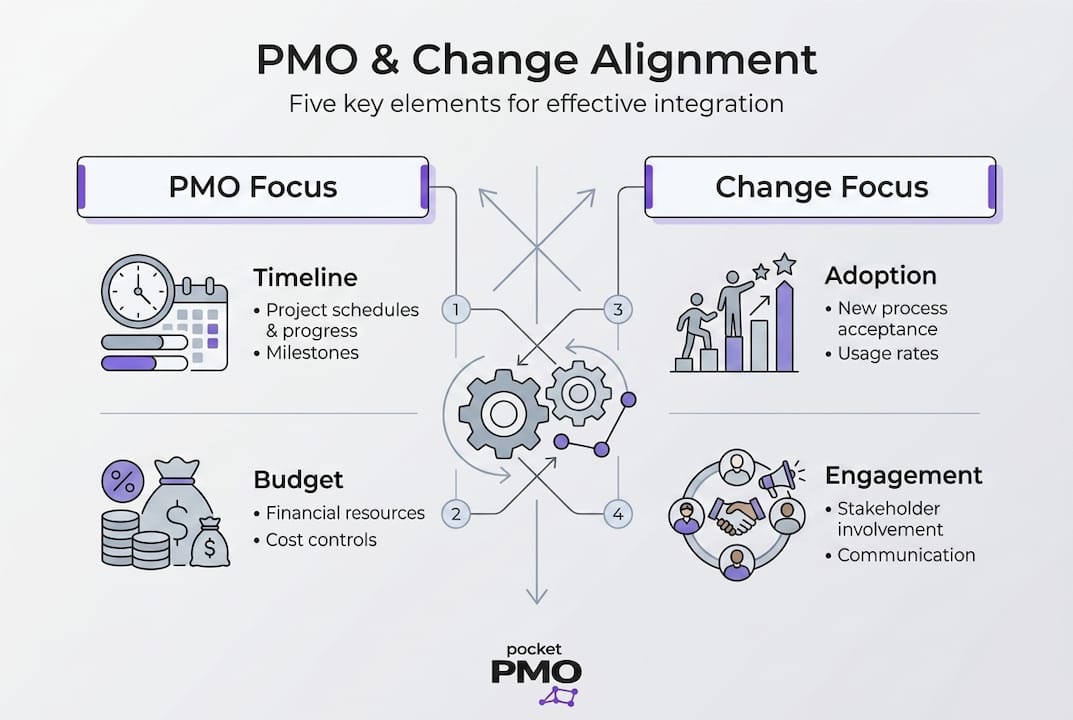
The PMO and change management communities have been having a version of the same argument for years. On one side, PMO leaders point to frameworks, templates, stage gates, and milestone tracking as the backbone of successful delivery. On the other side, change management practitioners argue that no template can capture the complexity of human behaviour during a transformation. Both sides are right. That is precisely the problem.
At the core, the two disciplines measure success very differently.
| Dimension | PMO focus | Change management focus |
|---|---|---|
| Primary goal | Delivery on time and budget | Adoption and sustained behaviour change |
| Key metrics | Milestones, cost variance, RAG status | Engagement scores, training completion, resistance levels |
| Core skills | Process design, governance, data analysis | Leadership, communication, empathy, coaching |
| Planning horizon | Project lifecycle | People journey (often longer than the project) |
| Risk definition | Schedule and cost risk | Human and cultural risk |
As industry expert Ron Leeman notes, PMO functions are fundamentally control-focused while change management is people-focused, and placing one under the authority of the other misaligns both. The recommended approach is to treat them as peers, not as a hierarchy.
The consequences of subordination are predictable. When change management sits beneath the PMO, adoption activity gets squeezed to fit project timelines rather than human readiness. When a PMO sits beneath a change function, governance and structure erode. Neither outcome serves the organisation or the people being asked to change.
There are also important lessons here about project proposal pitfalls. Transformation projects that fail to establish clear boundaries and collaborative working agreements between delivery and people functions from the outset often discover the problem only when it is too late to correct without significant cost.
- Delivery teams tend to escalate issues that affect timelines or costs.
- Change teams tend to escalate issues that affect engagement or readiness.
- When these escalation paths are not aligned, leadership receives an incomplete picture of transformation health.
"The mistake is not in having a PMO or a change function. The mistake is in believing one can manage the other." — A recurring theme in transformation post-mortems across sectors.
Recognising the divide is not a reason for pessimism. It is the starting point for building something better.
Why collaboration, not control, drives transformation
Now that we've seen the divide, let's consider why collaboration is the essential ingredient in real change.
The organisations that successfully navigate large-scale transformation tend to share a common characteristic: their PMO and change management functions operate as genuine peers. That means shared accountability, mutual respect for each other's expertise, and a willingness to learn from disciplines that may feel unfamiliar.
Here is a practical sequence for building that collaborative model:
- Establish a joint governance structure. Create a steering group that includes senior representatives from both delivery and change functions. Neither should chair by default. Rotate or share chairmanship based on the phase of the programme.
- Define dual success metrics from day one. Rather than measuring the programme solely by delivery milestones, agree on an integrated scorecard that tracks both progress and people adoption. This shapes how you report, escalate, and make decisions throughout.
- Invest in cross-education. PMO professionals benefit enormously from understanding change impact assessments and stakeholder engagement plans. Change practitioners benefit from understanding risk registers, dependency mapping, and multi-project success metrics. Neither group needs to become expert in the other's field, but fluency matters.
- Avoid rigid templating for people-centred activities. Templates are a PMO strength, and they are valuable for delivery tracking. However, balancing delivery and people outcomes requires flexibility. A change impact assessment conducted in week two of a project may need revisiting in week twelve, week twenty, and beyond. Build iterative review cycles into your governance model rather than a single point-in-time assessment.
- Build feedback loops that flow both ways. Delivery status should inform change communication. Change readiness data should inform delivery scheduling. If your stakeholders are not ready to adopt a new system, delaying go-live by two weeks may save months of remediation work.
The research supports this approach: success requires collaboration, not control. When PMOs and change functions operate as peers and invest in mutual education, they produce better delivery outcomes and better adoption outcomes simultaneously.
Pro Tip: Map your current programme governance to identify where PMO and change management decisions are made in isolation. Every isolated decision point is a potential blind spot for your transformation.
"The organisations that get this right are not the ones with the biggest PMOs or the most sophisticated change methodologies. They are the ones where delivery and change leaders genuinely trust each other."
Leveraging AI-driven PMO solutions for integrated change
Collaboration is crucial, but let's see how technology, especially AI, can empower this integration.
AI-powered PMO platforms are reshaping what integrated governance looks like in practice. The traditional challenge has been that delivery data and people data live in separate systems, reported by separate teams, to separate leadership audiences. AI bridges this gap by aggregating multiple data streams into a single, real-time view that supports both delivery and change management decision-making.

Consider the kind of dashboard an AI-driven PMO platform can generate:
| Metric category | Example indicators | Update frequency |
|---|---|---|
| Delivery progress | Milestone completion rate, schedule variance, budget burn | Daily or real-time |
| Risk profile | AI-predicted risk score, open RAID items, risk trend | Continuous |
| People adoption | Training completion rate, engagement survey results, resistance flags | Weekly or fortnightly |
| Governance health | Decisions outstanding, escalations logged, action item age | Real-time |
Platforms that support AI project tracking strategies can surface predictive insights that humans working from static spreadsheets simply cannot generate at speed. For example, an AI model can correlate low engagement scores in a particular business unit with an upcoming go-live milestone and flag the combination as a high-risk scenario before it becomes a crisis.
The practical benefits of AI integration for leaders include:
- Automated status reporting that draws on live data rather than relying on manual updates from stretched project teams.
- Predictive risk analysis that identifies which risks are likely to escalate based on patterns across similar programmes.
- Intelligent requirement tracking that connects AI requirements management to change impact, ensuring that scope changes are assessed for their effect on people as well as timelines.
- Consolidated stakeholder views that allow change practitioners to see delivery progress in context, and delivery leaders to see adoption health without switching tools.
The PMO solution features that matter most in a change context are those that connect structured delivery data with the qualitative signals that indicate whether people are ready, willing, and able to change.
As noted by industry analysis, avoiding the templating of human elements does not mean abandoning structure. It means ensuring that your platforms are flexible enough to capture the nuanced, time-sensitive nature of people data alongside the precision of delivery metrics.
Pro Tip: Shift your programme reporting cadence so that adoption milestones appear alongside delivery milestones in every executive update. If leadership only ever sees Gantt charts and RAG status, they will make decisions based on incomplete information.
Practical frameworks for aligning PMO and change management
With technology available, it's time to make these ideas actionable for your organisation.
Frameworks give structure to what can otherwise be an abstract aspiration. The following approach draws on proven practice and is designed to be adapted to your specific organisational context and scale.
Step 1: Conduct a current state assessment. Map your existing governance model. Where do PMO and change management currently interact? Where are there gaps, duplications, or tensions? Be honest about where control is prioritised over collaboration.
Step 2: Define peer-level accountability. Formalise the relationship between your PMO lead and your change lead at the same level in the programme hierarchy. Document it in your programme charter. This is not a cosmetic change. It signals to the entire team how decisions will be made and where authority sits.
Step 3: Agree on an integrated reporting framework. Design a single reporting template that captures both delivery and adoption performance. Use this as the basis for all steering committee updates. Over time, this trains leadership to consider both dimensions before making decisions.
Step 4: Establish joint planning sessions. Schedule regular joint planning sessions where delivery teams and change teams review upcoming milestones together. Each delivery milestone should be assessed for its people implications. Each change activity should be assessed for its delivery dependencies.
Step 5: Build in structured reviews. Set formal review points at key programme stages (for example, at 25%, 50%, and 75% of the delivery timeline) where both delivery performance and adoption health are assessed against original assumptions. Adjust plans accordingly.
The PMO use cases that generate the strongest results are those where this kind of structured, collaborative governance is embedded from the start rather than retrofitted after problems emerge.
Common pitfalls to avoid:
- Starting collaboration too late. By the time delivery is underway, patterns are set. Build the collaborative model during programme initiation.
- Treating adoption metrics as secondary. If adoption data only appears in change team reports and never in programme-level governance, it will not influence decisions at the speed required.
- Allowing either function to dominate. Monitor for signs that one function is gradually absorbing the other's decision authority. It happens subtly and damages trust quickly.
- Ignoring resistance signals. AI platforms can surface resistance patterns early. Act on them rather than hoping they will resolve at go-live.
Pro Tip: Establish a joint steering group that meets monthly, independent of the programme board. Use it to share learnings, surface tensions early, and continuously educate both functions. The insight from experienced practitioners consistently points to mutual education and peer-level governance as the foundation of transformation success.
Why matching PMO and change management requires a new mindset
Having explored practical frameworks, let's reflect on why mindset shifts truly matter.
Here is the uncomfortable truth that most transformation guidance avoids: the reason PMO and change management integration fails is rarely structural. It is cultural. Leaders who have built careers on process excellence instinctively reach for more structure when things go wrong. Leaders who have built careers on people engagement instinctively reach for more communication. Both responses, applied in isolation, make the problem worse.
The conventional view overvalues process and undervalues the irreducible complexity of human behaviour during change. You can have a flawless milestone plan and a beautifully maintained RAID log while your organisation's people are quietly deciding that the change is not for them. By the time that resistance surfaces in your metrics, you are already behind.
The contrasting insight from experienced practitioners is clear: PMO is control-focused and change management is people-focused, and these are genuinely different disciplines that require genuinely different skills. Putting one in charge of the other does not resolve that difference. It suppresses it until it erupts at the worst possible moment.
What actually works is a willingness from both sides to be changed by the collaboration. PMO professionals who have worked alongside skilled change practitioners learn to read programmes differently. They start to see a go-live milestone not as an endpoint but as a point of maximum human stress. Change practitioners who have worked alongside strong PMO functions learn to articulate their work in terms that land with delivery-focused leadership: impact on the critical path, risk to adoption readiness as a programme-level risk, and so on.
This is not soft skills training. It is strategic capability building. And it is the kind of learning you can accelerate by exploring change management insights that connect delivery discipline with people-centred practice.
Human change cannot be templated. Embrace that uncertainty rather than fighting it with more process. The organisations that do this consistently are the ones that look back at their transformations and see genuine, sustained change rather than a delivered project that nobody uses.
Advance your change management with a strategic PMO
If you're ready to apply these principles, discover how Pocket PMO can accelerate your journey.
Pocket PMO is built for exactly this challenge. The platform connects structured project delivery with real-time visibility across your portfolio, giving you the tools to track both delivery milestones and adoption indicators in a single, AI-powered environment. You do not need to build a PMO from scratch or manage multiple disconnected tools to achieve the integrated governance that transformation demands.
Whether you are a PMO leader looking to embed change management thinking into your governance model, or an organisational leader seeking clearer sight of transformation health, Pocket PMO's AI-driven features provide the visibility and automation to make it happen. Ready to see what an integrated PMO approach looks like in practice? Launch your PMO today and explore how Pocket PMO can support your next transformation from day one.
Frequently asked questions
How can a PMO support successful change management?
A PMO supports change management by providing structure, measuring both project delivery and adoption, and facilitating collaboration between delivery and people-focused teams. The most effective model treats PMO and change management as peers, not as a hierarchy.
What pitfalls should leaders avoid when integrating PMO and change management?
Leaders should avoid rigid hierarchies and templates, focusing instead on dual leadership and flexible frameworks that adapt to human factors. As practitioners consistently advise, avoid templating human elements of change within delivery-focused governance structures.
Why is AI important for PMO-driven change management in 2026?
AI enables PMOs to track delivery and adoption in real-time, offering actionable insight and streamlining processes for successful change management. It removes the manual burden of aggregating data from separate systems and surfaces predictive risks before they escalate.
What are dual metrics, and why do they matter?
Dual metrics track both delivery performance and change adoption, ensuring that programmes succeed from both process and people perspectives. They reflect the core principle that delivery and adoption are equally valid measures of transformation success.