

Many organisations assume that hiring skilled project managers is enough to guarantee delivery success. It is not. Without a supporting structure, even the best project managers face inconsistent processes, siloed decisions, and limited visibility across portfolios. 19% of professionals lack PMIS, often in environments where no PMO exists to establish the right foundations. This article explains what a Project Management Office truly is, why it matters to medium and large organisations, and how modern AI-driven PMOs are reshaping the governance landscape. If you are responsible for delivering consistent results across multiple projects, read on.
Table of Contents
- What is a PMO and what does it really do?
- The case for PMOs: Governance, alignment, and efficiency gains
- Common reasons PMOs fail and how to avoid them
- The future: AI-driven PMOs and the innovation edge
- A realistic perspective: Why PMO success is about influence, not bureaucracy
- How Pocket PMO can power your next step
- Frequently asked questions
Key Takeaways
| Point | Details |
|---|---|
| PMO adds strategic value | A well-designed PMO delivers governance and alignment across all projects, not just individual oversight. |
| Most failures are avoidable | PMOs typically fail due to poor strategic alignment and lack of executive buy-in, not inherent flaws. |
| AI transforms PMO impact | Modern PMOs leveraging AI tools achieve greater project efficiency and actionable insights. |
| Project managers can't replace PMOs | Individual project managers alone lack the portfolio-level visibility and consistency a PMO provides. |
What is a PMO and what does it really do?
Now that we understand the misconception, it is vital to define what a PMO truly is and what sets it apart from project managers.
A Project Management Office (PMO) is a centralised function within an organisation that defines, maintains, and enforces standards for project management across the business. It is not a team of project managers. It is the structure that supports them, holds them accountable, and connects their work to wider organisational strategy.
PMOs typically fall into three types:
- Supportive PMO: Provides templates, training, and best practices. Low control, high flexibility.
- Controlling PMO: Requires compliance with defined frameworks and governance standards. Moderate control.
- Directive PMO: Directly manages projects and assigns project managers. High control.
The type you need depends on your organisation's size, maturity, and complexity. What is consistent across all three is the core purpose: governance, standardisation, and multi-project management at a portfolio level.
So how does a PMO differ from a project manager? A project manager focuses on delivering a specific project on time, within budget, and to scope. A PMO looks across all projects simultaneously, ensuring they align with strategic goals, follow consistent processes, and collectively contribute to organisational outcomes. PMOs are essential for portfolio alignment and will fail if they operate at a purely tactical level.
Here is a clear breakdown of what a PMO is responsible for:
| Responsibility | Project manager | PMO |
|---|---|---|
| Deliver individual projects | ✓ | ✗ |
| Define governance standards | ✗ | ✓ |
| Align portfolio to strategy | ✗ | ✓ |
| Manage risk across projects | Partial | ✓ |
| Report to executive stakeholders | Partial | ✓ |
| Standardise tools and methods | ✗ | ✓ |
Organisations typically invest in a PMO when they are running multiple concurrent projects, experiencing repeated delivery failures, or scaling to a point where informal coordination no longer holds. Explore PMO use cases to see how different organisations have made this transition effectively.

The case for PMOs: Governance, alignment, and efficiency gains
With the PMO's definition clear, let us examine the unique benefits that only a well-integrated PMO can deliver.
Portfolio governance is not simply project management scaled up. It requires a dedicated function that tracks interdependencies, manages shared resources, and ensures every project contributes meaningfully to business goals. Without this, organisations frequently experience budget overruns, duplicated effort, and strategic drift.
A well-integrated PMO supports project managers in ways that individual effort cannot replicate:
- Standardised frameworks reduce the learning curve for new projects.
- Shared tools and templates create consistency across teams.
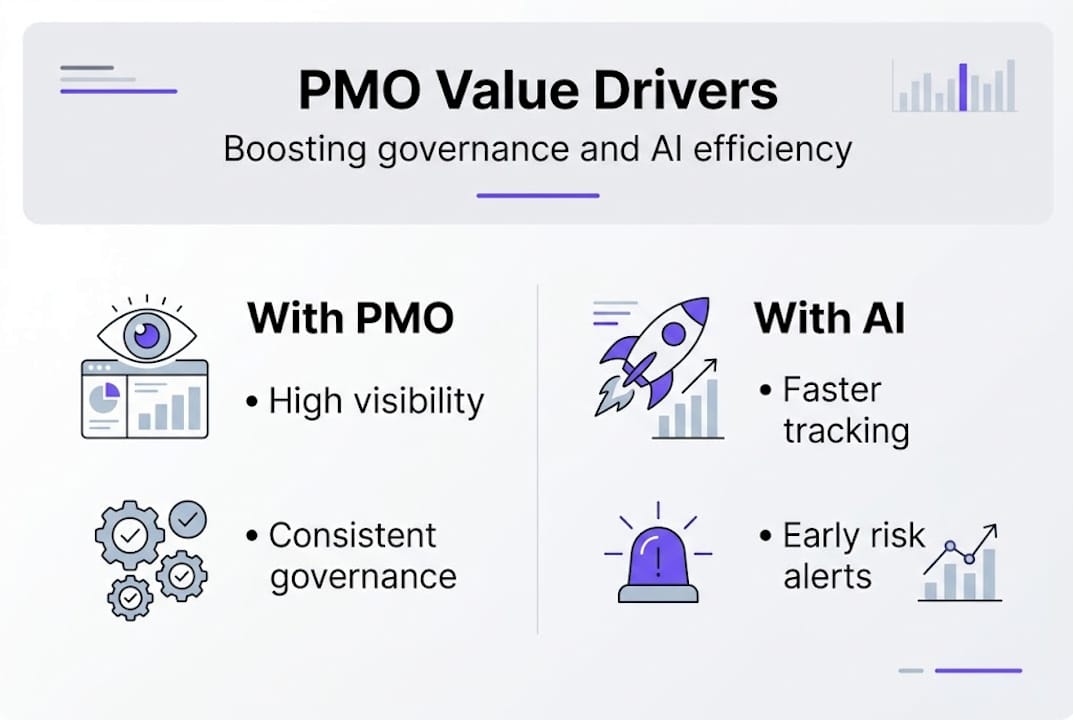
- Portfolio-wide reporting gives executives reliable, real-time visibility.
- Risk aggregation allows proactive decisions before issues escalate.
- Resource optimisation ensures capacity is allocated strategically, not reactively.
Effective PMOs integrate with PMIS to enhance project manager performance. Organisations without this integration are operating with a significant blind spot.
| Outcome | With PMO | Without PMO |
|---|---|---|
| Portfolio visibility | High | Low |
| Governance consistency | Structured | Ad hoc |
| Executive reporting | Routine | Reactive |
| Risk management | Proactive | Reactive |
| Project success rate | Improved | Variable |
Exploring AI project tracking strategies reveals how technology is now accelerating these gains considerably.
The PMO features that drive the most value tend to be those that reduce manual reporting, surface risks earlier, and give decision-makers confidence in their data.
Pro Tip: Build executive buy-in before your PMO is operational, not after. Stakeholders who understand the strategic purpose of a PMO from the outset are far more likely to champion it when it faces internal resistance.
Common reasons PMOs fail and how to avoid them
While the case for PMOs is compelling, it is equally important to acknowledge why many PMOs fall short and what can be learned from these failures.
Statistic to note: 50 to 60% of PMOs fail within the first three years. The cause is rarely a lack of process. It is almost always a failure of strategy, buy-in, or perceived value.
The most common reasons PMOs fail include:
- Unclear purpose: The PMO was established without a defined mandate or measurable objectives.
- Lack of executive sponsorship: Without senior support, the PMO cannot enforce governance or influence decisions.
- Over-bureaucracy: PMOs that prioritise documentation over delivery quickly lose credibility with project managers and stakeholders.
- Tactical focus only: A PMO that only tracks status updates adds little strategic value.
- Poor communication: Teams do not understand what the PMO does or why it exists.
Avoiding these pitfalls requires a deliberate approach. Here is a practical sequence to follow:
- Define a clear mandate with measurable success criteria before launch.
- Secure a senior executive sponsor who will actively advocate for the PMO.
- Focus your first 90 days on visible, high-impact wins rather than policy creation.
- Build relationships with project managers by solving their problems, not adding to them.
- Report outcomes in business language, not project management jargon.
- Continuously review whether your PMO activities add genuine value.
"A PMO without business acumen and executive buy-in is just administration with a budget."
Addressing project delivery challenges early in the PMO lifecycle is critical, as is understanding managing project requirements for AI environments where delivery speed and clarity are non-negotiable.
Pro Tip: Start with one or two projects where you can demonstrate measurable improvement. Early wins build the credibility that sustains a PMO long-term.
The future: AI-driven PMOs and the innovation edge
Understanding traditional and contemporary PMO challenges leads naturally to the next evolution: integrating AI for even greater impact.
AI is not replacing PMOs. It is making them far more powerful. Where traditional PMOs rely on manual reporting cycles and retrospective analysis, AI-driven PMOs operate in real time, surfacing insights before problems become costly.
Effective PMOs integrate with PMIS to enhance performance, and AI takes this integration several steps further by automating intelligence rather than just collecting data.
Here is what AI brings to the modern PMO:
- Automated status reporting: AI generates portfolio updates from live project data, eliminating manual compilation.
- Predictive risk analysis: Machine learning models identify patterns that signal delivery risk weeks in advance.
- Intelligent resource allocation: AI recommends where capacity should be directed based on project priority and progress.
- Natural language summaries: Executives receive clear, plain-language briefings without requiring deep project knowledge.
- Continuous portfolio monitoring: No more waiting for weekly updates. AI tracks progress around the clock.
- Faster decision support: Data is surfaced contextually, giving decision-makers what they need when they need it.
For competitive organisations, investing in AI project tracking is no longer optional. Organisations that rely on static spreadsheets and manual governance processes will struggle to match the speed and confidence of those running AI-enabled PMOs.
The shift is also cultural. AI reduces the administrative burden on PMO teams, freeing them to focus on strategic influence, stakeholder engagement, and continuous improvement. This is precisely where a PMO adds its greatest long-term value.
A realistic perspective: Why PMO success is about influence, not bureaucracy
Taking these insights, let us cut through the noise and look honestly at what makes a PMO resilient and valued in the real world.
The conventional thinking around PMOs is that more oversight and more documentation equals more control. In practice, this approach destroys trust and drives resistance. The PMOs we see succeed consistently are those that have made a deliberate choice to be enablers, not enforcers.
Real impact comes from empowering project managers with better tools, clearer frameworks, and faster access to the information they need. It comes from translating project performance into business outcomes that executives actually care about. And it comes from building a PMO that people turn to voluntarily because it makes their work easier, not harder.
AI accelerates this shift. When a PMO can deliver predictive insights, automate routine reporting, and surface risks without chasing project managers for updates, it earns genuine respect. Explore PMO in practice to see how this plays out across different sectors and organisational structures.
How Pocket PMO can power your next step
If you are ready to apply what you have learned, here is how you can leverage a fully operational PMO for your organisation without building one from scratch.
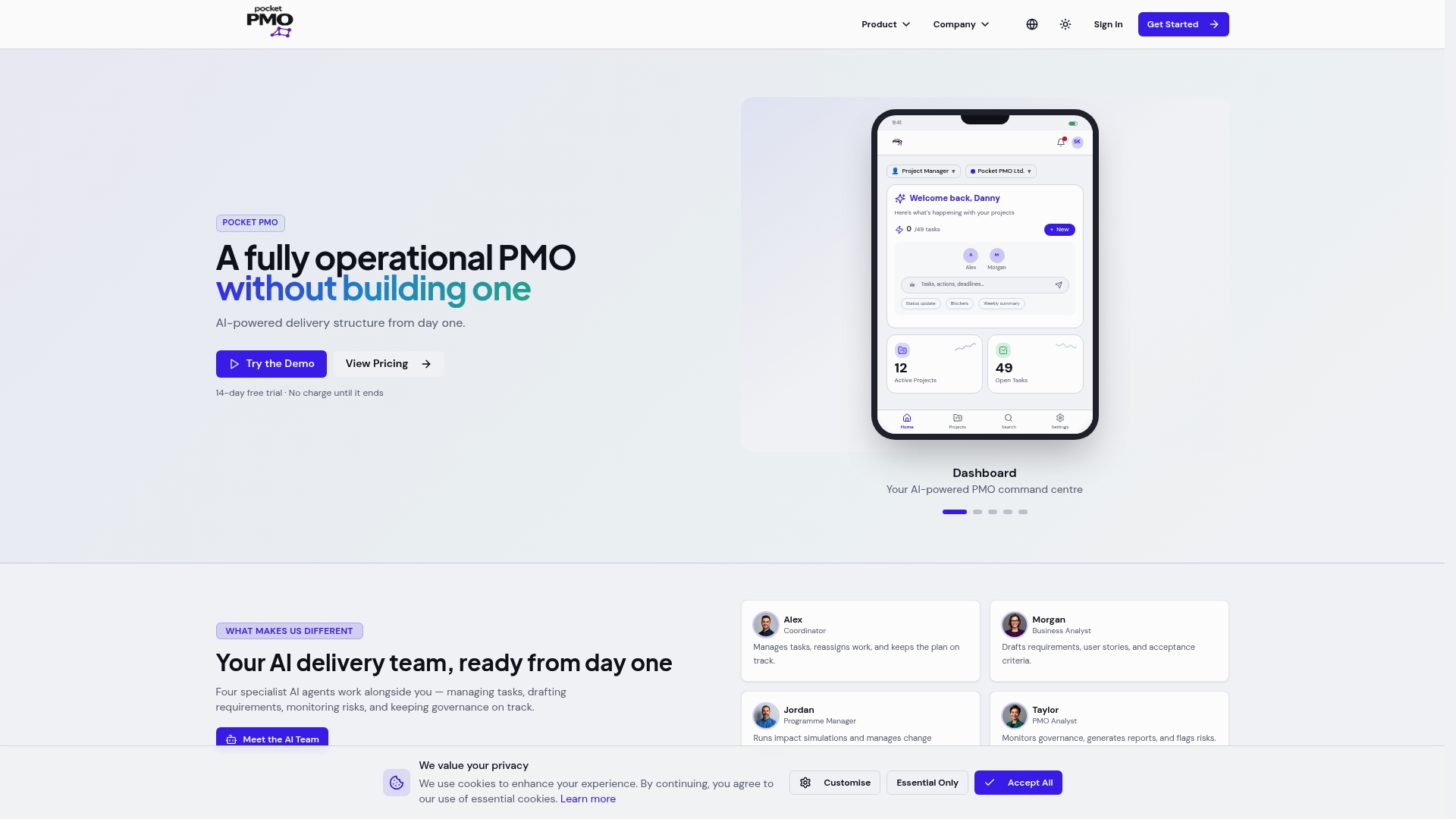
Pocket PMO gives you an AI-powered PMO from day one. You get real-time dashboards, predictive risk analysis, intelligent automation, and portfolio-wide visibility without the overhead of building and staffing a traditional PMO function. Whether you are managing a complex multi-project environment or scaling delivery across your enterprise, Pocket PMO adapts to your workflows immediately. Explore PMO solution features to see exactly what is available, or go straight to PMO implementation to get started with a solution that is operational from the moment you log in.
Frequently asked questions
What are the tangible benefits of a PMO for medium or large organisations?
A PMO delivers centralised governance, standard processes, and improved portfolio visibility. Effective PMOs integrate with PMIS to enhance project manager performance and produce consistently better delivery outcomes across the organisation.
Why do so many PMOs fail within the first three years?
50 to 60% of PMOs fail due to a lack of strategic alignment, limited executive support, and being perceived as bureaucratic rather than value-driven.
Is a PMO necessary if we already employ skilled project managers?
Yes. PMOs are essential beyond individual project managers for portfolio alignment, providing governance and structural consistency that individual managers cannot reliably maintain across multiple concurrent projects.
How is AI making PMOs more effective?
AI empowers PMOs with faster reporting, predictive analytics, and improved decision-making. PMIS integration enhances performance across the portfolio, and AI takes this further by enabling proactive, real-time project governance at scale.