

Most executives assume that deploying an AI project management tool is enough to unlock strategic value. It rarely is. The real driver of organisational benefit is the programme manager, whose role translates high-level business objectives into coordinated, measurable delivery. A programme manager oversees a group of related projects aligned to strategic goals, ensuring cohesive outcomes across workstreams. Without that human governance layer, even the most capable AI platform risks becoming an expensive reporting engine with no strategic direction behind it.
Table of Contents
- What is a programme manager: role and responsibilities
- AI in programme management: capabilities and limitations
- Selecting and measuring the ROI of AI-driven programme management tools
- Case studies: real-world AI-driven programme management success and caveats
- AI is only as effective as your programme management model
- How Pocket PMO delivers executive-ready AI-enabled programme management
- Frequently asked questions
Key Takeaways
| Point | Details |
|---|---|
| Programme manager role | Strategic oversight and governance across multiple projects transforms AI tool value into real business impact. |
| AI capabilities and limits | AI tools automate data handling and reporting but require robust programme models and sufficient data to deliver predictive value. |
| Measuring ROI | Success depends on tracking KPIs tied to executive strategic outcomes, including time savings, error reduction, and team productivity. |
| Case study results | Reported benefits like admin time savings and better data quality are context-specific and should be treated as benchmarks, not guarantees. |
| Critical success factor | AI effectiveness hinges on strong programme management discipline; tool selection should align with real organisational workflows. |
What is a programme manager: role and responsibilities
Now that we've set the context, let's look more closely at what defines the programme manager and why their role is strategically important.
A programme manager is not simply a senior project manager. They operate at the intersection of strategy and execution, accountable for ensuring that a collection of related projects, called a programme, actually delivers the business benefits your organisation intended. Where a project manager focuses on a single delivery with defined scope and timeline, a programme manager coordinates across multiple workstreams, managing dependencies, resolving conflicts, and maintaining alignment with shifting strategic priorities.
"A programme manager oversees a group of related projects aligned to strategic business objectives, ensuring cohesive delivery of outcomes and benefits across workstreams." — PRINCE2
The distinction between a programme manager and a PMO manager matters too. A PMO manager governs process standards and tooling across the organisation. A programme manager holds accountability for a specific set of outcomes. Both roles are essential, but they serve different purposes. Understanding how a PMO's operational strategy feeds into programme delivery helps executives avoid role confusion that often dilutes accountability.
Core responsibilities of a programme manager include:
- Governance design: Establishing roles, decision-making authority, escalation paths, and reporting structures across all constituent projects
- Risk and issue management: Identifying cross-project risks that individual project managers cannot see from their vantage point
- Stakeholder alignment: Maintaining executive and board-level confidence through consistent, credible communication
- Benefits management: Tracking whether delivered outputs are actually producing the intended organisational benefits
- Dependency management: Ensuring sequencing and resource constraints across projects do not derail overall programme outcomes
Programme managers are responsible for establishing programme governance, managing risks, and providing leadership reporting and monitoring. Without this layer, AI tools report on activity but cannot ensure that activity translates into strategic value.
The programme manager is also central to PMO in change management, particularly when AI adoption itself is the change being managed. Introducing AI-driven tooling without a governance model almost always leads to inconsistent adoption and unreliable data.

AI in programme management: capabilities and limitations
With the programme manager's core responsibilities established, it's crucial to understand how AI tools integrate and where their limits lie.
AI is genuinely useful in programme management contexts. The most mature use cases today cluster around three capabilities: content generation, progress tracking, and predictive insights. Each offers real value, but each also carries important caveats that executives should understand before committing budget.
| AI capability | Current maturity | Typical benefit | Key limitation |
|---|---|---|---|
| Content generation | High | Draft status reports, meeting summaries | Requires human review for accuracy |
| Progress tracking | High | Automated data collection, dashboard updates | Dependent on clean, consistent input data |
| Predictive analytics | Moderate | Risk flagging, schedule forecasting | Requires 3+ months of organisational history |
| Resource optimisation | Low to moderate | Workload balancing suggestions | Limited by data completeness |
AI can enhance project management by automating and analysing large volumes of project data to support planning, workflow management, and progress tracking. The recommended measurement framework includes KPIs such as milestone achievement rates and productivity metrics, not just time saved on administrative tasks.
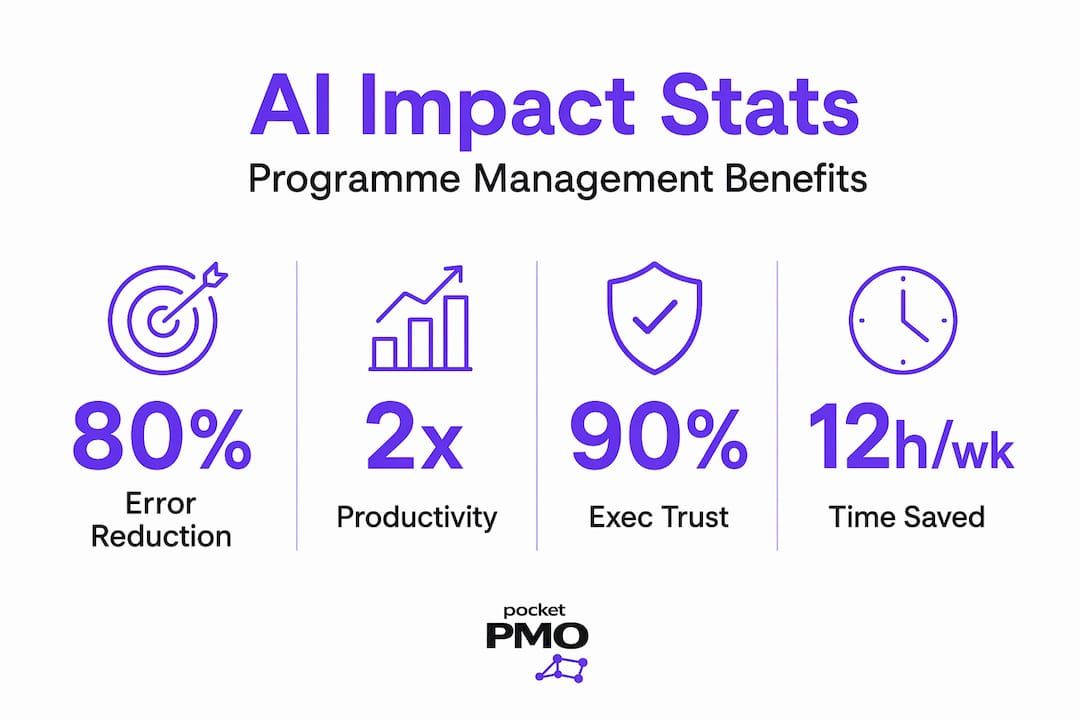
One of the most commonly overlooked limitations is data maturity. Predictive AI features need historical patterns to generate reliable forecasts. AI readiness in project management tooling is commonly skewed toward content generation and reactive assistance, while predictive capabilities are less prevalent and can require substantial organisational history. If your organisation is implementing AI tools for the first time, expect a minimum of three months before predictive features deliver meaningful accuracy.
Where AI adds clear value right now:
- Automating status report collection and standardisation
- Flagging anomalies in project data that humans might miss during busy periods
- Generating first-draft communications and documentation
- Aggregating cross-project data into executive dashboards in real time
Where manual workflow remains essential:
- Interpreting context around risk and making governance decisions
- Stakeholder relationship management and expectation setting
- Benefits realisation judgements that require business acumen
- Escalation decisions that carry political or strategic weight
Linking AI to AI and smart reporting practices can help bridge the gap between raw data and meaningful executive narrative. The platform layer matters, but so does the process design around it.
Pro Tip: Prioritise AI tools that align with your organisation's execution model and data maturity, not the tools with the most impressive AI marketing claims. Ask vendors specifically how their predictive features perform in the first 90 days of deployment, before historical data accumulates.
Selecting and measuring the ROI of AI-driven programme management tools
Understanding tool capabilities is important, but selecting and measuring impact is where executive decisions become crucial.
Choosing the right AI-driven programme management tool requires more than a feature comparison. You need a structured framework that ties tool selection to measurable business outcomes. ROI in this context is not just about licence cost versus time saved. It spans four categories that matter at board level.
- Direct time savings: Quantify hours reclaimed from manual reporting, data collection, and status chasing. Apply a fully loaded day rate to generate a financial figure.
- Error reduction: Measure the frequency of inaccurate status reports, missed risks, or miscommunicated priorities before and after implementation. Errors carry both financial and reputational costs.
- Productivity multipliers: Assess whether programme managers and project teams are spending more time on high-value work as a result of automation handling routine tasks.
- Opportunity cost recovery: Calculate the value of decisions made faster and with greater confidence. Delayed decisions in complex programmes frequently carry significant financial consequences.
Programme manager AI value measurement should focus on business-relevant ROI categories including direct time savings, error reduction, productivity multipliers, and opportunity cost recovery. This four-part framework gives you a credible basis for presenting investment cases to finance or the board.
When evaluating specific tools, use the following comparison approach:
| Evaluation criterion | What to assess | Red flags |
|---|---|---|
| Data integration | Can it connect to your existing systems? | Requires full data migration to start |
| AI transparency | Does it explain how predictions are made? | Black-box outputs with no rationale |
| Governance support | Does it model your programme governance structure? | Forces a rigid, tool-centric workflow |
| Reporting quality | Can executives consume outputs without training? | Requires technical expertise to interpret |
| Vendor benchmarks | Are claims verified or case-study only? | No KPI methodology provided |
Case studies report claimed improvements such as reductions in data quality errors and increased executive trust in status reporting, though it is worth noting these are vendor-reported results and should be benchmarked against your own context before being used in business cases.
Strong PMO governance and AI efficiency practices are the foundation that allows tool ROI to materialise. Governance gaps will erode the value of even the most capable AI platform. Before selecting a tool, map your current governance model and identify where AI automation will genuinely reinforce, rather than bypass, your controls.
Pro Tip: Look for measurable KPIs tied to strategic outcomes, not just process speed. A tool that saves two hours per week on reporting is useful. A tool that increases on-time milestone achievement by 15% is transformational. Ask vendors to show you which metric they optimise for. The answer tells you a great deal about how to streamline PMO decisions with genuine strategic intent.
Case studies: real-world AI-driven programme management success and caveats
To reinforce the frameworks and selection advice above, let's examine what real organisations have achieved and the nuances executives need to consider.
Real-world evidence of AI impact in programme management is building steadily, but it requires careful interpretation. Two cases are particularly instructive for executives assessing where genuine value lies.
DeepSense: 90% reduction in administrative time
Evidence suggests some AI-based PMO approaches can automate status and reporting collection and standardisation, with claimed large reductions in admin time and improvements in data quality. The DeepSense case centred on automating the collection of real-time project status information, which previously consumed significant programme manager and team time each week.
"Saving 90% of time on project status tracking freed the programme team to focus on risk management and stakeholder engagement rather than chasing updates."
The critical insight here is what that recovered time was redirected toward. The 90% figure is striking, but it only creates strategic value if the programme team reinvests that capacity in governance, risk identification, and benefits realisation work. Time savings that disappear into an expanded meeting schedule do not improve outcomes.
MindStudio: 80% reduction in data quality errors
MindStudio's PMO data management case study claims data quality errors dropped by 80% within six weeks of implementation. Additionally, status report accuracy improved from 73% to 96%, and the organisation reclaimed an estimated 3,200 hours annually. Earlier risk detection was also reported as a direct benefit of cleaner, more consistent data flowing into programme dashboards.
Key points from both case studies that executives should weigh:
- Context dependence: Results reflect specific organisational conditions, data maturity levels, and programme complexity. Your mileage will vary, and expecting identical outcomes without benchmarking is unrealistic.
- Data history requirements: Both implementations benefited from existing project data that AI models could learn from. Organisations starting from scratch should plan for a ramp-up period.
- Vendor-reported figures: Neither set of results is independently audited. Use them as directional evidence, not guaranteed benchmarks.
- What these results mean for decision-makers: The consistent theme across both cases is that AI performs best when it automates data collection and standardisation, freeing human programme managers to exercise judgement on the insights generated.
Achieving operational efficiency in PMO environments requires precisely this combination: reliable data automation underpinned by strong programme governance. Neither element alone produces the results executives are looking for.
AI is only as effective as your programme management model
There is a harder truth that does not feature prominently in most AI vendor conversations: the quality of your programme management model determines how much value any AI tool can generate. This is not a comfortable message for organisations that have rushed to deploy AI platforms in the hope of transforming project outcomes overnight.
AI features in PM tools are often convenience capabilities, such as summaries or draft outputs, that save small amounts of time and do not remove the underlying manual operational work. The underlying PM data model and workflow fit matter more than whether AI exists at all.
Think about what this means in practice. If your programme governance is unclear, if accountability for benefits realisation is diffuse, and if status reporting is inconsistently completed, then AI automation will efficiently produce unreliable outputs faster than before. Garbage in, garbage out has never been more relevant than in AI-driven programme management contexts.
The organisations that extract the most from AI tools are those that invest in programme management discipline first. They define governance structures, establish clear data standards, and assign accountable programme managers before they select a platform. AI then becomes a multiplier on an already-functioning operating model rather than a substitute for one that doesn't exist.
Selecting tools that align with your best PMO models for AI adoption is the highest-return decision you can make at the executive level. The platform question is secondary to the governance question. Get the governance right, and almost any well-designed AI tool will deliver value. Get it wrong, and even the most sophisticated platform will disappoint.
Our perspective, drawn from working with programme delivery teams across multiple sectors, is that executives consistently overestimate what AI can fix and underestimate what strong programme management enables. The opportunity is real, but it belongs to organisations that treat AI as an enhancement to disciplined delivery, not a replacement for it.
How Pocket PMO delivers executive-ready AI-enabled programme management
For leaders ready to move from insight to action, here is a practical path forward with solutions designed to support executive needs from day one.
Pocket PMO is built specifically for the reality this article describes: AI works best when it operates within a strong programme management model. The platform delivers real-time dashboards, intelligent automation, AI-driven risk analysis, and portfolio management without requiring you to build a PMO function from scratch.
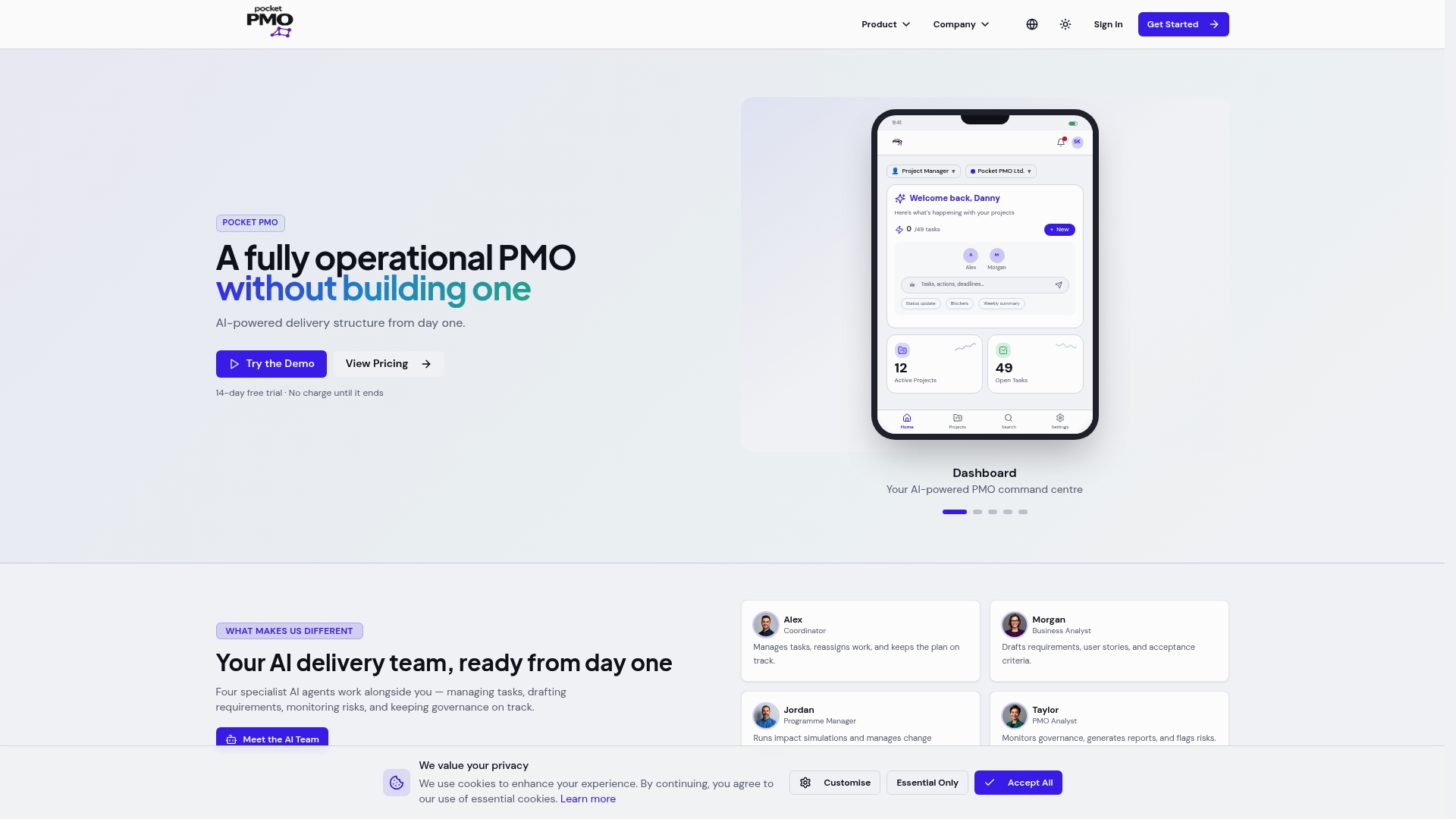
If you are evaluating how Pocket PMO compares to other AI-enabled project management platforms, the Pocket PMO vs Monday.com comparison gives you a direct, feature-level view of where the differences matter for executive oversight and governance. For organisations ready to act, the Pocket PMO launch page outlines how quickly you can get a dedicated AI-powered delivery team operational, tracking tasks, managing risks, and generating executive-ready reporting from the outset.
Frequently asked questions
How does a programme manager differ from a project manager?
A programme manager oversees multiple related projects aligned to business strategy, managing coordination, governance, and benefits across them, while a project manager handles delivery of one specific project. As defined by PRINCE2, the programme manager role ensures cohesive outcomes across workstreams rather than a single deliverable.
What KPIs should executives track to assess AI impact in programme management?
Key KPIs include milestone achievement rates, productivity metrics, error reduction, and reclaimed time, ideally measured against strategic business outcomes. IBM recommends organisations measure AI impact through planning quality and progress tracking improvements, not just time saved on routine tasks.
How reliable are AI-driven predictions in project management without historical data?
Predictive AI features are less reliable for organisations lacking sufficient historic project data, and accuracy typically improves after several months of consistent data capture. AI readiness research confirms that predictive capabilities require substantial organisational history to function at a useful level of confidence.
Can AI in PMO tools replace manual operational work completely?
Most AI features currently provide convenience value and automate routine tasks but do not eliminate all manual operational requirements. Research consistently shows that the underlying PM data model and workflow fit matter more than AI feature availability alone.