

A PMO with formal governance, dedicated staff, and a portfolio of tools is not automatically efficient. Many mature project management offices still struggle with duplicated reporting, unclear accountability, and decision bottlenecks that quietly erode value across the portfolio. Operational efficiency is something you design deliberately, measure rigorously, and improve continuously. This guide gives you a clear definition, proven methods, and practical steps to build a PMO that genuinely delivers more with less waste.
Table of Contents
- Defining operational efficiency in the PMO context
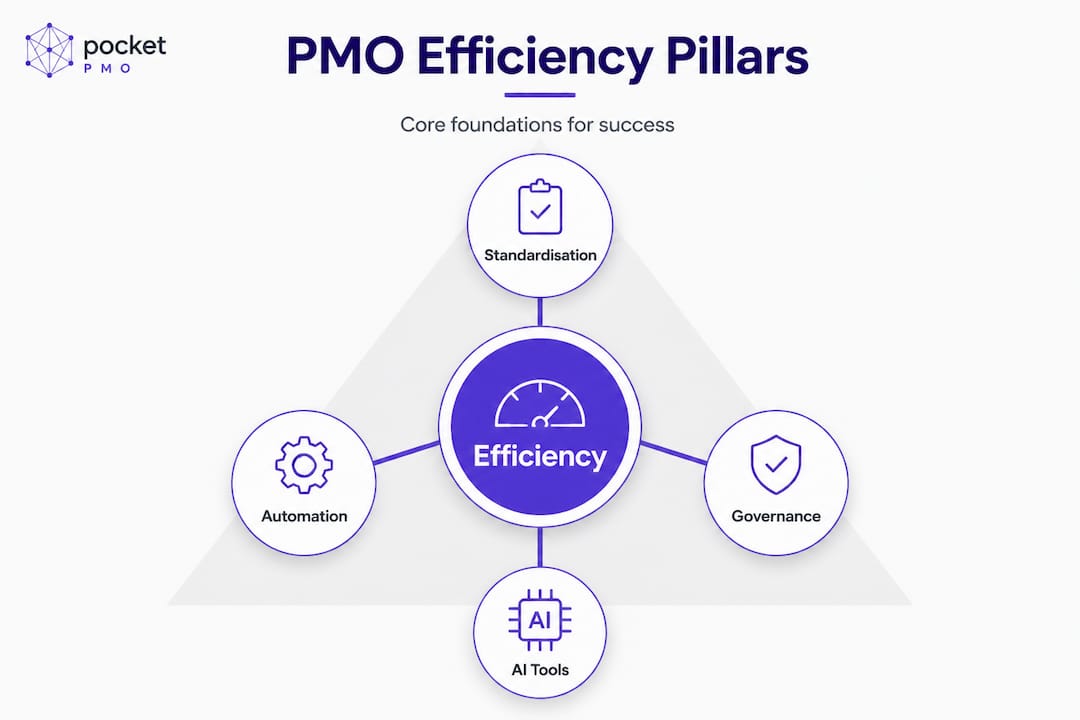
- Core pillars of operational efficiency in PMO
- The impact of AI and advanced tools in PMO operations
- How to measure and sustain operational efficiency
- Why most PMOs misunderstand operational efficiency
- Ready to raise your PMO's operational efficiency?
- Frequently asked questions
Key Takeaways
| Point | Details |
|---|---|
| Efficiency goes beyond speed | True operational efficiency means maximising value and reducing waste, not just faster work. |
| Key pillars drive results | Standardisation, automation, governance, and real-time tools form the backbone of an efficient PMO. |
| AI amplifies impact | AI-powered tools automate routine tasks and enhance decision-making for strategic gains. |
| Measurement is vital | Track metrics like cycle time and value delivered to sustainably improve PMO performance. |
| Mindset beats compliance | Value-focused leadership leads to greater efficiency than rigid process adherence. |
Defining operational efficiency in the PMO context
Operational efficiency in a PMO is not simply about doing things faster. It means maximising the value your office delivers relative to the time, effort, and resources it consumes. Speed matters, but so do quality, adaptability, and alignment between project outputs and organisational goals. A PMO that rushes outputs without quality controls is not efficient. It is just fast and unreliable.
The distinction is important because many PMOs mistake activity for value. Teams produce reports nobody reads, run status meetings that rehash last week's data, and maintain governance processes that satisfy auditors without improving delivery. This is operational drag, and it costs organisations dearly in both time and morale.
Understanding the operational strategy in PMO helps clarify what your office should actually be optimising for. Common inefficiencies include:
- Duplicated effort: Multiple teams tracking the same data in different formats
- Unclear reporting lines: Stakeholders unsure who owns decisions or escalations
- Manual bottlenecks: Status updates that require hours of manual collation each week
- Governance theatre: Approval processes that add delay without adding scrutiny
- Fragmented tooling: Data spread across spreadsheets, emails, and disconnected platforms
"A truly operationally efficient PMO uses clarity, consistency, and technology to enhance oversight — not to create more layers of process."
PMO best practices identify the key methodologies that address these failure points: standardising processes, automating repetitive tasks, implementing governance frameworks, resource levelling, and deploying tools that provide real-time visibility. These are not isolated fixes. They form a coherent system that, when applied together, transforms how a PMO operates and is perceived across the organisation.
Core pillars of operational efficiency in PMO
With a clear definition in place, explore the foundations that underpin operational efficiency for a modern PMO. There are five pillars that consistently separate high-performing offices from those that simply look the part.
| Pillar | What it means in practice | Example |
|---|---|---|
| Process standardisation | Consistent templates, workflows, and reporting formats | Single project initiation template across all portfolios |
| Automation | Technology executing repeatable tasks without manual input | Auto-generated weekly status reports |
| Governance frameworks | Clear rules for decisions, escalations, and change requests | Tiered approval authority based on risk level |
| Resource management | Matching capacity to demand across the portfolio | Resource levelling during peak delivery periods |
| Real-time visibility | Live dashboards surfacing portfolio health at a glance | RAG status updated automatically from project data |
Standardising processes and automating repetitive tasks are widely recognised as core methodologies for PMO efficiency. But the order matters. You must standardise before you automate. Automating a broken process simply produces the wrong output faster.
Here is how to build each pillar in sequence:
- Audit current processes. Map every recurring task your PMO performs and categorise by frequency, effort, and value delivered.
- Standardise first. Create consistent templates and workflows for the highest-frequency activities. Involve delivery teams so adoption is realistic.
- Identify automation candidates. Look for tasks that are rule-based, repetitive, and low-judgement. Reporting, scheduling reminders, and RAID log updates are strong starting points.
- Implement governance with purpose. Build PMO governance decision making frameworks that accelerate rather than impede delivery. Every approval gate should have a clear owner, criteria, and turnaround time.
- Introduce real-time tooling. Replace manual reporting cycles with platforms that surface live portfolio data. This removes the weekly collation burden and improves decision quality.
Good PMO governance and AI integration is increasingly central to this model. AI does not replace governance. It enforces it consistently, flags exceptions early, and reduces the cognitive load on your team.
Pro Tip: Never automate an ineffective process. If a workflow is unclear, inconsistent, or poorly designed, automation will embed those flaws at scale. Always optimise for value before you automate for speed.
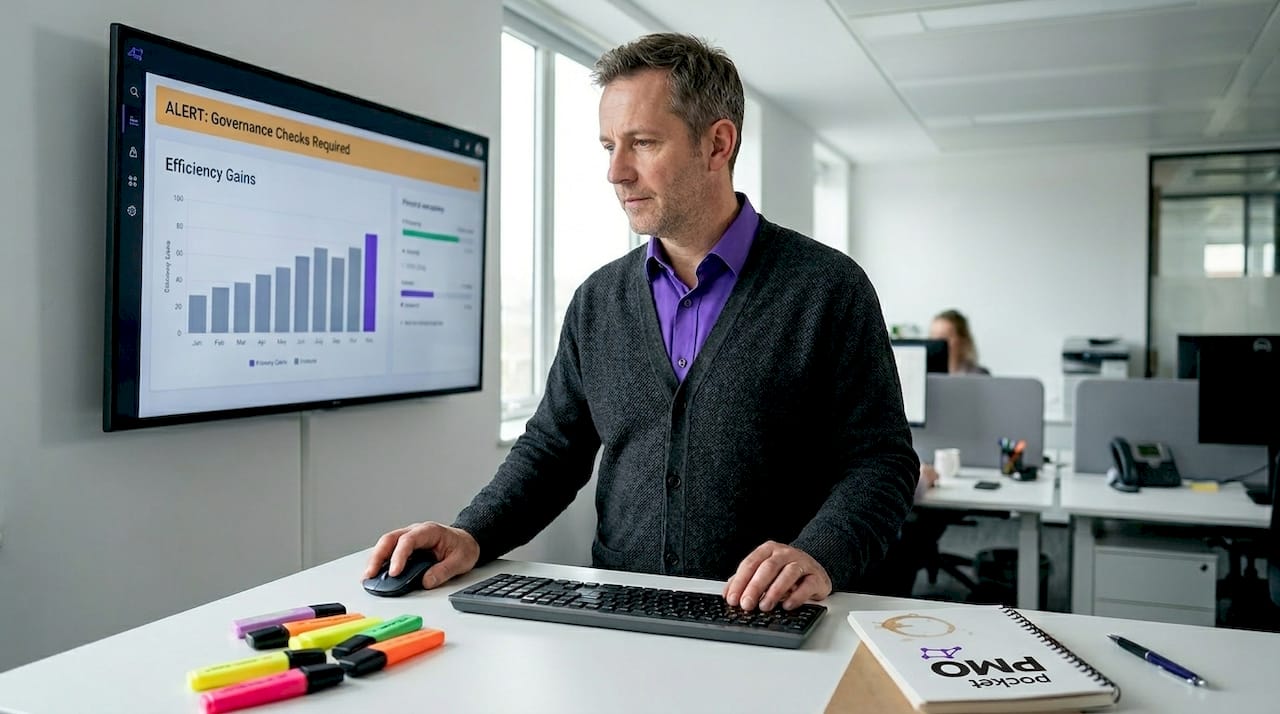
Reviewing AI in PMO best practices gives you a strong foundation for understanding where AI supports each pillar and how to sequence its introduction into your existing environment.
The impact of AI and advanced tools in PMO operations
With foundational pillars clarified, examine how AI and technology accelerate those efficiencies and deliver tangible returns. The shift from traditional PMO operations to AI-enhanced management is not incremental. It is structural.
Traditional PMOs rely heavily on manual data collection, periodic reporting cycles, and reactive risk management. An AI-enhanced PMO operates differently at every layer. Consider this comparison:
| Capability | Traditional PMO | AI-enhanced PMO |
|---|---|---|
| Status reporting | Weekly manual collation | Real-time automated updates |
| Risk identification | Periodic review meetings | Continuous AI-driven scanning |
| Resource forecasting | Spreadsheet modelling | Predictive demand analytics |
| Escalation management | Ad hoc, often delayed | Rules-based, instant alerts |
| Portfolio visibility | Static snapshots | Live dashboard with drill-down |
| Decision support | Experience and intuition | Data-backed recommendations |
Real-time visibility tools are not a luxury feature for large organisations. They are central to how efficient PMOs operate, regardless of size. When your team can see portfolio health in real time, they stop spending hours preparing reports and start spending time on decisions that move projects forward.
The benefits extend beyond speed. Real-time project reporting reduces the risk of decisions being made on stale data, which is one of the most common causes of late-stage project failures. When a risk surfaces on a Monday, your governance response should not wait until the Friday status meeting.
Effective project status reporting also strengthens stakeholder confidence. Executives who can access an accurate, current view of portfolio performance are less likely to request ad hoc updates, freeing your team from reactive communication loops.
When evaluating platforms, comparing capabilities side by side helps. The Pocket PMO vs Microsoft Project comparison is a useful reference if you are currently using traditional tooling and considering the move to an AI-native environment.
Pro Tip: Start with pilot automation on a single, well-defined process. Measure cycle time before and after, quantify the hours saved, and use that evidence to build the case for broader rollout. Scaling up on proven outcomes is far less risky than large-scale deployment without a baseline.
How to measure and sustain operational efficiency
Beyond introducing tools and practices, project leaders must measure and continually improve their PMO's operational efficiency. Without clear metrics, efficiency becomes a feeling rather than a fact.
Start by establishing a baseline. Before any improvement initiative, capture your current performance across four key dimensions:
- Cycle time: How long does it take to move a project from initiation to delivery? Measure at each phase gate, not just at completion.
- Value delivered: What percentage of projects deliver the outcomes specified at initiation? Track benefits realisation, not just on-time delivery.
- Error and rework rates: How often do deliverables require significant revision after handover? High rework rates signal process or quality failures upstream.
- User and stakeholder satisfaction: Survey both delivery teams and project sponsors. Low satisfaction from either group is an early warning of friction in your processes.
Once you have a baseline, run improvement cycles quarterly. Apply targeted changes, measure the delta, and adjust based on evidence. Real-time visibility tools make ongoing monitoring far less burdensome, because data collection is automated rather than manual.
Watch for these early warning signs of operational drag:
- Reporting cycles take more than two hours to produce. This signals excessive manual effort and likely data fragmentation.
- Stakeholders frequently request clarifications after reports are issued. This points to unclear communication or inconsistent formats.
- Projects consistently enter delivery phases with incomplete RAID logs. This indicates governance processes are being bypassed under time pressure.
- Team members duplicate effort across tools. A sign that your tooling ecosystem is fragmented and not integrated.
- Escalations frequently bypass formal channels. This suggests your governance framework lacks credibility or accessibility.
When you spot these signals, act quickly. The role of PMO in strategy depends on the office being trusted and valued. Operational drag undermines both.
"A one-time efficiency improvement is a project. Sustained operational efficiency is a capability. Build the capability, and the improvements compound over time."
For teams ready to move from measurement to action, exploring an operational PMO solution designed for continuous improvement gives you the infrastructure to make sustained efficiency a structural feature of your PMO rather than a periodic initiative.
Why most PMOs misunderstand operational efficiency
Here is the uncomfortable reality most articles will not say directly: many PMOs are efficient at the wrong things.
They are excellent at producing governance artefacts, maintaining audit trails, and running scheduled review meetings. Process compliance scores are high. Templates are consistent. Every change request goes through the proper channel. And yet projects still run late, stakeholders are still frustrated, and the PMO is still seen as an overhead rather than a value engine.
The trap is confusing process compliance with business impact. A PMO can tick every governance box and still deliver no meaningful improvement to project outcomes. We have seen organisations where the weekly status report took six hours to produce, was read by three people, and influenced zero decisions. That process was highly standardised, consistently executed, and completely inefficient in the truest sense of the word.
The mindset shift required is simple but difficult to sustain: efficiency is not about how well you follow process. It is about how much value you create per unit of effort invested. Every process in your PMO should be able to answer the question, "How does this help project delivery?" If it cannot, it deserves scrutiny.
Leaders who work on optimising PMO with AI often discover that AI does not just automate tasks. It forces a reckoning with which tasks were ever worth doing. When automation reveals that a particular report takes four hours to produce and is never acted upon, you have a clear decision to make.
The PMOs that genuinely lead on operational efficiency are those with a culture of ruthless prioritisation. They measure outcomes, not activity. They cut processes that produce no value, even if those processes have existed for years. And they use technology not to do more, but to do the right things better.
Pro Tip: Once a quarter, review your three most time-consuming PMO processes and ask your delivery team and stakeholders whether they add value. Cut at least one activity that fails the test. This practice builds a culture of continuous improvement without requiring a major transformation programme.
Ready to raise your PMO's operational efficiency?
Operational efficiency is not a destination you reach once. It is a discipline you build into the way your PMO works every day. The principles are clear: standardise, automate, govern with purpose, and measure what matters.
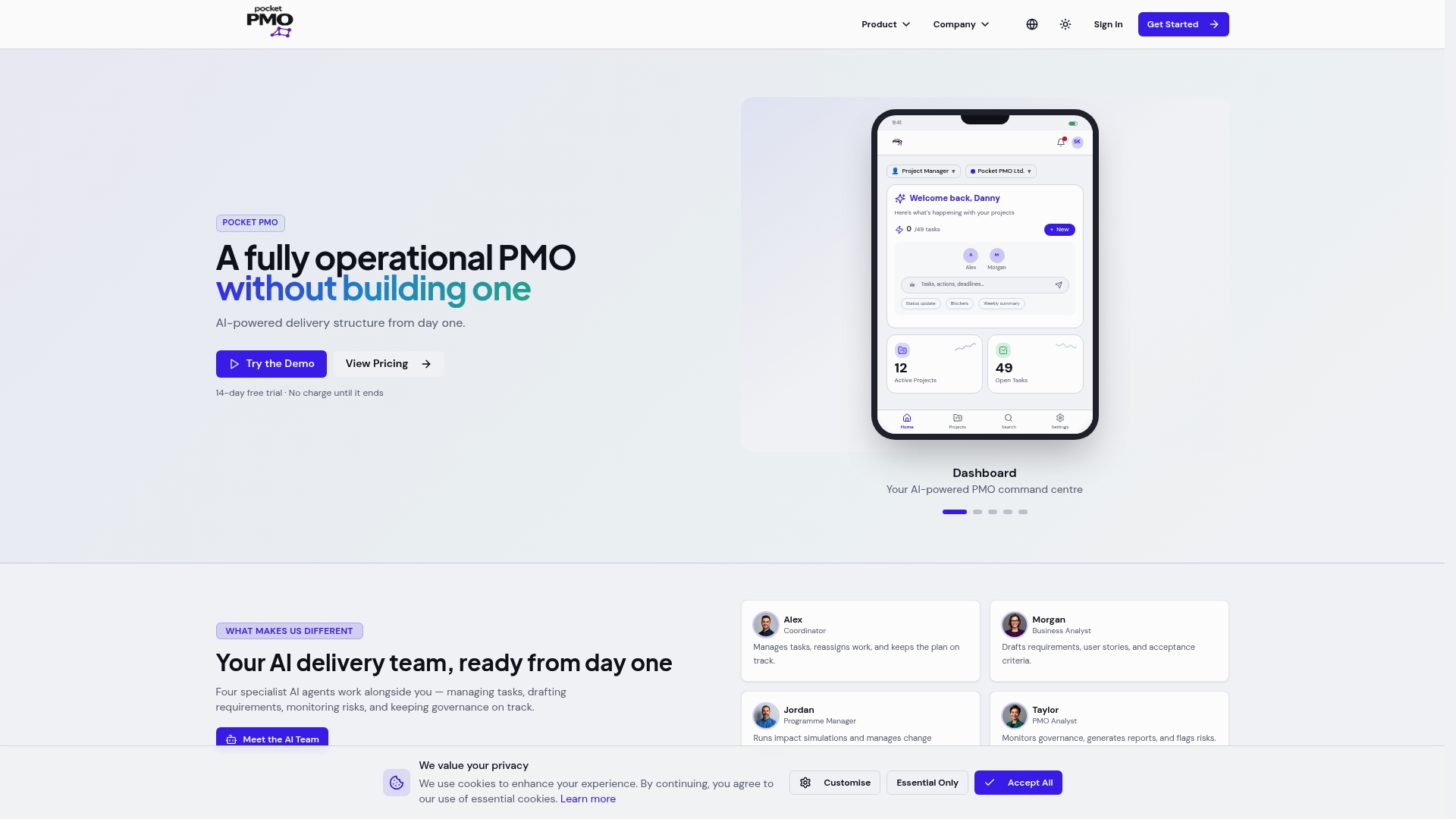
Pocket PMO gives you an AI-powered platform built specifically to make these principles operational from day one. With real-time dashboards, intelligent risk analysis, automated reporting, and a dedicated AI delivery team, you get the infrastructure of a high-performing PMO without the overhead of building one from scratch. Explore the full Pocket PMO solution to see how the platform maps to your current challenges. When you are ready to experience it in action, the AI team demo shows you exactly how AI-driven oversight works in practice. You can also review the complete Pocket PMO features list to assess fit with your portfolio environment.
Frequently asked questions
What are the most important KPIs for operational efficiency in a PMO?
Key KPIs include project cycle time, resource utilisation rate, stakeholder satisfaction scores, and the ratio of planned outcomes to delivered outcomes. Tracking these consistently gives you a clear picture of where your PMO is generating value and where effort is being lost.
How can AI enhance operational efficiency in a PMO?
AI automates routine tasks, enables predictive risk insights, and streamlines reporting workflows, freeing PMO leaders to focus on strategic priorities. Automating repetitive tasks and using real-time visibility tools are two of the most impactful applications available to modern PMOs.
What is the difference between standardisation and automation in a PMO?
Standardisation means creating consistent, agreed methods and templates across all projects, while automation uses technology to execute those methods with minimal human input. Standardising processes before automating ensures that technology reinforces good practice rather than embedding inefficiency at scale.
Can small organisations benefit from operational efficiency in a PMO?
Absolutely. Even small project teams see measurable value from streamlining reporting, adopting consistent templates, and introducing lightweight governance frameworks. The scale of the tooling should match the scale of the portfolio, but the underlying principles of efficiency apply universally.