
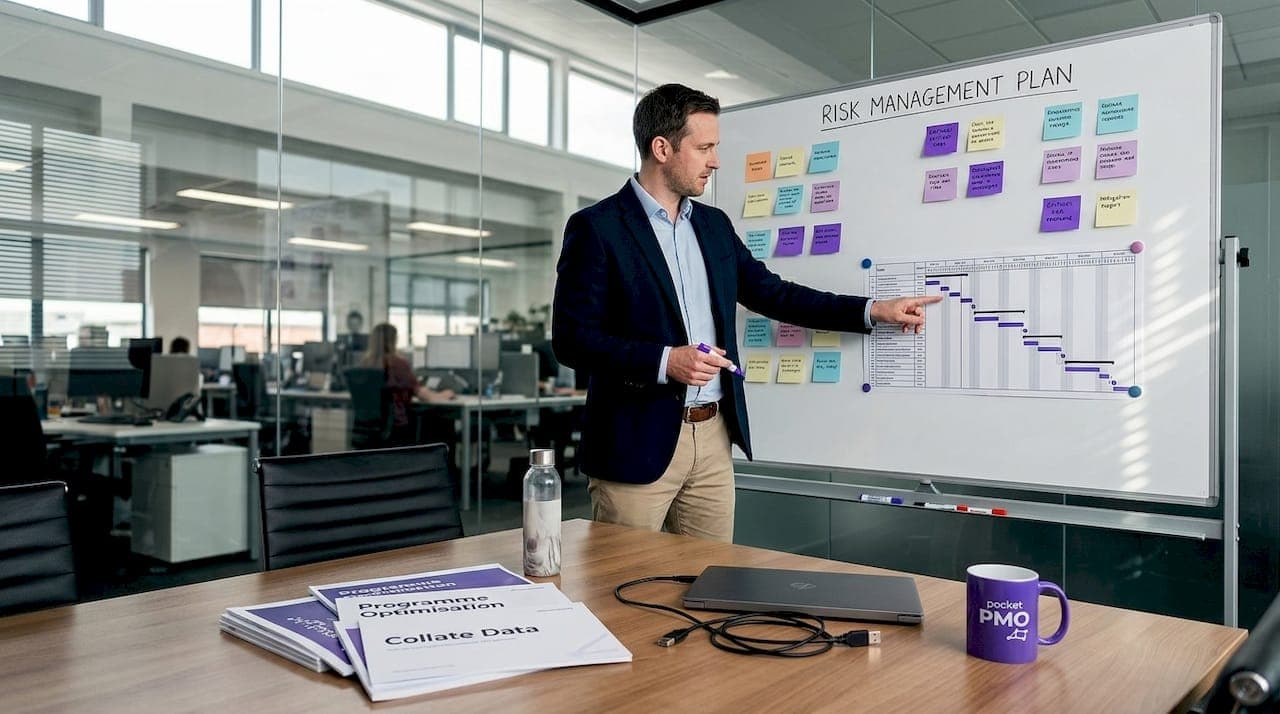
Only 31% of projects are delivered on time, within budget, and to scope. That figure should concern every project manager and PMO leader reading this. Yet despite decades of frameworks, templates, and training, risk management remains one of the most misunderstood disciplines in the profession. Teams either treat it as a compliance exercise or skip iterative reviews entirely, leaving projects exposed at the worst possible moments. This guide breaks down what risk management actually involves, compares the leading frameworks, and shows how AI-driven tools are fundamentally changing what good looks like.
Table of Contents
- Understanding risk management in projects
- Core methodologies and tools for managing risks
- Nuances and best practices in effective risk management
- Comparing PMBOK, ISO 31000, and COSO frameworks
- Why traditional risk management alone is not enough
- Accelerate your risk management with Pocket PMO
- Frequently asked questions
Key Takeaways
| Point | Details |
|---|---|
| Iterative risk analysis | Reviewing and updating risks throughout the project lifecycle leads to fewer surprises and better outcomes. |
| AI amplifies accuracy | AI-powered tools enable faster, more precise risk analysis and response for PMOs. |
| Framework integration | Combining PMBOK, ISO 31000, and COSO increases project resilience through strategic and tactical capabilities. |
| Business acumen boosts results | Teams with strong business acumen consistently outperform in risk mitigation and project success. |
Understanding risk management in projects
Risk management in a project context is not simply about listing things that might go wrong. It is a structured discipline designed to identify, analyse, respond to, and monitor uncertainties that could affect your project objectives. Done well, it protects scope, schedule, cost, and quality simultaneously.
A distinction worth making immediately: a risk is an uncertain event that has not yet occurred. An issue is a problem that has already materialised. Many PMs conflate the two, which leads to reactive firefighting rather than proactive planning. Your risk register and your issue log serve different purposes and should be managed separately.
PMBOK 8 defines six core processes for project risk management:
- Plan Risk Management — establishes the approach, tools, and responsibilities
- Identify Risks — captures all potential threats and opportunities
- Perform Qualitative Risk Analysis — prioritises risks by probability and impact
- Perform Quantitative Risk Analysis — models numerical impacts on objectives
- Plan Risk Responses — defines actions for each prioritised risk
- Implement and Monitor Risks — executes responses and tracks changes throughout the lifecycle
These processes are iterative, not linear. You revisit them as the project evolves, new risks emerge, and existing ones change in severity.
A solid risk management plan will document the following components:
- Methodology and tools to be used
- Risk categories and the Risk Breakdown Structure (RBS)
- Probability and impact scales, calibrated to your project
- Risk thresholds that trigger escalation
- Roles and responsibilities for risk ownership
- Timing of risk reviews and reporting cadence
"A risk management plan is not a risk register. The plan tells you how you will manage risk. The register captures the risks themselves."
Getting this distinction right is foundational. If you want to explore mastering risk management tips in practice, those fundamentals are the starting point.
| PMBOK 8 process | Primary output |
|---|---|
| Plan Risk Management | Risk management plan |
| Identify Risks | Risk register |
| Qualitative analysis | Prioritised risk list |
| Quantitative analysis | Numerical risk exposure |
| Plan Risk Responses | Risk response plan |
| Monitor Risks | Risk reports, updates |
Core methodologies and tools for managing risks
Understanding the processes is one thing. Knowing which tools to apply at each stage is what separates competent risk managers from exceptional ones. Let's walk through the key methodologies and how AI is now augmenting them.
Qualitative analysis tools:
The probability-impact matrix (often called the heat map) is the workhorse of qualitative analysis. You score each risk on both dimensions, multiply them together, and prioritise accordingly. Simple in theory, but the calibration of your scales matters enormously. A "high" probability on a research project is very different from a "high" probability on a construction project.

The Risk Breakdown Structure (RBS) helps you categorise risks hierarchically, similar to a Work Breakdown Structure. Core methodologies include technical, external, organisational, and project management categories at the top level, with sub-categories beneath. Clustering risks through the RBS reveals patterns you would otherwise miss — for example, a disproportionate number of risks sitting in the "dependencies" sub-category signals a structural planning problem.
Quantitative analysis tools:
Monte Carlo simulation models thousands of possible project outcomes based on ranges of cost and schedule estimates, giving you a probability distribution rather than a single-point forecast. Decision trees help you evaluate competing response options by mapping out the financial value of each path. These tools are optional for simpler projects but invaluable on complex, high-value programmes.
Response strategies for threats and opportunities are formally defined in PMBOK 8:
- Escalate — when the risk sits outside your authority
- Avoid (threat) / Exploit (opportunity) — eliminate the threat or guarantee the opportunity
- Transfer (threat) / Share (opportunity) — shift impact to a third party or partner
- Mitigate (threat) / Enhance (opportunity) — reduce probability or impact; increase them for opportunities
- Accept — consciously decide to deal with it if it occurs (active: contingency plan; passive: no action)
Pro Tip: Reserve analysis is often overlooked. Contingency reserves cover identified risks (known unknowns). Management reserves cover unidentified risks (unknown unknowns). Both belong in your budget from the outset, not as afterthoughts.
Now, the AI dimension. Only 31% of projects succeed across the board, and AI-driven tools can enhance Monte Carlo simulations, real-time risk registers, and predictive analytics to shift those odds meaningfully. Rather than running simulations manually in spreadsheets, AI platforms ingest live project data and continuously recalculate risk exposure as conditions change. That is a step-change in capability.
If you want to go deeper on methods, exploring AI insights for risk analysis covers the specific analytical approaches in detail. For broader delivery optimisation, AI project tracking strategies show how these tools connect across your portfolio.
| Tool | Type | Best used for |
|---|---|---|
| Probability-impact matrix | Qualitative | Prioritising risks quickly |
| Risk Breakdown Structure | Qualitative | Identifying risk patterns |
| Monte Carlo simulation | Quantitative | Complex cost/schedule modelling |
| Decision trees | Quantitative | Evaluating response options |
| AI risk registers | Augmented | Real-time tracking and prediction |
Nuances and best practices in effective risk management
With the core methods mapped, it is worth addressing the subtleties that distinguish top-performing PMOs from average ones. These are the details that rarely appear in training courses but frequently determine outcomes in the real world.
Calibrate your scales to your project, not a generic template. A probability of 70% might sit in the "high" band on a twelve-week digital project, but on a five-year infrastructure programme, your thresholds and appetite are entirely different. The same applies to impact scales. Financial impact of £50,000 is catastrophic for one project and negligible for another. Generic templates applied without calibration produce useless heat maps.
Treat risk analysis as iterative, not a one-off exercise. Risk analysis throughout the lifecycle should be revisited at every major milestone, phase gate, and change event. New risks emerge as the project progresses. Existing risks change in probability as work is completed. A risk register that is not updated is worse than no register at all, because it creates false confidence.
Understand the difference between active and passive acceptance. Passive acceptance means you note the risk and take no pre-emptive action, accepting consequences if it occurs. Active acceptance involves preparing a documented contingency response. Both are legitimate strategies, but the choice should be explicit and informed by the risk's severity and your available capacity.
Best practices worth building into your PMO standard:
- Assign a named risk owner for every item in the register (not just the PM)
- Set a review cadence that matches project pace (weekly for fast-moving projects; monthly for steady-state programmes)
- Use the RBS to run cluster analysis at regular intervals, identifying emerging risk themes
- Maintain a management reserve for unknown unknowns and govern its use at governance board level
- Document residual risk after responses, not just pre-response exposure
"The best risk managers are not the ones with the longest risk registers. They are the ones who know which risks actually matter and act on them before they become issues."
Business acumen is increasingly recognised as a critical differentiator. High-acumen PMs excel in risk mitigation at a rate of 62% and improve project success by 5 to 15% across key metrics. Understanding the commercial context of your project, the stakeholder landscape, and the organisational risk appetite is just as important as technical proficiency with risk tools.
Tracking risks for success consistently and connecting those insights to governance decisions is what PMO best practices are built around. The discipline only adds value when it informs decisions, not when it fills documentation requirements.
Pro Tip: Run a quarterly RBS cluster analysis across your portfolio. If 40% of open risks sit in the same sub-category across multiple projects, that is an organisational problem, not a project problem. It needs a strategic response, not more individual risk responses.
Comparing PMBOK, ISO 31000, and COSO frameworks
Most PMOs default to PMBOK because it is familiar and project-specific. But there are compelling reasons to look beyond it, and in many enterprise environments, a hybrid approach is not just beneficial — it is necessary.
Here is how the three dominant frameworks compare:
| Framework | Focus | Scope | Approach to risk |
|---|---|---|---|
| PMBOK 8 | Project execution | Project level | Process-driven, tactical |
| ISO 31000 | Strategic principles | Organisation-wide | Principle-based, neutral on risk type |
| COSO ERM | Governance and control | Enterprise level | Governance-focused, regulatory alignment |
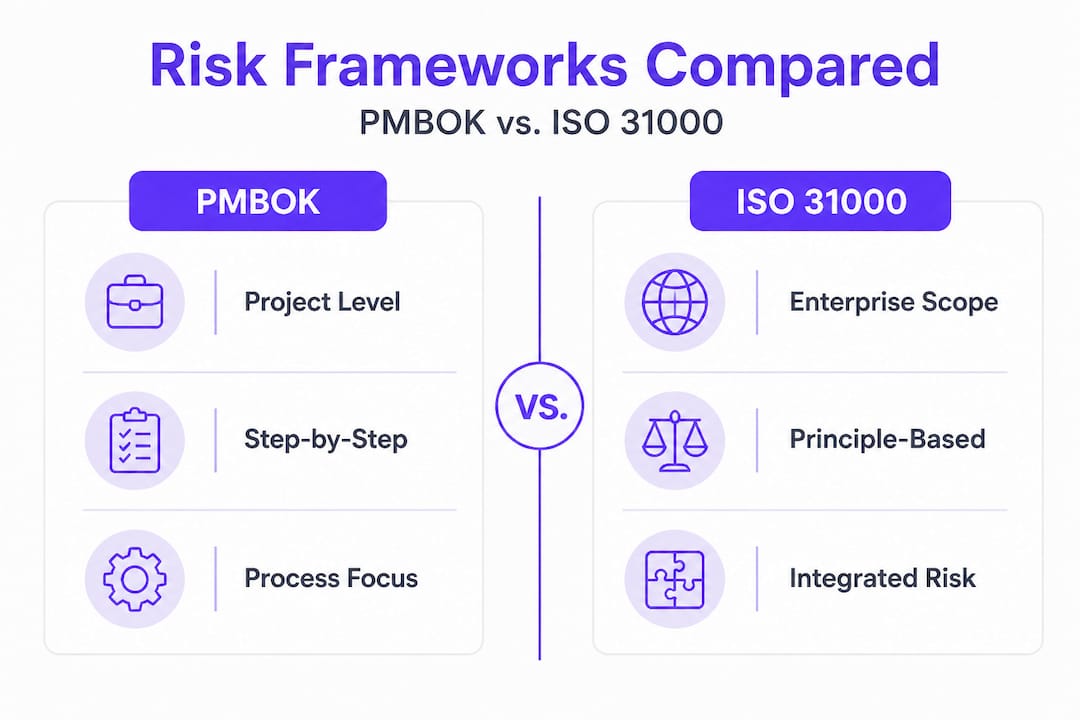
PMBOK is project-focused and execution-oriented, giving you precise processes and tools for managing risk at the delivery level. ISO 31000 takes a broader, principle-based view. Critically, it treats risk as neutral — encompassing both upside opportunities and downside threats — and applies across the entire organisation rather than a single project. COSO ERM focuses on governance, internal controls, and regulatory compliance, making it most relevant to finance-heavy or highly regulated environments.
A hybrid PMBOK and ISO 31000 approach is particularly effective. Use PMBOK's tactical processes for day-to-day risk identification, analysis, and response. Layer ISO 31000's strategic context to connect project risks to organisational risk appetite and enterprise-level priorities. This directly addresses PMBOK's main limitation, which is that its execution focus can disconnect project risk from the broader strategic picture.
In practice, hybrid adoption looks like this:
- Strategic context setting: ISO 31000 defines your organisation's risk appetite and tolerance thresholds before projects begin
- Tactical execution: PMBOK processes structure how individual project risks are identified, assessed, and responded to
- Governance alignment: COSO provides the reporting and control framework for escalation to board or executive level
- Portfolio coherence: Risk data from individual projects feeds upward into enterprise risk frameworks, enabling true portfolio-level visibility
For PMOs managing multiple projects simultaneously, PMO model comparisons show how different operating models align with these framework combinations. The key insight is that no single framework covers everything. The most effective PMOs treat frameworks as complementary toolsets, selecting the right elements for their context rather than rigidly adopting one approach wholesale.
Why traditional risk management alone is not enough
Here is an uncomfortable truth: most organisations have risk management processes on paper that bear little resemblance to what happens in practice. The risk register gets populated at project initiation, reviewed once at the next gate, and largely ignored thereafter. This is not a people problem. It is a process design problem.
Traditional risk management, even when competently applied, was designed for a world of slower-moving projects with more stable assumptions. Today's projects operate in conditions of genuine volatility. Vendor dependencies shift overnight. Regulatory environments change mid-delivery. Stakeholder priorities evolve as business strategies pivot. A static risk process cannot keep pace with that reality.
The check-box approach fails for a specific reason: it treats risk management as a compliance output rather than a decision-support function. When the risk register exists to satisfy a governance review rather than to genuinely inform the project manager's next decision, it has lost its purpose entirely.
What modern PMOs need is the integration of three things working together. First, the right framework blend, using PMBOK's tactical precision alongside ISO 31000's strategic breadth. Second, business acumen in the team, so risk assessments are grounded in commercial reality rather than just technical possibility. Third, AI-driven tooling that makes risk tracking continuous rather than periodic.
The case for managing requirements effectively with AI illustrates this broader point. When AI handles the continuous monitoring and pattern recognition, you free up your team to focus on the judgement calls that genuinely require human expertise. That is the right division of labour. Neither AI nor human alone is as effective as both working in concert.
The PMOs succeeding right now are not the ones with the most sophisticated risk frameworks on paper. They are the ones where risk intelligence flows continuously into decision-making, where the register is a live tool rather than a historical document, and where AI surfaces emerging patterns before they escalate into crises.
Accelerate your risk management with Pocket PMO
Risk management at this level of rigour requires the right infrastructure. Manually maintaining risk registers, running iterative analyses, and connecting project-level risks to portfolio governance is enormously time-consuming without the right tools in place.
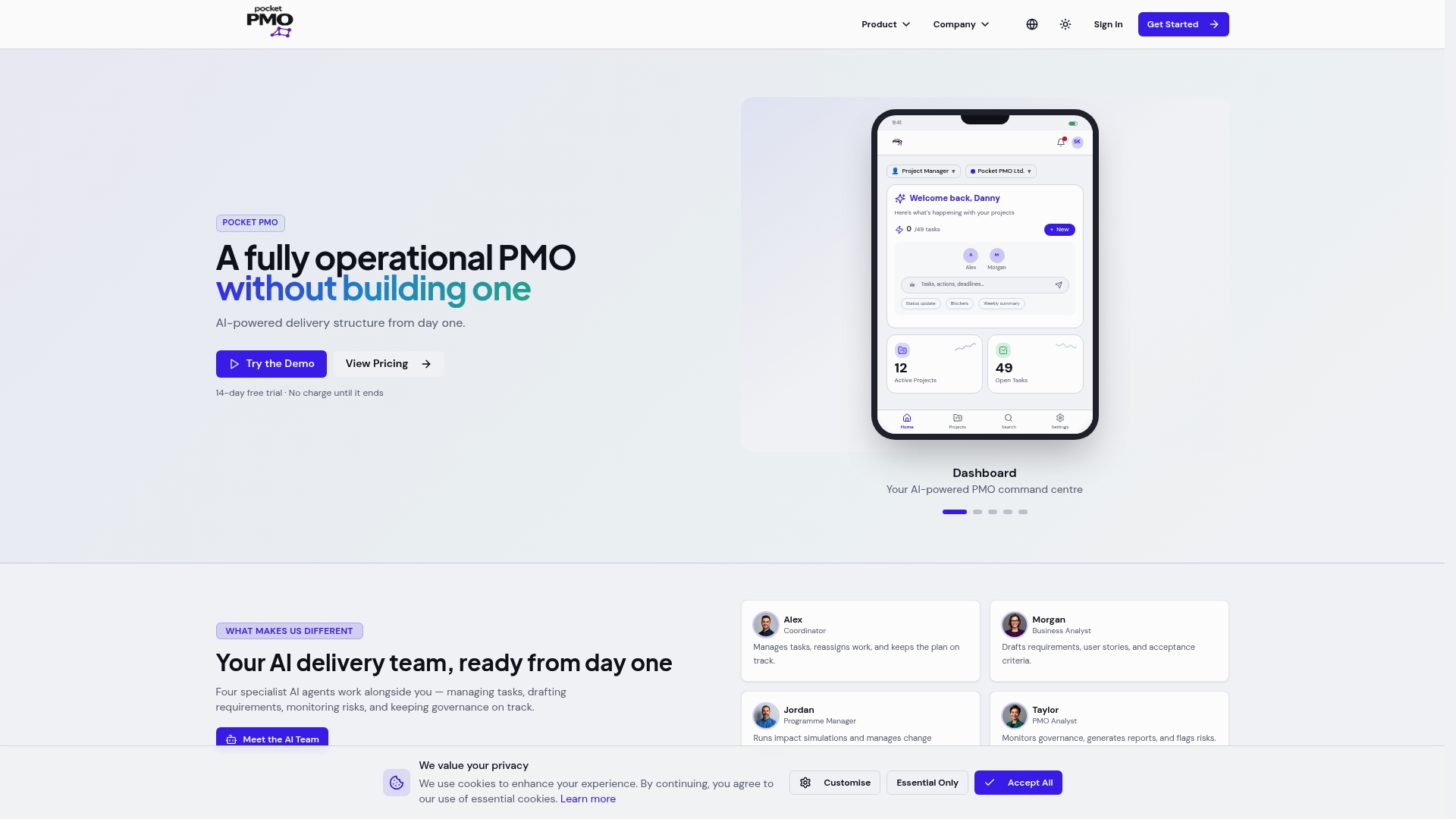
Pocket PMO delivers an AI-powered PMO platform purpose-built for project managers and PMOs who need real-time risk intelligence without building a custom solution from scratch. From AI-driven risk analysis and predictive analytics to live dashboards and RAID management, the platform puts continuous risk visibility at the centre of your delivery process. You can explore the full feature set and launch your PMO from day one, with an AI-powered delivery team ready to support your workflows immediately. Stop treating risk management as a periodic exercise and start managing it as a live capability.
Frequently asked questions
What is the most important step in project risk management?
Identifying risks early is most critical because PMBOK 8's Identify Risks process sets the foundation for every subsequent analysis and response decision. Without a thorough identification phase, your entire risk management effort is built on incomplete information.
How do AI tools optimise risk management?
AI-driven tools enhance Monte Carlo simulations, real-time risk registers, and predictive analytics, shifting risk monitoring from periodic reviews to continuous intelligence. This enables faster, more informed response decisions before risks escalate into issues.
What are common mistakes in risk management?
Failing to distinguish risks from issues and neglecting to update risk registers iteratively throughout the project lifecycle are two of the most damaging and most common pitfalls. Both lead directly to reactive management rather than proactive control.
Should PMOs use PMBOK or ISO 31000 frameworks?
Using PMBOK for tactical processes while applying ISO 31000 for strategic context and risk appetite alignment gives modern PMOs the best of both approaches. Choosing only one leaves either execution detail or strategic coherence on the table.