
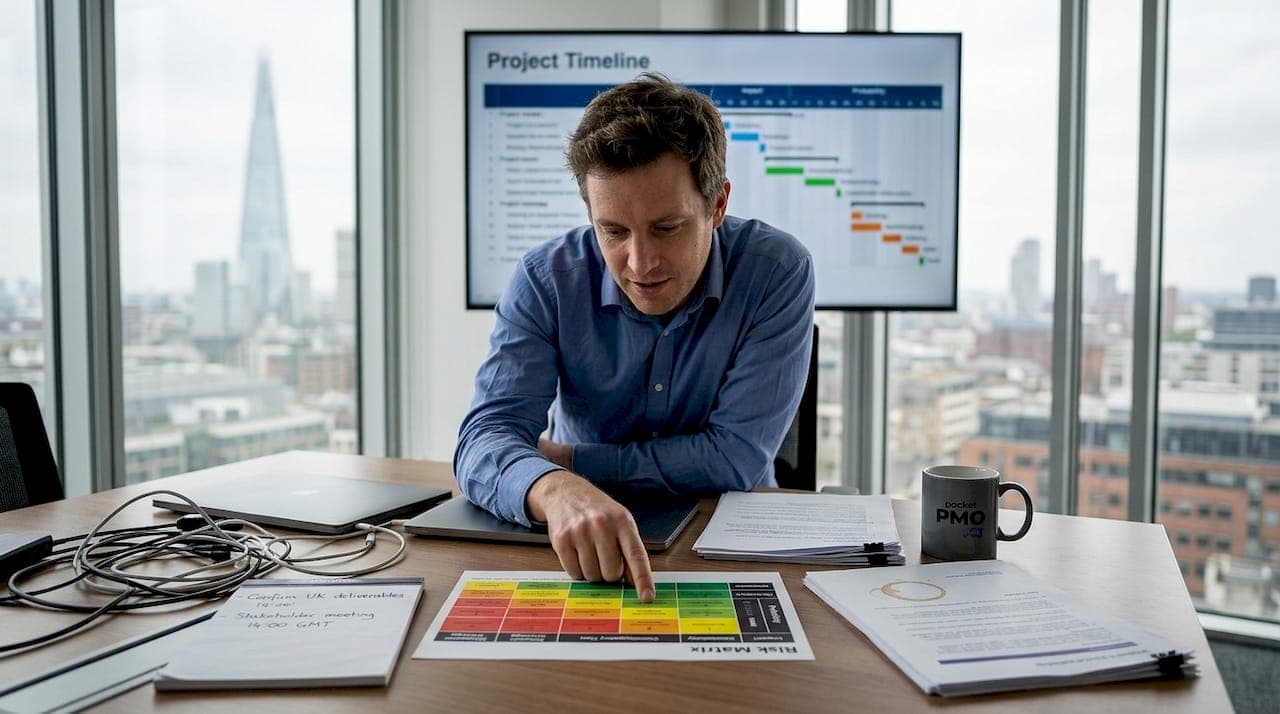
Most project managers know risk management matters, yet teams routinely treat risk registers as a box-ticking exercise rather than a live tool. The result is predictable. Organizations with mature risk management complete 85% more projects successfully, yet unmanaged risks still drive 70% of budget overruns across industries. If your PMO is serious about delivering on time and within budget, the conversation cannot stop at identifying risks. It must cover how you track, own, and respond to them every single week. This article breaks down the real cost of poor risk tracking, clarifies what modern practice looks like, and gives you actionable strategies to build a genuinely risk-aware project culture.
Table of Contents
- The real cost of unmanaged risks
- What does 'tracking project risks' really mean?
- Tracking both threats and opportunities
- Common pitfalls and how to build a risk-aware culture
- Why most risk logs fail (and how to get it right)
- Enable risk-aware project delivery with the right solutions
- Frequently asked questions
Key Takeaways
| Point | Details |
|---|---|
| Untracked risks threaten outcomes | Ignoring risks leads to budget overruns, missed deadlines, and project failure. |
| PMBOK and agile call for continuous tracking | Leading frameworks show success comes from ongoing risk monitoring and adaptation. |
| Opportunities should be tracked too | Capturing positive risks increases project value and is often overlooked in practice. |
| Dynamic culture is crucial | Effective risk management relies on embedded habits, clarity of ownership, and frequent iteration. |
The real cost of unmanaged risks
Budget overruns rarely appear overnight. They build gradually from risks that were spotted, logged once, and then quietly forgotten. Unmanaged risks lead to 70% budget overruns across projects globally, and yet many PMOs still treat risk tracking as an administrative chore rather than a strategic discipline.
The most common consequences your team will recognise include:
- Missed deadlines caused by dependencies that were never monitored
- Cost blowouts from issues that were flagged early but never formally owned
- Loss of sponsor confidence when surprises surface late in delivery
- Team demotivation from reactive firefighting instead of planned responses
- Reputation damage when clients or stakeholders feel blindsided
There is also a category of damage that rarely appears in post-project reviews: opportunity loss. When a team is consumed by firefighting, it cannot pivot to exploit a favourable change in scope, market conditions, or stakeholder appetite. That lost upside is a real cost, even if it never shows on a budget report.
"Organisations with mature risk management complete 85% more projects successfully, making continuous risk tracking a core project health indicator, not an optional extra."
This is not about adding overhead. Effective risk tracking is what separates teams that deliver from teams that apologise. Think of it the same way you think about managing project requirements: a structured approach saves far more time than it consumes.
When risks are visible, owned, and reviewed consistently, your team spends less time reacting and more time delivering. The discipline pays for itself many times over.
What does 'tracking project risks' really mean?
Risk tracking is not simply listing risks in a spreadsheet. It means documenting each risk with a clear owner, assigning a likelihood and impact score, defining a response action, and reviewing the status at agreed intervals. That cycle, repeated consistently, is what turns a static log into a living tool.
The PMI PMBOK framework emphasises continuous monitoring and control as a fundamental process group, not a one-off activity. Most mature PMOs also use Key Risk Indicators (KRIs) to spot when a risk is trending towards becoming an issue before it actually does.
Here is how the core risk management process maps to practical tools:
| Process | What it involves | Practical tools |
|---|---|---|
| Identification | Capturing risks from all project areas | Workshops, risk registers, IT risk assessment checklist |
| Analysis | Scoring likelihood and impact | Risk matrices, Monte Carlo simulation |
| Response planning | Defining mitigation, transfer, acceptance | RAID logs, action tracking |
| Monitoring | Reviewing status and triggers | KRIs, dashboards, sprint reviews |
The benefits of doing this well are significant:
- Full visibility across all open risks at any moment
- Early response before a risk escalates into a blocker
- Team alignment on priorities and accountability
- Audit trail for governance and stakeholder reporting
For practical examples of how risk identification works across different project types, the use cases of risk identification on the Pocket PMO site provide useful context.
Pro Tip: Always distinguish risks (uncertain future events) from issues (problems that have already occurred). Mixing the two in a single log creates confusion and delays response. Keep them in separate columns or separate logs entirely.
Tracking both threats and opportunities
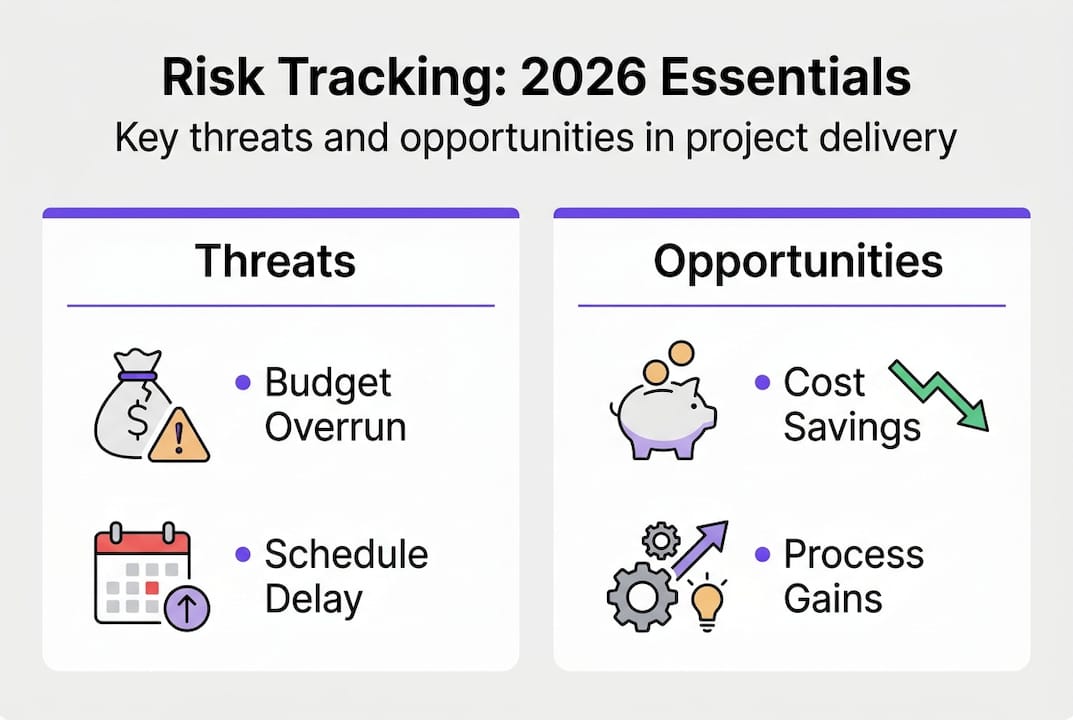
Most teams focus exclusively on threats when they think about project risk. That is understandable but incomplete. In project management, a risk is simply an uncertain event that could affect your objectives, either negatively or positively.

Positive risks, known as opportunities, are frequently overlooked during risk reviews, which means teams leave value on the table. A vendor delivering early, a technology proving faster than expected, or a regulatory change that simplifies compliance are all positive risks worth tracking and exploiting.
Here is how the approach differs between threat and opportunity tracking:
| Dimension | Threat (negative risk) | Opportunity (positive risk) |
|---|---|---|
| Approach | Avoid, mitigate, transfer, accept | Exploit, enhance, share, accept |
| Owner | Risk lead or delivery manager | Opportunity sponsor or PM |
| Sample action | Escalate supplier delays early | Accelerate scope delivery if vendor ahead |
| Review focus | Has probability/impact worsened? | Can we increase the probability? |
To add opportunity risks to your current process, follow these steps:
- Add an 'opportunity' flag to your existing risk register template
- Assign an opportunity owner with authority to act
- Include opportunities as a standing agenda item in your risk reviews
- Score them the same way you score threats: likelihood multiplied by impact
- Document the exploit or enhance action alongside your mitigation actions
This is also an area where using AI for risk tracking can surface patterns you might miss manually. AI-driven tools can flag when conditions in your project data suggest an opportunity is forming.
Pro Tip: Build explicit exploit and enhance strategies for your top positive risks into every formal review. Teams that do this consistently report faster delivery and higher stakeholder satisfaction scores.
Common pitfalls and how to build a risk-aware culture
Even well-intentioned teams fall into familiar traps. Understanding the most common pitfalls in risk tracking is the first step to avoiding them.
The four most damaging mistakes are:
- Over-categorisation: Spending hours classifying risks into elaborate taxonomies that nobody uses in practice
- Static registers: Creating a risk log at project initiation and never updating it again
- Tail risk underestimation: Ignoring low-probability, high-impact events because they feel unlikely
- Risks versus issues confusion: Logging active problems as risks, which delays the immediate response they need
"Risk tracking must be dynamic and integrated with agile culture for continuous assessment and clear ownership. A risk log that is not reviewed regularly is not a safety net. It is a false sense of security."
Building a risk-aware culture means making risk conversations habitual, not ceremonial. Practical steps include:
- Encourage your team to escalate risks early without fear of blame
- Assign a named risk owner to every entry, not just a team or department
- Review risks in weekly standups or sprint retrospectives, not just monthly steering groups
- Use automated alerts when a risk score changes or a review deadline is missed
For teams managing several concurrent deliveries, multi-project risk management requires an additional layer of portfolio-level risk aggregation. A risk that is low-impact on one project may be critical when it affects three simultaneously.
You can also reduce friction by integrating risk reviews with agile ceremonies, which keeps the process lightweight and embedded in how your team already works.
Why most risk logs fail (and how to get it right)
Here is an uncomfortable truth: most risk registers are written to satisfy governance, not to guide decisions. They are created at project kick-off, reviewed at stage gates, and largely ignored in between. That is not risk management. That is documentation theatre.
The logs that genuinely work share one characteristic: every team member can name the top three current risks without looking at a spreadsheet. That level of awareness does not come from a well-structured template. It comes from habits. Daily standups where risk owners give a thirty-second update. Sprint retrospectives where new risks are formally captured. A PMO lead who asks "what could stop us this week?" before any other agenda item.
The biggest shift is moving from risk tracking as a record to risk tracking as a conversation. When you review practical PMO use cases, the pattern is consistent: high-performing teams treat open risks as shared team knowledge, not the responsibility of a single risk manager.
Pro Tip: If you cannot name your top three current risks in a meeting, your process needs work. That single test tells you more about your risk culture than any audit ever will.
Enable risk-aware project delivery with the right solutions
Effective risk tracking is the foundation of consistent project success. When every risk is owned, reviewed, and connected to a clear response action, your team spends less time firefighting and more time delivering.
Pocket PMO embeds risk tracking, response planning, and continuous review directly into your project workflows from day one. With AI-driven risk analysis, automated alerts, and real-time dashboards, you get the visibility you need without the administrative burden. Whether you want to install a ready-made PMO, explore features for risk management, or review real use cases from teams like yours, the tools are ready to support you. Make risk management second nature across every project in your portfolio.
Frequently asked questions
What is a project risk and how does it differ from an issue?
A project risk is an uncertain future event that may affect your objectives, while an issue is a problem that has already occurred and requires immediate action. Keeping these distinct ensures each receives the right response at the right time.
Why should opportunities be tracked as risks in a project?
Opportunities are positive risks that increase value when actively tracked and exploited, rather than left to chance. Ignoring them means your team is only managing half of the risk landscape.
What is the most effective tool for tracking project risks?
Dynamic risk registers embedded in regular review cycles are the most effective foundation, supported by risk matrices and quantitative tools for high-impact items. The key is consistent review, not the tool itself.
How often should risks be reviewed and updated?
Risks should be reviewed continuously, with agile standups and sprint reviews providing the most effective cadence for keeping risk awareness current and actionable.
Recommended
- Project tracking with AI: strategies for better results
- Master the multi-project management process: boost success
- Why manage project requirements effectively for AI success
- Pocket PMO | A fully operational PMO without building one
- Cybersecurity in IT outsourcing: Protect your business
- Legal Risk Explained: Protect Your Business in 2026