

Only about 31% of projects succeed outright, with 50% classed as challenged and 19% failing entirely. Poor risk management contributes to between 30% and 50% of those failures, and unidentified risks alone account for 37% of project collapses. For project managers and PMO leaders, those are sobering numbers. This article gives you practical, advanced guidance to sharpen your risk management approach, reduce the likelihood of costly surprises, and turn risk visibility into a genuine competitive advantage across your portfolio.
Table of Contents
- Establishing a risk-aware culture and processes
- Practical techniques for identifying and analysing risks
- Effective risk response strategies: From mitigation to opportunity
- Advanced tips: AI, tools, and strategic integration
- Rethinking risk management: Avoiding the common traps
- Simplify your risk management with Pocket PMO
- Frequently asked questions
Key Takeaways
| Point | Details |
|---|---|
| Proactive culture | Embedding a risk-aware culture and routine reviews dramatically improves project outcomes. |
| Quantitative analysis | Using structured tools like Monte Carlo simulations turns risk insight into actionable priorities. |
| Strategic responses | Tailoring response strategies for each risk—mitigate, transfer, avoid, or accept—boosts project resilience. |
| Technology leverage | Modern AI and PPM tools enable real-time risk tracking but require validation to avoid automation bias. |
Establishing a risk-aware culture and processes
Before any tool or technique can work, you need the right foundation. A risk-aware culture means your team treats risk identification and reporting as a normal, valued part of the working week, not a box-ticking exercise that happens once at project kick-off.
The PMBOK risk management process provides a proven six-step framework that project managers can apply consistently across any project type:
- Plan risk management — Define your approach, tools, and responsibilities before the project begins.
- Identify risks — Capture threats and opportunities from all sources: stakeholders, lessons learned, technical constraints, and external factors.
- Perform qualitative risk analysis — Score each risk by probability and impact to prioritise your response efforts.
- Perform quantitative risk analysis — Apply numerical modelling to high-priority risks where the data justifies it.
- Plan risk responses — Assign specific actions, owners, and triggers for each significant risk.
- Monitor risks — Track status, review new risks, and assess whether responses are working throughout delivery.
Following this sequence is not just academic best practice. It gives your team a shared language and a repeatable cadence for embedding risk reviews into weekly workflows, which is where real visibility comes from.
Across multi-project management environments, this structured process becomes even more critical. When you are running five or ten projects simultaneously, inconsistent risk practices create blind spots that compound rapidly. Standardising the six steps across your portfolio ensures every project manager is working from the same playbook.
"Risk management is not a one-time event. It is a discipline embedded in every project conversation, every status update, and every decision checkpoint."
Pro Tip: The most common cultural failure is treating the risk register as a static document. A risk register without named owners and clear triggers is just a list. Assign every risk an owner, define what will trigger escalation, and review it weekly. Avoid using contingency budgets as a general slush fund — doing so erodes the quality of your historical risk data and makes future estimation less reliable. For more risk-aware culture tips, explore proven strategies from practitioners who have managed this challenge at scale.

Practical techniques for identifying and analysing risks
With a solid process in place, the next challenge is uncovering risks that other teams miss. The most damaging risks are often the ones that nobody thought to write down. Structured identification techniques close that gap.
Identification methods worth using:
- Brainstorming with diverse stakeholders — Include technical leads, business analysts, end users, and finance. Each group sees different risk categories.
- Assumption and constraint analysis — Question every assumption baked into your project plan. Each one is a potential risk if it proves false.
- Lessons learned reviews — Mine historical project data from your PMO or organisation. Patterns from past failures are highly predictive.
- Prompt lists and risk categories — Use structured categories such as technical, schedule, commercial, regulatory, and resource to ensure completeness.
- Interviews with subject matter experts — One-to-one conversations often surface risks that people will not raise in group settings.
Critically, do not limit identification to threats. Opportunities are risks too. An early supplier delivery, a favourable regulatory change, or a technology that becomes available ahead of schedule can all be exploited if you spot them in time. This is one of the most consistently overlooked areas in project risk practice.
Once risks are identified, you need to analyse them effectively. The right technique depends on project complexity. For most projects, qualitative analysis — scoring probability and impact on a defined scale — is sufficient to prioritise your focus. For high-value or complex projects, quantitative tools such as Monte Carlo simulation, decision trees, sensitivity analysis, and reserve analysis give you far more precise data for decision-making.
| Risk analysis technique | Best used for | Key output |
|---|---|---|
| Probability/impact matrix | All projects | Risk priority ranking |
| Monte Carlo simulation | Complex, high-value projects | Probability distribution of outcomes |
| Decision tree analysis | Projects with clear decision branches | Expected monetary value |
| Sensitivity analysis | Large programmes | Identification of highest-impact variables |
| Reserve analysis | Budget-constrained projects | Contingency and management reserves |
Because unidentified risks cause 37% of project failures, the investment you make in thorough identification pays back many times over. Spend more time here than feels comfortable. The risks you capture at initiation are far cheaper to manage than the surprises you discover mid-delivery.
Pro Tip: Avoid over-categorising risks into too many sub-groups. It creates administrative burden without adding analytical value. Aim for clarity over completeness in your taxonomy. Equally, make sure your project proposal templates include a dedicated risk section so that identification begins before the project is even approved. When managing requirements carefully, you also surface scope-related risks that often go undetected until late in delivery.
Effective risk response strategies: From mitigation to opportunity
Identifying and scoring risks is only half the job. The real value comes from what you do about them. Choosing the right response strategy requires matching the action to the risk profile, specifically its probability and potential impact.
The standard response strategies for threats are:
- Avoid — Change the project plan to eliminate the risk entirely. Use this when the probability and impact are both high and elimination is feasible.
- Mitigate — Reduce the probability of the risk occurring or limit its impact if it does. This is the most commonly applied strategy and works well for moderate-to-high risks.
- Transfer — Shift the financial or operational impact to a third party through insurance, contracts, or outsourcing. Effective for commercial and procurement risks.
- Accept — Acknowledge the risk and either do nothing (passive acceptance) or establish a contingency plan (active acceptance). Reserve this for genuinely low-impact risks.
- Escalate — Pass the risk to a higher level of authority when it falls outside the project team's ability to address.
For opportunities, the mirror strategies apply: exploit, enhance, share, accept, and escalate. Too many project teams focus exclusively on threat responses and ignore the opportunity side entirely. This is a missed advantage. If you spot that a key supplier has excess capacity, enhancing that opportunity through early engagement could save weeks of delivery time.
"The difference between a good risk plan and a great one is the treatment of opportunities. Threats are managed. Opportunities are captured."
A critical insight from risk management best practice is that common pitfalls undermine even well-structured processes. Risk registers without owners or triggers become passive documents. Over-categorisation burdens the team without improving outcomes. Treating contingency as a general-purpose fund erodes forecast accuracy. Infrequent reviews allow risks to escalate undetected. And ignoring upside risks means you miss genuine opportunities to accelerate delivery or reduce cost.
| Risk type | Recommended response | Trigger for action |
|---|---|---|
| High probability, high impact | Avoid or mitigate | Immediate |
| High probability, low impact | Mitigate or accept (active) | Weekly review |
| Low probability, high impact | Transfer or mitigate | Contingency plan ready |
| Low probability, low impact | Accept (passive) | Monitor only |
| Opportunity, high potential | Exploit or enhance | Resource allocation decision |
Explore practical risk management services to understand how specialist support can strengthen your response planning, particularly for complex regulatory or commercial risks that sit at the boundary of your team's expertise. You can also review the full suite of project management features to understand how integrated tools can support each response strategy in a live delivery environment.
Advanced tips: AI, tools, and strategic integration
Classical risk frameworks remain essential, but the most effective project managers in 2026 are combining them with modern tooling and a more integrated approach to risk across the full project lifecycle.
Traditional versus agile risk management:
One of the most important contrasts in modern practice is between traditional front-loaded risk management and the continuous, iterative approach that agile environments require. In waterfall projects, risk identification and analysis typically happen at the start and are revisited at major gates. In agile, every sprint creates new risk exposure. Risk management must match your delivery model, and many teams fail because they apply a waterfall risk register to an agile environment.
Where AI genuinely helps:
- Pattern recognition — AI tools can scan historical project data to flag risks that match patterns from past failures, surfacing threats that manual review would miss.
- Automated monitoring — AI-driven platforms track risk indicators in real time across your portfolio, alerting you when thresholds are breached.
- Predictive scheduling — Machine learning models can estimate the probability of schedule slippage based on current velocity and complexity.
- Natural language processing — Some platforms extract risk-relevant information from meeting notes, emails, and status reports automatically.
However, AI requires validation. As noted in AI-driven risk management research, over-reliance on historical data can introduce bias when a project type is genuinely novel. AI enhances your judgement but does not replace it.
Strategic integration across the lifecycle:
Risk management should not be siloed into a planning phase activity. The most effective teams weave risk actions throughout delivery by integrating them into project tracking with AI, linking risk updates to change requests, and reviewing risk exposure as part of every stage gate decision.
The strategic advantage comes from quantifying risks numerically rather than using vague labels such as "high" or "medium." A risk with a 70% probability of causing a £50,000 impact is entirely different from one with a 15% probability of the same value. Numerical quantification allows you to compare, prioritise, and communicate risk exposure with far greater precision.
Pro Tip: Use a Portfolio Project Management (PPM) tool that provides a real-time risk dashboard across all active projects. Weekly risk reviews become far more productive when the data is already aggregated and visual, rather than assembled from individual spreadsheets. This single habit, a structured weekly risk review with live data, is one of the highest-return disciplines you can establish.
Rethinking risk management: Avoiding the common traps
Here is an uncomfortable truth that most risk management articles will not say directly. The majority of project risk failures are not caused by inadequate frameworks. They are caused by perfectly adequate frameworks that nobody actually follows.
Teams invest significant effort in building detailed risk registers, probability matrices, and response plans during project initiation. Then delivery pressure arrives and those documents are quietly set aside. Reviews slip from weekly to monthly. Owners stop updating their entries. The register becomes a historical record rather than a live management tool. And when a risk materialises, the post-mortem reveals it was logged all along.
The fix is not a better template. It is a simpler, more repeatable habit. Short weekly risk reviews, ten to fifteen minutes, with named owners reporting status against live entries, outperform elaborate quarterly risk workshops every time. The cadence matters more than the sophistication.
Equally, the obsession with documenting threats often crowds out one of risk management's most powerful applications: finding opportunities. The teams that consistently deliver ahead of schedule and under budget are not just better at avoiding problems. They are better at spotting and acting on upside risks. A competitor's product delay, an available resource window, or a favourable exchange rate movement — these are all manageable opportunities if your risk process is looking for them.
The mindset shift worth making is this: treat risk management as a decision support tool, not a compliance obligation. When your team views the risk register as something that helps them make better choices rather than something they have to maintain for governance purposes, the quality and frequency of engagement changes entirely. Explore project risk management insights to see how forward-thinking teams are applying this philosophy in practice.
Simple, repeatable habits beat elaborate processes. That is the real lesson from the projects that succeed.
Simplify your risk management with Pocket PMO
The techniques in this article are proven and practical. The challenge for most teams is executing them consistently, especially across multiple projects with limited PMO resource. That is precisely the gap Pocket PMO is designed to close.
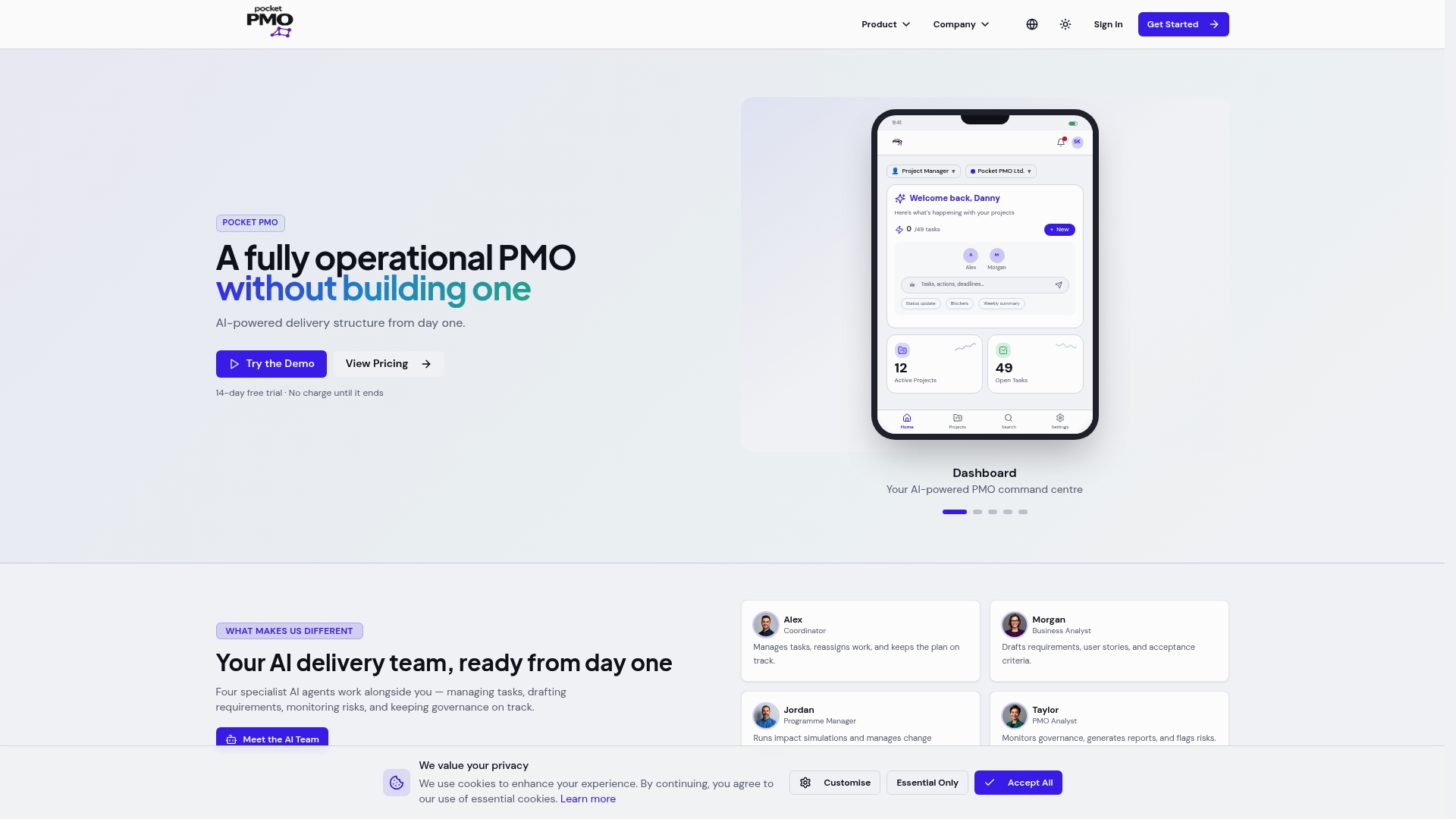
Pocket PMO delivers an AI-powered PMO solution that puts real-time risk dashboards, intelligent automation, and predictive analytics at your fingertips from day one. You can launch your PMO without building internal infrastructure, and immediately access RAID management, AI-driven risk analysis, and portfolio-level visibility across every active project. From automated risk flagging to weekly review workflows, the platform is built to make the good habits described in this article effortless to maintain. Explore PMO features to see how Pocket PMO can support your risk management strategy and strengthen delivery outcomes across your entire portfolio.
Frequently asked questions
What is the most important step in project risk management?
The most crucial step is identifying risks early, as unidentified risks account for 37% of project failures. Without thorough identification, no response strategy can address what the team does not know exists.
How often should risks be reviewed during a project?
Risks should be reviewed at least weekly for effective monitoring to address emerging threats promptly. Weekly cadence ensures your register stays live and actionable rather than becoming a static document.
What are some quantitative tools for risk analysis?
Common quantitative tools include Monte Carlo simulations, decision trees, and sensitivity analysis. These methods assign numerical values to risk probability and impact, enabling more precise prioritisation and contingency planning.
Why is risk ownership essential?
Without assigned risk owners, risk registers become passive documents rather than active management tools. Named ownership creates accountability and ensures that planned responses are actually implemented before risks escalate.