

Organisations running multiple concurrent projects often discover, too late, that their risk registers are out of date, their escalation processes are sluggish, and their portfolio visibility is patchy at best. AI-powered PMO solutions enhance project delivery and risk management through predictive analytics, automated risk identification, and dynamic assessment using machine learning and natural language processing. The result is a step change in what programme teams can see, predict, and act upon. This guide explains exactly how that transformation works and what your organisation needs to do to make it a reality.
Table of Contents
- Why traditional programme management struggles with risk
- How AI-powered PMO transforms programme delivery
- Key frameworks and methodologies powering AI-driven PMOs
- Cautions and governance: What most implementations get wrong
- The evolving role of people in AI-enabled programmes
- Why the real AI edge is making people more effective
- Explore AI-powered PMO solutions for your organisation
- Frequently asked questions
Key Takeaways
| Point | Details |
|---|---|
| AI boosts risk detection | AI-powered PMOs identify more risks and predict schedule delays with significantly greater accuracy than traditional methods. |
| Governance is essential | Effective data cleansing, oversight, and model transparency are crucial for successful AI adoption in programme management. |
| Human-AI collaboration wins | Combining human creativity and ethics with AI automation yields the best results in complex project portfolios. |
| Real-world impact proven | Industry benchmarks show AI-PMO tools like DHL's result in fewer failures and better forecasts. |
| Start with best-fit frameworks | Organisations should align AI-powered PMO solutions with their project needs, governance maturity, and culture for optimal success. |
Why traditional programme management struggles with risk
Having highlighted the scale of missed opportunity, let's examine where traditional programme management goes wrong. Most organisations still rely on risk registers that are updated weekly or fortnightly, manually populated by project managers who are already stretched. By the time a risk is logged, discussed in a steering committee, and escalated, the window for early intervention has often closed.
The problems run deep. Traditional risk assessment methods frequently miss emerging risks in fast-changing project landscapes, particularly when those risks cross project boundaries within a portfolio.
The most common failure points include:
- Static risk registers that capture historical risks but rarely surface emerging patterns across interdependent projects
- Siloed project data stored in spreadsheets or disconnected tools, preventing portfolio-level pattern recognition
- Subjective risk scoring that varies significantly between project managers, making prioritisation inconsistent
- Lagging escalation where risks that should have been red-flagged two weeks prior only reach leadership when they become issues
- Weak dependency mapping that fails to show how one project's delay cascades into three others downstream
"The real danger in programme management is not the risks you can see on your register. It is the interconnected, cross-project risks that no single project manager has full visibility of — and no spreadsheet can surface."
These limitations are not a reflection of effort or talent. They reflect the structural limits of manual, periodic approaches to risk in complex environments. Improving PMO governance and AI efficiency starts with recognising those structural gaps and addressing them with the right tools.
How AI-powered PMO transforms programme delivery
Understanding the limitations of legacy approaches, it is clear why many organisations are adopting AI-powered PMO solutions. The mechanics behind these tools are specific and measurable, not vague promises of "digital transformation."
AI-powered PMO solutions use predictive analytics and machine learning to identify risks earlier and more accurately than manual methods allow. Machine learning models trained on historical project data can flag up to 30% more risks than human reviewers, and they predict schedule delays with 60% accuracy compared to approximately 30% for unaided human judgement. That is not a marginal gain. It is a fundamental shift in the reliability of your programme forecasting.

A compelling real-world example comes from DHL. DHL's IPP platform won the 2023 APM Technology Project of the Year for reducing deadline failures by applying machine learning to more than ten years of historical delivery data. The platform analysed patterns across thousands of projects to identify conditions that typically precede missed deadlines, enabling intervention before failure occurred. The result was measurable, sustained improvement in on-time delivery across a complex global portfolio.
| Capability | Traditional PMO | AI-powered PMO |
|---|---|---|
| Risk identification | Manual, periodic, register-based | Continuous, automated, pattern-driven |
| Risk detection rate | Baseline | Up to 30% more risks flagged |
| Delay prediction accuracy | ~30% | ~60% |
| Portfolio visibility | Siloed, lagging | Real-time, cross-project |
| Escalation speed | Days to weeks | Near-instant alerts |
| Reporting burden | High, manual | Automated, auto-generated |
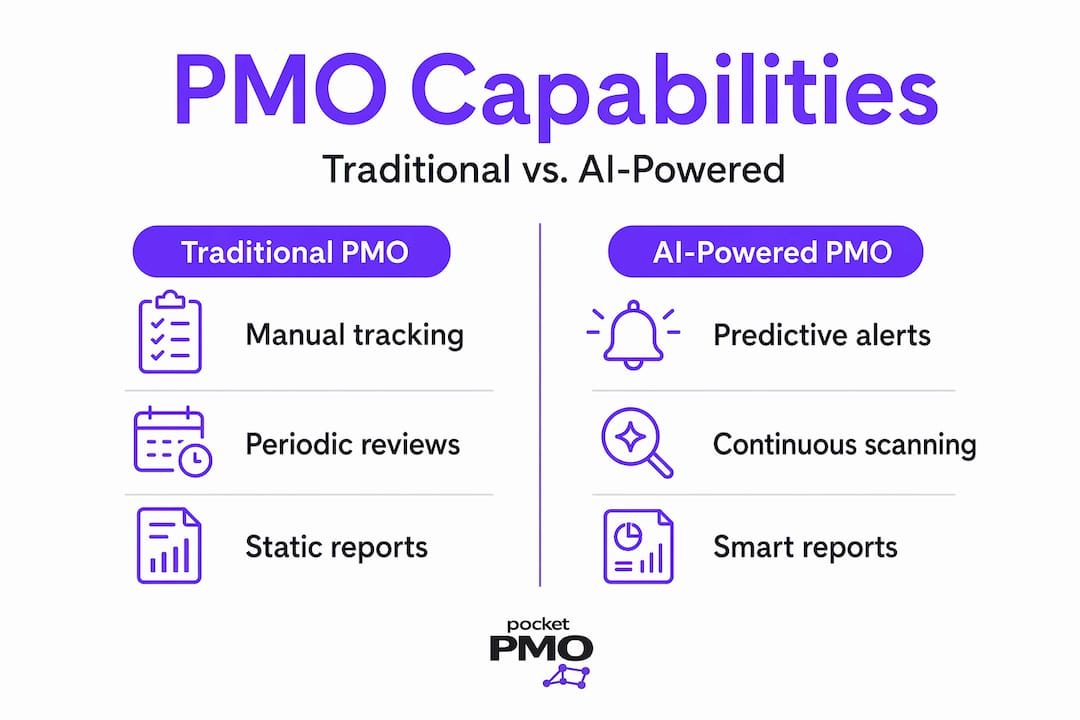
The comparison makes the case clearly. AI and smart reporting together remove the reporting burden from your team while increasing the quality and currency of the information reaching decision-makers.
Pro Tip: Avoid treating AI predictions as final verdicts. Use them as structured prompts for human review. Your project managers bring context, stakeholder knowledge, and organisational judgment that algorithms cannot replicate. The best outcomes come from combining both, which aligns with PMO best practices for AI-enabled delivery.
Key frameworks and methodologies powering AI-driven PMOs
To deliver these results, AI-PMO solutions rely on a set of core methodologies and frameworks. Understanding what is under the bonnet helps you evaluate solutions more confidently and integrate them effectively.
Continuous risk scanning, qualitative and quantitative risk analysis, and explainable AI models underpin the leading PMO solutions available today. These are not interchangeable features. Each serves a distinct purpose across the programme lifecycle.
| AI framework | Description | Application in PMO |
|---|---|---|
| ML classification | Categorises risks by type, severity, and likelihood | Automated risk triage and register population |
| Natural language processing | Analyses documents, emails, and meeting notes for risk signals | Early warning from unstructured data |
| Expected monetary value (EMV) analysis | Quantifies the financial exposure of risk scenarios | Prioritisation and contingency planning |
| Scenario simulation (Monte Carlo) | Models thousands of possible outcomes | Schedule and budget confidence intervals |
| Anomaly detection | Flags unusual patterns in project metrics | Real-time alerts on deviating projects |
| Explainable AI (XAI) | Makes model decisions transparent and auditable | Governance and stakeholder trust |
Integrating these capabilities effectively requires a structured approach. Here is a proven sequence for moving from initial intake to continuous monitoring:
- Establish a clean data foundation. Audit your existing project data across all active and recently closed projects. Inconsistent field definitions, missing actuals, and duplicate records undermine model accuracy from the outset.
- Define risk taxonomy. Agree on a standardised classification scheme for risks across all projects in the portfolio. This ensures that ML classification models learn consistent patterns rather than noise.
- Connect data sources. Integrate your project management tools, financial systems, and resource management platforms to provide the AI engine with a complete picture.
- Configure continuous scanning. Set the AI to monitor key risk indicators on a daily basis, including schedule variance, resource utilisation, dependency status, and stakeholder engagement metrics.
- Apply EMV and scenario simulation at programme level. Run quantitative models monthly or when major changes occur to update confidence intervals for key delivery milestones.
- Review explainability outputs with your team. Ensure that every AI-generated risk flag includes a plain-language rationale that project managers can assess and act on without needing a data science background.
- Embed escalation protocols. Define clear rules for when AI alerts trigger human escalation, who is responsible, and what the expected response time is.
This structured integration supports robust decision-making and governance across your portfolio without creating dependency on a single point of failure.
Cautions and governance: What most implementations get wrong
Despite their promise, AI-PMO solutions are not without serious risks and common missteps. Most implementations that underdeliver do so for reasons that have nothing to do with the quality of the AI itself.
The numbers are sobering. 93% of organisations use some form of AI, but only 7% have full AI governance in place. Data preparation alone consumes between 50 and 80% of total project time in most implementations. That figure illustrates the most common mistake clearly: organisations invest heavily in selecting an AI tool but underinvest in preparing the data and governance structures that determine whether it works.
Additionally, Gartner warns that PMO roles risk erosion without deeper AI governance investment, as decisions made by opaque models without human accountability structures can undermine trust and compliance.
The essential governance actions your organisation should put in place before and during deployment include:
- Data cleansing and validation: Define minimum data quality standards for all project inputs and enforce them before connecting to AI systems
- Clear accountability for AI outputs: Assign named roles responsible for reviewing, challenging, and acting on AI-generated risk flags
- Model transparency requirements: Insist on explainability features that show why a risk has been flagged, not just that it has been flagged
- Escalation protocols: Document the conditions under which AI alerts must be escalated to programme board level, with clear timescales
- Bias auditing: Periodically review model outputs for systematic bias, particularly where historical data may reflect past resource constraints or cultural assumptions
- Regulatory compliance review: Ensure that AI-driven decision support aligns with your sector's data protection and audit requirements
- Integration governance: Manage API connections and data flows between your AI-PMO and source systems with the same rigour as any critical infrastructure
Pro Tip: Invest at least as much in data stewardship and human oversight as you do in the AI algorithms themselves. A well-governed, moderately sophisticated AI will consistently outperform a technically advanced model running on poor-quality, ungoverned data. Review PMO governance for project control to build a robust foundation before you scale.
The evolving role of people in AI-enabled programmes
With governance in focus, it is important to understand how people and machines should work together in an AI-enabled programme environment. This question tends to generate more anxiety than it deserves, and a clear-eyed view is more useful than either uncritical enthusiasm or defensive scepticism.
"AI augments rather than replaces project managers. The future of programme delivery lies in hybrid PMO models that blend the predictive power of AI with the irreplaceable value of human creativity, ethical judgement, and stakeholder relationship management." — The AI-powered future of project portfolio management
The roles that AI cannot fulfil in programme management are not trivial edge cases. They include some of the most consequential activities in delivery:
- Stakeholder negotiation and relationship management, where trust, tone, and political sensitivity determine outcomes
- Ethical escalation decisions, particularly where risk mitigation involves difficult trade-offs between cost, safety, and scope
- Strategic reframing, when a programme needs to be fundamentally rethought in response to shifting organisational priorities
- Motivating and coaching delivery teams, especially during periods of high pressure or programme recovery
- Interpreting ambiguous signals from senior leadership or clients that do not surface in data but significantly affect programme risk
- Creative problem-solving when standard risk responses are insufficient and novel approaches are required
People are not the weak link in an AI-powered programme. They are the mechanism by which AI recommendations become real decisions, real actions, and real outcomes. Exploring PMO models for AI success helps you design a structure where human and machine contributions reinforce each other rather than compete.
Why the real AI edge is making people more effective
Here is an opinion that runs counter to much of the technology marketing you will encounter: the organisations that gain the most from AI-powered PMOs are not the ones with the most sophisticated algorithms. They are the ones that invest most seriously in helping their people use AI well.
We have seen implementations where genuinely impressive predictive models were deployed, only to have their outputs ignored, second-guessed, or actioned so slowly that the advantage was lost. The failure was not technical. It was cultural. Project managers who had not been trained to interpret model outputs defaulted to their own instincts. Governance structures that had not been updated to incorporate AI escalation pathways left risk alerts floating in inboxes without owners.
The organisations that consistently outperform are those that treat AI implementation as a change management challenge first and a technology challenge second. They invest in upskilling their project managers to become confident consumers of AI-generated insight. They redesign their escalation and reporting cadences around AI capability rather than simply bolting a new tool onto old processes. And they build a culture where questioning an AI output is encouraged, not seen as resistance to change.
Practical AI automation works best when it is embedded in workflows that people understand and trust. The technology creates the headroom. Your people decide what to do with it. That is why hybrid AI and human models consistently outperform either alone, and why upskilling your team is not an optional add-on but a core part of your AI-PMO investment.
Explore AI-powered PMO solutions for your organisation
If you are ready to apply these lessons and experience real impact in your organisation, here is where to begin.
Pocket PMO brings together the AI capabilities this article has described — continuous risk scanning, predictive analytics, real-time dashboards, automated reporting, and portfolio-level visibility — in a platform that is ready to deploy from day one, without the cost or complexity of building your own PMO function from scratch.
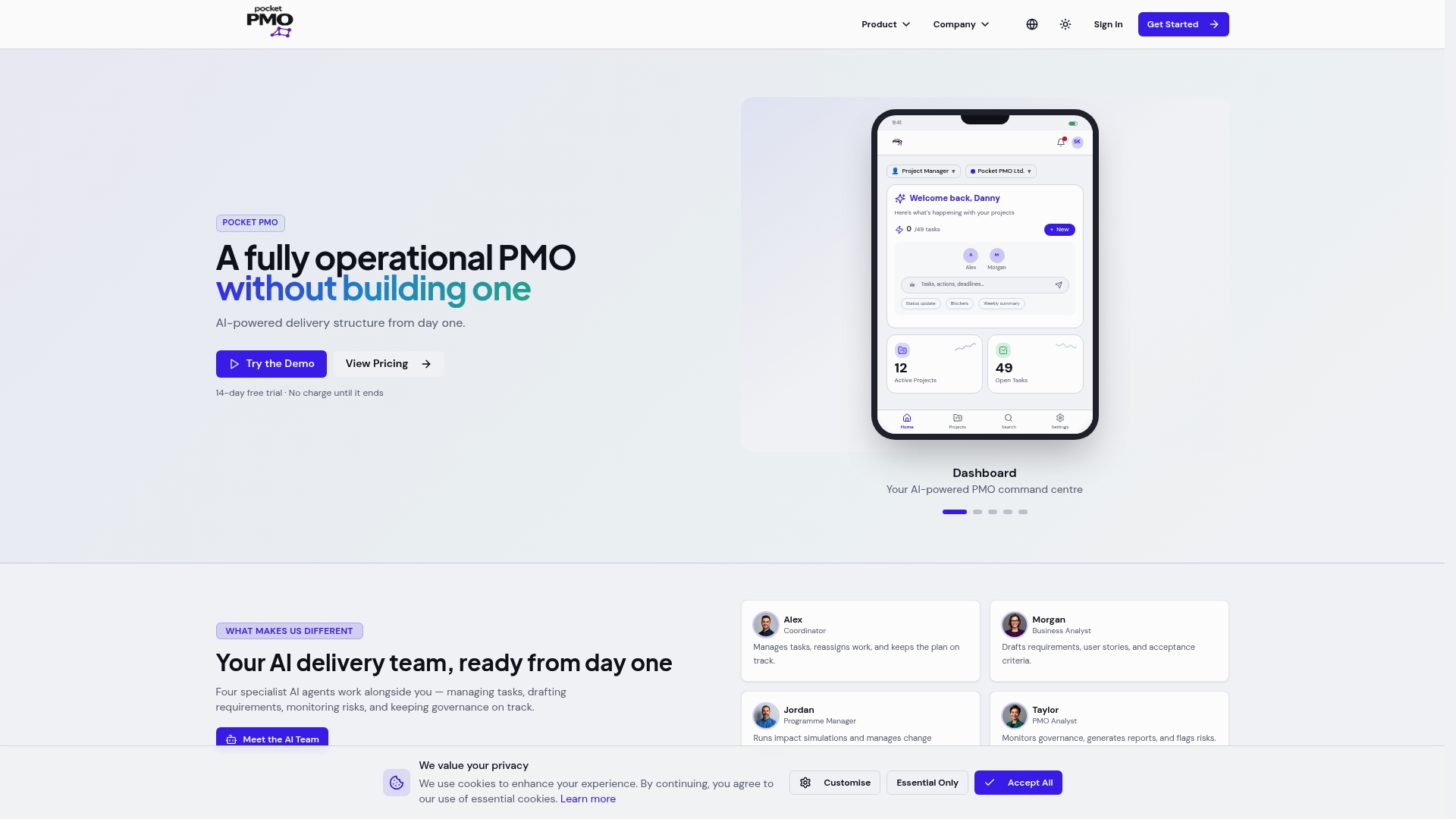
You can launch your AI-powered PMO immediately and see programme-level improvements in risk detection and delivery confidence within your first sprint. If you want to understand how Pocket PMO compares to the tools your teams already use, explore the detailed feature comparisons with Pocket PMO vs Asana and Pocket PMO vs Microsoft Project. Both comparisons show, side by side, the AI-driven capabilities that traditional project management tools simply do not offer at portfolio scale.
Frequently asked questions
What is an AI-powered PMO and how does it benefit programme management?
An AI-powered PMO uses machine learning and analytics to automate risk identification and scenario analysis, helping organisations deliver programmes faster and with lower overall risk. As AI-powered PMO solutions demonstrate, the combination of predictive analytics, NLP, and dynamic risk assessment provides a step change in visibility and control across multi-project environments.
Are there proven results from AI in multi-project programme environments?
Yes. DHL's IPP platform reduced deadline failures significantly by applying machine learning to over ten years of historical delivery data, earning the 2023 APM Technology Project of the Year award. Similar improvements in forecasting accuracy and risk detection have been reported across sectors adopting AI-powered portfolio management.
What are the main challenges in implementing AI-driven PMO solutions?
The most significant challenges are poor data quality, model opacity (often called the "black box" problem), lack of governance structures, and integration complexity. Research confirms that poor data quality and model opacity require sustained investment in data cleansing, governance frameworks, and human oversight to overcome effectively.
Does AI replace the role of programme managers?
No. AI augments, not replaces, the programme manager's role. Human expertise in creativity, ethics, stakeholder relationships, and complex escalation remains essential in any AI-enabled programme environment, and the most effective models combine AI prediction with experienced human judgement.