

Most projects don't fail because of bad ideas. They fail because the work begins before the thinking does. A project without a clear scope, a realistic project timeline, and defined project team roles is essentially organised chaos. Whether you are preparing a project proposal for a new client, kicking off an internal initiative, or managing several workstreams at once, the principles that separate successful delivery from frustrated teams are consistent, learnable, and worth committing to from day one.
Table of Contents
- Key takeaways
- What a project actually is
- Building a project plan that holds up
- Writing a project proposal that gets approved
- Modern tools for smarter project planning
- Avoiding the pitfalls that derail delivery
- My honest view on why planning gets skipped
- Take your project planning further with Pocketpmo
- FAQ
Key takeaways
| Point | Details |
|---|---|
| Define scope before starting | A project without a fixed scope invites creep, confusion, and missed deadlines. |
| Planning is a distinct discipline | Effective project planning requires its own tools and processes, separate from execution. |
| Proposals need a sharp executive summary | Decision-makers skim; your summary must cover the problem, approach, outcome, and cost in 2 to 4 sentences. |
| Use scenario planning before committing | Test timeline and resource changes in a safe environment before altering your live plan. |
| Resource visibility prevents burnout | Visualising team capacity stops one person absorbing 80% of the workload. |
What a project actually is
People use the word "project" loosely. A recurring monthly report is not a project. A project is a temporary, goal-directed effort with a defined start, finish, and measurable outcome. That distinction matters because it shapes how you structure the work.
Every project moves through five core lifecycle stages.
- Initiation. The project idea is validated, a sponsor is identified, and a business case or charter is produced. This is where you confirm the effort is worth pursuing.
- Planning. Scope, tasks, timelines, resources, and risks are defined. This stage is where most teams underinvest time, and where most problems later originate.
- Execution. The team delivers the work according to the plan. Progress tracking and communication become critical here.
- Monitoring and control. Performance is measured against the baseline plan. Deviations trigger change requests or risk responses.
- Closure. Deliverables are handed over, lessons are documented, and the project is formally closed.
Each stage has its own failure modes. Initiation fails when the business case is weak or stakeholders are not aligned. Planning fails when scope is vague or timelines are optimistic. Execution fails when roles are unclear and nobody owns the critical tasks. Early stakeholder identification prevents many of these bottlenecks before they form.
Pro Tip: Write a one-page project brief before anything else. It forces the team to agree on the goal, the boundaries, and the definition of done. Arguments that arise during the brief would have derailed the project mid-delivery if left unaddressed.
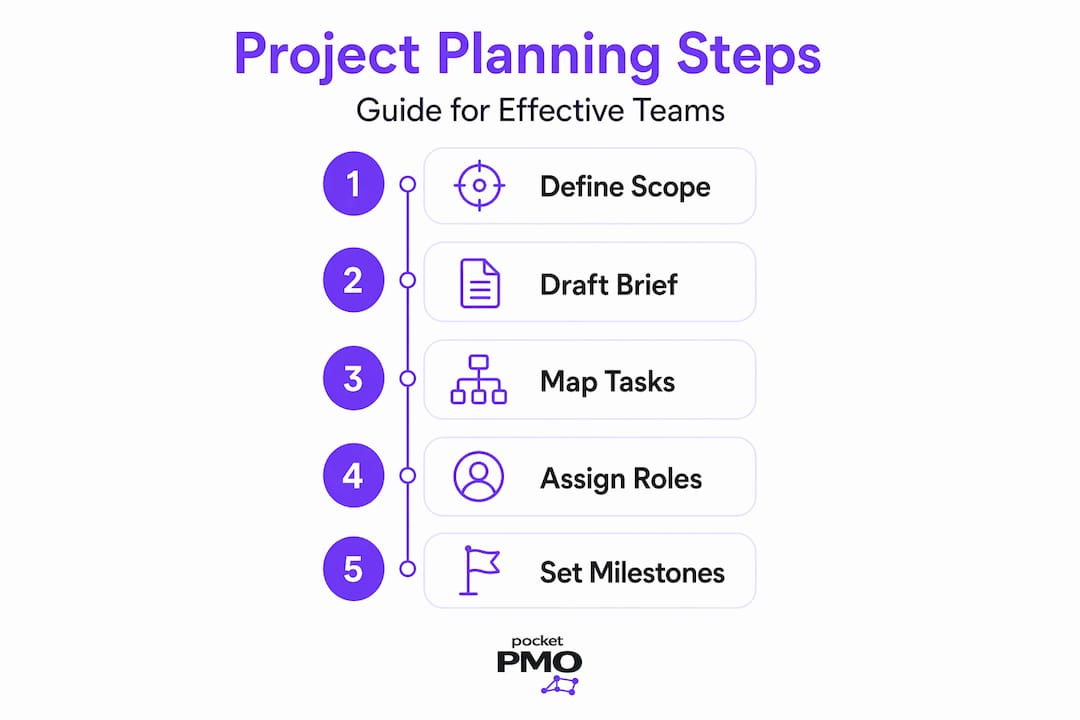
Understanding the project delivery lifecycle gives you a map. Without it, you are solving problems in the wrong order and at the wrong cost.
Building a project plan that holds up
A project plan is not a Gantt chart. A Gantt chart is one output of planning. The plan itself is a set of decisions: what is in scope, who does what, in what order, with what resources, and what happens when things go wrong.
A well-constructed plan covers these elements:
- Scope definition. Every feature, deliverable, and boundary must be written down. Anything not listed is out of scope.
- Work breakdown structure. Break the scope into tasks and sub-tasks until each item is small enough to assign to one person with a clear deadline.
- Project timeline. Map tasks against a calendar. Identify the critical path, which is the sequence of dependent tasks that determines the earliest possible completion date.
- Resource allocation. Assign people, budget, and tools to each task. Check capacity before you commit.
- Risk register. Identify what could go wrong, assess likelihood and impact, and assign an owner to each risk.
- Communication plan. Decide who needs which information, how often, and in what format.
The distinction between planning tools and management tools is worth understanding. Planning tools focus on scope and schedule before work begins. Management tools track progress and issues during execution. Using the wrong category of tool for the wrong phase creates blind spots.
| Planning tool feature | Why it matters |
|---|---|
| Gantt chart with dependencies | Shows the critical path and task relationships clearly |
| Resource load view | Reveals over-allocation before it causes delays |
| Milestone tracking | Provides clear checkpoints to measure forward progress |
| Risk register integration | Keeps risk visible alongside the plan, not buried in a spreadsheet |
| Document linking | Connects RACI charts, budgets, and charters to the central plan |

Project plans linked to key documents such as RACI charts, budgets, and risk logs improve coherence across the team. Everyone works from the same source of truth.
Pro Tip: Set your milestones before you set your task deadlines. Milestones are the commitments that matter to stakeholders. Work backwards from them to stress-test your timeline rather than forwards from your start date.
Writing a project proposal that gets approved
A project proposal is not a formality. It is the document that converts a project idea into a funded, sanctioned piece of work. Treat it as a persuasive argument, not a description.
The core sections every proposal needs:
- Executive summary. Brief, focused, and written last. Decision-makers skim this section and most will not read further. Cover the problem, your approach, the expected outcome, and the cost in 2 to 4 sentences.
- Problem statement. What is broken, missing, or at risk? Quantify it where you can.
- Proposed scope. What will be delivered and, crucially, what will not be. Clear scope language protects you later.
- Project timeline. A high-level view of phases and key milestones. Avoid optimistic compression; a realistic timeline builds credibility.
- Budget. Line-item or summary depending on the audience, but always with justification.
- Team. Who is accountable for delivery? Identifying project team roles at the proposal stage signals that you have thought through execution, not just the concept.
- Risks and mitigations. Acknowledging risk shows maturity. Proposing mitigations shows preparedness. Use a structured risk analysis to strengthen this section.
One common mistake is writing the executive summary first. You will end up summarising what you think the proposal will say rather than what it actually says. Write it last and you will write it better.
If you are preparing a proposal for external funding, note that formal programmes such as the UNDP GEF Small Grants Programme carry maximum funding limits and firm submission deadlines. Proposal discipline is not optional in those contexts.
A strong proposal template can cut drafting time significantly and keep your structure consistent across submissions.
Modern tools for smarter project planning
Choosing the right tool depends on what stage of the project you are in and how complex the work is. For a solo freelancer managing one client project, a simple Gantt tool may suffice. For a team managing a portfolio of interdependent initiatives, you need something with resource views, dependency tracking, and portfolio-level visibility.
The features that make a real difference:
- Timeline visualisation. Gantt-style views help everyone see what is happening and when, without needing to interpret a spreadsheet.
- Resource load views. Spot over-allocation before it becomes a delivery problem. This is one of the most underused planning features across teams of all sizes.
- Scenario planning. Scenario planning tools allow you to compare the impact of timeline or resource changes side by side before altering the live plan. This removes the fear of what-if exploration and improves alignment before decisions are made.
- Portfolio management. When you are running multiple projects simultaneously, portfolio views surface conflicts, priorities, and capacity gaps that are invisible at the individual project level.
- Time tracking integration. Comparing planned versus actual effort reveals where your estimates are consistently wrong, which is the first step to improving future planning.
Scenario planning reduces rework by letting teams test options without touching the baseline. It is one of the more significant advances in modern planning software and is worth prioritising when evaluating tools.
Pro Tip: Before buying any project planning tool, run one real project through it as a trial. Paper evaluations and demo environments never expose the friction you will encounter in practice.
Avoiding the pitfalls that derail delivery
Even well-planned projects hit problems. The difference between teams that recover and teams that collapse is usually preparation, not talent.
One of the most damaging patterns in project work is hero culture, where one person absorbs a disproportionate share of the critical work because responsibilities were never clearly distributed. Resource visualisation tools expose this pattern before it causes burnout or single points of failure.
Monitoring cannot be passive. Set up regular status checkpoints from the start rather than waiting until a missed deadline forces a conversation. Weekly or fortnightly status updates tied to your project timeline keep small deviations visible while they are still manageable. Consistent status reporting builds stakeholder confidence even when things are going wrong, because people trust teams that communicate.
Role clarity is another frequent gap. If two people think they own the same decision, neither of them truly does. A RACI matrix, linked directly to your project plan, removes this ambiguity. Assign one accountable owner per deliverable and keep that assignment visible throughout the project.
Shifting priorities are inevitable on longer projects. Build a change request process before you need it, not after scope creep has already occurred. Teams that track risks proactively rather than reactively give themselves the time and information needed to manage project risks before they become delivery failures.
My honest view on why planning gets skipped
Here is what I have observed repeatedly across projects of all sizes: planning feels like delay. Teams want to move. Stakeholders want to see progress. And so the planning phase gets compressed or bypassed entirely in favour of the visible comfort of people doing things.
The result is almost always the same. Rework. Missed expectations. Scope that grows because it was never fixed. And a team working harder than necessary because the thinking was not done upfront.
What I have learnt is that planning is not a barrier to speed. It is what makes speed possible without sacrificing quality. The teams that plan well do not spend longer on projects. They spend far less time on confusion, correction, and conflict.
I have also seen what happens when role clarity is treated as optional. Two people assume they are making the same decision. Nobody is. And by the time it surfaces, the cost is either delay, rework, or a difficult stakeholder conversation that could have been avoided on day one.
My advice is to treat planning as non-negotiable, even on short projects. A two-week engagement still needs a clear scope, an owner for every task, and an agreed definition of done. The discipline does not scale down with project size. The consequences of skipping it do scale up.
— Danny
Take your project planning further with Pocketpmo
If you recognise the gaps described in this article, whether that is poor resource visibility, inconsistent status reporting, or proposals that lack rigour, Pocketpmo is built to address exactly those problems.
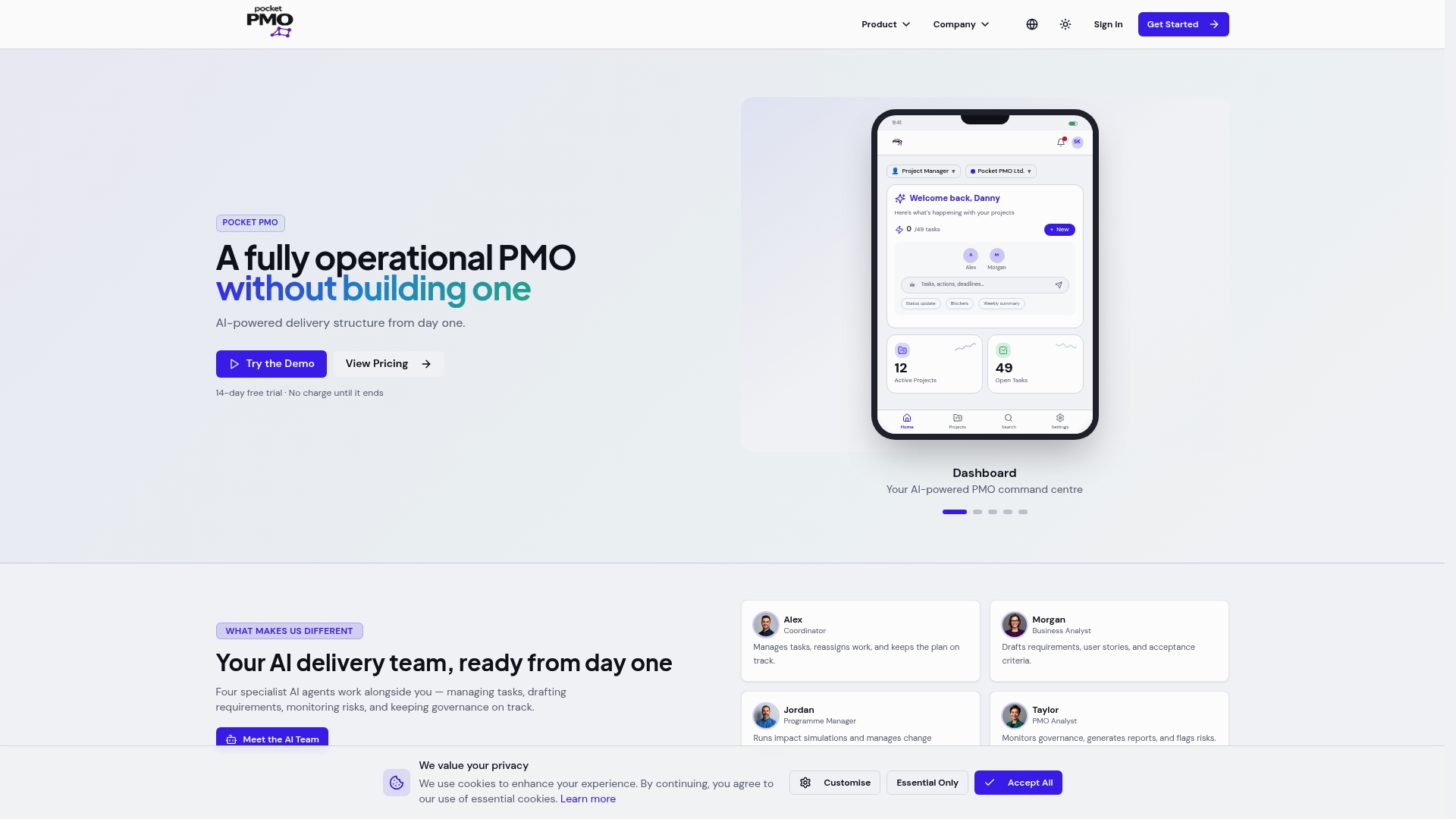
Pocketpmo delivers an AI-powered PMO without the overhead of building one from scratch. You get real-time dashboards, risk tracking, portfolio management, and automated status reporting in a platform that works from day one. If you are currently using tools that were not built for project complexity, it is worth seeing how Pocketpmo compares. Check the Pocketpmo vs Monday.com comparison and the Pocketpmo vs Microsoft Project page to understand where the differences matter most for your team. Or explore the full platform and see what a purpose-built PMO solution looks like in practice.
FAQ
What is a project in project management?
A project is a temporary, goal-directed effort with a defined start and finish date and at least one measurable outcome. It differs from ongoing operations because it has a clear endpoint and a unique deliverable.
What are the key elements of a project plan?
A project plan covers scope, task breakdown, project timeline, resource allocation, risk register, and a communication plan. Linked documents such as RACI charts and budgets are typically attached for central reference.
How long should a project proposal be?
Length depends on the audience and funding requirements, but the executive summary should be no more than 2 to 4 sentences. The full proposal should be as long as it needs to be to cover scope, timeline, budget, team, and risks without padding.
What is scenario planning in project management?
Scenario planning lets teams compare the impact of different timeline or resource options side by side before committing to a change in the live plan. It reduces rework and improves team alignment before decisions are finalised.
How do you prevent scope creep on a project?
Define scope in writing at the start and implement a formal change request process before any additions are agreed. Any work not listed in the original scope document requires a reviewed and approved change request before it enters the plan.