

Project coordinators are frequently dismissed as administrative support, the people who book meetings and chase emails. That view is wrong, and costly. A project coordinator is the operational backbone of effective project delivery, maintaining schedules, documentation, communications, and task alignment across multiple workstreams simultaneously. In AI-driven environments where speed and data volume have both increased dramatically, the coordinator's role has become more strategic, not less. This guide clarifies what coordinators actually do, how AI amplifies their impact, and how executive teams can leverage this function for measurable delivery improvement.
Table of Contents
- Understanding the project coordinator's real value
- Key responsibilities of the modern project coordinator
- How AI amplifies (and complicates) project coordination-project-coordination)
- Operational nuances in regulated and complex environments
- Why treating coordination as information flow is the executive edge
- AI-driven project coordination made effortless
- Frequently asked questions
Key Takeaways
| Point | Details |
|---|---|
| Coordinator vs manager | Project coordinators facilitate daily execution and artefact flow, but do not lead strategic decisions. |
| AI amplifies efficiency | AI-driven tools can automate and accelerate project tracking and reporting when paired with vigilant oversight. |
| Critical in complex settings | Regulated and multi-project environments demand coordinators with advanced compliance and documentation skills. |
| Avoid coordination trap | Do not confuse accelerated coordination with effective leadership; decision accountability must remain paramount. |
Understanding the project coordinator's real value
There is a persistent misconception in executive circles: that coordination is a junior administrative function, a role you fill with a capable graduate and move on. The reality is considerably different. Levels of project management are clearly differentiated, with coordination sitting firmly in the execution support tier while project managers own strategy, decisions, and governance. Understanding this distinction is not semantics. It defines how you resource your delivery capability.
A project manager sets direction, manages stakeholders, and makes strategic calls. A PMO establishes governance standards, portfolio oversight, and reporting frameworks. A project coordinator ensures the day-to-day machinery runs without friction. They track tasks, maintain artefacts, coordinate schedules, and keep communications flowing between teams and leadership.
In multi-project environments, that last function becomes exponentially more demanding. Consider a portfolio of eight concurrent projects, each with its own milestones, dependencies, and stakeholder groups. Without a coordinator managing that connective tissue, updates fall out of sync, dependencies are missed, and project managers spend their time on operational firefighting rather than decision-making.
Explore project coordinator use cases to see how this function manifests across different sectors and portfolio sizes.
| Role | Primary focus | Decision authority | Typical deliverables |
|---|---|---|---|
| Project coordinator | Day-to-day execution support | Low | Schedules, RAID logs, status updates |
| Project manager | Strategy, stakeholder management | High | Project plans, risk registers, delivery roadmaps |
| PMO | Governance, standards, portfolio oversight | Programme level | Reporting frameworks, policies, dashboards |
"A project coordinator supports day-to-day execution by coordinating tasks, schedules, documentation, and communications, working closely with project managers rather than owning overall project leadership."
That operational specificity is exactly why coordinators are indispensable. They do not lead. They enable leaders to lead more effectively, by removing the noise and keeping the signal clear.
Key responsibilities of the modern project coordinator
In practice, the modern project coordinator handles a breadth of responsibilities that would surprise anyone who still thinks this role is primarily about calendar management. In multi-project or programme settings, coordinators act as connective tissue, maintaining recurring status cadence, artefact hygiene, and dependency tracking across workstreams.

Coordinators maintain tracking structures including milestones, dependencies, and RAID logs (Risks, Assumptions, Issues, Dependencies), while keeping stakeholders informed through structured status reporting. These are not minor tasks. In a portfolio environment, a single missed dependency can cause a cascade of delays across multiple projects.
The core responsibilities break down as follows:
- Scheduling and milestone management: Maintaining Gantt charts, tracking milestone completion, and flagging schedule risks before they escalate.
- Documentation and artefact management: Owning the version control of project plans, RAID logs, decision registers, and meeting minutes.
- Status reporting: Producing regular updates for project managers, PMOs, and executive sponsors, ensuring project status reporting is accurate and timely.
- Dependency tracking: Monitoring inter-project dependencies, particularly in portfolio settings where one team's output is another team's input.
- Communication coordination: Routing the right information to the right people at the right time, without creating noise.
- Resource monitoring: Flagging capacity conflicts and resource bottlenecks before they affect delivery timelines.
- Change control support: Logging change requests, tracking approvals, and updating documentation to reflect agreed changes.
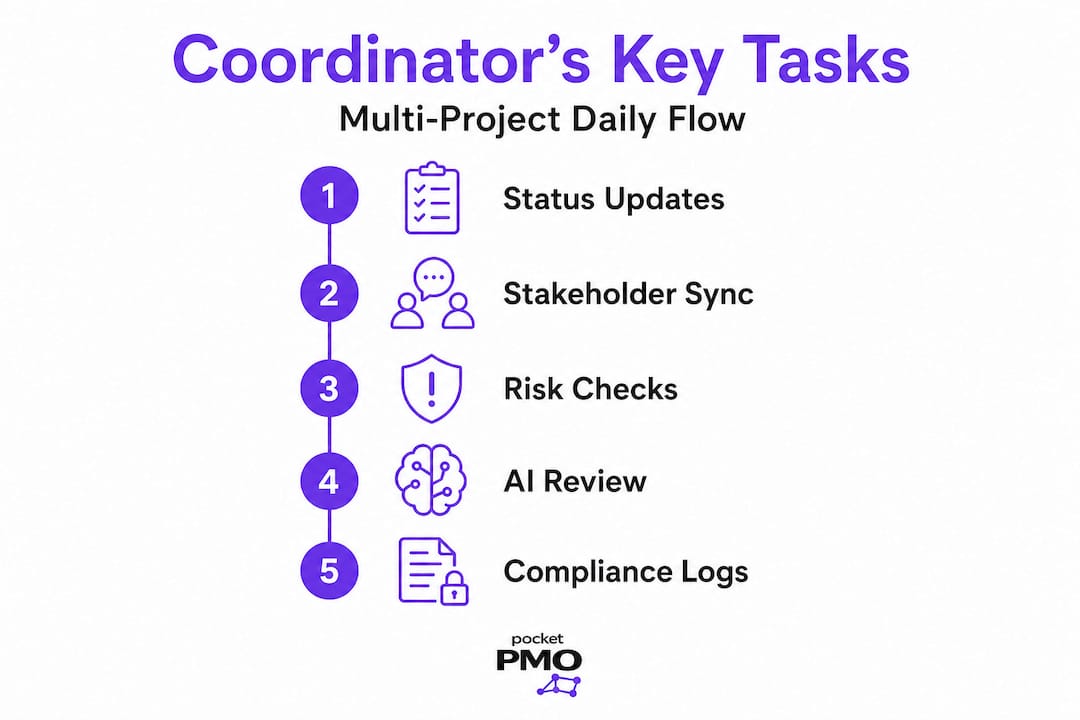
To make this concrete, here is how a coordinator's day unfolds in a large portfolio environment:
- Morning review: Check overnight alerts from project tracking tools, identify any new risks or overdue tasks, and update the RAID log accordingly.
- Status collation: Gather updates from project leads across the portfolio and consolidate them into a single status summary for the PMO or delivery director.
- Dependency review: Cross-reference project timelines to identify emerging dependency conflicts and alert relevant project managers.
- Documentation update: Ensure meeting actions from the previous day are captured, assigned, and tracked to completion.
- Stakeholder communications: Distribute the consolidated status report and follow up on outstanding decisions or approvals.
- End-of-day log: Record any new issues raised during the day, update milestone trackers, and prepare the agenda for the next morning's coordination review.
- Escalation check: Flag any items that require leadership attention before close of business, ensuring decision-makers are never surprised by issues that have been sitting unactioned.
Effective management of multiple projects depends on this kind of disciplined daily rhythm.
| Responsibility | AI-augmented approach | Human oversight needed |
|---|---|---|
| Status reporting | Auto-generated summaries from live data | Contextual interpretation and exception notes |
| RAID log maintenance | Automated risk alerts and updates | Prioritisation and escalation decisions |
| Dependency tracking | Real-time dependency mapping | Impact assessment and mitigation planning |
| Scheduling | AI-driven schedule forecasting | Approval of schedule changes |
| Communication routing | Automated stakeholder notifications | Relationship management and sensitive messaging |
Pro Tip: Use AI automation for routine updates and recurring status summaries, but always require a human coordinator to review exceptions before they are communicated to senior stakeholders. Automated alerts can miss context that changes everything.
How AI amplifies (and complicates) project coordination
AI is reshaping how project coordinators work, and not always in the ways executives expect. The promise is clear: automated reminders, real-time risk detection, instant document generation, and intelligent status summaries. The reality is more nuanced.
On the positive side, AI project tracking delivers genuine efficiency gains for coordinators:
- Automated status summaries: AI pulls data from multiple project tools and generates coherent update reports, reducing the time a coordinator spends collating manually.
- Risk detection: AI models surface anomalies in project data, flagging potential schedule slippage or resource conflicts before they become visible issues.
- Document management: Intelligent platforms auto-tag, version, and retrieve project documents, reducing the administrative burden on coordinators.
- Dependency alerts: AI monitors cross-project dependencies in real time, alerting coordinators when upstream changes threaten downstream delivery.
- Predictive scheduling: AI forecasting tools identify schedule risk earlier, giving coordinators time to escalate and mitigate before impact is felt.
However, executives need to design for alert fatigue and exception handling in AI-augmented coordination. When AI generates hundreds of automated notifications, coordinators stop reading them carefully. Miscommunication can propagate at scale when automation replaces human judgement in interpreting unusual situations.
For multi-project management strategies to succeed with AI, the coordinator function must be framed as an information-flow system, managing status cadence, artefact hygiene, and dependency visibility rather than purely scheduling tasks.
The practical principle is this: AI should accelerate the coordinator's ability to detect and surface information. It should not replace the coordinator's judgement in deciding what that information means or what action is required.
Pro Tip: Configure your AI platform to distinguish between informational alerts and actionable alerts. Coordinators should only receive a notification requiring a response when AI has determined that human intervention is genuinely needed. Everything else should be logged automatically and reviewed on a set cadence.
A useful benchmark: organisations that deploy AI coordination tools without establishing clear exception-handling protocols typically see short-term efficiency gains erode within six months, as alert fatigue sets in and coordinators begin bypassing automated notifications entirely. The tool becomes noise rather than signal.
Operational nuances in regulated and complex environments
Not all project environments are equal. In regulated or high-stakes sectors, including financial services, healthcare, local government, and infrastructure, the project coordinator's role carries additional weight. Compliance is not optional, and documentation failures can have legal or operational consequences.
In these environments, coordinators may be embedded in regulated settings requiring compliance-minded document handling and tool usage, including Microsoft 365, permissioning structures, and full audit trails. This is a materially different operating context from a commercial software delivery team.
The key compliance responsibilities for coordinators in regulated environments include:
- Audit trail management: Every change to a project document, plan, or log must be recorded with a timestamp, author, and reason for change. Coordinators own this discipline.
- Permission management: Access to sensitive project documentation must be controlled and reviewed regularly. Coordinators enforce role-based access and ensure only authorised personnel can view or edit project artefacts.
- Version control: Regulated environments require a clear, unambiguous record of which version of a document was approved and when. Ad hoc document sharing without version control creates compliance risk.
- Retention and archiving: Project records must be retained according to regulatory requirements. Coordinators manage the archiving process and ensure records are retrievable for audit purposes.
- Tool compliance: Not every AI or cloud-based tool is approved for use in regulated environments. Coordinators must operate within approved tool sets and flag any requests to use non-compliant platforms.
- Risk documentation: Risk tracking in complex projects must meet regulatory standards, with evidence of risk identification, assessment, mitigation, and review at each project stage.
"In regulated or specialised environments, coordinators must apply compliance-minded document handling practices and use approved tools with full permissioning and audit trail capability."
Executives leading programmes in regulated sectors should treat the coordinator's compliance function as a risk management asset, not an administrative overhead. A coordinator who maintains impeccable audit trails and document integrity protects the organisation from regulatory exposure that can dwarf the cost of the coordination function itself.
Why treating coordination as information flow is the executive edge
Here is a perspective worth sitting with. Most organisations think of project coordination as task management. They measure it by whether updates are on time and whether the RAID log is current. That framing is too narrow and it costs them.
The real competitive advantage lies in treating coordination as an information-flow discipline, not an administrative one. When coordination is designed to move the right information to the right people with minimal latency and maximum accuracy, it becomes a strategic capability.
Here is the uncomfortable truth: organisations can drift into coordinator-level work at the leadership tier, creating what might be called execution debt. Leaders spend their time collating updates and chasing status rather than making decisions. AI accelerates this problem if it is deployed poorly. Faster coordination throughput without clear decision accountability simply means you get to the wrong answer more quickly.
The executive edge is not in deploying more coordination tools. It is in ensuring that coordination acceleration is paired with clear decision authority. When AI surfaces a risk, someone with the right authority must own the response. When a dependency conflict is flagged, a leader must make the call on priority. Coordination provides the visibility. Leadership provides the judgement.
Pro Tip: Review your governance structure before deploying AI-powered coordination tools. Confirm that every escalation path leads to a named decision-maker with a clear remit. If it does not, you will accelerate information flow into a decision-making vacuum.
This is where organisations that invest in structured coordination outperform those that rely on informal status updates and ad hoc escalations. The discipline of information flow, when properly designed, becomes the operating system of your delivery capability.
AI-driven project coordination made effortless
If this article has highlighted the complexity and criticality of effective project coordination, the natural next question is: how do you build this capability without constructing an entire internal infrastructure from scratch?
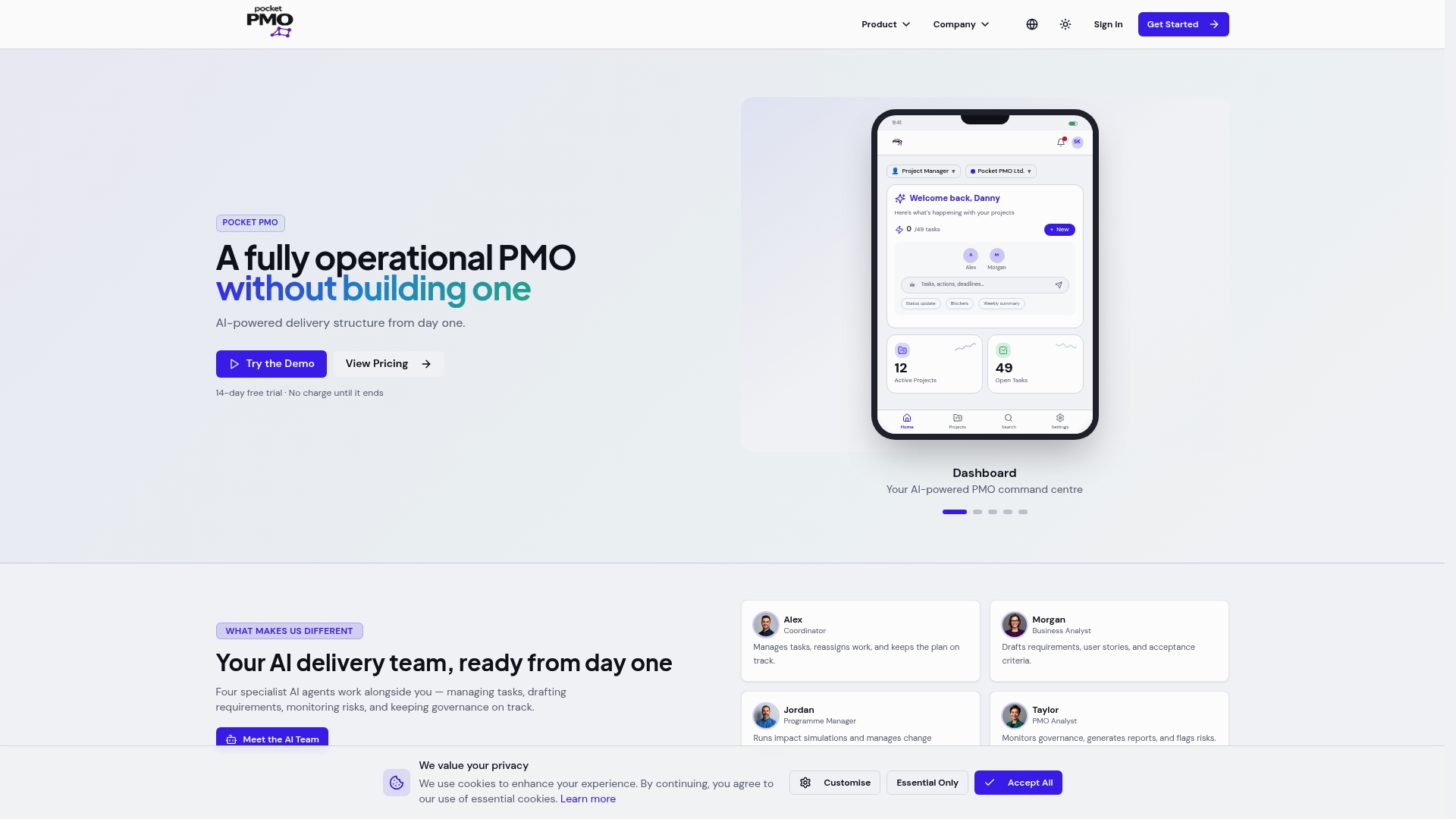
Pocket PMO is designed precisely for this challenge. It delivers an AI-powered PMO and coordination capability from day one, without the need to hire, train, and retain a large coordination team. Real-time dashboards, automated RAID log management, intelligent status reporting, and dependency tracking are all built in. You get the full coordination function, powered by AI, with the governance and audit trail capability that regulated environments demand. Launch Pocket PMO to see how quickly your portfolio can gain the visibility and control it needs. If you are evaluating platforms, explore how Pocket PMO compares to Monday.com for multi-project delivery at scale.
Frequently asked questions
How does a project coordinator differ from a project manager?
A project coordinator focuses on day-to-day execution support, keeping tasks, documentation, and schedules aligned, while a project manager owns strategic decisions and overall project outcomes. The two roles are complementary, not interchangeable.
What tools do project coordinators use in multi-project environments?
They rely on project trackers, RAID logs, Microsoft 365, and AI-driven platforms to schedule work, monitor progress, and manage documents. Coordination artefacts such as milestone trackers and dependency maps are central to their toolkit.
Why is information flow important for project coordinators?
Efficient information flow ensures that status, risks, and dependencies are visible to the right people at the right time. Treating coordination as an information-flow system rather than purely a scheduling function enables faster, better-informed decisions.
What compliance risks must project coordinators manage?
Coordinators must uphold documentation standards, manage access permissions, and maintain full audit trails, particularly in regulated sectors where documentation failures carry legal or operational consequences.
How can AI help project coordinators?
AI can automate routine reporting, detect risks and dependency conflicts in real time, and streamline artefact management. However, organisations must design for exception handling to prevent alert fatigue from undermining the value of automation.