

Managing several high-stakes projects at the same time is one of the most demanding challenges a project manager faces. Deadlines collide, resources get pulled in opposite directions, and a decision made for one initiative can quietly derail another. Traditional single-project thinking simply does not scale. This guide walks you through the full arc from understanding the unique pressures of multi-project environments to building the preparations, execution habits, and verification cycles that keep your portfolio on track. You will find actionable strategies grounded in expert insight and modern AI-driven tools.
Table of Contents
- Understanding the unique challenges of multi-project management
- Preparation: Setting up for multi-project success
- Execution: Optimising workflows across multiple projects
- Verification and continuous improvement
- A fresh perspective: Why simplicity beats complexity in multi-project management
- Get started with seamless multi-project management
- Frequently asked questions
Key Takeaways
| Point | Details |
|---|---|
| Master resource allocation | Efficiently assign people and time to avoid bottlenecks and burnout. |
| Reduce context switching | Batch similar work and use AI tools to minimise productivity loss from hopping between tasks. |
| Standardise processes | Build consistency and speed by using templates, routines, and shared metrics. |
| Act on risks proactively | Consolidate and review risks across the portfolio to prevent issues from spiralling. |
| Continuous improvement | Frequently review and adapt your methods to boost efficiency and outcomes. |
Understanding the unique challenges of multi-project management
The multi-project management process operates on an entirely different level of complexity than managing a single initiative. In a single-project setting, your focus is linear: scope, timeline, budget, team. Add a second, third, or fourth project and those variables multiply exponentially. Dependencies link projects together in ways that are not always visible until something breaks.
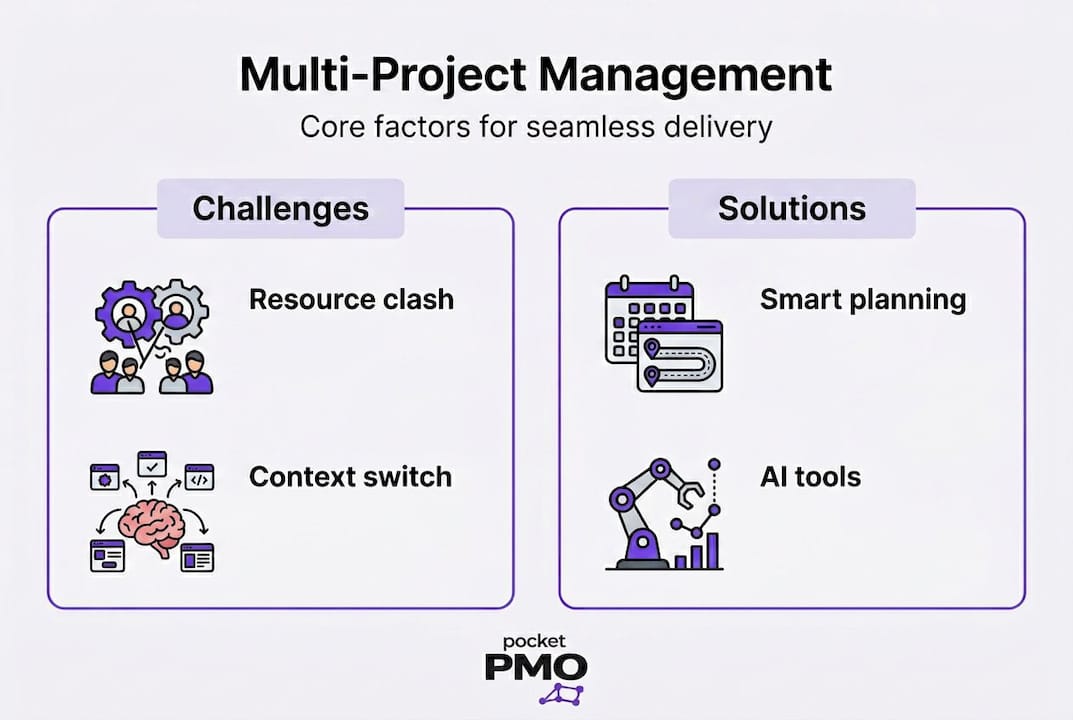
Research into project portfolio management highlights several recurring pain points that resource bottlenecks across projects, interdependencies causing cascades, context switching costs, multitasking inefficiencies, and episodes of regression in portfolio and programme management capability building are the primary drivers of failure in complex multi-project environments. Each of these creates compounding damage when left unmanaged.
The hidden cost of context switching is especially significant. Studies in cognitive science consistently show that switching between tasks can cost as much as 40% of productive time. For project managers running four or five simultaneous initiatives, the mental overhead of re-orientating to a different project, team, and set of priorities multiple times a day is genuinely exhausting and expensive. Mistakes increase. Decisions take longer. Momentum stalls.
Here is a snapshot of how single-project and multi-project management differ on key dimensions:
| Dimension | Single-project management | Multi-project management |
|---|---|---|
| Resource allocation | Contained within one team | Shared across multiple teams and projects |
| Risk management | Focused on one risk register | Requires portfolio-wide risk management |
| Dependencies | Internal milestones only | Cross-project dependencies with cascade potential |
| Reporting | One dashboard or status report | Consolidated portfolio view needed |
| Decision-making | Single project sponsor | Multiple stakeholders with competing priorities |
The most common problems you will encounter include:
- Resource bottlenecks: A skilled architect, data analyst, or developer needed on two projects simultaneously with no clear priority rule.
- Risk cascades: A delay on one project's deliverable blocks a dependency in another, triggering a chain reaction across the portfolio.
- Context switching fatigue: Teams and managers lose significant productivity through repeated mental reorientation.
- Misaligned priorities: Without a unified prioritisation framework, teams default to whoever shouted loudest last.
- Invisible dependencies: No one maps how Project A's outputs feed Project B's inputs until a crisis occurs.
"Managing multiple projects is not simply doing project management several times over. It requires a fundamentally different operating model, one built around visibility, portfolio-level decision-making, and proactive coordination." — Project portfolio management research
Stronger visibility and smarter planning tools are not optional extras in this environment. They are the foundation everything else rests on.
Preparation: Setting up for multi-project success
Once you know the hurdles, it is essential to lay solid groundwork for success before diving in. The temptation to rush straight into execution is real, especially when stakeholders are already applying pressure. Resist it. The time you invest in preparation pays back many times over.
Expert guidance on portfolio and programme management emphasises the importance of
, consolidating risks portfolio-wide, standardising tools and metrics, delegating based on skills, and using sensemaking for PPM adoption. These are not abstract principles. They are concrete preparation decisions you can make before your first cross-project stand-up.Here is how to build a solid foundation:
-
Choose the right collaboration tools. Legacy project management suites designed for single projects often buckle under multi-project complexity. AI-enabled platforms provide real-time dashboards, automated status updates, and predictive analytics that surface problems before they become crises. When evaluating tools, ask whether they support portfolio-level views, resource calendars, and cross-project dependency mapping.
-
Build a unified resource calendar. Every person, every hour, every skill set should be visible in one place. Map out team availability, existing commitments, and planned leave across all projects. This single step eliminates a significant proportion of resource bottlenecks before they materialise.
-
Define standard KPIs across all projects. Consistency matters enormously when you are comparing progress across initiatives with different sponsors, scopes, and timelines. Agree on a shared set of metrics such as schedule performance index (SPI), cost performance index (CPI), risk score, and milestone completion rate. Using standardised project templates ensures every project starts from the same baseline, making portfolio-level reporting far more straightforward.
-
Synchronise project schedules. Lay all project timelines side by side and identify where critical path milestones coincide. Stagger resource-intensive phases where possible. A small adjustment at planning stage can prevent a major collision two months into delivery.
-
Adopt sensemaking for tool and process onboarding. Sensemaking refers to the practice of helping teams understand why a new tool or process exists, not just how to use it. Teams that understand the rationale behind standardised workflows adopt them faster and maintain them more consistently.
Pro Tip: Pair your resource calendar with AI-driven project tracking to receive automated alerts when allocation thresholds are approaching. This means you act before a bottleneck forms, rather than reacting after the damage is done.
Compare how legacy and AI-enabled approaches perform across key preparation activities:
| Preparation activity | Legacy suite | AI-enabled platform |
|---|---|---|
| Resource visibility | Manual spreadsheets, updated periodically | Real-time, automated resource dashboard |
| Risk consolidation | Separate risk registers per project | Unified portfolio risk view with AI scoring |
| Status reporting | Manually compiled, often delayed | Auto-generated reports with predictive insights |
| Dependency mapping | Diagrammed manually | Automatically surfaced from task data |
| KPI standardisation | Custom per project | Template-driven, consistent across portfolio |
The contrast is stark. AI-enabled platforms do not just speed up what legacy suites do slowly. They make entirely new levels of visibility and proactive management possible.
Execution: Optimising workflows across multiple projects
With robust preparations in place, effective execution becomes the critical next step. This is where your planning either holds or falls apart. Execution in a multi-project environment demands discipline, clear communication, and the right tools working in the background.
Follow these steps to keep your portfolio moving efficiently:
-
Synchronise task priorities every week. Hold a brief portfolio-level review at the start of each week. Confirm which projects have the highest strategic priority and align task scheduling across teams accordingly. This prevents individuals from defaulting to whichever project feels most urgent rather than most important.
-
Use time blocking to reduce switching. Allocate focused blocks of time for specific projects rather than allowing team members to hop between initiatives reactively. Research on time blocking to minimise switching confirms that grouping similar work reduces cognitive load and improves output quality.
-
Consolidate risk management at portfolio level. Do not manage risk registers in isolation. Pull all risks into a single consolidated view so you can see when multiple projects face similar threats, enabling a coordinated response. AI-powered platforms can automatically rank and cluster risks by severity and likelihood.
-
Delegate based on verified strengths. Effective delegation is not just about workload distribution. Assign tasks to the people whose skills match them most closely. When you are managing project requirements across multiple workstreams, matching the right person to the right requirement dramatically reduces rework.
-
Monitor for early warning signs of over-allocation. Watch for tell-tale indicators: consistently missed micro-deadlines, declining update quality in status reports, or team members repeatedly flagging that they are stretched. Act on these signals early.
Pro Tip: Use the multi-project features within your platform to set automated threshold alerts. When a team member's allocation exceeds 80%, the system flags it for review before it becomes a delivery risk.
The most common execution mistakes in multi-project environments include:
- Failing to escalate conflicts. When two projects compete for the same resource and no one escalates to the portfolio level, both projects lose.
- Allowing priority drift. Without a weekly reaffirmation of priorities, teams gradually drift toward the loudest stakeholder rather than the most strategic need.
- Under-communicating across project teams. Silos form quickly. Build in cross-project communication checkpoints, even brief ones, to maintain shared awareness.
- Ignoring dependency updates. A dependency mapped at the start of a project may shift as delivery evolves. Review and update dependency maps regularly, not just at initiation.
- Over-relying on status reports alone. Status reports capture what happened. AI-powered analytics predict what is about to happen. Use both.
Disciplined execution, supported by smart automation, is what separates portfolios that hum from ones that constantly firefight.

Verification and continuous improvement
To ensure ongoing success and avoid regressions, effective verification is essential. Many project managers invest heavily in planning and execution but treat the review cycle as an afterthought. That gap is where portfolios quietly deteriorate.
Regular verification across your portfolio involves more than checking whether milestones were hit. It means examining how delivery happened, what friction emerged, and what systemic changes would make the next cycle smoother. Research on PPM capability building highlights that episodes of regression in portfolio management capability are common when organisations skip this reflective step.
Use this framework for structured verification:
- Review KPIs against targets fortnightly. Compare actual SPI and CPI against your baseline for every project. Look for consistent underperformance, not just one-off blips.
- Assess context switching and bottleneck patterns. Where did team members lose productive time to unplanned switching? Which resources were consistently over-allocated? Use this data to adjust future planning.
- Run structured retrospectives. Invite honest feedback from team members on what worked, what did not, and what they needed but did not have. Psychological safety matters here. People share the most useful information when they are not afraid of the response.
- Document lessons in a shared knowledge base. Every lesson learned that is not captured is a lesson that will need to be learned again. Build a simple, accessible repository and make contributing to it part of your project close-down process.
- Update standard practices iteratively. If your retrospectives consistently surface the same issue, it is a signal to change the standard, not manage the exception repeatedly.
"Continuous improvement in portfolio management is not a phase. It is a discipline embedded in every delivery cycle, every review, and every decision about how work gets done."
Visiting the Pocket PMO blog regularly gives you access to evolving best practice, case studies, and practical guidance that keeps your verification process current. Exploring the full suite of portfolio management features can also reveal automation opportunities you have not yet activated.
Common mistakes to avoid in this phase:
- Ignoring the hidden cost of multitasking. If your retrospectives never surface context switching as a concern, you are probably not asking the right questions.
- Failing to update standard practices. Lessons identified but not acted upon are worse than useless. They erode trust in the review process itself.
- Reviewing outcomes without reviewing processes. A project can hit its deadline by burning out the team. Healthy delivery requires examining both results and the way those results were achieved.
A fresh perspective: Why simplicity beats complexity in multi-project management
Stepping back, it is worth considering what really makes multi-project management work in the field. The instinct, particularly when adopting new technology, is to add more. More dashboards. More integrations. More governance gates. More reporting layers. In practice, the teams that manage multiple projects most effectively tend to do fewer things better.
Layering tools and processes onto a fundamentally unclear operating model does not create clarity. It creates noise. The best multi-project managers we observe share three traits: they communicate relentlessly, they automate the repetitive and predictable, and they protect the time and attention of their teams with genuine discipline.
Sensemaking matters far more than most organisations acknowledge. When your team understands why they are using a particular workflow, they maintain it. When they feel it was imposed without rationale, they work around it. Simple standards that people actually follow outperform sophisticated frameworks that gather dust.
The most effective use of AI in multi-project management is not to create more reports. It is to eliminate the manual effort that stops project managers from thinking clearly. Explore multi-project adoption tips to see how a focused, well-adopted setup delivers far more than a sprawling one. Automate, delegate, and focus relentlessly on what creates results, not what adds administrative weight.
Get started with seamless multi-project management
Ready to apply these practices with the help of a purpose-built solution? Managing multiple projects should not mean managing multiple headaches.
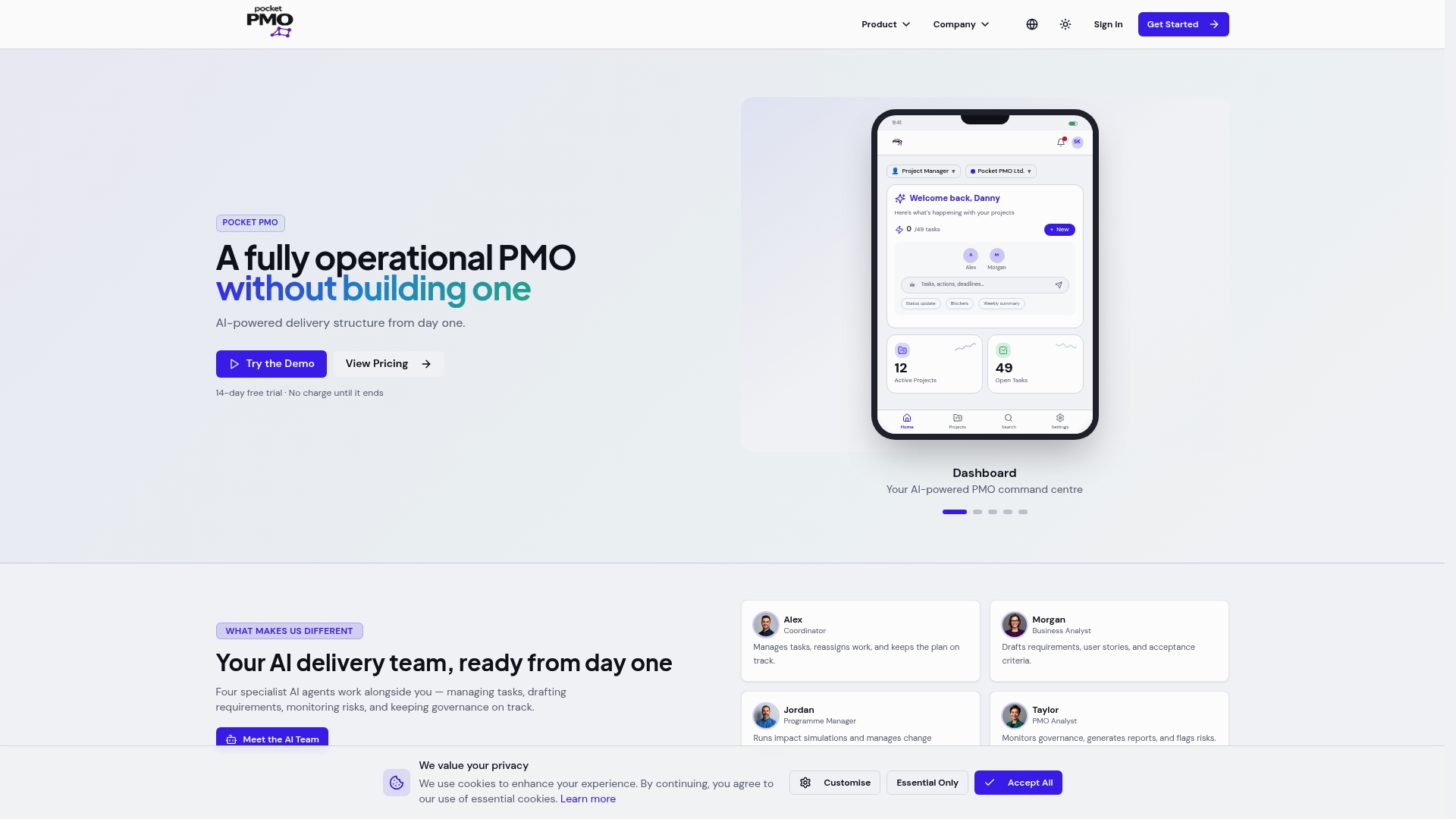
Pocket PMO delivers the centralisation, real-time visibility, and intelligent automation that project managers and PMOs need to run complex portfolios with confidence. You do not need to build a PMO from scratch or invest months in configuration. The platform is designed to work from day one, with AI-powered risk analysis, portfolio dashboards, delegation tools, and automated status reporting built in. Browse real-world multi-project use cases to see how teams like yours are already benefiting, and when you are ready, launch a PMO solution that grows with your organisation.
Frequently asked questions
How can I avoid resource bottlenecks when managing multiple projects?
Use resource allocation tools and maintain a single, unified resource calendar across all projects to detect bottlenecks early, then review workloads regularly and act before conflicts become critical.
What's the best way to handle shifting priorities in a multi-project environment?
Time blocking and AI-driven prioritisation create structured focus periods and surface the most strategically important work, while clear communication with stakeholders prevents last-minute priority overrides from derailing delivery.
How do AI tools improve multi-project management?
AI tools automate reporting, optimise resource use, and flag risks proactively, drawing on standardised tools and metrics to give you a consistent, real-time view of your entire portfolio rather than isolated project snapshots.
Can standardising project templates really save time across projects?
Yes, standardised templates reduce setup time significantly and ensure every project feeds data into a consistent reporting framework, making portfolio-level tracking and comparison far more efficient from the outset.