

Most executives who encounter AI-powered Project Management Offices (PMOs) for the first time assume they are paying a premium for better-looking dashboards. That assumption is costly. When built on the right frameworks, an AI-powered PMO fundamentally changes the speed, rigour, and enforceability of project governance across your entire portfolio. This article cuts through the noise, contrasts the models that actually work, examines the governance frameworks shaping responsible adoption, and gives you a practical, evidence-based roadmap for capturing real value from AI in your PMO.
Table of Contents
- What is a PMO and how does AI change the landscape?
- AI-powered governance: frameworks, ethics, and practical roles
- How AI transforms risk management and decision-making
- Automation, data quality, and real-world ROI for PMOs
- Edge cases and pitfalls: where AI PMOs go wrong
- A modern PMO is more than dashboards: what most leaders miss
- Explore next-generation PMO solutions for efficiency and governance
- Frequently asked questions
Key Takeaways
| Point | Details |
|---|---|
| AI empowers proactive PMOs | AI enables PMOs to move from static oversight to dynamic governance with faster risk response. |
| Frameworks matter for trust | Structured governance and human oversight are critical for ethical and effective AI use. |
| Real ROI is achievable | Automation with AI delivers measurable benefits in data quality and team efficiency, but scrutiny of vendor claims is essential. |
| New pitfalls emerge | AI introduces challenges like 'governance theatre' and dashboard overload, requiring adaptive, not rigid, controls. |
What is a PMO and how does AI change the landscape?
To understand how AI redefines PMO value, it is important to revisit the core types and their roles in large organisations.
A Project Management Office is the organisational function responsible for defining, maintaining, and enforcing project delivery standards. In most enterprises, PMO models fall into three broad categories, each with a different degree of authority over project teams.
PMOs are described in terms of standardised governance and process enablement, with organisational modes ranging from supportive to directive based on how much authority the PMO exercises. The three core models break down as follows:
- Supportive PMOs provide templates, guidance, and best-practice resources. Project teams adopt them voluntarily.
- Controlling PMOs require compliance with frameworks and conduct compliance reviews, but stop short of directing work.
- Directive PMOs assign project managers, allocate resources, and take direct ownership of delivery outcomes.
Understanding where your organisation sits on this spectrum matters enormously when you introduce AI, because the impact is not uniform across all three types. The table below illustrates how AI augments each dimension of PMO operation.
| Dimension | Traditional PMO | AI-augmented PMO |
|---|---|---|
| Governance authority | Manual enforcement, periodic review | Real-time alerts, automated escalation |
| Data use | Spreadsheets, static reports | Integrated data pipelines, live dashboards |
| Risk detection | Reactive, schedule-based | Continuous monitoring, predictive signals |
| Adaptability | Slow, change-request-driven | Dynamic policy updates, machine-learning models |
| Decision speed | Days to weeks | Hours to minutes |
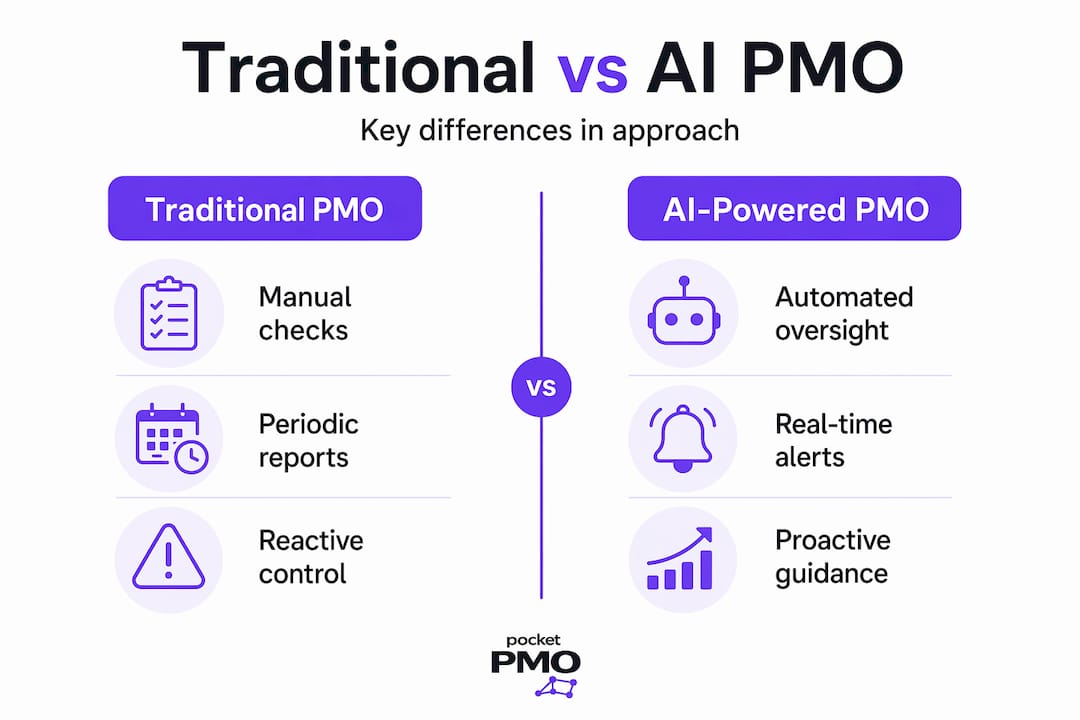
AI integration moves PMOs from periodic monitoring to proactive, insight-driven governance. Rather than waiting for a weekly status report to reveal a schedule slip, an AI-enabled PMO flags the risk as it emerges in the project data. This shift has direct operational consequences for how leaders prioritise their attention and allocate resources.
Here is how AI specifically addresses the pain points most common in legacy PMOs:
- Speed: Automated data aggregation eliminates the lag between project activity and management awareness.
- Accuracy: AI reduces manual transcription errors and inconsistent data entry that plague spreadsheet-based reporting.
- Decision enforceability: Automated workflows ensure that governance decisions trigger the right actions without relying solely on individual project managers to self-report compliance.
AI-powered governance: frameworks, ethics, and practical roles
With basic PMO types and AI's impact outlined, we next examine the frameworks governing these AI-powered environments and the new ethical challenges they create.
The Artificial Intelligence Project Governance Framework (AIPGF) has emerged as the most structured response to the unique control requirements of AI-enabled projects. Unlike traditional project governance frameworks, the AIPGF treats AI governance as methodology-independent, meaning it can sit on top of any delivery approach from Agile to waterfall. Critically, it focuses on managing AI-specific risks such as black-box behaviour, algorithmic bias, and data privacy concerns, all with prescribed human oversight requirements.
These are not abstract concerns. Black-box risk refers to situations where an AI model produces a recommendation or alert that the team cannot explain or trace to a specific input. In high-stakes programme decisions, an unexplainable output is not just unhelpful; it can actively undermine confidence in the entire governance process.
"The governance challenge in AI-driven PMOs is not simply whether a dashboard is accurate, but whether decision-makers can interrogate, challenge, and override AI outputs without breaking the system's integrity. Human oversight is not optional; it is the accountability mechanism that gives AI-powered governance its authority."
The table below summarises the key roles and human oversight touchpoints that a well-structured AI governance model should define.
| Role | Responsibility | Oversight touchpoint |
|---|---|---|
| AI governance sponsor | Strategic accountability for AI model outcomes | Quarterly model performance review |
| Data steward | Data quality, provenance, and lineage | Continuous data validation reports |
| Risk owner | Validates AI risk outputs against lived project context | Weekly risk register sign-off |
| Delivery assurance lead | Challenges AI recommendations before escalation | Pre-escalation review gate |
| Ethics reviewer | Audits for bias, fairness, and compliance | Bi-annual independent audit |
Practising AI governance best practices in your organisation means assigning these roles explicitly, not assuming that general project governance covers them. The ethical dimension is particularly important when AI is influencing resource allocation or supplier decisions, where bias in training data can produce systematically unfair outcomes.
How AI transforms risk management and decision-making
Having tackled governance and ethics, let us now focus on the operational backbone: how AI changes risk management in practice.

Traditional PMO risk management operates on a static, schedule-driven cycle. A project team updates a risk register every two weeks, a PMO analyst compiles it into a report, and leaders review it at a monthly governance meeting. By that time, the risk landscape has already shifted. AI-enabled risk management moves from these periodic reviews to continuous, dynamic evaluation and faster response actions, with an emphasis on data readiness, integration architecture, and model validation.
In practice, an AI-powered risk response follows a structured sequence:
- Data ingestion: The AI model continuously pulls from project scheduling tools, financial systems, and team collaboration platforms.
- Anomaly detection: The model identifies deviations from baseline patterns, such as cost burn rates trending above forecast or milestone completion velocity slowing.
- Risk scoring and prioritisation: Each risk is automatically scored and ranked based on probability and impact, using historical project data as the calibration reference.
- Alert generation: High-priority risks trigger automated alerts routed to the relevant risk owner and sponsor.
- Response tracking: Mitigation actions are logged, tracked, and their effectiveness is fed back into the model to improve future predictions.
- Audit trail maintenance: Every alert, decision, and response is time-stamped and stored for governance review.
Reviewing AI risk analysis methods reveals that the most common failure point is not the algorithm itself; it is poor data provenance. When the inputs feeding the model are inconsistent, incomplete, or drawn from siloed systems with conflicting data definitions, the outputs cannot be trusted regardless of how sophisticated the model is.
Pro Tip: Insist on explainable AI (XAI) capabilities in any PMO platform you evaluate. If your team cannot see why a risk has been flagged or how a recommendation was generated, you lose the human oversight that makes AI-powered governance legitimate. Explainability is not a nice-to-have feature; it is the foundation of accountability.
Robust change logs and model validation cycles are equally non-negotiable. Every time a project's scope, team, or systems integration changes, the model must be re-validated to confirm that its baseline assumptions still hold. Skipping this step is one of the most common causes of risk output failures in complex multi-project environments.
Automation, data quality, and real-world ROI for PMOs
Now that risk and control aspects are clear, let us examine how automation influences efficiency, data quality, and the measurable business case for AI-based PMOs.
The efficiency gains reported by organisations adopting AI in their PMOs are striking. Vendors and early adopters have reported data quality improvements including errors dropping by 80% within six weeks, forecast accuracy improving from 73% to 96%, and manual reporting effort reducing by 70 to 80%. One case study cited savings of over 3,200 hours of manual data handling in a single year.
These figures represent what is achievable in well-prepared environments. The practical automations driving these results include:
- Automated data quality checks: AI flags incomplete fields, inconsistent data formats, and duplicate entries before they contaminate reporting outputs.
- Natural language processing (NLP) bots: Teams interact with project data via conversational interfaces, reducing the time needed to locate status information or generate summary reports.
- Real-time portfolio dashboards: Live views across the full project portfolio replace static slide decks, giving executives an always-current picture of delivery health.
- Auto-generated status reports: AI compiles milestone updates, risk summaries, and financial variances into structured reports, cutting the manual effort involved in weekly reporting cycles.
- Change request workflow automation: Approval chains are enforced automatically, with AI flagging impacts on scope, cost, and schedule before sign-off.
Reviewing smart reporting in AI-driven PMOs shows that organisations realising the highest returns share one characteristic: they invest in data integration architecture before they invest in AI tooling. The automation is only as effective as the data flowing into it.
Pro Tip: Before accepting vendor ROI claims at face value, ask for the baseline methodology. Most figures come from customer testimonials or vendor-produced case studies rather than independent benchmarks. Validate reported efficiency gains against your own PMO's current cost per report, error rate per project cycle, and manual hours per portfolio review. That comparison will give you a realistic expectation for your context.
Edge cases and pitfalls: where AI PMOs go wrong
While AI enables new efficiencies and controls, it also introduces new risks and opportunities for failure if not thoughtfully managed.
"Governance theatre" is perhaps the most insidious failure mode in AI-powered PMOs. It refers to the situation where governance processes appear rigorous because dashboards are populated and alerts are firing, but decision rights are not actually enforceable and no one is held accountable for acting on them. The system looks effective while producing no real improvement in delivery outcomes.
Common pitfalls to watch for include:
- Cosmetic compliance: Project teams learn which data points trigger alerts and game the inputs to avoid flags, without addressing the underlying issues.
- Dashboard overload: Executives are presented with dozens of metrics but given no clear signal about which ones require action. Volume of information replaces clarity of insight.
- One-size-fits-all controls: The same governance rigour is applied to a two-week internal project and a two-year, multi-supplier programme, creating excessive bureaucracy in the former and insufficient controls in the latter.
- Lack of feedback loops: AI models are deployed but never updated based on actual project outcomes, causing them to drift further from reality over time.
- Absent human challenge: Teams defer entirely to AI outputs without questioning whether the model's assumptions reflect current project conditions.
"Governance that cannot be adapted to the risk profile and complexity of each project will either strangle low-risk initiatives with bureaucracy or fail to protect high-risk programmes from the control failures they actually need protection against."
Addressing PMO governance pitfalls starts with a frank audit of how decisions are actually made versus how the governance model says they should be made. If the gap is large, no AI tool will close it without leadership commitment to genuine accountability.
Leaders who want to build a strategic PMO with AI must treat governance design and culture as the primary investment, with tooling as the enabler rather than the solution.
A modern PMO is more than dashboards: what most leaders miss
Synthesising the practical, ethical, and operational findings above, here is a perspective on where the real differentiator lies in successful AI-powered PMOs.
The organisations that extract lasting value from AI in their PMOs are not necessarily those that select the most advanced platforms. They are the ones whose leadership actively questions the models, challenges the outputs, and builds feedback mechanisms between what the AI recommends and what actually happens on the ground.
This is harder than it sounds. It requires a culture of operational humility, where leaders acknowledge that a model trained on historical data may not fully capture the dynamics of a novel programme. It means enforcing feedback loops between project realities and digital controls, so that when a risk prediction proves wrong, the team investigates why and updates the model rather than quietly moving on.
The uncomfortable truth is that most AI PMO failures are not technology failures. They are governance culture failures. Organisations resist changing their control structures, accountability mechanisms, and decision-making habits to match the new environment that AI creates. They adopt the tooling but keep the old behaviour, and then wonder why the dashboards are not driving better outcomes.
Reviewing PMO best practices for AI consistently points to the same conclusion: success depends less on which platform you choose and more on whether your organisation is genuinely prepared to act on what the platform tells you. That readiness is a leadership question, not a procurement question.
Explore next-generation PMO solutions for efficiency and governance
For leaders ready to move from concept to application, expert-reviewed AI PMO solutions can accelerate the journey significantly. The principles covered in this article, from governance frameworks and ethical oversight to risk automation and data quality, are not theoretical ideals. They are capabilities you can deploy and operationalise today.
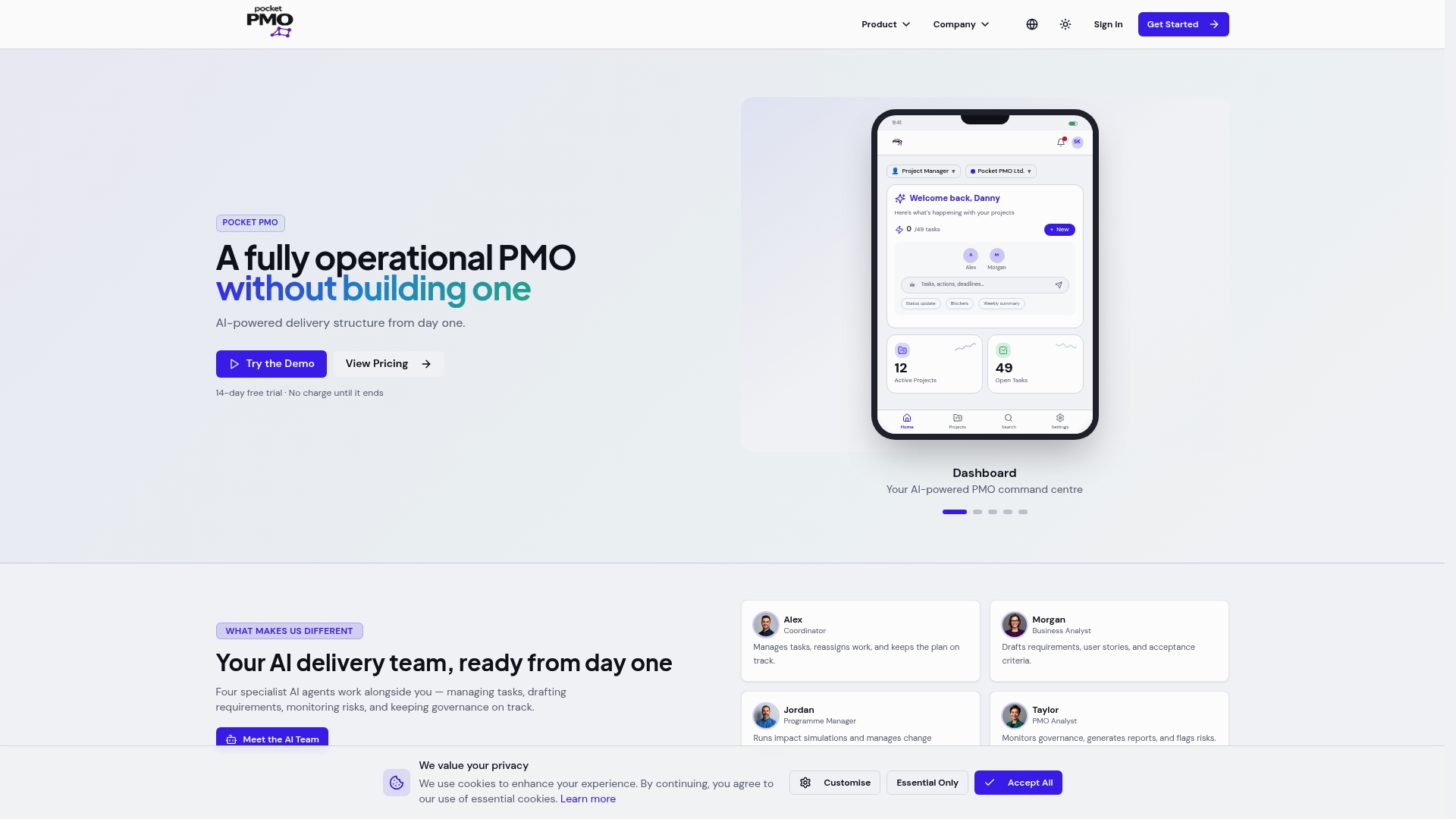
Pocket PMO is built to bridge the gap between strategic PMO intent and practical, day-one delivery. Whether you are evaluating options or ready to act, you can compare how Pocket PMO's AI-powered capabilities position against other platforms, such as reviewing Pocket PMO vs Monday.com to understand the governance and risk management depth on offer. When you are ready to move forward, you can deploy a fully operational PMO without the overhead of building internal capability from scratch. Start with real governance, real automation, and real results.
Frequently asked questions
What are the main types of PMOs, and which fits best with AI integration?
PMOs range from supportive to directive depending on the authority they exercise over project teams, but AI can be applied across all models. The most transformative gains typically emerge in directive PMOs where project control is highly centralised and AI can enforce governance at scale.
How does AI help a PMO manage project risks more effectively?
AI shifts risk management from static, periodic reviews to real-time updates and predictive alerts, which improves both response speed and accuracy as project conditions change.
Are there risks or downsides to adopting AI-powered PMO tools?
Key risks include governance theatre where decision rights are unenforced, dashboard overload that obscures rather than clarifies, and rigid controls that fail to adapt to varying project complexity. Constant model validation and human oversight are essential to managing these risks.
What measurable ROI has been seen with AI-driven PMOs?
Reported results include data quality error reductions of up to 80%, forecast accuracy improvements from 73% to 96%, and reporting effort reductions of 70 to 80%, though most figures come from vendor sources rather than independent research.
Which frameworks lead in ethical AI governance for PMOs?
The AIPGF offers methodology-independent guidance that designates clear human oversight roles and specifically addresses AI risks such as bias, black-box behaviour, and data privacy, making it the leading structured framework for ethical AI governance in project environments.