

Artificial intelligence technology is no longer a distant prospect for project managers and PMO leaders. It is already embedded in daily workflows, risk reporting, and portfolio decisions across thousands of organisations. Yet the gap between adopting AI and actually benefiting from it remains surprisingly wide. This guide cuts through the noise to give you a clear picture of where AI stands today, why so many implementations stall, what governance frameworks you need to know, and how to build an implementation strategy that delivers measurable results from the start.
Table of Contents
- Key takeaways
- The current state of AI in business
- Why AI ROI is harder than it looks
- AI governance and risk management
- Implementing AI in project management
- Sustaining AI benefits over the long term
- My honest take on AI adoption
- How Pocketpmo supports AI-driven project delivery
- FAQ
Key takeaways
| Point | Details |
|---|---|
| Adoption is rising fast | AI adoption doubled in Canadian firms in a single year, but most organisations are still experimenting rather than integrating. |
| ROI requires systemic change | Individual productivity gains do not translate to enterprise returns without end-to-end workflow integration and clear measurement. |
| Governance is non-negotiable | Frameworks like NIST AI RMF and ISO/IEC 42001 provide the structure needed to manage AI risk reliably across project lifecycles. |
| Start with microservices | Deploy AI as discrete, bounded functions with ROI validation gates rather than attempting full-scale rollouts from day one. |
| Skills gaps slow progress | Most employees need upskilling to use AI effectively, and organisational support remains patchy across most sectors. |
The current state of AI in business
The numbers tell an interesting story. AI adoption in Canadian firms reached 12.2% in 2025, roughly double the rate from the previous year, with a further 14.5% of firms planning to adopt within 12 months. That trajectory is steep. What makes these figures particularly useful is the data on why adoption succeeds. Firms with strong data analytics capabilities saw adoption rates jump by 15 percentage points compared to those without. Cloud computing added 2.8 percentage points, and robotics added 8.1 percentage points. The message is clear: AI does not perform in isolation.

At the individual level, the picture is even more striking. 79% of Canadian adults who used generative AI at work reported meaningful productivity gains. That is a compelling statistic. But dig deeper and you find that 83% acknowledged needing upskilling to use it effectively, and only 48% felt their organisation provided adequate support.
What are people actually using AI for? The honest answer is mostly writing and analysis. AI is predominantly used for productivity assistance such as drafting documents, summarising reports, and analysing data rather than replacing full workflows or entire roles. This matters for project managers because it means the biggest near-term gains come from applying AI to discrete, well-defined tasks rather than expecting it to manage entire projects autonomously.
| AI use case | Typical benefit | Adoption maturity |
|---|---|---|
| Document drafting and summarising | Time saving on routine reporting | High |
| Data analysis and forecasting | Improved decision accuracy | Medium |
| Risk identification and flagging | Earlier issue detection | Medium |
| Full workflow automation | End-to-end efficiency | Low |
| Autonomous project management | Reduced human oversight | Very low |
Why AI ROI is harder than it looks
Here is the uncomfortable reality. 93% of Canadian business leaders report using AI, yet only 31% have fully integrated generative AI into core workflows. More telling still, just 2% are seeing strong ROI. The majority who do report returns see only 5 to 20% improvements, which is modest given the investment involved.
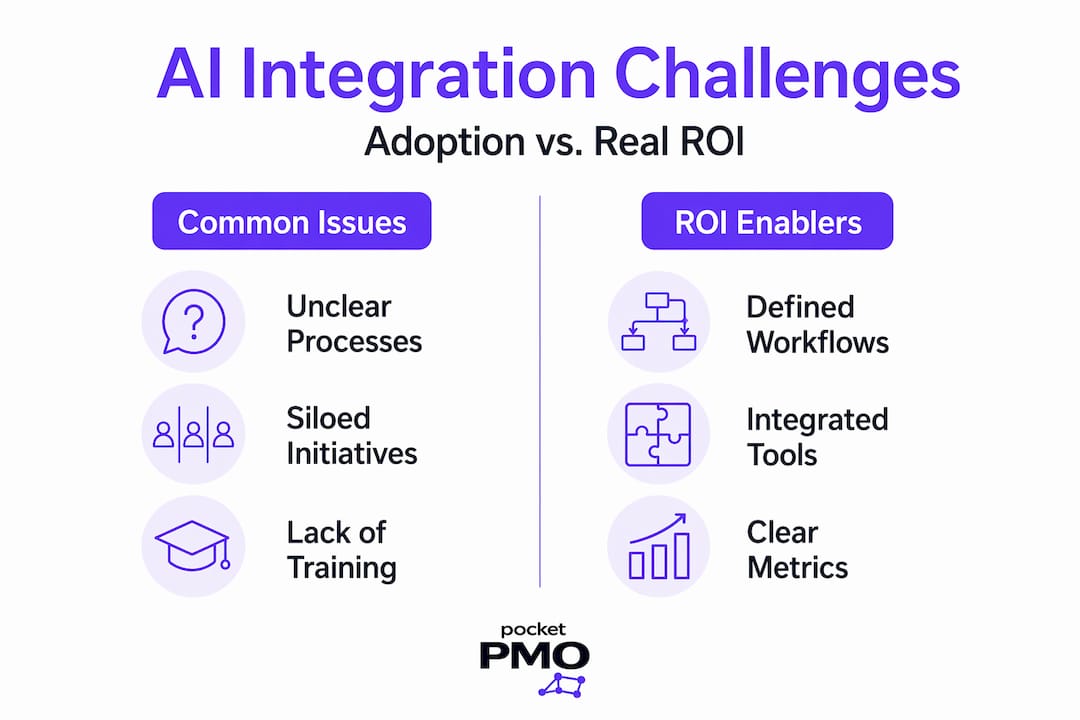
The root cause is a pattern KPMG describes as "feature buying without workflow binding." Organisations purchase AI tools, run pilots, and then fail to embed those tools into the actual processes that drive value. The AI sits alongside the workflow rather than inside it. Twenty percent of firms are still in the pure experimentation phase, which means they are generating learning but not returns.
For project management teams, this shows up in a specific way. A team might adopt an AI tool for status reporting but continue to manually compile data from five different sources before feeding it in. The AI handles the last 10% of the task while the other 90% remains unchanged. That is not integration. That is decoration.
- Partial integration is the most common failure mode, not outright rejection of AI.
- Measurement gaps compound the problem. If you cannot define what success looks like before implementation, you cannot demonstrate ROI afterwards.
- Skills deficits slow adoption even when tools are available and budgets are approved.
- Organisational support is inconsistent. Less than half of employees feel adequately supported in their AI use.
Pro Tip: Before purchasing any AI tool, write down the specific workflow step it will replace or improve, the metric you will use to measure success, and the baseline value of that metric today. Without this, you are buying a feature, not an outcome.
AI governance and risk management
Governance is where most organisations are furthest behind, and it is also where the stakes are highest. Two frameworks stand out as the current standard for managing AI risk in a structured, auditable way.
The NIST AI Risk Management Framework (AI RMF 1.0), published in 2023, organises AI risk management across four functions: Govern, Map, Measure, and Manage. The Govern function establishes policies, roles, and accountability. Map identifies the context and risks associated with a specific AI application. Measure applies methods to assess those risks. Manage puts controls in place and monitors them continuously. Critically, the framework treats risk management as a lifecycle activity, not a one-time assessment.
The seven trustworthiness characteristics the NIST framework emphasises are accuracy, explainability, interpretability, privacy, reliability, safety, and security. These are not abstract ideals. In a project management context, they translate directly to questions like: Can you explain why the AI flagged this risk? Can you demonstrate that its forecasts are accurate? What happens when the model encounters data it was not trained on?
| Framework | Certifiable | Key focus | Review cycle |
|---|---|---|---|
| NIST AI RMF 1.0 | No | Lifecycle risk management | Continuous |
| ISO/IEC 42001:2023 | Yes | AI management system | 3 years with surveillance |
ISO/IEC 42001:2023 takes a different approach. As the first certifiable AI management system standard, it requires documented processes, formal audits, and a commitment to continual improvement. Certification is valid for three years with ongoing surveillance audits in between. For organisations that need to demonstrate AI governance to clients, regulators, or board members, this certification provides a recognised and verifiable signal of maturity.
Pro Tip: If you are building an AI governance framework from scratch, start with the NIST AI RMF's Govern function. Define who is accountable for each AI system, what decisions it influences, and how those decisions will be reviewed. This foundation makes everything else easier to build.
For deeper reading on how AI governance supports programme delivery, the relationship between risk management and project outcomes is well worth exploring.
Implementing AI in project management
The organisations that achieve consistent AI benefits share one common approach: they treat AI as a collection of discrete services rather than a single transformation. Bounded AI microservices with ROI gates have been shown to improve project concurrency by 1.4 to 1.8 times over two years. That is a meaningful operational gain, and it comes from disciplined, incremental implementation rather than wholesale change.
Here is a practical sequence for getting started:
- Identify a single, well-defined workflow pain point. Not a vague goal like "improve reporting," but a specific task such as "compile weekly status updates from five project leads into a single summary."
- Define your success metric before you start. Time saved per week, reduction in reporting errors, or faster escalation of risks are all measurable. Choose one and record the baseline.
- Run a time-boxed proof of concept. Four to six weeks is enough to generate meaningful data. Keep the scope tight.
- Evaluate against your metric. If the POC delivers, move to full integration. If it does not, diagnose why before expanding.
- Bind the AI to the workflow. This means changing the process so the AI output is a required input to the next step, not an optional add-on.
- Document and repeat. Each successful microservice becomes a template for the next one.
This approach directly counters the feature-buying trap. You are not buying a platform and hoping value emerges. You are validating value at each step before committing further. For AI project tracking strategies that follow this incremental model, the evidence consistently points to better long-term outcomes.
A few additional principles worth keeping in mind:
- Contextual data improves AI outputs significantly. Combining user intent with verified data sources reduces generic, low-value responses and increases relevance to your specific project environment.
- Change management is as important as the technology. Teams need to understand why the AI is being introduced and what it means for their roles.
- Start with managing project requirements clearly before layering AI on top. Garbage in, garbage out applies here more than anywhere.
Sustaining AI benefits over the long term
Getting AI working is one challenge. Keeping it working, and improving it over time, is another. The NIST framework's lifecycle approach requires continual monitoring and planned decommissioning of AI systems. This is not bureaucracy for its own sake. AI models drift. The data they were trained on becomes less representative over time. A risk prediction model that was accurate in 2024 may perform poorly in 2026 if the underlying project environment has changed.
Sustaining AI benefits requires investment in four areas:
- Skills development. The 83% upskilling gap identified in the generative AI research does not close by itself. Structured training, peer learning, and access to AI support need to be built into team operations.
- Infrastructure and data quality. AI performance is directly tied to the quality of the data it consumes. Investing in clean, consistent, well-governed data pays dividends across every AI application.
- Governance cadence. Schedule regular reviews of AI performance against your defined metrics. Treat underperforming models the same way you would treat an underperforming supplier.
- Human oversight. Automation handles volume. Humans handle judgement. The most effective AI implementations keep humans accountable for decisions while AI handles the analytical groundwork.
The future of artificial intelligence in project management is not about replacing project managers. It is about giving them better information, faster, with less manual effort. That future is already available to organisations willing to implement it properly.
My honest take on AI adoption
I have watched a lot of organisations get excited about AI and then quietly shelve their pilots six months later. The pattern is almost always the same. They buy a tool, run a demo, get impressed, and then try to bolt it onto existing processes without changing anything fundamental. When the results are underwhelming, they blame the technology.
In my experience, the technology is rarely the problem. The problem is that AI cannot compensate for unclear processes, poor data quality, or a team that does not understand what the tool is supposed to do. I have seen PMO governance frameworks transform AI outcomes simply by giving teams a clear structure to work within. The AI did not change. The context around it did.
What I find genuinely encouraging is the growing maturity of governance standards. When ISO/IEC 42001 and NIST AI RMF are part of the conversation from the start, not bolted on after a problem occurs, the quality of implementation improves noticeably. Organisations that treat governance as an enabler rather than a constraint tend to move faster and with more confidence.
My advice is to resist the pressure to scale quickly. One AI microservice that genuinely works is worth more than ten that sort of work. Build the habit of validation before expansion, and you will avoid the ROI trap that catches most organisations off guard.
— Danny
How Pocketpmo supports AI-driven project delivery
If you are ready to move beyond experimentation and build AI into your project management workflows properly, Pocketpmo is designed for exactly that transition.
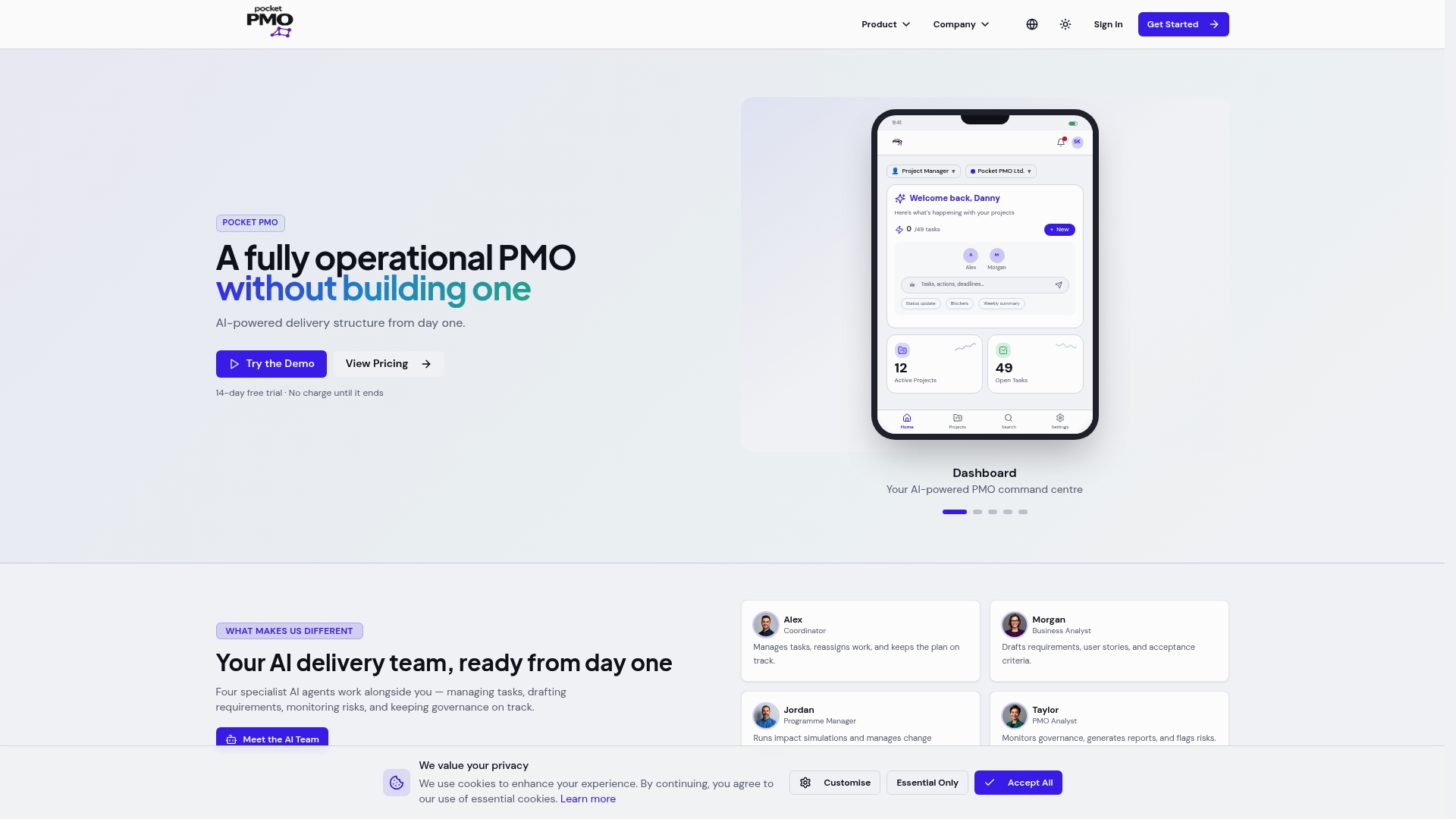
Pocketpmo delivers an AI-powered PMO platform without requiring you to build one from scratch. The platform combines real-time dashboards, predictive risk analysis, portfolio management, and intelligent automation into a single environment that works from day one. You get the governance structure, the reporting cadence, and the AI-driven insights without the months of configuration typically required by general-purpose tools. If you are weighing your options, the Pocketpmo vs Monday.com comparison sets out clearly where the differences lie for AI-driven project management. For teams that need structure, visibility, and AI capability working together, Pocketpmo is built to deliver all three.
FAQ
What is AI in project management?
AI in project management refers to the use of artificial intelligence technology to automate tasks, analyse project data, predict risks, and support decision-making. Common applications include status reporting, risk flagging, and resource forecasting.
Why are so few organisations seeing ROI from AI?
Only 2% of organisations report strong ROI from AI because most implement tools without changing underlying workflows. Partial integration and unclear success metrics are the primary causes.
What is the NIST AI Risk Management Framework?
The NIST AI RMF is a structured framework for managing AI risk across the full system lifecycle using four functions: Govern, Map, Measure, and Manage. It supports trustworthy and accountable AI deployment.
How should organisations start implementing AI?
Start with a single, well-defined workflow task, define a measurable success metric, and run a time-boxed proof of concept before expanding. Binding AI outputs to actual workflow steps is what separates successful implementations from stalled pilots.
What is ISO/IEC 42001 and why does it matter?
ISO/IEC 42001:2023 is the first certifiable AI management system standard. It gives organisations a recognised, auditable framework for demonstrating AI governance maturity to clients, regulators, and stakeholders.