

Strategic project delivery is defined as the coordinated execution of projects in direct alignment with an organisation's strategic objectives to maximise long-term business value. It is the recognised industry practice that sits at the intersection of strategic project management and operational delivery. Where traditional project management focuses on time, cost, and scope, strategic project delivery shifts success metrics toward ROI, benefits realisation, and sustained organisational impact. For project managers seeking to move beyond task completion and into genuine value creation, understanding this distinction is the foundation of everything that follows.
What is strategic project delivery and how does it differ from traditional project management?
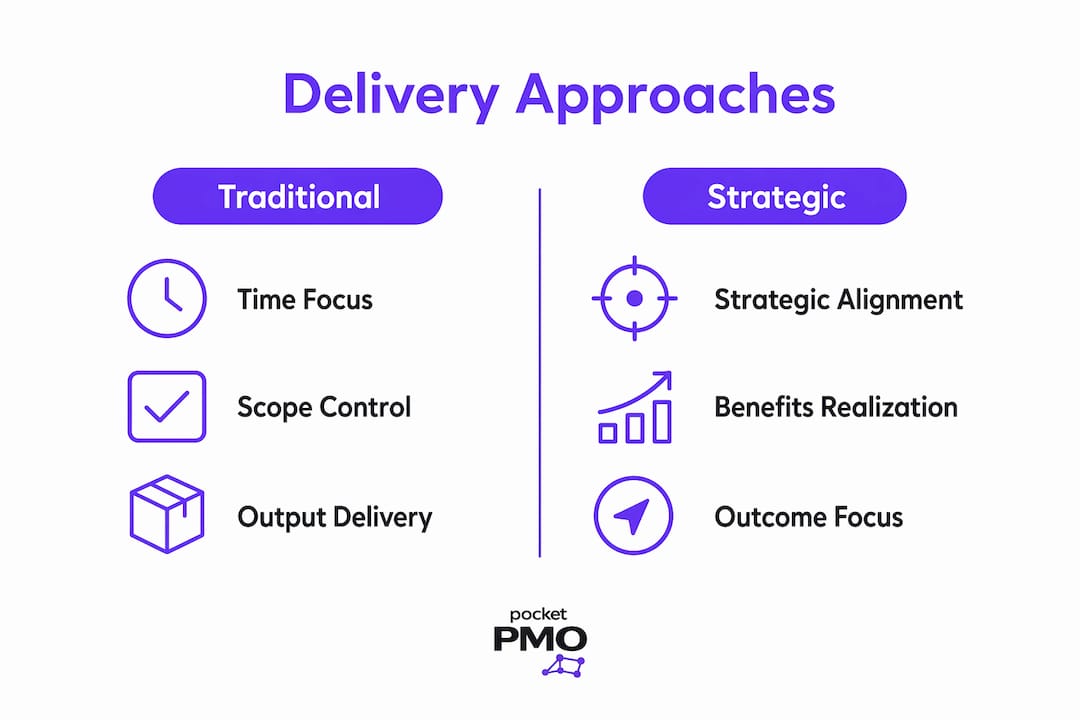
Strategic project delivery shifts success metrics from tactical efficiency to strategic effectiveness, ensuring every project ties directly to organisational goals with benefits tracked beyond project closure. That shift changes how you define success. A project delivered on time and within budget is not a success if it fails to produce the business outcome it was commissioned to achieve.
Traditional project management asks: "Did we deliver what was specified?" Strategic project delivery asks a fundamentally different question. Asking the right question means starting with "What business outcome do we want?" rather than executing requirements blindly. This reframing changes governance, planning, and how you measure results at every stage.
The table below captures the core differences between the two approaches.
| Dimension | Traditional project management | Strategic project delivery |
|---|---|---|
| Primary focus | Time, cost, scope | Business value, ROI, strategic alignment |
| Success measure | On-time, on-budget delivery | Benefits realised post-closure |
| Governance style | Milestone sign-off | Continuous alignment reviews |
| Planning tools | Gantt charts, work breakdown structures | Balanced scorecards, strategy maps |
| Project selection | Prioritised by availability | Prioritised by strategic fit |
Strategic mapping tools such as balanced scorecards and strategy maps enable early linkage of projects to long-term organisational vision and mission. They are not optional extras. They are the mechanism by which a project brief gets tested against real organisational intent before a single resource is committed.
Pro Tip: Before approving any project, map it to at least one strategic objective on your organisation's balanced scorecard. If you cannot draw a clear line, the project needs to be challenged or redesigned.
How do project delivery methods support strategic goals?
Choosing the right project delivery method is one of the most consequential decisions made during project initiation. No single method is ideal for every context. The choice directly shapes collaboration, risk allocation, cost control, and ultimately whether the project delivers its intended strategic value.
The four primary delivery methods each carry distinct characteristics:
- Design-Bid-Build (DBB): The owner commissions design separately from construction. It offers price certainty but limits early contractor input, which can increase rework and reduce constructability.
- Design-Build (DB): A single entity handles both design and construction. Speed improves and accountability is clearer, but the owner has less control over design decisions.
- Construction Manager at Risk (CM@Risk): A construction manager joins the project during design, providing cost guidance and then taking on delivery risk at a guaranteed maximum price. This model improves collaboration without fully surrendering design control.
- Integrated Project Delivery (IPD): All key parties, including owner, designer, and contractor, share risk, reward, and decision-making from the outset. IPD promotes collaboration and transparency, resulting in predictable outcomes across complex projects.
Early contractor involvement improves cost control and collaboration regardless of which method you select. The earlier key parties engage, the fewer costly surprises emerge during delivery.
Delivery methods that involve early collaboration reduce rework, disputes, and constructability issues, which directly improves long-term stakeholder satisfaction. That outcome matters because stakeholder satisfaction is a core measure of strategic delivery success, not an afterthought.

The decision depends on your project type, your organisation's risk appetite, schedule constraints, and internal capability. A public sector body with limited construction expertise will make a different choice than a private developer with an experienced in-house team. Matching method to context is itself a strategic act.
Pro Tip: Evaluate your organisation's risk appetite and internal capability before selecting a delivery method. A method that works well for a high-capability owner can expose a less experienced team to significant cost and schedule risk.
What are the practical steps to implement effective strategic project delivery?
Embedding strategic project delivery into your organisation requires a structured approach, not a one-off workshop. The following steps give you a repeatable framework.
- Map every project to a strategic objective. Use your organisation's strategy map or balanced scorecard as the filter. Projects that cannot be linked to a defined objective should be deferred or cancelled.
- Apply a project selection model. Weighted scoring models and cost-benefit analysis provide a consistent, auditable basis for prioritisation. Weighted scoring assigns numerical values to criteria such as strategic fit, ROI, risk, and resource demand, then ranks candidates objectively.
- Establish benefits realisation management from day one. Assign a named benefits owner for every project. That person is accountable for tracking whether the intended value is delivered, not just whether the project closed on schedule.
- Build governance checkpoints into the project lifecycle. Portfolio integration with continuous alignment checks improves resource allocation and supports enterprise-level risk management. Schedule formal reviews at initiation, mid-point, and closure to test whether the project still serves its original strategic intent.
- Document and communicate the business case throughout delivery. The business case is not a document you write once and file. It is a live reference that governance checkpoints use to challenge scope changes and re-prioritise resources.
- Avoid the common pitfall of scope creep masquerading as agility. Changes to scope must be evaluated against their impact on strategic alignment, not just cost and schedule. A change that saves money but dilutes the strategic outcome is not a good change.
For risk management guidance that supports these governance steps, the Pocketpmo blog offers practical frameworks tailored to project managers working across multiple initiatives.
Pro Tip: Assign a benefits owner at project kick-off, not at project closure. Waiting until the end means accountability arrives too late to influence delivery decisions.
How do you measure and sustain benefits realisation after delivery?
Benefits realisation management is the true measure of project success, extending beyond project closure to verify financial returns and operational improvements. A project is not complete when the final deliverable is handed over. It is complete when the intended business value is confirmed.
Sustaining that measurement requires a structured approach across three benefit categories:
- Financial benefits: Track ROI, cost savings, and revenue uplift against the original business case. Set review points at three months, six months, and twelve months post-closure.
- Operational benefits: Measure process efficiency gains, error rate reductions, and cycle time improvements. These are often the first benefits to appear and the easiest to quantify.
- Strategic benefits: Assess whether the project has improved the organisation's competitive position, capability, or stakeholder relationships. These take longer to materialise and require qualitative as well as quantitative evaluation.
Benefits realisation must be owned and tracked beyond project closure to truly validate strategic success and support continuous organisational improvement. Without a named owner and a defined review schedule, benefits tracking becomes an intention rather than a practice.
Real-time dashboards play a critical role here. When benefits data is visible to senior stakeholders, it influences future project portfolio alignment decisions. Organisations that track benefits consistently make better project selection choices in subsequent planning cycles. The data from one completed project becomes the evidence base for the next.
Key takeaways
Strategic project delivery succeeds when every project is selected, governed, and measured against its intended business outcome, not just its delivery milestones.
| Point | Details |
|---|---|
| Redefine success metrics | Measure ROI and benefits realised post-closure, not just on-time and on-budget delivery. |
| Choose delivery methods deliberately | Match Design-Bid-Build, Design-Build, CM@Risk, or IPD to your project context and risk appetite. |
| Assign benefits ownership early | Name a benefits owner at kick-off to maintain accountability throughout and after delivery. |
| Use governance checkpoints | Schedule formal alignment reviews at initiation, mid-point, and closure to protect strategic intent. |
| Track benefits across three categories | Monitor financial, operational, and strategic benefits at defined intervals post-delivery. |
Why strategic delivery is harder than it looks
The honest truth about strategic project delivery is that most organisations understand it in principle and struggle with it in practice. The gap is rarely about frameworks or tools. It is about discipline and the willingness to challenge projects that are already in motion.
I have seen teams invest months executing a project with technical precision, only to reach closure and realise the original business case had quietly shifted six months earlier. Nobody stopped to ask whether the project still served its purpose. The governance checkpoints existed on paper but were treated as formalities rather than genuine decision points.
The other pattern I see repeatedly is benefits realisation treated as a post-project administrative task. A spreadsheet gets filed, a review gets scheduled, and then the team moves on to the next initiative before the first review ever happens. Strategic alignment in PMO is not a one-time exercise. It requires the same rigour after delivery as it does during planning.
My advice to project managers who want to champion this approach in their organisations is straightforward. Start with one project. Map it explicitly to a strategic objective. Assign a benefits owner on day one. Run a genuine mid-point alignment review. Then present the results to your leadership team. That single example, done well, is more persuasive than any framework document.
The delivery method question is also underestimated. Most project managers inherit a method rather than select one. Pushing for an early conversation about delivery method, risk appetite, and owner capability is one of the highest-value contributions a project manager can make before a project begins.
— Danny
How Pocketpmo supports strategic project delivery
Pocketpmo is a fully operational, AI-powered PMO solution built for project managers, PMOs, and consultancies who need strategic oversight without building an internal PMO from scratch.
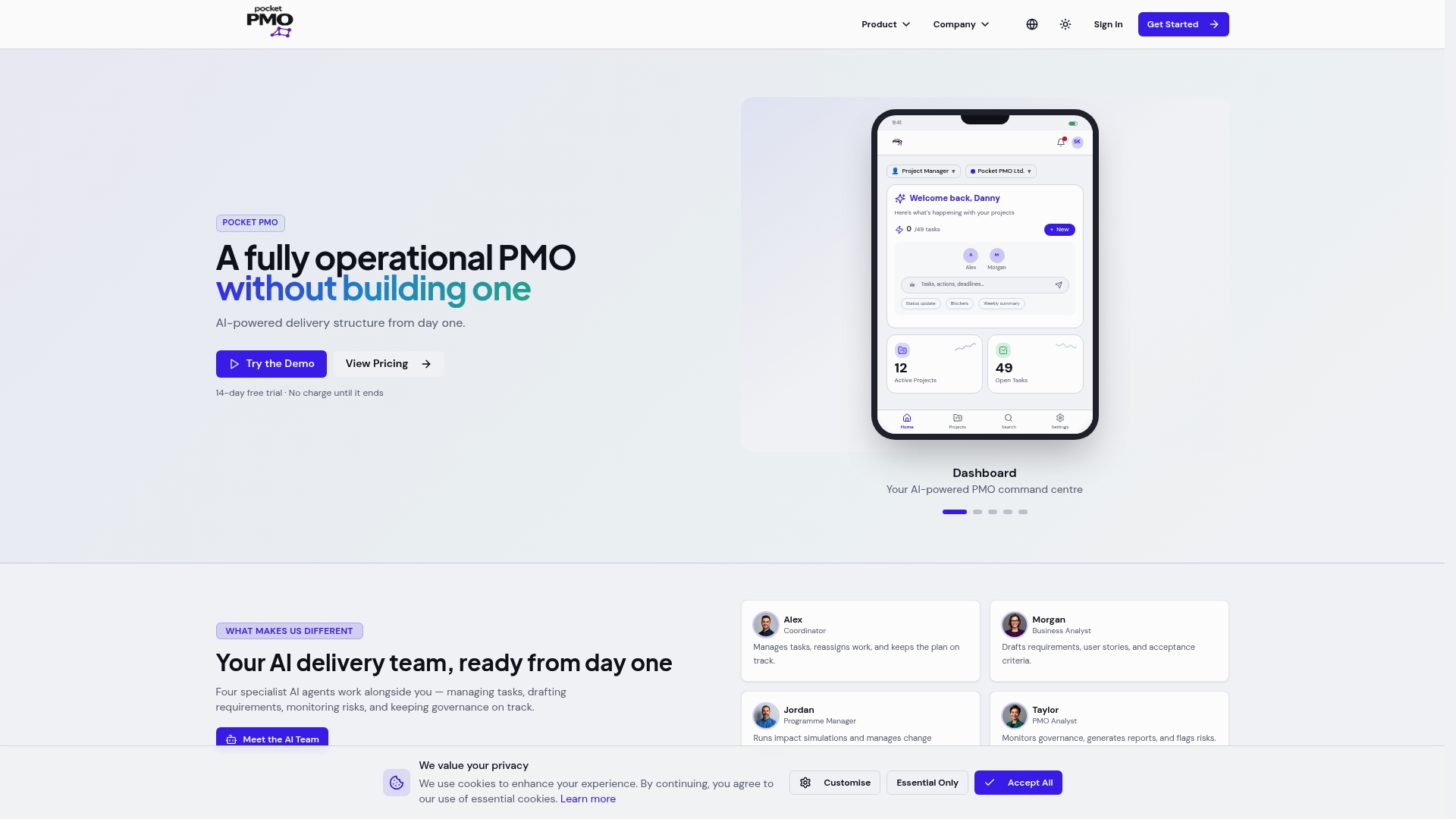
The platform brings together real-time dashboards, benefits tracking, portfolio management, and AI-driven risk analysis in one place. That means you can monitor strategic alignment, run governance checkpoints, and track post-delivery benefits without switching between disconnected tools. Pocketpmo's AI delivery team manages tasks, requirements, and risks from day one, giving you the governance infrastructure that strategic project delivery demands. Explore the full platform features or see how Pocketpmo compares to traditional project management tools with the Pocketpmo vs Microsoft Project comparison.
FAQ
What is strategic project delivery in simple terms?
Strategic project delivery is the practice of executing projects in direct alignment with an organisation's strategic objectives, measuring success by the business value delivered rather than by schedule or budget alone.
How does strategic project delivery differ from traditional project management?
Traditional project management focuses on delivering outputs within time, cost, and scope constraints. Strategic project delivery extends that focus to include benefits realisation, strategic alignment, and long-term organisational value confirmed after project closure.
What are the four main project delivery methods?
The four primary methods are Design-Bid-Build, Design-Build, Construction Manager at Risk, and Integrated Project Delivery. Each carries different risk-sharing, collaboration, and cost-control characteristics suited to different project contexts.
Why is benefits realisation management important?
Benefits realisation management confirms that a project has delivered its intended business value post-closure. Without it, organisations cannot verify whether their investment produced the outcomes the business case promised.
How do you select the right project delivery method?
The right method depends on your project type, the organisation's risk appetite, schedule requirements, and internal capability. Choosing the right method early in the project lifecycle is critical to avoiding cost overruns and collaboration failures later.