

Projects fail not because risks are unforeseeable, but because teams lack the discipline to manage them well. Effective risk management tips are not about filling in a spreadsheet once and forgetting it. They are about building a repeatable system that turns uncertainty into a decision advantage. Whether you lead a single project or oversee a full portfolio, the right risk management strategies will help you spot threats earlier, respond faster, and protect delivery outcomes. This article covers the practical, evidence-backed approaches that separate high-performing project teams from the rest.
Table of Contents
- Key takeaways
- How to choose and apply risk management tips effectively
- 1. Map every risk to a project objective
- 2. Apply consistent likelihood and impact scoring
- 3. Define your risk response strategy up front
- 4. Cost your risk treatments with real market data
- 5. Maintain a dynamic, actionable risk register
- 6. Monitor risks continuously, not periodically
- 7. Test and rehearse your risk response plans
- 8. Integrate risk management with governance and compliance
- 9. Use technology and data analytics for decision advantage
- 10. Assign clear risk owners and accountability structures
- Comparing risk response strategies: when to use each
- Making risk decisions in context
- My perspective on what actually works
- How Pocketpmo supports smarter risk management
- FAQ
Key takeaways
| Point | Details |
|---|---|
| Score risks consistently | Apply a standardised 1-5 likelihood and impact model to compare and prioritise risks objectively. |
| Keep registers dynamic | Link your risk register to escalation triggers and workflows so data never goes stale. |
| Match strategy to context | Choose from avoidance, reduction, transference, acceptance, or contingency based on your project's size and risk profile. |
| Cost your treatments | Use vendor quotes and procurement data rather than generic estimates to budget risk responses accurately. |
| Monitor continuously | Move from periodic reviews to ongoing monitoring to catch control drift and emerging threats early. |
How to choose and apply risk management tips effectively
Not every risk management tip applies equally to every project. Before you adopt any approach from a risk management strategies list, you need a clear framework for evaluating which techniques fit your context.
The most useful criteria are:
- Relevance: Does the risk directly threaten a project objective? If it does not affect scope, cost, schedule, or quality, it may not warrant immediate attention.
- Impact and likelihood: A 1-5 scoring scale across both dimensions gives you a consistent, comparable rating for every risk on your register.
- Feasibility: Can your team realistically implement the proposed response within your current constraints?
- Cost-effectiveness: Will the cost of the risk treatment be proportionate to the loss you are trying to prevent?
Prioritisation is where most teams go wrong. They spend equal energy on every risk rather than concentrating effort where it matters most. Scoring models solve this by producing a ranked list that guides resource allocation decisions.
Pro Tip: After scoring, divide your risk register into three tiers: watch, manage, and escalate. Assign owner actions only to risks in the top two tiers. This prevents your team from wasting time on low-probability, low-impact items.
Dynamic risk registers are a related must. Integrated with escalation triggers, they keep your risk data current and connected to delivery workflows. A static register reviewed once per month is already outdated before you open it.
1. Map every risk to a project objective
Before you rate a risk, confirm it is actually relevant. Each risk entry should reference a specific objective it threatens, whether that is a delivery milestone, a budget line, a compliance requirement, or a stakeholder commitment. This single habit removes the clutter from your register and keeps the team focused on what genuinely matters to project success.
2. Apply consistent likelihood and impact scoring
Objective prioritisation depends on consistent measurement. Using a standardised scoring model across all risks lets you compare a technical dependency risk against a vendor delivery risk using the same scale. Score likelihood from 1 (rare) to 5 (almost certain) and impact from 1 (negligible) to 5 (critical). Multiply to get a risk rating, then sort your register by that number.
3. Define your risk response strategy up front
Each risk needs a named response type before it becomes a problem. The five primary strategies are avoidance, reduction, transference, acceptance, and contingency planning. Assigning one to every risk at the point of identification means your team already knows what to do if that risk materialises, which cuts response time significantly.

4. Cost your risk treatments with real market data
Generic cost estimates for risk responses are almost always wrong. Use vendor quotes obtained within 48 hours and recent procurement records to price each treatment accurately. This discipline matters most when you are preparing board-level risk reports or seeking contingency budget approval. A treatment costed at £50,000 based on a quote is far more defensible than one estimated at £40,000 based on a guess.
Pro Tip: Develop three priced treatment scenarios for your top risks across short-term (0 to 3 months), medium-term (3 to 12 months), and long-term (12 to 24 months) horizons. This gives leadership genuine options rather than a single take-it-or-leave-it recommendation.
5. Maintain a dynamic, actionable risk register
Most organisations treat risk registers as static documents rather than live management tools. This is one of the most common and costly mistakes in project risk practice. Your register should be tied to timed workstreams, trigger thresholds, and escalation paths so that when a risk rating changes, an action automatically follows. A free risk register template can help you build this structure from the start.
6. Monitor risks continuously, not periodically
Shifting from periodic to continuous monitoring is one of the most impactful upgrades you can make to your risk management practice. Monthly reviews let control drift go undetected for weeks. Continuous monitoring using dashboards, automated alerts, or AI-assisted tools catches emerging risks the moment conditions change. For a deeper look at how teams are making this shift, see this analysis of tracking risks in 2026.
7. Test and rehearse your risk response plans
A risk response plan that has never been tested is a theory. Run tabletop exercises for your highest-rated risks at least once per project phase. This surfaces gaps in your response procedures, confirms that owners know their roles, and reduces panic when an actual event occurs. Rehearsals also help you refine the plan based on realistic feedback from the people who would execute it.
8. Integrate risk management with governance and compliance
Risk management best practices do not sit in isolation from your governance framework. Link your risk register to change control, lessons learned, and benefit realisation reviews. When a change request comes in, your risk process should automatically assess the new exposure it introduces. This integration makes risk management a part of delivery, not a separate administrative burden.
9. Use technology and data analytics for decision advantage
Risk management realises its true value when it gives leadership clarity and confidence, not when it generates reports. AI-assisted risk analysis tools can process patterns across your project portfolio to flag risks that a manual review might miss. For practical guidance on the methods and pitfalls in this area, the Pocketpmo guide on project risk analysis is worth reading.
10. Assign clear risk owners and accountability structures
Every risk entry needs a named owner, not a team or department. The owner is responsible for monitoring the risk, implementing the response, and escalating if the situation changes. Without this clarity, risks get watched by everyone and actioned by no one. Pair ownership with a regular cadence of brief owner updates to keep accountability visible to the whole project team.
Comparing risk response strategies: when to use each
Understanding the five response types is one thing. Knowing which to apply in your specific situation is another. Here is a practical comparison to guide your selection.
| Strategy | Best suited for | Trade-offs |
|---|---|---|
| Avoidance | High-impact risks where the activity creating the risk can be removed or changed | Removes the risk but may also remove value or scope |
| Reduction | Risks that are likely but manageable with additional controls | Requires investment; may only partially reduce the risk |
| Transference | Financial or technical risks where a third party is better placed to absorb them | Shifts liability but adds contract cost and vendor dependency |
| Acceptance | Low-impact or low-likelihood risks where treatment cost exceeds expected loss | No immediate cost, but requires contingency funds if the risk materialises |
| Contingency planning | Risks where the trigger is known but timing is uncertain | Provides a clear response path; requires discipline to activate at the right moment |
In practice, the most resilient risk management strategies layer multiple approaches. You might reduce a cyber risk through additional controls while simultaneously transferring residual financial exposure through insurance. A holistic approach to risk treats insurance as a strategic asset, not just a line item, which unlocks further capital for proactive risk investment.
Making risk decisions in context
Good risk management is not about applying the same formula to every project. The decisions that work for a regulated financial services programme will differ significantly from those for an agile product development sprint.
Factors that should shape your risk decision-making include:
- Project size and complexity: Larger programmes warrant more formal risk governance, dedicated risk owners, and executive-level escalation paths.
- Industry and regulatory environment: Compliance risks in regulated sectors carry legal and financial consequences that demand avoidance or transference rather than acceptance.
- Risk cost versus reward: The Economic Cost of Risk (ECOR) framework incorporates expected losses, premiums, and volatility to inform financial comparisons between risk transfer options. Use it when evaluating insurance against self-funded contingency.
- Stakeholder risk tolerance: Some sponsors will accept more uncertainty in exchange for speed. Others will not. Clarify this at the start of each project and document it as a guiding constraint.
Pro Tip: Review your risk decisions at each phase gate, not just when something goes wrong. As project context evolves, the right response for a given risk often changes too. Build this review into your existing governance cadence rather than creating a separate meeting.
Continuous adaptation is the hallmark of effective risk strategies. The risk management strategies list you define at project initiation should be a starting point, not a fixed contract. For further guidance on applying these approaches in practice, the Pocketpmo resource on mastering project risk covers consulting-grade response models in detail.
My perspective on what actually works
I've spent years watching project teams mistake activity for effectiveness in risk management. They maintain tidy registers, hold fortnightly reviews, and produce colour-coded heat maps. Then a risk they scored as low materialises and causes serious damage because nobody had looked at it in six weeks.
The shift I've seen make the biggest difference is this: treat your risk register as a decision-support tool, not a compliance document. When every risk entry is mapped to a project objective and owned by a named individual, the register stops being something you maintain and starts being something you use.
What I've also learned is that accountability without communication fails. Risk owners need a simple, repeatable way to flag changes. If your process requires them to attend a two-hour risk workshop to raise a concern, they will wait until the next one. Build lightweight reporting into your weekly rhythm instead.
The teams that manage risk well are not necessarily the ones with the most sophisticated frameworks. They are the ones where risk is a normal part of the conversation at every level.
— Danny
How Pocketpmo supports smarter risk management
If the tips above resonate but your current tooling makes them difficult to execute consistently, Pocketpmo is built to close that gap.
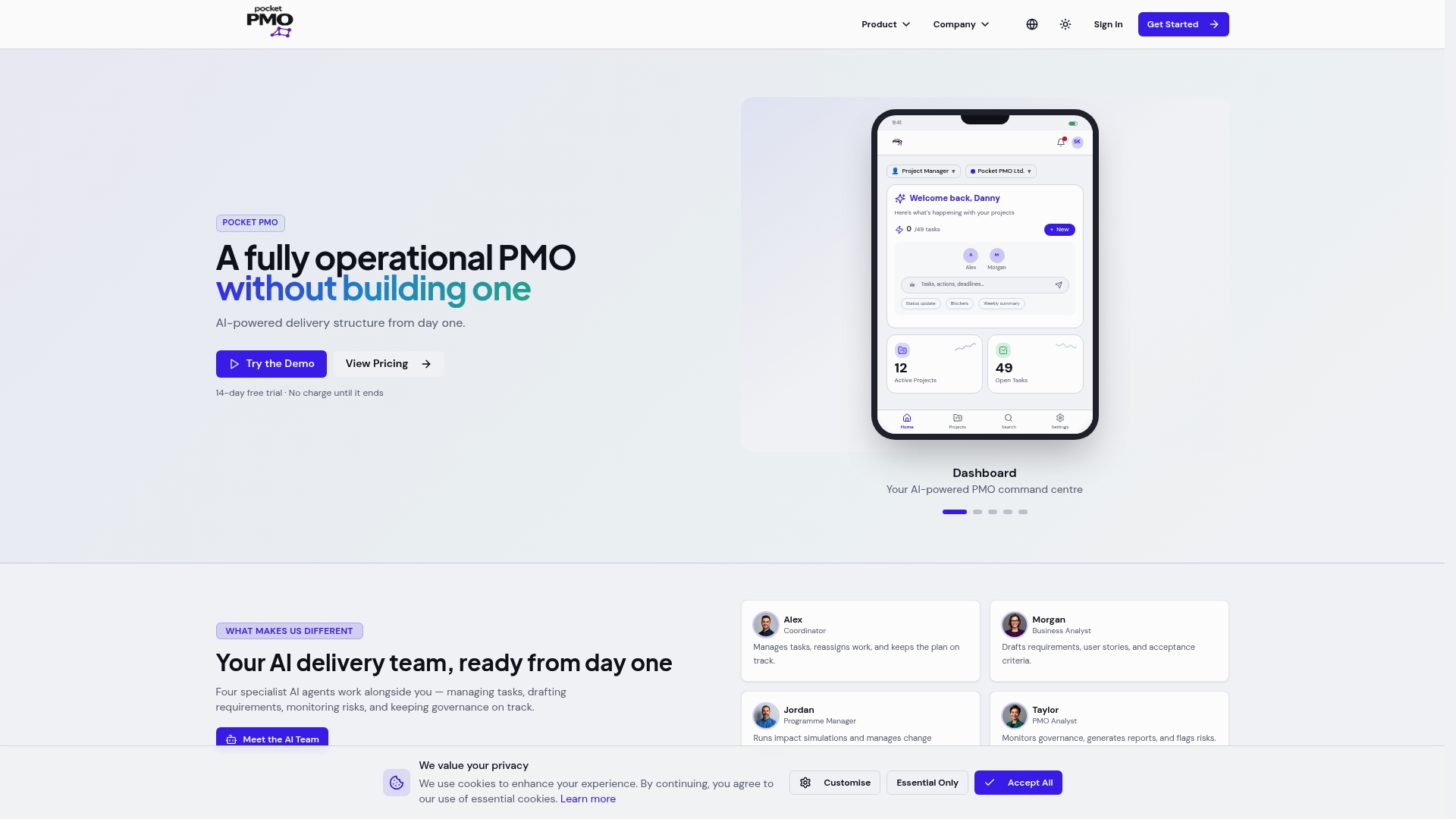
Pocketpmo delivers an AI-powered PMO without requiring you to build one from scratch. The platform provides real-time risk dashboards, automated escalation workflows, and predictive analytics that surface emerging risks before they become delivery problems. You get a dynamic risk register connected directly to your project governance, change control, and reporting processes. Risk owners receive automated prompts, and leadership gets the visibility they need to make confident decisions. Whether you are managing a single complex project or a full portfolio, Pocketpmo's AI delivery platform gives you the structure and intelligence to manage risk proactively from day one. Download the free risk register template to get started immediately.
FAQ
What are the most effective risk management tips for project managers?
The most effective risk management tips include mapping risks to project objectives, scoring them on a consistent 1-5 scale, assigning named owners, and monitoring continuously rather than relying on periodic reviews. Keeping your risk register dynamic and linked to escalation workflows is particularly high-impact.
What are the five main risk response strategies?
The five primary risk response strategies are avoidance, reduction, transference, acceptance, and contingency planning. Each suits different risk profiles based on impact, likelihood, cost, and the feasibility of control.
How often should you review a project risk register?
Best practice in 2026 is to move beyond fixed-interval reviews toward continuous monitoring, supplemented by formal reviews at each project phase gate. This approach detects control drift and emerging risks far earlier than monthly reviews allow.
How do you cost risk treatments accurately?
Cost risk treatments using market-validated vendor quotes obtained within 48 hours and recent procurement records, rather than generic estimates. Develop three priced scenarios per top risk across short-, medium-, and long-term horizons for the most defensible budgets.
What is the Economic Cost of Risk (ECOR)?
ECOR is a financial framework that incorporates expected losses, premiums, and volatility to compare the true cost of different risk transfer options, including insurance versus self-funded contingency. It gives project leaders a grounded basis for financial risk decisions.