

Every project carries risk. The problem is that most teams only discover which types of project risks they are dealing with after something has already gone wrong. A missed dependency here, a regulatory change there, and suddenly you are explaining a blown budget to a steering committee. Understanding the full range of risk categories in projects before they materialise is the difference between reactive firefighting and confident project delivery.
Table of Contents
- Key takeaways
- 1. How to define and categorise types of project risks
- 2. Technical, schedule, budget, and resource risks
- 3. Stakeholder, communication, scope, and compliance risks
- 4. External and environmental risks, and the case for positive risk
- 5. Risk types compared: a practical reference table
- My perspective on managing project risks well
- How Pocketpmo helps you manage project risks from day one
- FAQ
Key takeaways
| Point | Details |
|---|---|
| Classify risks early | Identifying risk types at the outset improves ownership and speeds up response decisions. |
| Use 6-10 categories | Frameworks like PMI and PRINCE2 recommend this range to balance clarity with sufficient granularity. |
| Include positive risks | Opportunities are risks too and should receive the same tracking rigour as threats. |
| Embed risk dialogue daily | Risk registers and brief team discussions outperform complex tools reviewed only monthly. |
| Define risk appetite first | Without a clear appetite statement, teams make inconsistent decisions across project phases. |
1. How to define and categorise types of project risks
Before you can manage risks, you need a consistent way to sort them. Most project managers instinctively log what worries them, but without a clear classification system, risk registers become disorganised and lose their value fast.
Frameworks including PMI's PMBOK, PRINCE2, and ISO 31000 each provide guidance on risk classification, though they approach it slightly differently. What they share is the principle that 6-10 categories offer the right balance: enough structure to create ownership and clarity, but not so many buckets that everything overlaps.
There are a few terms worth anchoring before you read further:
- Likelihood: the probability that a risk event will occur
- Impact: the severity of the consequence if it does occur
- Risk appetite: how much uncertainty your organisation is willing to accept in pursuit of its objectives
- Residual risk: what remains after your chosen treatment has been applied
- Threats vs opportunities: risks can be negative (threats) or positive (opportunities), and both deserve attention
One point that often gets missed is the distinction between a risk and an issue. Risks are future events managed proactively, while issues are current problems demanding immediate resolution. Conflating the two leads to muddled prioritisation.
Pro Tip: Tailor your risk categories to the type of project and the industry you are working in. A construction project will weight environmental and safety risks heavily, while a software delivery project may centre on technical and dependency risks. Generic category lists are a starting point, not a final answer.
2. Technical, schedule, budget, and resource risks
These four categories represent the most commonly encountered types of risks in project management. They tend to be well understood, but that familiarity can breed complacency.
Technical risk
Technical risk covers technology failure, software defects, infrastructure breakdown, and integration issues. A legacy system that cannot communicate with a new platform is a classic example. So is a cloud environment that performs well in testing but buckles under real production load.

Typical mitigations include proof-of-concept testing early in the delivery lifecycle, clear technical standards, and building contingency time for integration phases.
Schedule risk
Schedule risk arises from unrealistic timelines, poor dependency mapping, and resource bottlenecks. Teams often underestimate how long handoffs between workstreams take, particularly in multi-vendor environments. A single delayed approval can cascade through an entire critical path.
Mitigation approaches: independent timeline reviews, buffer allocation on high-dependency tasks, and weekly tracking against a baselined plan.
Budget and cost risk
Cost overruns are one of the most visible types of risks in projects. Causes range from scope growth and inflation to underestimating supplier costs or foreign exchange exposure on international projects. Studies consistently show that large capital projects overrun their budgets far more often than they come in on target.
Maintain a cost contingency reserve and review budget variance at least fortnightly. Treat any unplanned expenditure as a trigger for a risk review, not just a finance adjustment.
Resource risk
Resource risk includes personnel availability, skills shortages, and competing demands across the portfolio. A specialist who is shared across three projects is a single point of failure waiting to happen.
- Map critical resource dependencies at the planning stage
- Identify skills gaps and build in time for knowledge transfer
- Track resource utilisation actively through delivery, not just at milestones
Pro Tip: Build a simple resource risk heat map at the start of each project phase. It takes less than an hour and forces the honest conversation about who is genuinely available versus who has been promised.
3. Stakeholder, communication, scope, and compliance risks
These are the risks that experienced project managers know can derail a technically perfect plan. They are softer to measure but no less damaging.
Stakeholder and communication risk
Misaligned expectations are the root cause of more project failures than any technical problem. When stakeholders have different mental models of what the project will deliver, conflict surfaces at exactly the wrong moment, usually during user acceptance testing or at go-live.
Poor communication compounds this. Unclear roles, infrequent updates, and ambiguous decision-making authority all create the conditions for stakeholder risk to escalate.
Mitigations: a RACI matrix agreed at the start, structured weekly status updates, and a clear escalation path for unresolved decisions.
Scope risk
Scope creep is relentless. It rarely arrives as a bold request. Instead, it accumulates through small additions, each reasonable on its own, that collectively consume contingency and delay delivery. Unclear requirements at the outset make this worse by leaving room for interpretation.
Effective scope management begins before the project does: invest time in requirements workshops, document acceptance criteria clearly, and implement a formal change request process from day one.
Regulatory and compliance risk
Legal changes, evolving industry standards, and audit requirements can shift the delivery landscape mid-project. A data protection regulation update, a new financial services directive, or a change in building standards can each force rework at significant cost.
Tailoring risk categories to your specific regulatory context improves ownership and reduces the chance of compliance risks being assigned vaguely to "the whole team."
Pro Tip: Carry out a compliance horizon scan at the start of every project. Identify any regulatory changes that are scheduled or anticipated during the delivery window. Log them as risks immediately, even if their probability is low.
4. External and environmental risks, and the case for positive risk
External risks are the ones that originate entirely outside your organisation. They are often underestimated precisely because they feel beyond your control.
Common external risk types include:
- Market shifts that change the business case mid-delivery
- Natural disasters or extreme weather affecting site access or supply chains
- Political changes that alter funding, procurement rules, or regulatory requirements
- Supplier insolvency or capacity constraints
The instinct is to accept these risks as unavoidable. That is only partially correct. While you may not be able to prevent a political shift, you can reduce exposure through contract terms, dual sourcing, or phased delivery that protects sunk cost.
"Ignoring opportunity risk is a common failure mode. Positive risks should be managed with equal rigour as threats to avoid missed chances for improved outcomes."
Positive risk is the concept that not all uncertainty is negative. If a new technology becomes available that could accelerate your timeline, that is an opportunity risk. If market conditions shift in a way that makes your product more competitive, that matters to your project too. Yet most risk registers contain only threats.
A detailed risk register that tracks both threats and opportunities improves communication and signals to senior stakeholders that your risk management approach is genuinely strategic. Assign owners to opportunities just as you would to threats, and build response strategies around exploiting, sharing, or enhancing those positive events.
5. Risk types compared: a practical reference table
Use this table as a working reference when building or reviewing your project risk register. Treatment options are drawn from ISO 31000 guidance: avoid, mitigate, transfer, and accept.
| Risk type | Typical impact | Common triggers | Recommended treatment |
|---|---|---|---|
| Technical | Rework, delays, defects | New technology, poor integration testing | Mitigate (PoC, testing protocols) |
| Schedule | Delay, cost growth | Dependencies, resource constraints | Mitigate, avoid (buffer, replanning) |
| Budget/cost | Overspend, funding gap | Scope growth, market inflation | Mitigate, transfer (contingency, contracts) |
| Resource | Delivery failure | Staff turnover, shared resources | Mitigate (succession planning, cross-training) |
| Stakeholder/communication | Rework, rejection | Poor governance, unclear RACI | Mitigate (engagement plans, comms cadence) |
| Scope | Overrun, quality reduction | Weak requirements, change appetite | Avoid (baselined requirements, change control) |
| Regulatory/compliance | Rework, fines, delays | Regulatory change, audit findings | Transfer, mitigate (legal review, horizon scan) |
| External/environmental | Business case change, site disruption | Market shifts, supplier failure | Accept, transfer (contracts, scenario planning) |
Selecting the right treatment depends heavily on your organisation's risk appetite. A low-appetite organisation may avoid risks that another would confidently accept. PRINCE2 methodology strengthens this further by assigning each risk a named owner, which creates clear accountability and prevents risks from sitting unclaimed in a register.
Applying multiple treatment strategies to a single risk simultaneously, such as reducing its likelihood while also transferring the residual exposure through insurance or contract, often produces better outcomes than a single response action.
My perspective on managing project risks well
I have reviewed a lot of project risk registers over the years, and the pattern I keep seeing is that teams spend enormous energy building them at the start and then barely revisit them. The register becomes a compliance artefact rather than a live management tool.
What I have found actually works is treating risk as a conversation topic, not a document. When risk is discussed briefly at every project meeting, team members naturally surface emerging concerns earlier. The integration of risk management into daily operations matters far more than the sophistication of the tool you are using.
I also think the industry underserves positive risk. Every framework mentions it, but in practice, most project teams still treat their risk registers as threat catalogues. When I started applying the same rigour to opportunities, tracking owners, response strategies, and trigger conditions, the conversations with senior stakeholders changed completely. It shifted the framing from "what could go wrong" to "what could we do better."
My strongest advice: define your risk appetite before the project starts, not after your first major risk event. Undefined risk appetite causes inconsistent responses across the team. One person escalates everything; another accepts risks that should have been mitigated weeks ago. A single page summarising your threshold for cost, schedule, and quality risk is worth more than a hundred rows in a risk register.
— Danny
How Pocketpmo helps you manage project risks from day one
Managing the full range of types of project risks is hard enough without wrestling with fragmented tools or building your PMO infrastructure from scratch.
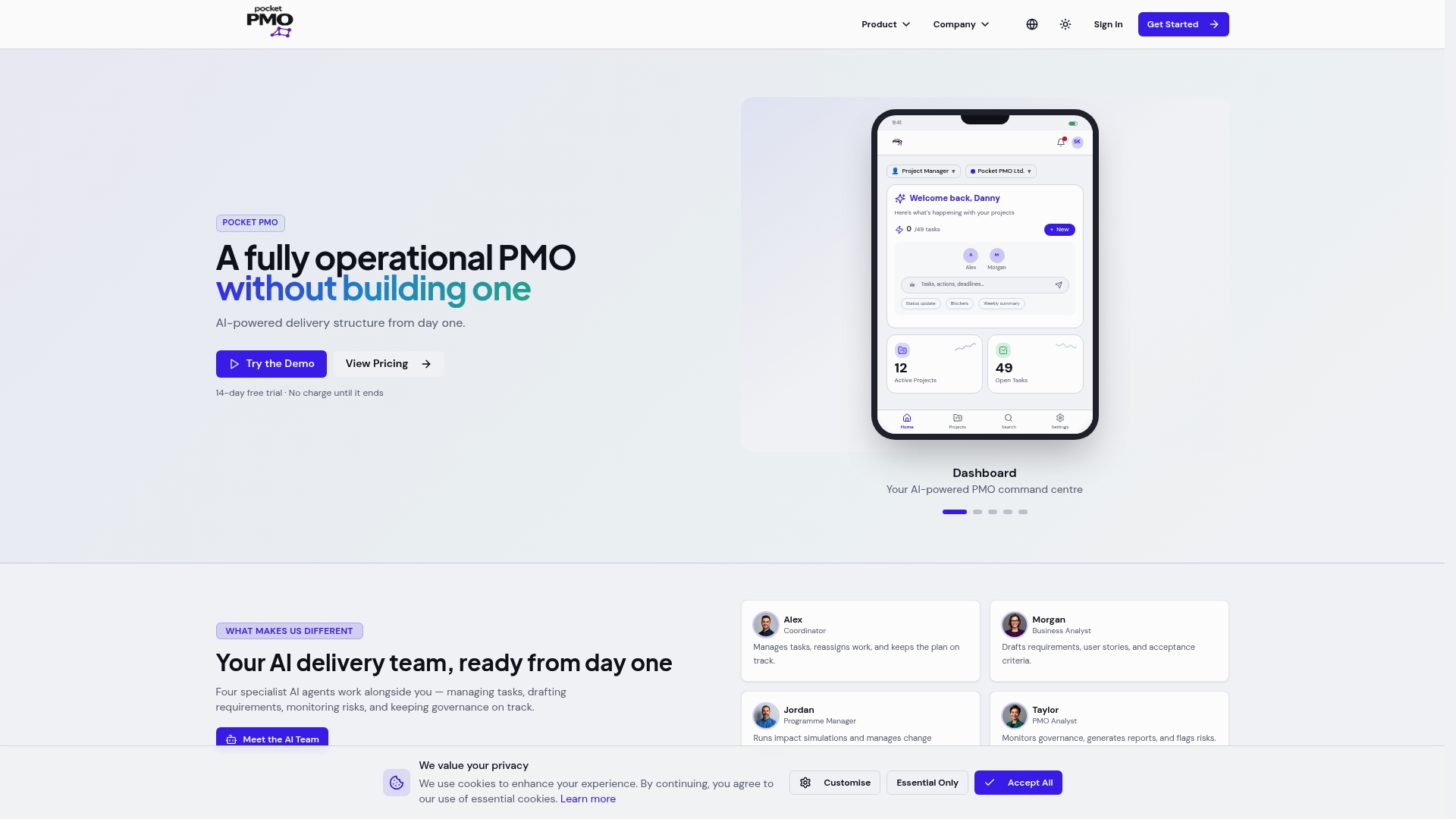
Pocketpmo gives you a fully operational AI-powered PMO from day one. The platform includes a built-in risk register template aligned to major frameworks, automated risk reporting, and AI-driven analysis that flags emerging risks before they become issues. You get real-time dashboards, collaborative risk tracking across teams, and predictive analytics designed for complex multi-project environments. If you are evaluating alternatives, see how Pocketpmo compares on risk module capabilities before you commit. For teams ready to improve risk transparency and response speed, Pocketpmo is built for exactly that.
FAQ
What are the main types of project risks?
The core types of project risks are technical, schedule, budget/cost, resource, scope, stakeholder/communication, regulatory/compliance, and external/environmental. Most frameworks recommend working with 6 to 10 categories to maintain clarity and accountability.
What is the difference between a risk and an issue?
A risk is a potential future event that has not yet occurred, while an issue is a current problem requiring immediate resolution. Managing them separately prevents your risk register from becoming a reactive to-do list.
How do you treat different types of risks in projects?
Treatment options drawn from ISO 31000 include avoid, mitigate, transfer, and accept. The right choice depends on your organisation's risk appetite and the cost of each response relative to the potential impact.
Should positive risks be tracked alongside threats?
Yes. Positive risks, or opportunities, should appear in the same risk register as threats, with owners and response strategies assigned. Ignoring opportunity risk means missing chances to improve project outcomes.
How often should a project risk register be reviewed?
Risk registers should be reviewed at every project meeting, not just at milestone gates. Brief, frequent risk conversations surface emerging issues earlier and keep the register current and genuinely useful.