

Project management trends 2026 are defined by four forces: AI adoption as an efficiency multiplier, hybrid methodologies as the dominant delivery approach, async-first collaboration as a new team norm, and real-time portfolio management replacing static planning. These are not speculative shifts. PMI's Pulse of the Profession and Gartner research confirm each one is already reshaping how project managers and business analysts work. The question is not whether to adapt. The question is how fast you can apply these changes before your delivery model falls behind.
1. How generative AI is transforming project management workflows
Generative AI is the most significant force reshaping project delivery right now. 54% of project professionals use generative AI in 16–50% of their projects, while 20% use it in more than half. That level of adoption signals a genuine shift, not a passing experiment.
The AI features delivering real value today are the unglamorous ones:
- Automated status report drafting from task data
- Meeting summarisation and action item extraction
- Risk log updates based on schedule changes
- Task creation from requirements documents
- Progress narrative generation for stakeholder updates
AI automates drafting and summarisation tasks, saving notable time, but does not yet replace human judgement on priorities or stakeholder decisions. Fully autonomous portfolio management remains unreliable. The gap between what AI can do today and what vendors claim it will do is still wide.
The skills gap compounds the problem. Only 20% of project managers report having extensive or good practical AI skills. Most practitioners have access to AI tools but lack the confidence to use them beyond basic prompting. That gap is where productivity gains are being lost.
Pro Tip: Focus your AI adoption on tools that remove administrative burden first. Status drafting, risk summarisation, and meeting notes are where you will see immediate returns. Leave autonomous decision-making features for later, once you trust the outputs.
2. Hybrid methodologies: fitting the method to the project
Hybrid project management is now the dominant delivery approach, not a compromise. Hybrid approaches combining Waterfall, Agile, and Kanban fit diverse project phases better than rigid adherence to a single method. Teams use Waterfall gates for regulatory compliance, Agile sprints for development work, and Kanban boards for ongoing maintenance queues.

The shift is away from methodology dogma and towards fit-for-purpose thinking. A regulated infrastructure project needs documented sign-offs and sequential phases. The same project's software integration layer benefits from two-week sprints. Applying one method across both phases creates friction and risk.
| Approach | Best suited for | Key characteristic |
|---|---|---|
| Predictive (Waterfall) | Stable requirements, regulated environments | Sequential phases with formal gates |
| Adaptive (Agile/Scrum) | Evolving requirements, product development | Iterative delivery with frequent feedback |
| Hybrid | Complex projects with mixed requirements | Method selected per phase or workstream |
Choosing a hybrid methodology requires evaluating requirement stability, team size, and industry regulatory demands, then mixing methods accordingly. There is no universal formula. The right blend depends on your project's specific constraints.
Pro Tip: Before selecting your methodology mix, map your project into phases and ask two questions for each: how stable are the requirements, and what does the governance structure demand? The answers will tell you which method fits each phase.
3. Async-first communication: reducing meeting overload
Async-first project management is the practice of making written communication the default rather than the exception. Effective asynchronous communication requires that tasks contain all needed context and that status updates are visible in shared systems rather than discussed in meetings. This is a structural change, not just a preference.
The core principles of async-first work are:
- Every task description must be self-explanatory, with no verbal handoff needed
- Decisions are written down permanently, not stored in meeting memory
- Project status is visible in a shared system at all times
- Updates flow through documented channels, not ephemeral chats
Async-first approaches reduce coordination burden in distributed teams by shifting communication to permanent written artefacts. The practical result is fewer status meetings, less micromanagement, and better trust between team members across time zones.
The challenge is discipline. Teams accustomed to verbal updates resist writing detailed task descriptions. The transition requires a short period of deliberate effort before the habit forms.
Pro Tip: Write every task description as if the person reading it has no prior context. Include the goal, the constraints, the definition of done, and any relevant links. This single habit eliminates most clarification requests.
4. AI-driven risk detection and portfolio prioritisation
AI is changing how project managers detect risk and manage portfolios. AI-powered risk detection and resource balancing alert managers to issues weeks ahead of when they would surface in a manual review. The system identifies patterns like declining velocity, overallocated team members, and budget trajectory shifts before they become critical.
Risk detection
AI algorithms monitor schedule data continuously. When a workstream shows consistent task slippage, the system flags it as a risk rather than waiting for a milestone review. This moves risk management from reactive to genuinely proactive.
Resource management
Automated resource suggestions prevent burnout by identifying overallocation early. A team member assigned to three concurrent workstreams at full capacity is a risk. AI surfaces that conflict before it affects delivery.
Portfolio prioritisation
Portfolio management is moving from static quarterly plans to real-time reprioritisation. When a project's risk profile changes, AI surfaces the impact on the broader portfolio immediately. Decision-makers can reallocate resources or adjust timelines based on current data rather than last month's report.
| AI application | What it detects | Benefit to the PM |
|---|---|---|
| Schedule risk monitoring | Velocity decline, task slippage patterns | Early warning before milestone impact |
| Resource conflict detection | Overallocation across concurrent projects | Prevents burnout and delivery delays |
| Portfolio impact analysis | Cross-project dependency and risk spread | Faster, data-informed reprioritisation |
Platforms like Pocketpmo apply AI-driven risk analysis across live portfolio data, giving project managers a real-time view of where risks are concentrating rather than a static snapshot from the last status meeting.
5. Emerging project management tools and what to look for
55% of PM software buyers in 2025 cited AI features as their main purchase driver. That demand is reshaping the software market at pace. Platforms now compete on AI maturity, not just feature count.
AI maturity in PM software ranges from medium to high across leading platforms, with features like autonomous task triage, no-code workflow builders, and predictive analytics becoming standard at the higher end. The gap between entry-level field apps and enterprise platforms is widening.
When evaluating tools, look for these capabilities:
- Automated reporting: status reports generated from live task data, not manual input
- Predictive analytics: schedule and budget forecasting based on current trajectory
- No-code workflow builders: custom automation without engineering support
- AI risk analysis: pattern detection across tasks, resources, and timelines
- Portfolio dashboards: real-time visibility across multiple concurrent projects
The future PM role shifts from manual data gathering to strategic judgement, leadership, and collaboration augmented by AI. The tools you choose should reflect that shift. If a platform still requires you to manually compile status data, it is not keeping pace with 2026 project management technologies.
Test free tiers before committing. The gap between a vendor's marketing and the actual user experience is often significant. Run a real project workstream through the tool for two weeks before making a decision.
6. The evolving PM role: from data gatherer to decision-maker
The project manager's role is changing in a specific and measurable way. AI reduces data collection but increases the importance of human leadership and adaptive decision-making. The administrative layer of the PM role is being automated. What remains is the work that requires context, relationships, and judgement.
This is not a threat to the profession. It is a reallocation of time. Project managers who previously spent hours compiling status reports now spend that time on stakeholder alignment, risk response planning, and team development. The output is higher quality because the input is higher quality thinking.
The practical guide to AI-driven workflows for project managers shows that the transition works best when it is gradual. Automate one task type at a time. Validate the AI output before trusting it fully. Build confidence in the tool before expanding its scope.
Business analysts face a parallel shift. AI can generate requirements drafts, identify gaps in user stories, and flag inconsistencies in acceptance criteria. The analyst's job becomes reviewing and refining AI output rather than producing the first draft from scratch. That is a significant productivity gain when the AI output is good enough to be a useful starting point.
Key takeaways
The most effective approach to 2026 project management is combining AI-driven automation with hybrid methodologies and async communication, applied in that order of priority.
| Point | Details |
|---|---|
| AI adoption is uneven | Only 20% of PMs have strong AI skills; focus on automating admin tasks first. |
| Hybrid methods dominate | Match your methodology to each project phase, not to a single framework. |
| Async-first requires discipline | Write every task with full context so verbal handoffs become unnecessary. |
| AI detects risk early | Use AI monitoring to surface schedule and resource risks weeks before they escalate. |
| Tool choice signals maturity | Prioritise platforms with live portfolio dashboards and automated reporting over feature-heavy but manual tools. |
Why the AI skills gap is the real story of 2026
The trend headlines focus on AI capabilities. The real story is the gap between what AI can do and what most project managers currently know how to use. I have seen this pattern repeatedly. Organisations invest in AI-enabled platforms and then use them at 20% of their potential because the team defaults to familiar habits.
The fix is not a training course. It is deliberate, incremental adoption. Pick one AI feature. Use it on a live project. Validate the output. Then expand. The project managers who will be most effective in 2026 are not the ones who adopted every AI feature at once. They are the ones who built genuine confidence in a small set of AI tools and applied them consistently.
Hybrid methodologies deserve equal attention. The instinct to pick one framework and apply it everywhere is understandable. It is also the source of most methodology-related delivery failures I have observed. Fit the method to the project phase. That single discipline change improves delivery outcomes more than any tool upgrade.
Async-first communication is the trend most teams resist and most teams benefit from once they commit. The initial friction of writing detailed task descriptions pays back in fewer interruptions, clearer accountability, and better records for retrospectives.
— Danny
How Pocketpmo supports your 2026 delivery approach
Pocketpmo is built for project managers who want AI-powered delivery without building a PMO from scratch. The platform combines real-time portfolio dashboards, AI-driven risk analysis, automated status reporting, and change request workflows in a single environment. You get portfolio visibility and proactive risk alerts from day one.
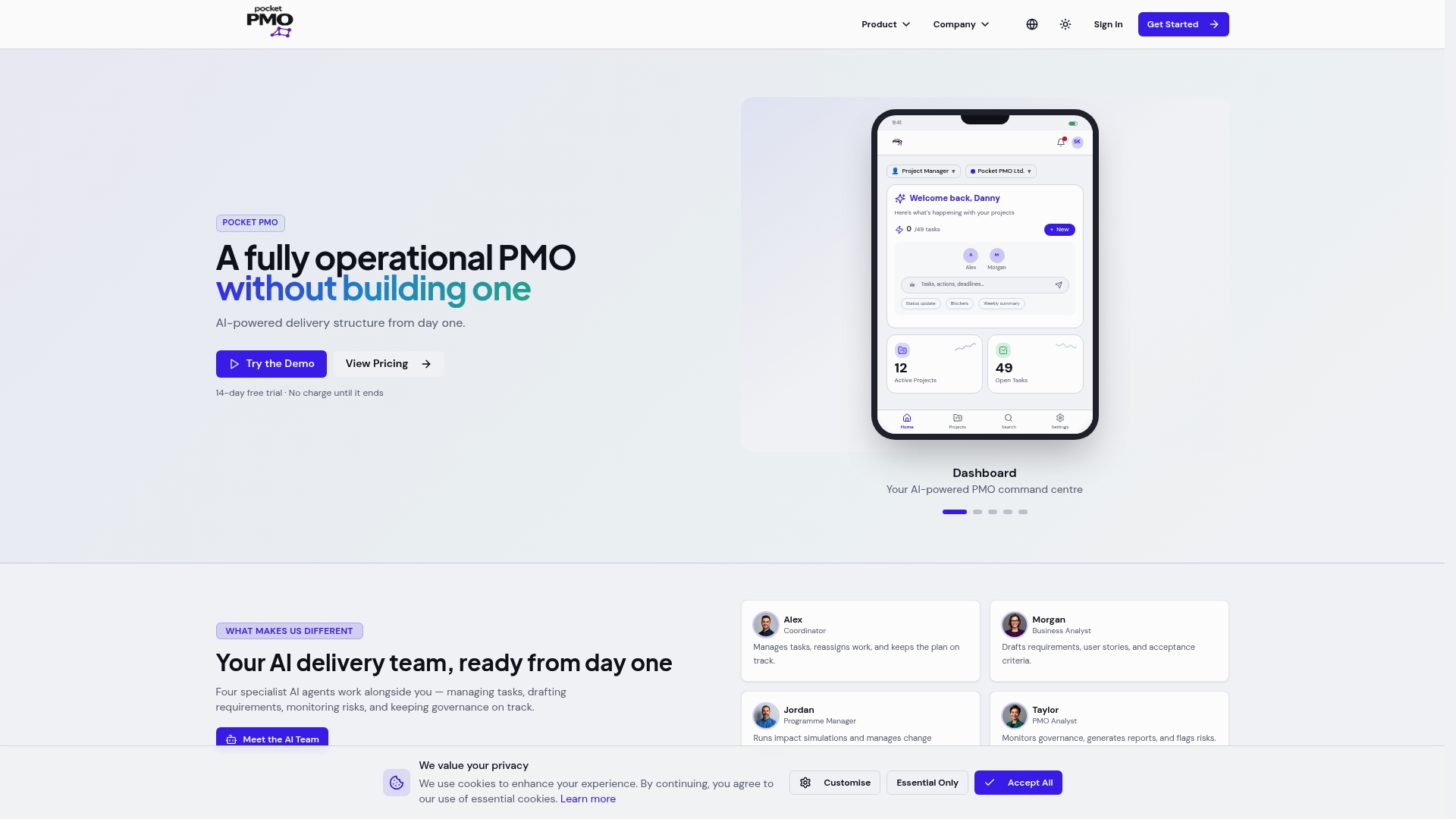
If you are evaluating your options, Pocketpmo's free project status report template is a practical starting point for improving your reporting before you commit to any platform. For teams ready to move further, the Pocketpmo platform deploys a dedicated AI-powered delivery team that manages tasks, requirements, and risks alongside you. See the full feature set and request a demo to assess the fit for your organisation.
FAQ
What are the top project management trends for 2026?
The leading trends are AI-driven automation, hybrid methodologies, async-first communication, and real-time portfolio management. Each addresses a specific gap in how traditional project delivery handles speed, flexibility, and distributed teams.
How is AI changing project management in 2026?
AI automates administrative tasks like status drafting and risk log updates, freeing project managers to focus on judgement and leadership. Fully autonomous AI for portfolio decisions is not yet reliable, so human oversight remains essential.
What is a hybrid project management methodology?
A hybrid methodology combines predictive approaches like Waterfall with adaptive ones like Agile or Kanban, applying each where it fits best within a project. Teams use Waterfall gates for compliance phases and Agile sprints for development workstreams.
Why is async-first communication important for project teams?
Async-first communication reduces meeting overload and makes project status visible to all team members at any time. It works by requiring written task context and documented decisions rather than verbal updates.
How do I choose the right project management tool for 2026?
Look for platforms with automated reporting, predictive analytics, and live portfolio dashboards. Test any tool on a real workstream for at least two weeks before committing, since vendor claims and actual usability often differ significantly.