

Most PMOs are not struggling because they lack project managers. They are struggling because nobody agreed on which workflows actually matter. The key PMO workflows list you define shapes everything downstream: governance quality, reporting accuracy, resource decisions, and project outcomes. In practice, "essential PMO processes" is a phrase that gets used freely but rarely backed by a concrete, prioritised set of activities. This guide gives you exactly that. You will find the core workflows, a framework for choosing between them, a side-by-side comparison, and implementation advice grounded in real PMO experience.
Table of Contents
- Key takeaways
- How to build your key PMO workflows list
- The 8 essential PMO workflows in detail
- Comparing core PMO workflows at a glance
- Making PMO workflows stick: practical recommendations
- My take on PMO workflow adoption
- How Pocketpmo brings your PMO workflows to life
- FAQ
Key takeaways
| Point | Details |
|---|---|
| Start with one workflow | Pick your biggest pain point first and build outward iteratively rather than rolling out everything at once. |
| Intake must be non-negotiable | A well-designed intake form with no exceptions prevents process degradation and maintains governance integrity. |
| Align workflows to strategy | Each workflow you adopt should trace directly back to a strategic goal or measurable organisational outcome. |
| Automate before you scale | AI and automation tools reduce manual reporting effort, freeing your team to focus on decisions rather than data entry. |
| Treat workflows as products | Review, iterate, and retire workflows the same way you would manage a product backlog. |
How to build your key PMO workflows list
Before you pick workflows, you need a selection lens. Not every process that appears in a frameworks document belongs in your PMO. PMBOK 8 defines 40 processes across five focus areas, with planning accounting for roughly half. That breadth is useful as a reference, but trying to implement all of it at once is one of the fastest ways to kill PMO credibility.
The most practical criteria for selecting your project management workflow list are:
- Strategic fit: Does this workflow produce an output that a senior decision-maker actually uses?
- Pain-point priority: Is there a visible, recurring problem this workflow solves right now?
- Adoption feasibility: Can your team adopt this within sixty days without significant retraining?
- Automation readiness: Can parts of this workflow be automated using tools you already own or can realistically procure?
- Maturity alignment: Does your organisation have the governance discipline to sustain this workflow once introduced?
PMOs that focus on value and capacity rather than schedule adherence alone tend to produce far better outcomes for their stakeholders. That orientation should guide every workflow selection decision you make.
Pro Tip: Run a ten-minute survey with your delivery leads before finalising your list. Ask them to name the one process failure that cost the most time last quarter. Their answers will tell you exactly where to start.
The 8 essential PMO workflows in detail
## 1. Portfolio governance and prioritisation
Portfolio governance is the mechanism by which your PMO decides which projects receive funding, resources, and attention. Without it, you end up with a portfolio driven by whoever shouted loudest in the last steering meeting.

A well-structured governance workflow sets clear decision thresholds: for example, any project requesting budget above a defined level automatically triggers a portfolio review. Twelve-week monitoring cycles for strategic initiatives have proven effective at keeping portfolios aligned without creating excessive governance overhead. The output of this workflow is a ranked, funded, and visible portfolio that executives can interrogate at any time.
## 2. Structured project intake
Your intake process is your first line of governance defence. If projects can enter your portfolio through informal conversations or executive sponsorship alone, you will never have clean data or reliable capacity figures.
Effective intake forms take roughly twelve minutes to complete and balance thoroughness with real-world adoption. The key discipline here is the no-exceptions policy. Every project, regardless of size or sponsor seniority, enters through the same gate. Enforcing no exceptions prevents the gradual erosion of governance standards that kills most PMO intake processes within six months.
## 3. Status reporting and governance reviews
Status reporting is the workflow that most PMOs get backwards. They spend hours compiling reports that nobody reads and then wonder why stakeholders still feel uninformed. The fix is to design your reporting workflow around decisions, not documents.
A well-run governance review cycle ties directly to the questions your steering committee needs to answer each fortnight. You can read more about effective management review meetings and how to structure them so they actually close feedback loops rather than consume calendar time. Your reporting workflow should produce a single source of truth, not multiple spreadsheets from different project managers.
## 4. Change control and scope management
Scope creep does not usually arrive as a big dramatic request. It arrives as a series of small, reasonable-sounding asks that individually seem harmless. Change control exists to surface the cumulative cost of those asks.
A structured change control workflow captures every request, assesses its impact on budget, timeline, and resource, and routes it to the appropriate approver. You can reference a detailed change control process guide for a step-by-step breakdown. The critical design choice is setting the right approval threshold: too low and you create bureaucracy; too high and changes bypass the process entirely.
Pro Tip: Log every change request even when the answer is no. A six-month history of declined requests is one of the most powerful governance documents a PMO can produce.
## 5. Risk identification and monitoring
Risk management is the workflow most project managers believe they are doing but few are actually doing well. Identifying risks at project kick-off and then never revisiting them is not a risk workflow. It is a compliance exercise.
A functional risk monitoring workflow runs on a regular cadence, typically fortnightly, and distinguishes between risks that need escalation and those the project team can manage locally. It tracks probability and impact over time, not just at the point of initial identification. Feeding this data into a portfolio-level RAID log gives your PMO genuine early-warning capability.
## 6. Resource and capacity planning
You cannot make good project prioritisation decisions without accurate capacity data. Resource planning is the workflow that translates your portfolio decisions into real allocations against real people.
Effective capacity utilisation tracking means knowing not just who is allocated, but at what percentage and for how long. This workflow should integrate with your HR and finance systems so that resource data does not live in a separate spreadsheet that one person maintains. When capacity planning is connected to intake and governance, your PMO can say no to new projects with data rather than instinct.
## 7. Benefits realisation tracking
This is the most neglected workflow in most PMO operational workflow lists. Projects close, resources are released, and nobody ever checks whether the promised benefits actually materialised.
Benefits realisation requires you to define measurable outcomes at intake, assign an owner for each benefit, and schedule a review at six and twelve months post-delivery. It is the workflow that most directly justifies the PMO's existence to the business. PMOs that act as strategic hubs with visibility into benefits realisation are far harder to cut during organisational restructures.
## 8. Project closure and lessons learned
Closure is not just administrative housekeeping. Done well, it is the feedback mechanism that makes your entire PMO smarter over time. A structured closure workflow captures what worked, what did not, and what the next project team should do differently.
The common failure here is timing. Lessons-learned sessions held three weeks after a project closes, once the team has dispersed, produce generic and unhelpful feedback. Schedule them before the team disbands, while the experience is still fresh.
Comparing core PMO workflows at a glance
Use this table to weigh each workflow against your organisation's current maturity and immediate priorities.
| Workflow | Primary purpose | Key benefit | Maturity needed | Automation readiness |
|---|---|---|---|---|
| Portfolio governance | Prioritise and fund projects | Strategic alignment | Medium to high | Moderate |
| Project intake | Control portfolio entry | Data quality and governance | Low to medium | High |
| Status reporting | Provide decision-ready visibility | Stakeholder confidence | Low | High |
| Change control | Manage scope and budget | Cost and time protection | Medium | Moderate |
| Risk monitoring | Track and escalate threats | Proactive issue resolution | Medium | High |
| Capacity planning | Allocate resources accurately | Reduced over-commitment | Medium to high | Moderate |
| Benefits realisation | Confirm delivered value | PMO business case | High | Low to moderate |
| Project closure | Capture institutional knowledge | Continuous improvement | Low | Low |
The automation readiness column matters more than most PMOs acknowledge. AI-driven automation can handle status updates, calendar integrations, and administrative task tracking, which means your highest-automation workflows can largely run without manual effort once configured. That frees your team to focus where human judgement is genuinely needed.
Making PMO workflows stick: practical recommendations
Getting the workflows right on paper is the straightforward part. Sustaining them in a pressured delivery environment is where most PMOs fail. These are the practices that separate durable PMO operational workflows from ones that quietly die after the first quarter:
- Start with your biggest pain point. Implementing workflows iteratively from the most urgent problem outward is significantly more effective than launching everything simultaneously.
- Enforce the intake gate without exceptions. Senior sponsors bypassing the process is not a minor issue. It is the beginning of the end for your governance model.
- Automate the reporting layer first. Automation reduces manual updates and gives executives faster access to decision-relevant data. This is where the ROI of your tooling becomes visible quickly.
- Assign clear owners for each workflow. A process without an owner is a process in decline. Each workflow needs one person accountable for its quality and evolution.
- Review and retire low-value processes. Treat your workflow list the same way you would treat a product backlog. If a process is consuming effort without producing a useful output, remove it.
- Connect your tools. ERP, HR, finance, and collaboration system integration is the foundation for PMO tool effectiveness. Without it, your data will always be incomplete.
Pro Tip: Run a monthly "workflow health check" where each process owner reports a single red, amber, or green status for their workflow. It takes fifteen minutes and surfaces problems before they become crises.
My take on PMO workflow adoption
I have seen a lot of PMOs launch with impressive process documentation and collapse within twelve months. The pattern is almost always the same: too many workflows, too quickly, with too little regard for the humans being asked to adopt them.
The mistake I see most often is treating a workflow list as a destination rather than a starting point. In my experience, the PMOs that last are the ones that pick two or three workflows, run them well, and build from there. They treat each process as something to be iterated on rather than locked down. They ask whether each workflow is producing genuine value for the people who use it, not just for the PMO team that designed it.
The other thing I have learned is that transparency is a more powerful governance tool than any formal process. When project managers trust that the data they submit will be used to support them rather than audit them, they maintain better records, flag risks earlier, and engage with governance cycles honestly. Build that trust before you build the process, and your workflows will actually work.
— Danny
How Pocketpmo brings your PMO workflows to life
If you are ready to move from workflow documentation to live execution, Pocketpmo gives you a fully operational PMO from day one without building one from scratch.
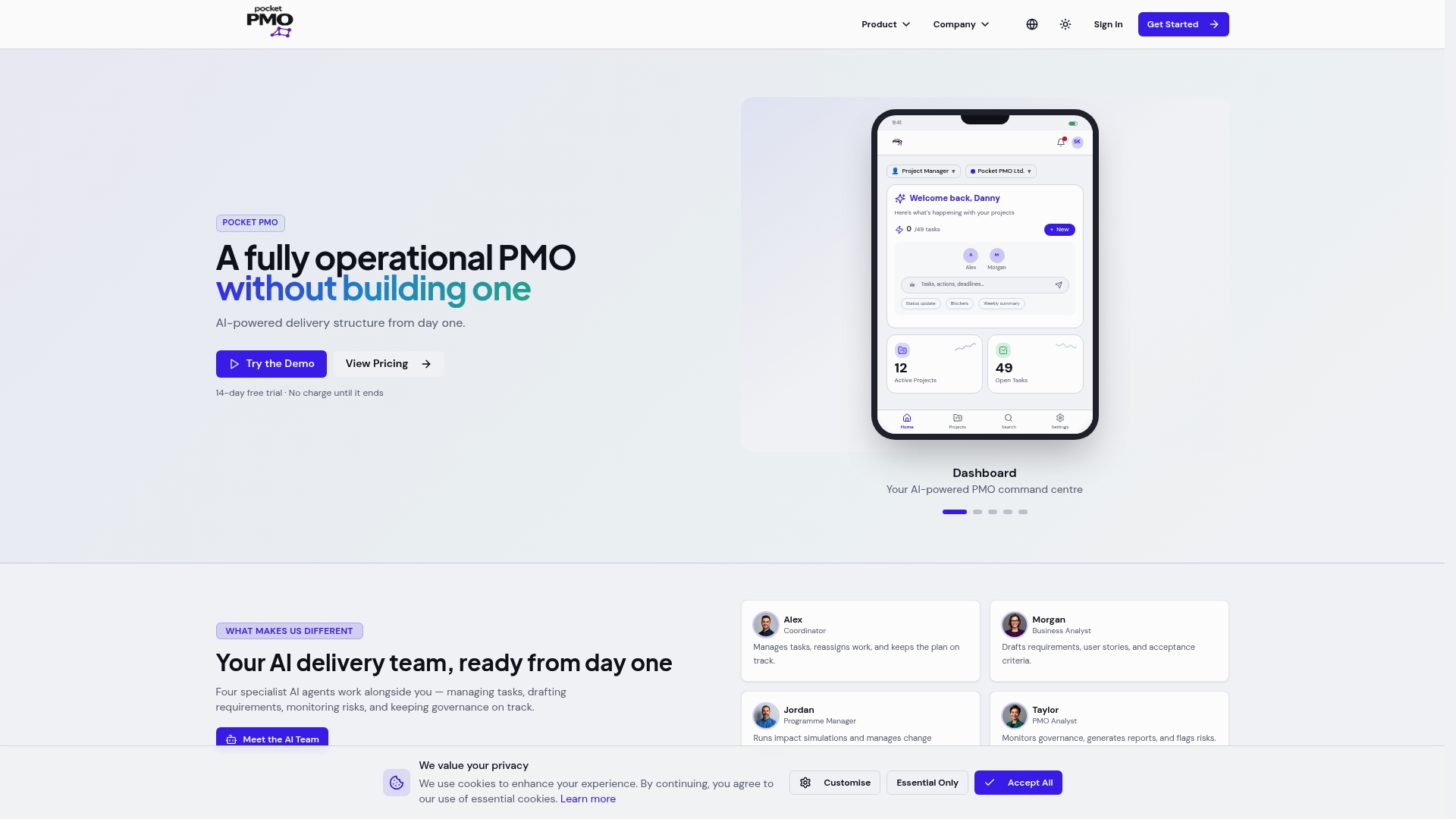
Pocketpmo's AI-powered platform covers your core workflow needs out of the box: structured intake, change request management, status reporting, risk tracking, and capacity visibility are all built in and connected. The platform's intelligent automation handles the administrative layer that typically consumes your team's time, so you can focus on governance and decisions. Whether you are comparing your current tooling or evaluating your options, see how Pocketpmo compares to Microsoft Project and Monday.com. Ready to see it in action? Launch Pocketpmo and start running your workflows today.
FAQ
What is a PMO workflow?
A PMO workflow is a defined sequence of steps and decisions that governs a recurring activity, such as project intake, change control, or risk monitoring. It creates consistency, accountability, and measurable outputs across the portfolio.
How many PMO workflows should you start with?
Start with one or two workflows targeting your most pressing operational pain point. Iterative rollout consistently outperforms launching a full process framework at once, particularly in organisations new to formal PMO governance.
What makes a project intake workflow effective?
An effective intake workflow is short enough to complete in approximately twelve minutes, captures all data needed for governance decisions, and applies a strict no-exceptions policy regardless of project size or sponsor seniority.
Which PMO workflows are easiest to automate?
Status reporting, project intake, and risk monitoring have the highest automation readiness. AI-driven tools can handle data collection, update scheduling, and alert routing, significantly reducing manual effort in these workflows.
How do you measure whether a PMO workflow is working?
Measure adoption rate, output quality, and the decisions it enables. If a workflow is producing reports that nobody reads or data that nobody acts on, it needs redesigning before it needs scaling.