

Choosing the wrong workflow for your project is one of the most costly decisions you can make quietly. The consequences rarely announce themselves until a deadline slips, a deliverable misses the brief, or a team loses confidence in the process entirely. Understanding the types of project management workflows available to you gives you the foundation to make that choice deliberately rather than by default. This article covers sequential, agile, hybrid, and AI-augmented workflows, compares them side by side, and equips you to select the right approach based on your project's real characteristics.
Table of Contents
- Key takeaways
- 1. How to evaluate which workflow fits your project
- 2. Sequential (waterfall) workflows
- 3. Agile workflows: Kanban and Scrum
- 4. Hybrid workflows
- 5. Modern AI-augmented workflows in 2026
- 6. Workflow types compared: a quick reference
- My take on where workflows are heading
- How Pocketpmo supports your workflow decisions
- FAQ
Key takeaways
| Point | Details |
|---|---|
| Match workflow to project type | Sequential workflows suit fixed-scope projects; agile and hybrid suit evolving requirements. |
| Checkpoints outperform milestones | Proactive checkpoints let you intervene before deadlines slip, not after. |
| Hybrid workflows add nuance | Blending waterfall and agile preserves structure where needed and flexibility where it matters. |
| AI requires modular design | AI-augmented workflows perform best when built around independently testable modules. |
| Escalation paths prevent collapse | Every workflow needs defined protocols for blockers and mid-project team changes. |
1. How to evaluate which workflow fits your project
Before exploring specific types of workflows, you need a consistent framework for assessment. Not every methodology suits every context, and applying Scrum to a regulatory compliance project with locked requirements is just as damaging as applying waterfall to a product where customer feedback drives decisions weekly.
According to five core workflow steps, effective project workflow implementation requires defined objectives, clear stage identification, assigned ownership, automated status tracking, and ongoing performance refinement. That structure applies across all workflow types.
When evaluating which approach to adopt, consider these criteria:
- Project complexity. High-complexity projects with many interdependencies typically need structured oversight. Low-complexity, fast-moving projects need speed over documentation.
- Flexibility needs. If requirements are likely to change mid-delivery, a rigid sequential model will create friction and rework.
- Team size and communication style. Smaller, co-located teams often thrive on Kanban or Scrum. Larger, distributed teams may need the predictability of a phased plan.
- Stakeholder involvement. Projects with active clients who want regular input need iterative workflows. Projects with passive sponsors who need quarterly reporting suit waterfall.
- Risk tolerance. High-risk projects where errors are expensive need structured gates and sign-off processes at each phase.
Pro Tip: Prioritise checkpoints over milestones in your workflow design. Checkpoints let you intervene proactively before a deadline is missed. Milestones simply confirm that something already happened.
2. Sequential (waterfall) workflows
The waterfall model is the original structured approach to project delivery, and it still earns its place in the right context. Waterfall workflows follow strict sequential phases with requirements locked before development begins. Each phase must complete fully before the next starts.
The typical structure runs through: requirements gathering, design, development, testing, and deployment. There is no looping back. Once you move from design to development, revisiting design is expensive and disruptive.
Where waterfall works well:
- Construction and engineering projects with physical dependencies.
- Regulatory or compliance-driven projects where documentation and audit trails are mandatory.
- Projects with fixed budgets and fixed scopes where any change triggers a formal request.
- Government contracts with detailed specifications agreed upon before work begins.
The model's strength is predictability. Sponsors know what they are funding, planners know what they are sequencing, and the team knows what success looks like at each phase. The weakness is equally clear. If your assumptions at the start prove wrong, corrections at the end are costly. Testing happens late, so defects discovered during that phase can unravel significant upstream work.
3. Agile workflows: Kanban and Scrum
Agile project management is not a single workflow. It is a philosophy with several practical expressions, the two most widely used being Kanban and Scrum. The fundamental shift is that agile workflows replace sequential phases with iterative cycles, producing testable increments per sprint or per delivery cycle.
Kanban is a continuous flow model. Work items are visualised on a board, typically with columns representing stages such as backlog, in progress, review, and done. Teams pull work as capacity allows rather than being assigned batches. There are no fixed timeboxes. Kanban suits teams managing ongoing workloads, such as support queues, maintenance backlogs, or content pipelines.
Scrum introduces more structure. Work is divided into fixed-length sprints, typically one to four weeks. Each sprint begins with planning, runs through delivery, and ends with a review and retrospective. Defined roles include the Scrum Master, Product Owner, and Development Team. The ceremonies are intentional: they create rhythm, shared accountability, and rapid feedback loops.
When each agile workflow excels:
- Kanban: ongoing or unpredictable workloads, operational teams, or environments where priorities shift frequently.
- Scrum: product development teams with a defined backlog, a willing Product Owner, and the ability to commit to sprint goals.
- Both: projects where customer feedback should shape future iterations rather than be deferred to the end.
The limitation of both is that agile requires a mature team culture. Without discipline around backlog management and sprint commitment, agile ceremonies become overhead without the corresponding benefit.
4. Hybrid workflows
Hybrid workflows are exactly what the name suggests. You take elements from sequential and iterative approaches and combine them in a way that fits your specific delivery context.
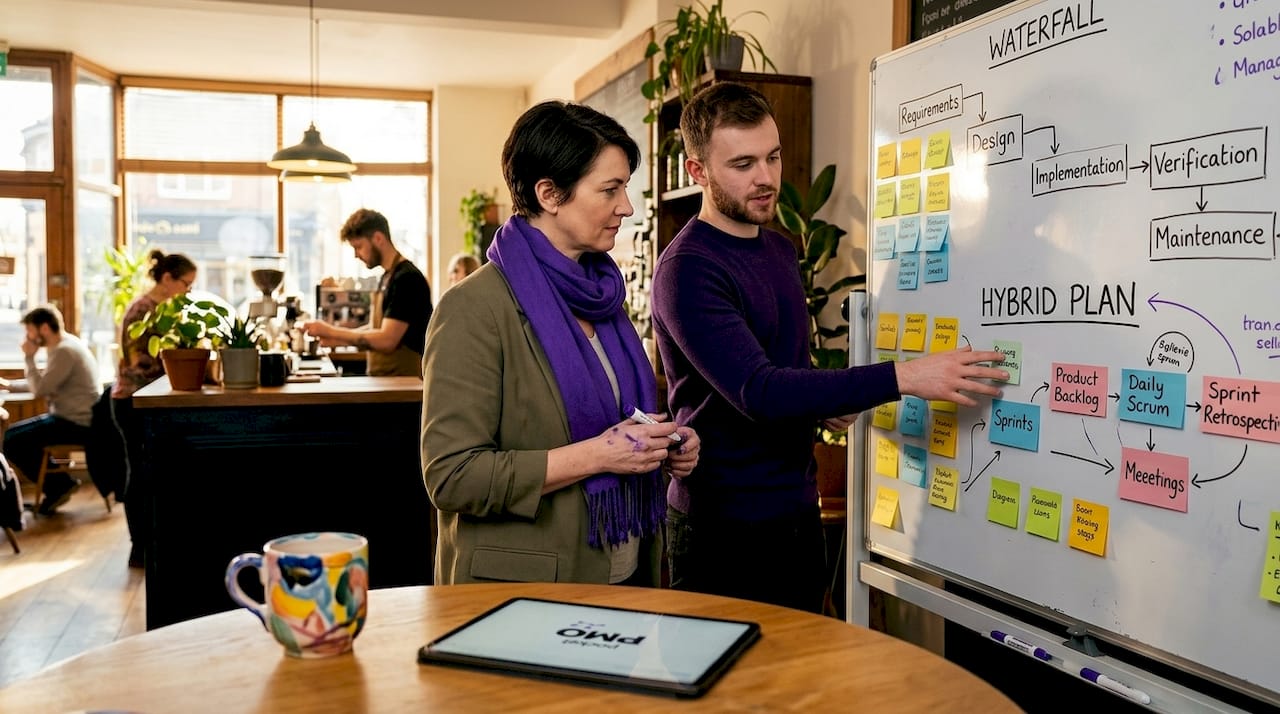
A common example: a software project uses waterfall for infrastructure and environments, where dependencies are fixed and sequencing matters, then switches to Scrum sprints for front-end feature development where user feedback shapes each iteration. The infrastructure work needs a Gantt chart and defined sign-off gates. The product work needs a sprint board and weekly reviews.
The rationale is practical. Most real projects do not fit neatly into one methodology. Requirements may be mostly defined but with one or two areas of genuine uncertainty. Governance may require phased approval but the delivery team needs autonomy within each phase.
The challenge with hybrid models is management overhead. You are, in effect, running two operating rhythms simultaneously. Reporting structures need to accommodate both. Stakeholders need to understand which part of the project is following which approach and why. Without clear communication, a hybrid workflow can feel like inconsistency rather than intentional design.
5. Modern AI-augmented workflows in 2026
The types of project management workflows available in 2026 include a genuinely new category: AI-augmented workflows. These are not simply traditional workflows with a chatbot bolted on. They are purpose-designed processes where AI handles routine orchestration so your team focuses on decisions and quality.
One emerging pattern is the phase-based rapid workflow: blueprint, scaffold, build, and polish. This four-phase approach emphasises iterative delivery with AI assistance managing routine, repeatable tasks within each phase. The result is faster cycle times without reducing quality gates.
Modular sub-workflow design is becoming standard practice in this space. Separating distinct agents with their own roles and prompts makes AI-assisted workflows more maintainable and easier to debug. When a step fails, you know which module is responsible. You can test and refine that module independently rather than interrogating a monolithic process. Pocketpmo's AI tools for multi-project management follow this modular principle closely.
A critical design boundary to understand: autonomous workflows fail when tasks require modifying existing files. This finding from testing across twelve ForgeFlow projects reveals that modification tasks lead to deadlocks, while new file generation is reliably more successful. The implication for workflow design is to structure AI tasks around creation rather than amendment wherever possible.
Key considerations for AI-augmented workflows:
- Design for independent module testing from the outset.
- Define clear handoff points between AI-automated steps and human decision points.
- Avoid assigning AI agents to tasks that require contextual judgement about existing work.
- Build in human review gates before any AI-generated output reaches stakeholders.
Pro Tip: Define escalation paths and turnover protocols explicitly in your workflow documentation. Without them, workflows often collapse when a key team member leaves mid-project or a blocker goes unresolved for too long.
6. Workflow types compared: a quick reference
Use this table to match workflow types to your project context at a glance.
| Workflow type | Best suited for | Flexibility | Team size | Risk management |
|---|---|---|---|---|
| Waterfall | Fixed scope, regulatory projects | Low | Medium to large | Strong phase gates |
| Kanban | Ongoing operations, support teams | High | Small to medium | Continuous visibility |
| Scrum | Product development with evolving backlog | High | Small (5 to 9) | Sprint review cycles |
| Hybrid | Projects with mixed certainty levels | Medium | Medium to large | Dual-mode governance |
| AI-augmented | High-volume, repeatable task environments | Medium | Any | Modular, automated checks |
The table above simplifies, as all good comparison tools do. The real decision requires you to layer in your organisational maturity, your sponsor's appetite for reporting, and your team's experience with each method. Workflow friction often stems from informal workarounds rather than a missing process, so mapping what your team actually does today is as important as choosing a new framework for tomorrow.
For teams selecting AI-assisted tools, the AI in project management guide from Pocketpmo covers practical integration considerations worth reviewing before committing to a platform.
My take on where workflows are heading
I've worked with enough delivery teams to have a firm view on this: most workflow failures are not methodology failures. They are communication failures dressed up as process problems.
I've seen waterfall projects collapse not because the phases were wrong, but because nobody defined what "complete" meant at each gate. I've seen Scrum teams go through the motions of sprints without a single genuine retrospective action being implemented. The ceremonies ran, the boards updated, and the product still delivered late.
What I've learned is that the most important part of any workflow is not the model you choose. It is the escalation path you define when things go wrong. Without explicit blocker protocols, workflows that look solid on paper become paralysed the moment a dependency stalls or a team member departs unexpectedly.
On AI-augmented workflows specifically, my view is that organisations rushing to implement them without modular design discipline are setting themselves up for significant rework. The promise is real. The requirement for thoughtful architecture is equally real. Start small, build independently testable modules, and resist the temptation to automate everything before you understand what should stay human. The PMO best practices for AI workflows resource is a solid starting point if you are planning that transition.
— Danny
How Pocketpmo supports your workflow decisions
Choosing a workflow is step one. Operationalising it across a portfolio of projects is where most teams need support.
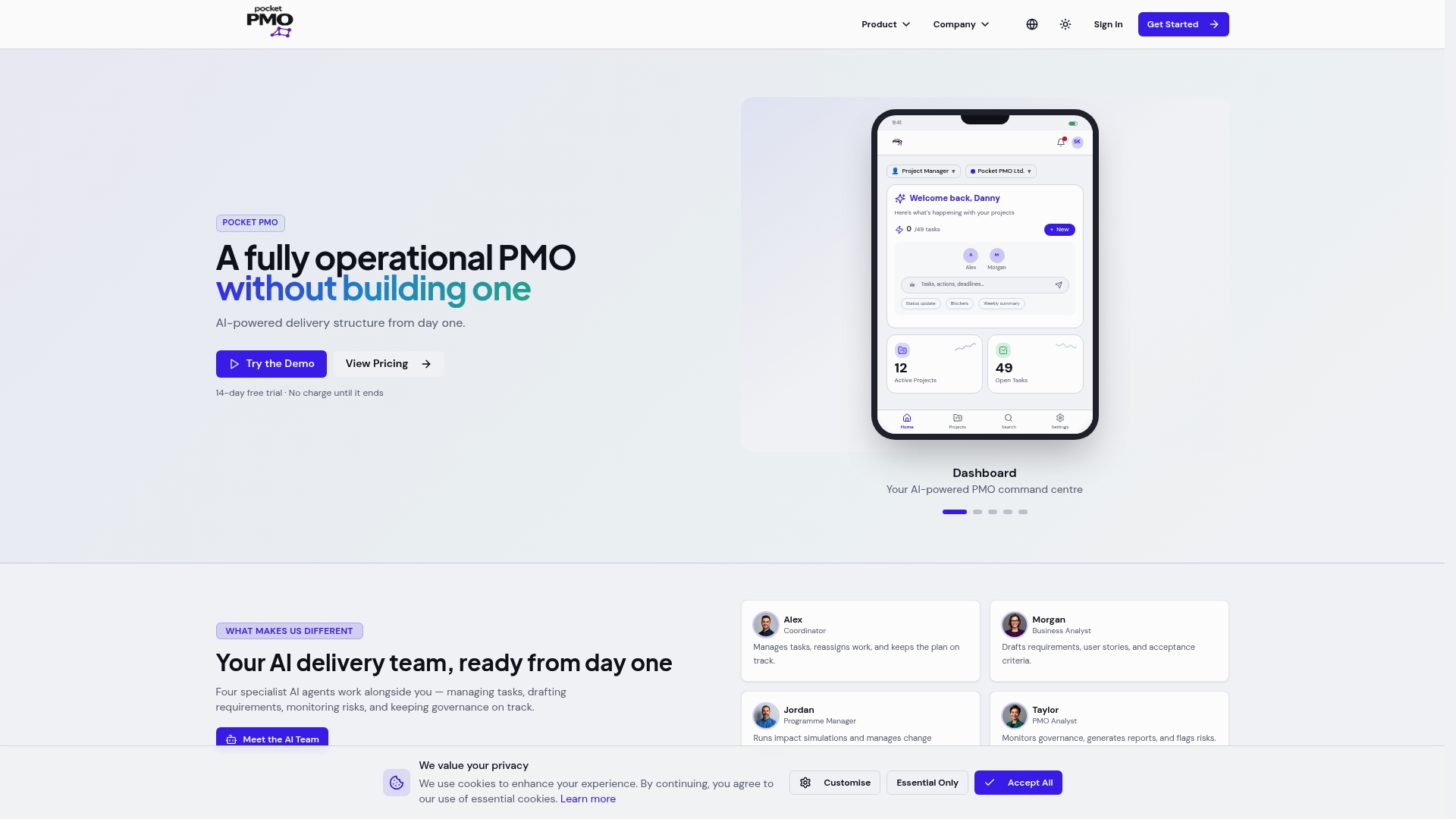
Pocketpmo gives you an AI-powered PMO without the overhead of building one yourself. Whether you're running waterfall delivery with structured phase gates, managing Scrum teams across multiple programmes, or exploring AI-augmented workflows, Pocketpmo adapts to your method rather than forcing you into one. You can compare Pocketpmo with Monday.com directly to see how it handles workflow management, status reporting, and risk tracking in practice. Free templates including the project status report and risk register are available to get your workflow documentation started today.
FAQ
What are the main types of project management workflows?
The main types are sequential (waterfall), agile (Kanban and Scrum), hybrid, and AI-augmented workflows. Each suits different project characteristics including scope certainty, team size, and required flexibility.
When should you use a waterfall workflow over agile?
Use waterfall when requirements are fully defined before work begins and late-stage changes would be costly. Waterfall suits regulatory, construction, and fixed-contract projects where phase sign-off is mandatory.
What is a hybrid workflow in project management?
A hybrid workflow combines elements of sequential and iterative approaches, using waterfall for structured phases and agile methods for areas with evolving requirements. It suits projects with mixed certainty across different workstreams.
How do checkpoints differ from milestones in workflow management?
Checkpoints are proactive review points that allow intervention before a deadline is missed. Milestones confirm that a stage has already been completed. Checkpoints give teams more control over project trajectory.
What makes AI-augmented workflows different from standard agile workflows?
AI-augmented workflows use AI agents to automate status tracking, task generation, and routine orchestration. Unlike standard agile, they require modular design to remain testable and reliable, with explicit human review gates before outputs reach stakeholders.