

Strategic alignment in PMO is defined as the continuous process of connecting every project and portfolio decision to an organisation's overarching strategic objectives. Without it, projects consume resources, deliver outputs, and still fail to move the organisation forward. Understanding what is strategic alignment in PMO is the foundation of every high-performing project function. The PMO sits at the intersection of leadership intent and project execution, making it the natural owner of this process. Get alignment right, and your portfolio becomes a direct instrument of organisational strategy.
What is strategic alignment in PMO and why does it matter?
Strategic alignment is a continuous system integrating vision, strategy, and execution layers, not a one-time exercise completed at the start of a financial year. That distinction matters enormously. Organisations that treat alignment as a planning event rather than an ongoing discipline find their portfolios drifting within months of a strategy refresh.
The importance of strategic alignment shows up directly in outcomes. Alignment is a systematic process essential for organisational unity, improved collaboration, and operational consistency. When the PMO maintains that process, project teams spend less time on work that does not contribute to measurable goals. Resources flow to the right initiatives, and leadership can make faster, more confident decisions.
The role of PMO in strategic alignment is to translate executive intent into a prioritised, governed portfolio. That means the PMO does not simply track project status. It actively connects each initiative to a strategic objective, challenges work that lacks a clear link, and reports on value delivered, not just milestones reached.

How do alignment frameworks connect vision, strategy, and execution?
Three connected layers form the system that sustains alignment across an organisation.
| Layer | What it does | Example |
|---|---|---|
| Vision to strategy | Translates long-term ambition into a strategic plan | "Become the market leader in the UK by 2028" becomes a three-year growth strategy |
| Strategy to objectives | Turns strategy into measurable goals | Growth strategy becomes OKRs: 30% revenue increase, two new product lines |
| Objectives to execution | Links daily project work to those goals | A product development project maps directly to the new product line OKR |
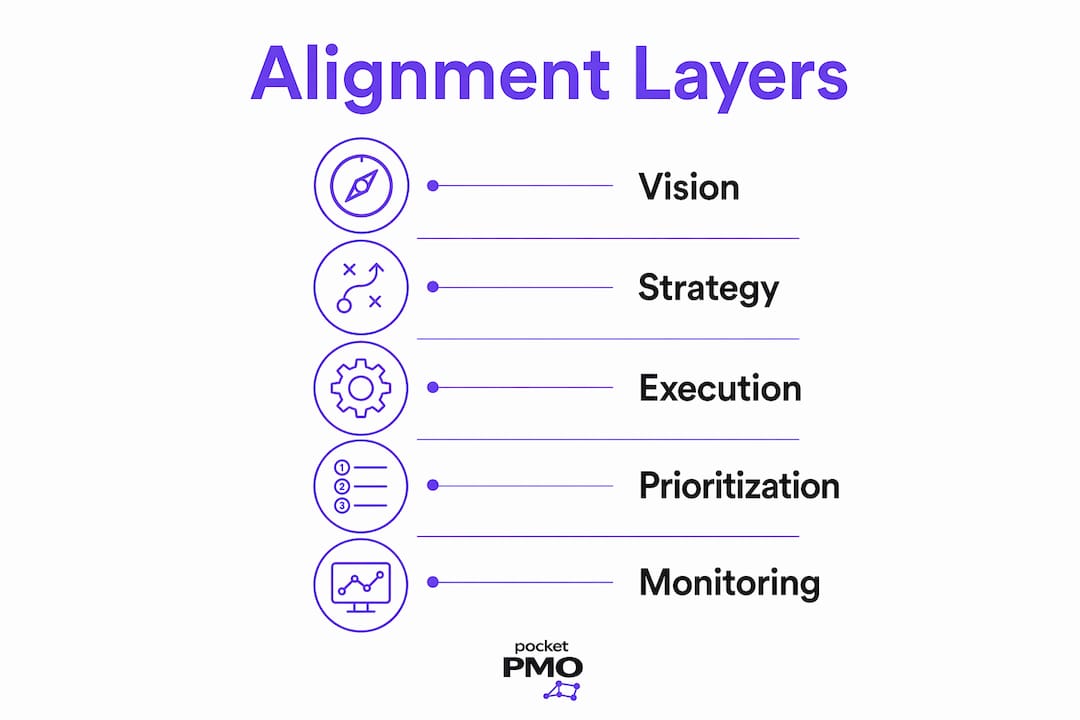
The PMO operates primarily in the third layer, but it must understand all three. A PMO that only manages execution without visibility of the layers above it cannot challenge misaligned work or prioritise effectively.
Cascading OKRs from strategy to individual objectives improves visibility and accountability, closing alignment gaps across the portfolio. OKRs work because they force specificity. Vague strategic intentions become quantified targets that project teams can test their work against.
Cascading goals follow the same logic. Each team's goals derive from the layer above, creating a traceable line from a board-level ambition to a sprint task. When that line breaks, the PMO can see exactly where the disconnect sits.
Pro Tip: Map each active project to a named strategic objective before your next portfolio review. Any project that cannot be mapped to an objective is a candidate for deferral or cancellation.
What gaps cause misalignment between strategy and project execution?
Alignment failures break down along three recurring gaps that require cadence-based operating rhythms to address. Recognising these gaps is the first step to closing them.
-
The translation gap. Strategy exists at a level of abstraction that project teams cannot act on directly. A strategic objective like "improve customer experience" means different things to different teams. Without a PMO translating that intent into specific, measurable project outcomes, each team interprets the strategy independently. The result is a portfolio of projects that all claim strategic relevance but pull in different directions.
-
The visibility gap. Teams are often unaware of what other teams are doing. Two departments may be running parallel initiatives that duplicate effort or, worse, contradict each other. The PMO's portfolio view is the only function positioned to see and resolve this. Signs to watch for include repeated requests for the same data, conflicting project dependencies, and resource contention with no clear resolution process.
-
The feedback gap. Projects complete, but nobody formally assesses whether the intended strategic benefit was realised. Without a benefits realisation review, the organisation cannot learn whether its alignment decisions were correct. This gap is the most dangerous because it allows misalignment to repeat across successive planning cycles.
Starting alignment conversations from current constraints leads to fragmented and divergent project visions among stakeholders. The instinct to begin with "what problems do we have now?" sounds practical, but it anchors the conversation in existing limitations rather than the destination the project must reach.
Pro Tip: Before any project kickoff, run a brief alignment session focused entirely on the destination picture. What does success look like? What must be true when this project closes? Agree on that before discussing constraints.
What is the role of a strategic PMO in sustaining alignment?
A strategic PMO focuses on value-based decision making and tracks outcomes and benefits beyond deliverables. That is the core distinction between a strategic PMO and a traditional delivery-focused PMO. A traditional PMO asks: "Are projects on time and on budget?" A strategic PMO asks: "Are projects delivering the value we expected, and is that value still the right priority?"
Strategic PMOs differentiate themselves through authority in prioritisation and governance, with a focus on outcomes and sustained value delivery. That authority is not optional. Without the mandate to challenge, defer, or stop projects, the PMO becomes a reporting function rather than a governance function.
Key responsibilities of a strategic PMO include:
- Portfolio prioritisation. Ranking initiatives by strategic value, not by who asked loudest or who has the most budget.
- Resource allocation. Directing people and budget to the highest-value work, and actively reallocating when priorities shift.
- Governance and decision rights. Holding clear authority over project approval, stage gates, and escalation paths.
- Benefits tracking. Measuring whether completed projects delivered their intended strategic outcomes, not just their stated deliverables.
- Cultural alignment. High-performing organisations align culture, people, and processes daily, not by having a better written strategy. The strategic PMO reinforces this by making alignment visible and habitual.
The PMO's role in operational strategy extends to capability building. A strategic PMO trains project managers to think in terms of value and outcomes, not just scope and schedule. That shift in mindset is what makes alignment self-sustaining.
How to achieve strategic alignment in PMO: practical tools and approaches
The Seven-Question Execution Hypothesis helps teams capture a full, verified destination picture in 30–40 minutes to prevent misalignment before project start. The seven questions cover the project's purpose, the intended beneficiaries, the measurable outcomes, the constraints, the risks, the dependencies, and the definition of done. Running this exercise before kickoff gives every stakeholder a shared, tested understanding of where the project is going.
Practical tools and approaches that sustain alignment across the portfolio include:
- OKRs and cascading goals. Set objectives at the organisational level, cascade them to programme and project level, and review them on a quarterly cadence. Every project team should be able to name the OKR their work supports.
- Operating rhythms. Weekly team check-ins, monthly portfolio reviews, and quarterly strategy reviews create the cadence that keeps alignment from drifting. Alignment is not a document. It is a conversation that happens repeatedly.
- Real-time dashboards. Shared visibility across the portfolio breaks down silos. When every team can see how their work connects to others, duplication and contradiction become visible before they cause damage. PMO dashboards are the practical mechanism for this.
- Change request governance. Every scope change should be assessed against the strategic objective it supports. A change that does not strengthen the project's alignment to its objective should require explicit approval.
AI in project planning can either worsen misalignment or support it, depending on the completeness of the strategic framing. AI tools that generate project plans, risk registers, or resource schedules will accelerate whatever direction the project is already pointed in. If the destination picture is incomplete or wrong, AI makes the problem worse faster. Successful AI use in alignment requires that initial project frameworks are comprehensive and verified before AI assistance is applied.
Pro Tip: Never use AI to generate a project plan until the Seven-Question Execution Hypothesis has been completed and signed off by key stakeholders. AI amplifies your starting point. Make sure that starting point is correct.
Key takeaways
Strategic alignment in PMO requires a continuous, governed process connecting vision, strategy, and execution, with the PMO holding authority over prioritisation, benefits tracking, and operating cadence.
| Point | Details |
|---|---|
| Alignment is continuous | Treat alignment as an ongoing discipline, not a one-time planning event. |
| Three gaps cause failure | Translation, visibility, and feedback gaps are the root causes of most misalignment. |
| Strategic PMOs need authority | Without decision rights over prioritisation and governance, a PMO cannot sustain alignment. |
| Start with the destination | Agree on a verified destination picture before discussing current constraints or kickoff. |
| AI requires a verified foundation | AI tools accelerate execution in whatever direction the project is pointed, so verify alignment first. |
Why most PMOs get alignment wrong from the start
Leaders often mistake alignment for simple coordination of tasks instead of aligning core value drivers as an interconnected ecosystem. I have seen this play out repeatedly in PMO engagements. The PMO produces a beautifully formatted strategy map, leadership nods in agreement, and six months later the portfolio looks exactly as it did before. Nothing changed because the conversation never moved beyond tasks.
The mistake I see most often is starting alignment work by cataloguing current problems. It feels productive. You fill a whiteboard with issues, risks, and constraints. But you have just anchored every stakeholder to the present state, and now every proposed solution is shaped by existing limitations. The destination picture gets built around what you can do today, not what the strategy actually requires.
The second mistake is treating alignment as a PMO responsibility alone. Alignment requires leadership buy-in and, critically, leadership authority delegated to the PMO. Without that, the PMO can identify misaligned projects but cannot act on them. I have worked with PMOs that produced excellent portfolio analysis and watched it sit unread because no one had given the function the authority to act on its findings.
The fix is not complicated, but it requires discipline. Establish the destination picture first. Secure explicit authority for the PMO to challenge and defer work. Build operating rhythms that make alignment a regular conversation, not an annual event. And use agile PMO frameworks to keep the process responsive when strategy shifts. Alignment is not a state you achieve. It is a practice you maintain.
— Danny
How Pocketpmo supports strategic alignment across your portfolio
Pocketpmo is built for project managers and PMO professionals who need operational PMO capacity without the overhead of building a full internal function. Its real-time dashboards give you instant visibility across your portfolio, so translation, visibility, and feedback gaps become visible before they compound. The AI-powered delivery team helps you pressure-test project plans against your strategic objectives from day one.
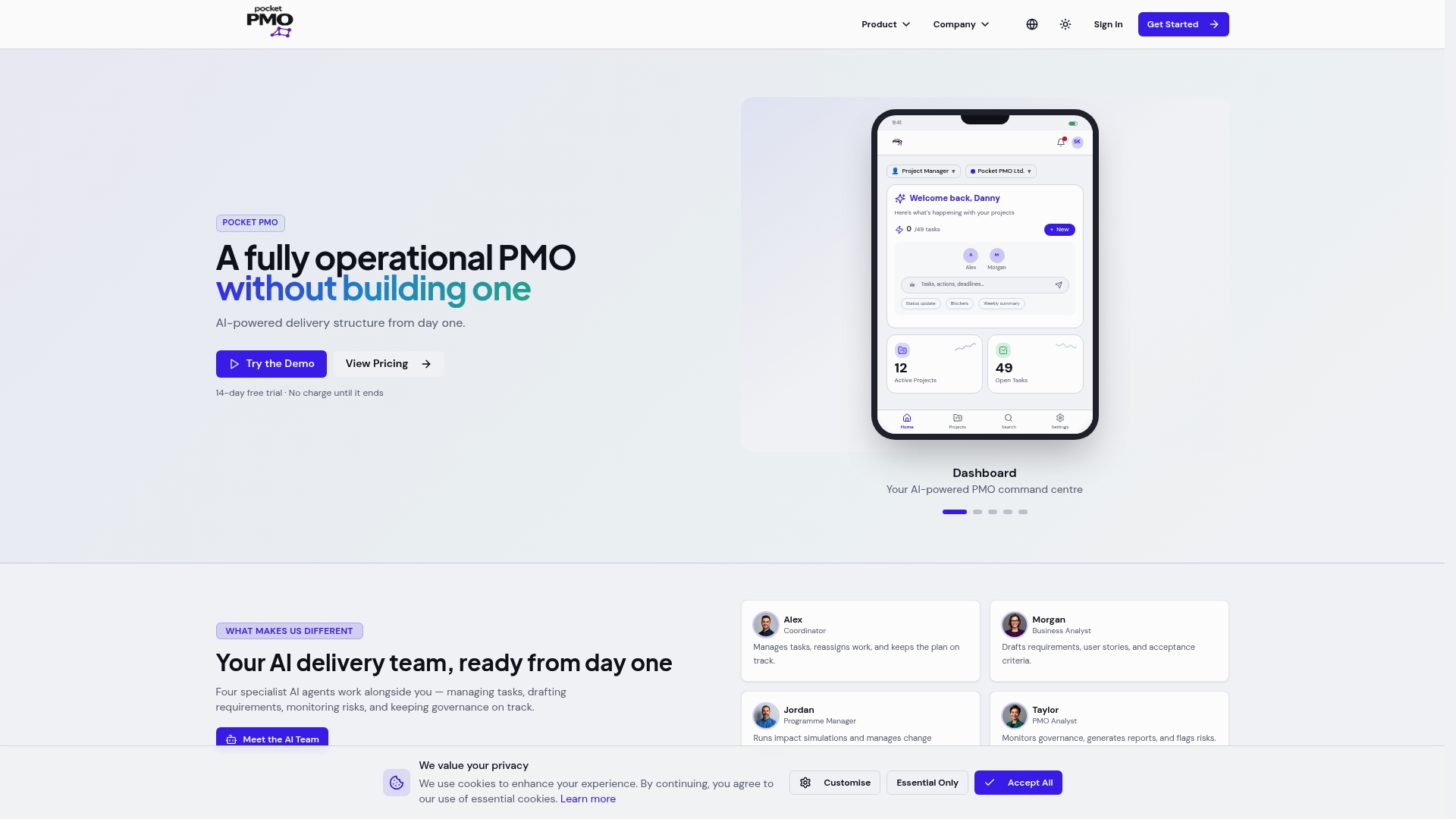
Pocketpmo's portfolio management, change request workflows, and benefits tracking tools directly support the governance and prioritisation work that a strategic PMO requires. If you are ready to connect your projects to your strategy with confidence, Pocketpmo gives you the platform to do it without building from scratch.
FAQ
What is strategic alignment in PMO?
Strategic alignment in PMO is the process of ensuring every project and portfolio decision directly supports the organisation's strategic objectives. The PMO governs this process through prioritisation, governance, and benefits tracking.
Why do projects fail due to misalignment?
Projects fail due to three gaps: the translation gap, the visibility gap, and the feedback gap. Each gap breaks the connection between strategy and execution at a different point in the delivery lifecycle.
What is the Seven-Question Execution Hypothesis?
The Seven-Question Execution Hypothesis is a pre-kickoff alignment tool that captures a verified destination picture in 30–40 minutes. It covers purpose, beneficiaries, outcomes, constraints, risks, dependencies, and the definition of done.
What is the difference between a strategic PMO and a traditional PMO?
A traditional PMO tracks delivery against time and budget. A strategic PMO holds authority over prioritisation and governance, and measures success by whether projects deliver their intended strategic value.
How do OKRs support strategic alignment in project management?
OKRs cascade strategic objectives from organisational level down to individual projects, creating a traceable link between board-level ambition and daily project work. That traceability closes both the translation and visibility gaps.