

Agile PMO frameworks are defined as structures that embed Agile principles into a Project Management Office, shifting its role from control and compliance to facilitation, coaching, and adaptive governance. Traditional PMOs produce monthly status reports while Agile teams operate on two-week sprints with daily standups. That mismatch is one of the most common reasons PMO transformations stall. Frameworks like SAFe (Scaled Agile Framework) and Scrum give PMO leaders a practical model for aligning governance with delivery rhythms. The result is faster decisions, better portfolio visibility, and teams that actually trust the PMO to support rather than obstruct them.
Why agile PMO frameworks outperform traditional approaches
The benefits of agile PMO adoption are measurable, not theoretical. Teams that manage complexity with Agile approaches are five times more likely to succeed, achieving an 88% success rate compared to 14% for those using conventional methods. That gap exists because Agile PMOs build feedback loops and adaptive coordination into the delivery process rather than relying on upfront plans that rarely survive contact with reality.
The core agile framework advantages include:
- Alignment with delivery cadence. Governance reviews sync with sprint cycles, so decisions happen when they are relevant, not weeks after the fact.
- Higher success rates in complex projects. The data above reflects environments where requirements shift, dependencies multiply, and risk is constant.
- Reduced bureaucracy. Lean Governance replaces stage-gate approvals with budget guardrails, cutting the approval overhead that slows teams down.
- Team empowerment. Agile PMOs coach rather than police, which builds capability across the organisation over time.
- Continuous improvement. Sprint retrospectives and portfolio reviews create regular checkpoints to refine both delivery and governance practices.
- Faster value delivery. Scrum's emphasis on early and frequent value means stakeholders see progress in weeks, not quarters.
Pro Tip: Before measuring the benefits of your Agile PMO, establish a baseline. Track project success rates, decision turnaround times, and team satisfaction scores before and after the transition. Without a baseline, the improvement is invisible to leadership.
How does an agile PMO differ from a traditional PMO?
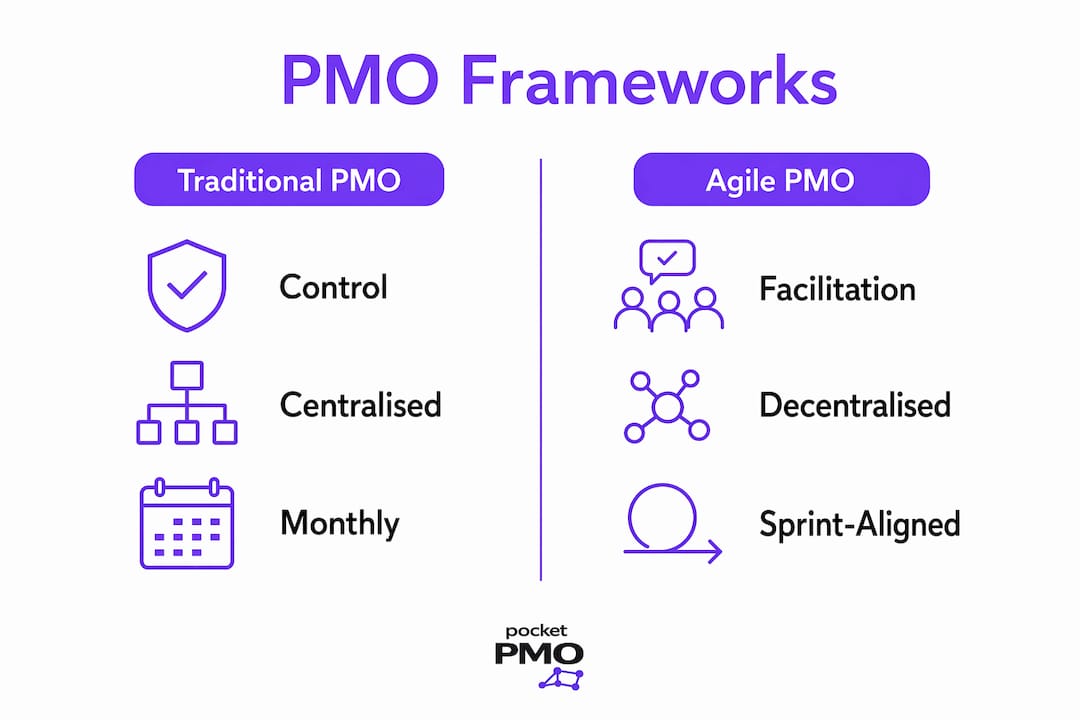
The difference is not cosmetic. Traditional PMOs are built around control: standardised processes, centralised approvals, and monthly reporting cycles. Agile PMOs are built around enablement: coaching, portfolio visibility, and governance that adapts to delivery rhythms.
| Dimension | Traditional PMO | Agile PMO |
|---|---|---|
| Primary role | Control and compliance | Facilitation and coaching |
| Reporting cadence | Monthly status reports | Aligned with sprint cycles |
| Decision-making | Centralised approvals | Decentralised with guardrails |
| Governance model | Stage-gate approvals | Lean Governance and portfolio Kanban |
| Team relationship | Oversight and audit | Support and capability building |
| Response to change | Change control process | Adaptive planning and reprioritisation |
The cadence mismatch is the most damaging structural problem. A PMO that asks Agile teams to pause and produce monthly reports is asking them to context-switch out of their delivery rhythm. The result is either stale data or resentful teams. Aligning governance tempo with Agile delivery rhythms solves both problems at once.
SAFe's Lean Governance model addresses this directly. It replaces centralised approvals with budget guardrails and decentralised decision-making, so portfolio leadership retains authority for strategic decisions while teams decide frequently near the work. Governance becomes an enabler rather than a bottleneck.
Pro Tip: Map your current governance touchpoints against your teams' sprint calendars. Any governance event that falls outside a sprint boundary is a friction point. Reschedule it to coincide with sprint reviews or planning sessions.
The Agile PMO also takes responsibility for managing cross-team dependencies. In a multi-team environment, unresolved dependencies are the single fastest way to derail delivery. The PMO creates visibility across those dependencies without requiring teams to escalate every issue through a formal process.
What are the key components of an agile PMO framework?
An effective Agile PMO is built on five components. Each one reinforces the others, and missing any one of them creates a structural weakness.
-
Portfolio visibility. Real-time reporting across all active projects gives leadership the information they need to make fast, confident decisions. This replaces the monthly pack with a living portfolio view.
-
Consistent Agile standards. Inconsistent Agile application across teams is the top failure mode in Agile transformations. The PMO sets minimum viable standards: a shared definition of done, consistent sprint cadence, and common metrics. These standards make cross-team coordination and portfolio reporting reliable.
-
Coaching and capability uplift. PMOs that prioritise coaching and methodology guidance over immediate control enforcement demonstrate faster value and improve outcomes. Coaching is not a soft option. It is the fastest route to sustainable Agile practice.
-
Cross-team dependency management. The PMO maps and tracks dependencies across Agile Release Trains and delivery teams. This prevents the silent blockers that accumulate when teams work in isolation.
-
Lean Portfolio Management. SAFe's Lean Portfolio Management framework defines budget guardrails and decision boundaries, enabling teams to make frequent operational decisions while leadership handles infrequent strategic ones. Portfolio Kanban and cadence events replace stage-gates entirely.
Pro Tip: Build trust before building governance. Spend the first 60 days of an Agile PMO transition focused entirely on removing blockers for teams. Once teams see the PMO as a support function, governance acceptance follows naturally.
Agile PMO best practices also include a maturity model. Measuring where your PMO sits on a maturity scale gives you a structured way to identify gaps and prioritise improvements. Without it, progress feels anecdotal and leadership support erodes.
How can organisations implement agile PMO frameworks successfully?
Implementation sequencing matters as much as the framework itself. Many PMOs fail by enforcing control before building relationships. The steps below reflect the sequence that produces the fastest credibility and the least resistance.
- Start with relationships, not rules. Spend the first weeks listening to delivery teams. Understand their blockers, their sprint rhythms, and their frustrations with existing governance. This intelligence shapes everything that follows.
- Align governance cadence with delivery rhythms. Schedule portfolio reviews, risk escalations, and dependency checks to coincide with sprint events. Daily impediment surfacing replaces monthly reporting as the primary visibility mechanism.
- Involve leadership in defining guardrails. Budget guardrails and decision boundaries only work if senior leadership owns them. Facilitate a workshop to define what decisions teams can make autonomously and which require escalation.
- Invest in coaching from day one. Assign Agile coaches or trained practitioners to each delivery team. Coaching accelerates consistent Agile practice and reduces the variation that undermines portfolio reporting.
- Use a maturity model to track progress. Define what good looks like at each maturity level and assess your PMO quarterly. Share results transparently with leadership to sustain organisational support.
- Monitor early value delivery. Identify two or three quick wins in the first sprint cycle. Visible early progress builds the political capital needed to introduce more substantive governance changes later.
- Adapt continuously. Treat the PMO operating model as a product. Run retrospectives on governance processes, not just delivery. Adjust what is not working without waiting for an annual review cycle.
The organisations that implement agile project management frameworks most successfully treat the PMO itself as an Agile team. They apply the same principles of inspection, adaptation, and continuous improvement to their own ways of working.
Key takeaways
Agile PMO frameworks succeed by aligning governance with delivery cadence, setting consistent standards, and building trust before enforcing control.
| Point | Details |
|---|---|
| Cadence alignment is critical | Sync governance reviews with sprint cycles to avoid stale data and team friction. |
| Consistent standards prevent failure | Set a shared definition of done and common metrics to enable reliable cross-team reporting. |
| Coaching outperforms control | PMOs that prioritise coaching over enforcement demonstrate faster value and better outcomes. |
| Lean Governance reduces bureaucracy | Replace stage-gate approvals with budget guardrails and decentralised decision authority. |
| Sequence implementation carefully | Build relationships and remove blockers first; introduce formal governance once trust is established. |
What i have learned from agile PMO transitions
The hardest part of adopting Agile PMO frameworks is not the framework. It is the culture shift from control to trust. I have seen PMOs with excellent Agile knowledge fail because they introduced governance before they had any credibility with delivery teams. The teams saw the PMO as another layer of bureaucracy, and they were not wrong.
The organisations that get this right share one habit: patience in the early stages. They spend weeks building relationships before they introduce a single governance artefact. When the PMO eventually asks teams to align on a shared definition of done or report dependencies in a portfolio Kanban, teams comply because they have already seen the PMO remove blockers for them.
The cadence alignment point is where I have seen the most immediate impact. When a PMO stops asking for monthly reports and starts attending sprint reviews instead, the quality of portfolio information improves overnight. Leadership gets real data. Teams stop producing documents nobody reads. That single change builds more credibility than months of framework documentation.
The other lesson is that coaching is not optional. You cannot install Agile PMO best practices through a policy document. You need practitioners embedded with teams, modelling the behaviours and helping people apply the standards in context. The investment pays back quickly in reduced variation and more reliable delivery.
If I were advising a PMO leader starting this transition today, I would say: measure your governance cadence against your delivery cadence on day one. Every gap you find is a friction point. Fix those first, and the rest of the transformation becomes significantly easier.
— Danny
How Pocketpmo supports your agile PMO transition
Agile PMO frameworks require real-time portfolio visibility, consistent reporting, and governance that keeps pace with delivery. Pocketpmo delivers all of that without requiring you to build a PMO infrastructure from scratch.
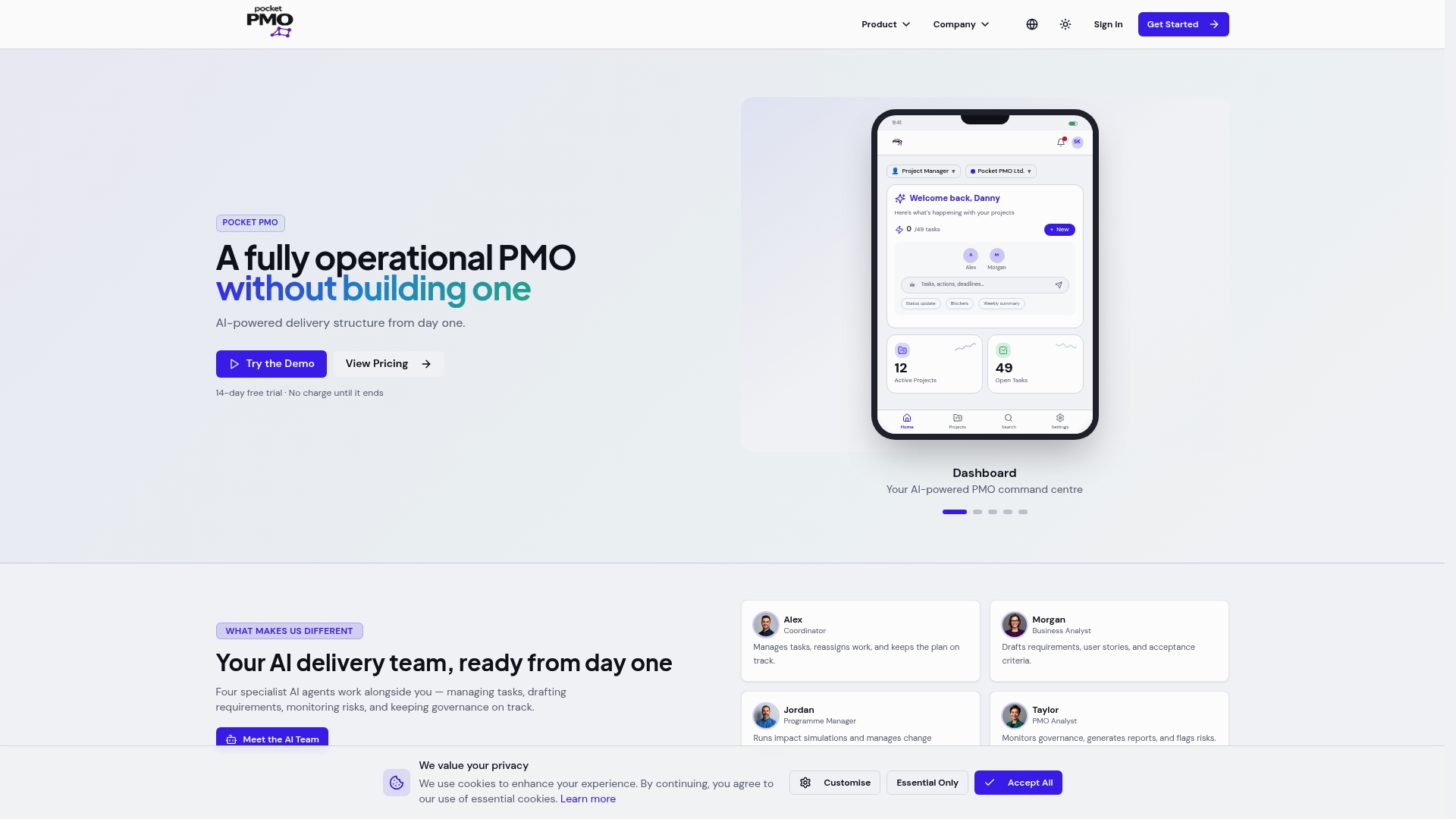
Pocketpmo's AI-powered platform gives you live dashboards, automated status reporting aligned with sprint cadences, and dependency tracking across multiple projects. The platform's fully operational PMO service means you can apply Agile PMO practices from day one, with intelligent automation handling the reporting overhead that typically consumes PMO capacity. If you want to see how it compares to tools you may already be using, the Pocketpmo vs Microsoft Project comparison covers the key differences in agility and PMO framework support. Start with a demo and see the portfolio visibility your teams have been missing.
FAQ
What is an agile PMO framework?
An Agile PMO framework is a structure that embeds Agile principles into a Project Management Office, shifting its focus from control and compliance to facilitation, coaching, and adaptive governance aligned with delivery cadences.
Why do traditional pmos struggle with agile teams?
Traditional PMOs operate on monthly reporting cycles while Agile teams work in two-week sprints. That cadence mismatch produces stale portfolio data and creates friction that stalls Agile transformations.
What is lean governance in an agile PMO?
Lean Governance replaces centralised stage-gate approvals with budget guardrails and portfolio Kanban, enabling teams to make frequent operational decisions while leadership retains authority for strategic choices.
How long does it take to implement an agile PMO?
There is no fixed timeline, but the first 60 days should focus on building relationships and removing team blockers rather than introducing governance. Formal governance structures gain acceptance faster once trust is established.
What is the biggest risk when adopting agile PMO frameworks?
The top failure mode is inconsistent Agile application across teams. Without minimum viable standards such as a shared definition of done and consistent sprint cadence, cross-team coordination and portfolio reporting both break down.