

A strategic project planning workflow is a systematic sequence of phases that guides a project from initiation through to delivery, ensuring every decision and output aligns with organisational objectives. Without this structure, teams default to ad-hoc methods. Organisations with structured planning processes are 2.5 times more likely to succeed in execution than those without one. That single statistic explains why project managers who rely on instinct alone consistently miss targets. The most effective workflows combine outcome-based roadmaps, layered planning methods such as OKRs and the Balanced Scorecard, and disciplined governance rhythms that keep teams aligned from day one.
What are the essential phases in a strategic project planning workflow?
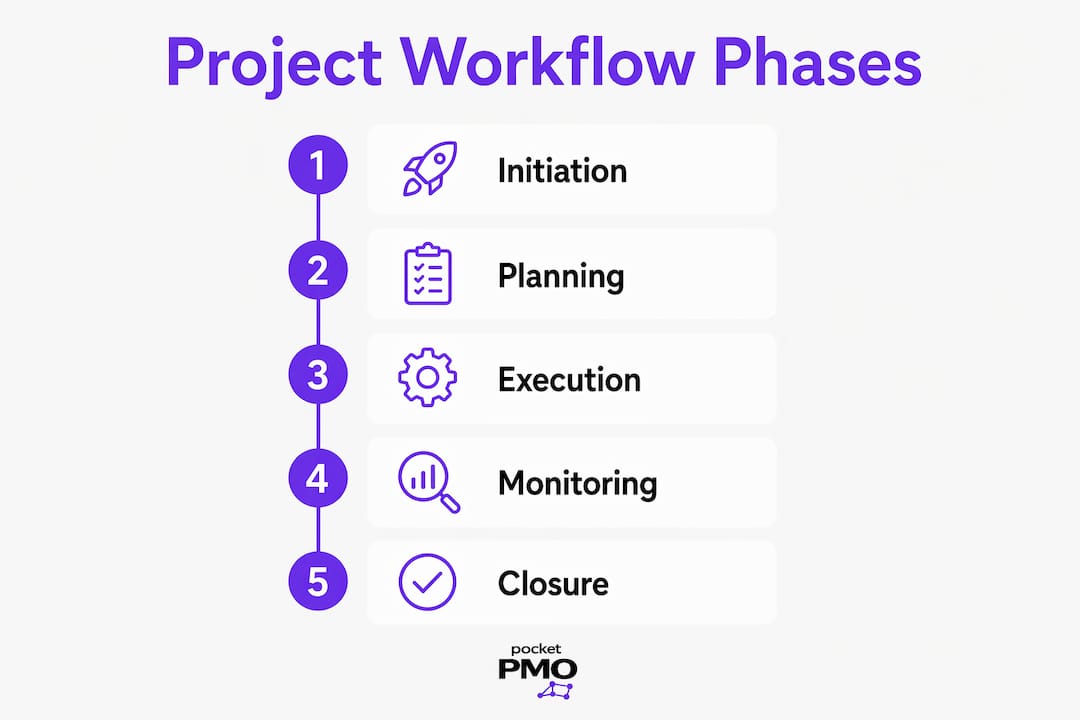
Optimal project workflows contain 4–7 distinct phases to balance completeness with usability. Fewer than four phases omit critical activities; more than seven become unmanageable for most teams. That range is not arbitrary. It reflects decades of practice across thousands of projects where teams either cut corners or drowned in process.
The four core phases most teams need are:
- Initiation. Define the business case, identify stakeholders, and confirm strategic alignment before any planning begins.
- Planning. Build the project plan, assign ownership, set measurable outcomes, and agree the governance model.
- Execution and delivery. Deliver work in structured increments, track progress against outcomes, and manage risks and changes.
- Closure and review. Confirm benefits realisation, capture lessons learned, and formally close the project.
Each phase needs clearly defined inputs, outputs, decision gates, and named gate owners. Without gate owners, decisions stall. Without defined outputs, teams argue about whether a phase is actually complete.
| Phase | Key output | Gate owner |
|---|---|---|
| Initiation | Approved business case | Sponsor |
| Planning | Signed-off project plan | Project manager |
| Execution | Delivered increments with outcome evidence | Delivery lead |
| Closure | Benefits realisation report | Sponsor and PM |

Pro Tip: Assign a named gate owner at the start of the project, not at the gate itself. Late assignment creates delays and ambiguity about who holds decision authority.
Phase duration matters as much as phase structure. Outcome-based roadmaps structure phases of 2–4 months, each delivering clear measurable outcomes rather than task lists. A phase labelled "Months 1–3: platform foundation" is far more useful than one labelled "setup." The first tells your team what done looks like; the second does not.
Which strategic planning tools and frameworks enhance workflow effectiveness?
The biggest mistake teams make with planning frameworks is searching for one perfect model. Layering diagnostic and execution frameworks simultaneously delivers both strategic depth and operational clarity. No single framework does both jobs well.
Diagnostic frameworks assess your current state:
- SWOT maps internal strengths and weaknesses against external opportunities and threats.
- PESTLE examines political, economic, social, technological, legal, and environmental factors affecting the project context.
- Porter's Five Forces analyses competitive pressures relevant to the project's strategic environment.
Execution frameworks translate diagnosis into action:
- OKRs (Objectives and Key Results) set ambitious goals with measurable outcomes at team and project level.
- Balanced Scorecard tracks performance across financial, customer, internal process, and learning dimensions.
| Framework type | Best use | Example |
|---|---|---|
| Diagnostic | Current state assessment | SWOT, PESTLE |
| Execution | Ongoing management and tracking | OKRs, Balanced Scorecard |
| Hybrid | Full lifecycle coverage | SWOT + OKRs layered |
The practical approach is to run a SWOT or PESTLE analysis during initiation, then set OKRs for each delivery phase. This gives you a clear picture of where you are starting from and a measurable definition of where you need to reach. Teams that skip the diagnostic step often set objectives that do not reflect real constraints.
Pro Tip: Set no more than three OKRs per phase. More than three dilutes focus and makes it harder to assess whether the phase genuinely succeeded.
You can find a detailed breakdown of how different workflow structures compare across project types, which helps when selecting the right framework combination for your context.
How to execute and govern a project workflow effectively?
Execution is where most workflows break down. Teams plan well but govern poorly. The fix is a hybrid governance model that blends Waterfall controls with Agile delivery sprints. Waterfall provides the regulatory gates and audit trail; Agile provides the adaptability and continuous feedback loops. Neither approach alone is sufficient for complex projects.
Effective execution governance requires four things:
- Outcome-based roadmaps. Structure your delivery phases into 2–4 month blocks, each with a named outcome and success measure.
- Role clarity at every gate. Every decision point needs one named owner. Committees decide slowly; named owners decide clearly.
- Async-first communication. Teams that adopt async-first cultures reserve synchronous meetings for complex decisions only. This cuts status-meeting bloat and frees time for real work.
- Disciplined change control. Change requests are opportunities to re-validate strategic alignment, not administrative hurdles. Reject any change that does not serve the agreed strategic objective.
"Effectiveness depends on delivering outcomes aligned to strategy, not just on-time and on-budget task completion." Project Management Formula
That distinction matters more than most teams realise. A project can finish on time, within budget, and still fail to deliver business value. Strategic alignment must be validated at each decision gate to prevent scope creep and strategic drift. Build that validation into your gate criteria, not as an afterthought.
Pro Tip: Reserve your weekly team meeting for decisions that genuinely require real-time discussion. Use a shared async log for status updates, blockers, and progress notes. You will recover hours every week.
For a practical guide to decision ownership at project gates, the principles of clear accountability apply across every methodology.
What common challenges occur in project planning workflows?
The most persistent challenge is confusing efficiency with effectiveness. A team can run a perfectly efficient process and still deliver the wrong outcome. Effectiveness means delivering outcomes aligned to strategy, not simply completing tasks on schedule. Project managers who measure only velocity miss the bigger picture entirely.
Four challenges appear repeatedly across project types:
- Overly rigid workflows. Waterfall-only governance without Agile flexibility causes delays when requirements change. Teams spend more time managing the process than delivering value.
- Overly flexible workflows. Pure Agile without governance gates creates scope creep and makes it difficult to demonstrate strategic progress to leadership.
- Weak change control. Teams that approve changes without checking strategic alignment gradually drift from the original objective. The project delivers something, but not what the organisation needed.
- Skipping benefits realisation. Many teams close a project at go-live and never confirm whether the expected business value materialised. Benefits realisation planning from day one tracks whether projects deliver value beyond delivery milestones.
Organisations that define a regular review rhythm for progress, obstacles, and adaptation reports improve both strategy visibility and execution outcomes. A fortnightly leadership review and a weekly team review are the minimum cadence for most projects. Without a defined rhythm, strategic drift goes unnoticed until it is too late to correct.
Stakeholder communication is the final common failure point. Teams that communicate only at milestones leave stakeholders uninformed between gates. Regular, brief async updates keep sponsors engaged without consuming delivery time.
Key takeaways
A strategic project planning workflow succeeds when it combines clear phase structure, layered planning frameworks, hybrid governance, and a consistent review rhythm aligned to business outcomes.
| Point | Details |
|---|---|
| Phase structure matters | Use 4–7 phases with named gate owners and defined outputs for every stage. |
| Layer your frameworks | Combine diagnostic tools like SWOT with execution models like OKRs for full lifecycle coverage. |
| Govern with a hybrid model | Blend Waterfall controls with Agile sprints to maintain both rigour and adaptability. |
| Validate at every gate | Check strategic alignment at each decision point, not just at project closure. |
| Build in benefits realisation | Track business value from day one, not only after go-live. |
Why I think most project workflows fail before execution starts
The uncomfortable truth I have observed across years of project delivery is that most workflow failures are not execution problems. They are design problems. Teams invest heavily in planning tools and methodology training, then build workflows that look thorough on paper but collapse under the weight of real decisions.
The shift I have seen work consistently is treating the governance model as a first-class deliverable, not a background document. When you define who owns each gate, what the exit criteria are, and how change requests will be evaluated before the project starts, execution becomes far less chaotic. The 2026 project management guidance from Vact reinforces this: hybrid governance and async communication are not trends. They are responses to the real cost of poorly designed workflows.
The other thing I would push teams on is benefits realisation. Most project managers treat it as a post-project activity. The teams that deliver genuine business value start tracking it at initiation. They define what success looks like in business terms, not just delivery terms, and they check against that definition at every gate. That single habit separates projects that deliver outcomes from projects that simply deliver outputs.
Adopt a disciplined governance rhythm. Define your gate owners early. Layer your frameworks rather than picking one. These are not complex changes, but they are the ones that actually shift outcomes.
— Danny
How Pocketpmo supports your project planning workflow
Pocketpmo is built for project managers who need governance, planning, and delivery management in one place without building a PMO from scratch.
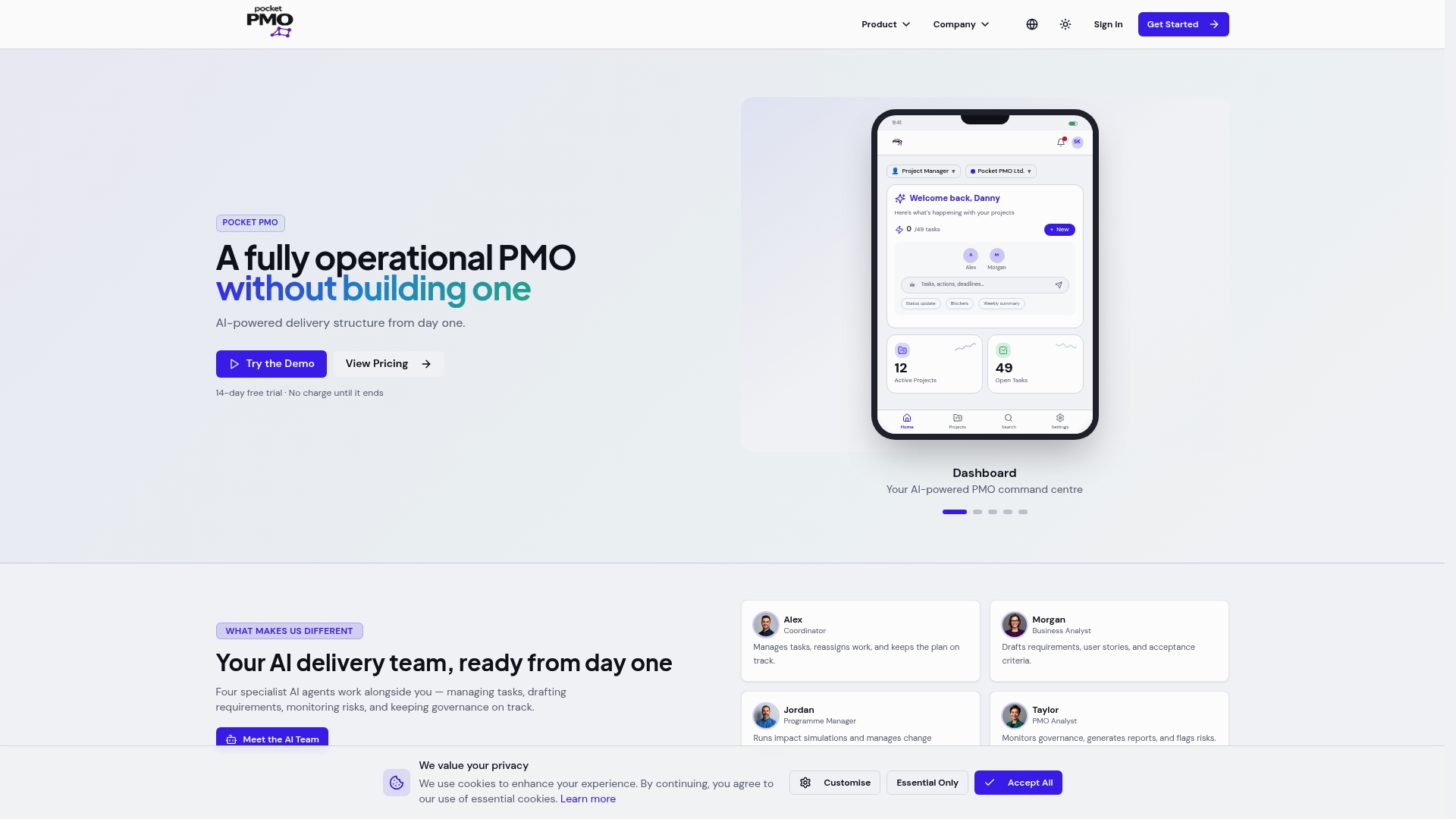
The platform gives you AI-powered risk analysis, change request workflows, and real-time dashboards that track strategic alignment across every phase. You can manage gate reviews, capture decisions, and monitor benefits realisation from initiation through to closure. If you want to see how it fits your workflow, explore the Pocketpmo platform or try the AI team demo to see the delivery team in action. You can also download a free risk register template to get your RAID log in place from day one.
FAQ
What is a strategic project planning workflow?
A strategic project planning workflow is a structured sequence of phases, from initiation to closure, that aligns project delivery with organisational objectives. Each phase has defined inputs, outputs, and decision gates to maintain strategic focus throughout delivery.
How many phases should a project workflow have?
Optimal project workflows contain 4–7 phases. Fewer than four omit critical activities; more than seven become unmanageable for most project teams.
Which planning frameworks work best together?
Combining a diagnostic framework such as SWOT or PESTLE with an execution framework such as OKRs or the Balanced Scorecard delivers the most complete coverage. Diagnostic frameworks assess your starting position; execution frameworks track progress toward defined outcomes.
How do you prevent scope creep in a project workflow?
Treat every change request as a strategic checkpoint. Reject changes that do not serve the agreed project objective and validate alignment at each decision gate, not only at project closure.
What is benefits realisation and when should it start?
Benefits realisation is the process of tracking whether a project delivers its intended business value. It should begin at initiation, with defined success measures in business terms, so progress can be assessed at every phase gate rather than only after go-live.