

Step by step project planning is the structured process of breaking a project into defined stages, each with clear ownership, deliverables, and success criteria, so your team can deliver on time and within budget. Without this structure, even well-resourced projects drift. The PMBOK 7 framework, adaptive thinking principles, and hybrid methodologies all point to the same truth: clarity of purpose and accountability are the prerequisites for successful delivery. This guide walks you through every stage, from defining objectives to adapting your plan mid-delivery, with the tools and strategies that actually work in practice.
What are the essential steps in project planning?
Clear definition of project objectives before assigning tasks prevents misalignment and is the foundation of every successful project. Start here, and everything else follows logically. Skip it, and you will spend the rest of the project correcting course.
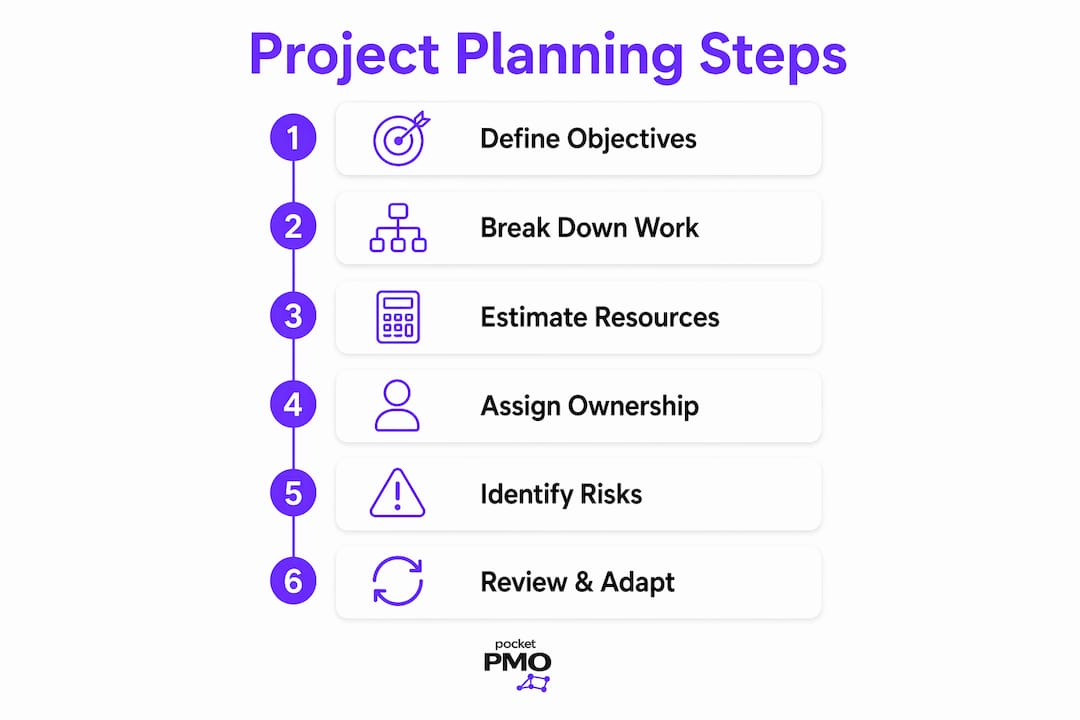
Follow these six planning steps in sequence:
-
Define goals and scope using SMART criteria. Your objective must be Specific, Measurable, Achievable, Relevant, and Time-bound. "Launch a new client portal by Q3" is a SMART goal. "Improve the website" is not. Scope definition belongs here too. Document what is included and, critically, what is not.
-
Break work into deliverables, tasks, and milestones. Use a Work Breakdown Structure (WBS) to decompose the project into manageable units. Each deliverable should map to at least one milestone so progress is visible. A practical planning guide for teams recommends tying every task to a named deliverable from day one.
-
Estimate time, budget, and resources realistically. Optimism bias is the single biggest cause of budget overruns. Use historical data from similar projects, apply a contingency buffer of at least 10 to 15 per cent, and validate estimates with the people doing the work, not just the people commissioning it.
-
Assign responsibilities with clear ownership. Every deliverable needs one named owner, not a team or a department. Diffused accountability where no single person is responsible for a deliverable is the most common cause of project failure, more damaging than faulty tools or impossible deadlines.
-
Identify dependencies and risks early. Map task dependencies before work begins. Use a RAID log (Risks, Assumptions, Issues, Dependencies) to capture everything your team identifies in the planning phase. A risk register template gives you a structured format to track and prioritise these from the outset.
-
Establish communication and tracking plans. Decide how often you will report progress, to whom, and in what format. Define your escalation path for issues. This is not bureaucracy. It is the mechanism that keeps stakeholders informed and decisions moving.
Pro Tip: Use a project charter template to capture goals, scope, ownership, and constraints in a single document before any work begins. It takes one hour to complete and saves weeks of rework.
Which tools and methodologies support effective project planning?

Methodology selection should depend on the stability of your requirements, not on trends. Predictive approaches suit fixed scope; adaptive approaches suit evolving requirements. Choosing the wrong methodology for your context is one of the most common and most avoidable planning mistakes.
Here is how the three main approaches compare:
| Methodology | Best suited for | Key characteristic |
|---|---|---|
| Waterfall | Fixed scope, regulated industries | Sequential phases with formal sign-off gates |
| Agile | Evolving requirements, product development | Iterative sprints with continuous feedback |
| Hybrid | Complex projects with mixed requirements | Waterfall gates for milestones, Agile sprints for delivery |
Hybrid approaches combining Waterfall governance gates with Agile delivery sprints are increasingly prevalent in modern project environments. This reflects the reality that most real-world projects have some fixed constraints (budget, regulatory deadlines) alongside elements that evolve as you learn more.
Beyond methodology, the tools you choose determine how well your plan translates into daily execution:
- Task and schedule management: Microsoft Project for complex, resource-heavy programmes; Pocketpmo for AI-powered portfolio oversight with real-time dashboards and predictive risk analysis.
- Documentation and templates: Standardised project planning templates reduce setup time and create consistency across projects and teams.
- Communication: Separate asynchronous from synchronous channels deliberately. Organisations that prioritise communication alignment see measurably better delivery performance. Use written updates for routine progress; reserve meetings for decisions that require dialogue.
- Reporting: Structured status reports keep stakeholders engaged without requiring constant meetings. Customisable reporting templates make this repeatable and consistent.
The right combination of methodology and tooling is not universal. A ten-person software team and a 200-person infrastructure programme need different approaches. What they share is the need for clear governance, defined ownership, and a communication rhythm that keeps everyone aligned.
What are common challenges in project planning and how can you avoid them?
Effective project management requires balancing delivery, relationships, and value. Missing any one of these three dimensions leads to failure, even when the other two are handled well. Most planning failures are predictable and preventable.
The most damaging pitfalls, and how to counter them:
-
Scope creep without change control. New requests arrive mid-project and get absorbed without formal assessment. The fix is a change request process, however lightweight, that evaluates impact on time, cost, and risk before any change is approved.
-
Inadequate stakeholder engagement. Stakeholders who feel uninformed become obstacles. Schedule structured touchpoints at key milestones, not just when problems arise. Use a project proposal template to align expectations before work starts.
-
Failure to track risks continuously. A RAID log completed in week one and never updated is worse than no RAID log. It creates false confidence. Structured governance with active risk management is non-negotiable regardless of which methodology you use. Assign a risk owner to every identified risk and review the log at every status meeting.
-
Poor communication and ineffective reporting. Status reports that say "on track" without evidence erode trust. Every report should state what was completed, what is next, what is at risk, and what decisions are needed. This is the foundation of step by step project reporting that stakeholders actually read.
-
Confusing activity with progress. Teams can be busy without moving the project forward. Tie every weekly update to a milestone or deliverable, not just a list of tasks completed.
Pro Tip: Run a 30-minute planning risk workshop at the start of every project phase. Ask the team: "What could stop us delivering this phase on time?" The answers will surface risks your RAID log has not captured yet.
How to monitor progress and adapt your project plan through delivery?
Monitoring is not a passive activity. It is the mechanism by which you catch drift early, before it becomes a crisis. The projects that stay on track are not the ones with perfect plans. They are the ones with the most responsive feedback loops.
Use this four-step monitoring rhythm:
-
Track progress against milestones weekly. Compare actual completion against your baseline plan. If a milestone is at risk, flag it immediately. Waiting for the next formal review is how small delays become large ones.
-
Run structured retrospectives at the end of each phase. Retrospectives are underused and often ineffective when they produce repetitive action items with no owner. Effective retrospectives generate time-bound actions, each with a named owner, verified at the next meeting. Nothing else counts as a retrospective output.
-
Reassess risks at every status meeting. New risks emerge as projects progress. Adaptive thinking means holding your plan lightly but your objectives firmly. When circumstances change, update the plan. Do not defend an outdated baseline.
-
Communicate changes clearly and promptly. When the plan changes, tell stakeholders before they ask. Explain what changed, why, and what the impact is. Silence breeds distrust. A structured project status report makes this communication consistent and credible.
Here is a simple monitoring framework to apply across your project lifecycle:
| Review type | Frequency | Purpose |
|---|---|---|
| Milestone check | Weekly | Confirm delivery against plan |
| Risk review | Fortnightly | Update RAID log and reassign owners |
| Stakeholder update | Monthly | Communicate progress, risks, and decisions needed |
| Phase retrospective | End of each phase | Capture lessons and update next phase plan |
The goal is not to eliminate change. It is to absorb change without losing sight of your objectives. Tracking risks proactively throughout delivery is what separates projects that recover from setbacks from those that collapse under them.
Key takeaways
Successful project delivery depends on clear objectives, named ownership, active risk management, and a communication rhythm that keeps stakeholders informed at every stage.
| Point | Details |
|---|---|
| Define objectives first | Use SMART criteria to set goals before assigning any tasks or resources. |
| Name a single owner per deliverable | Diffused accountability is the leading cause of project failure, not tools or deadlines. |
| Match methodology to requirements stability | Use Waterfall for fixed scope, Agile for evolving needs, and Hybrid for complex projects. |
| Monitor continuously, not periodically | Weekly milestone checks and fortnightly risk reviews catch drift before it becomes a crisis. |
| Make retrospectives count | Assign a named owner and deadline to every retrospective action, then verify it at the next meeting. |
Why I think most project plans fail before work even starts
After working across dozens of projects in different sectors, the pattern I see most often is not technical failure. It is a planning phase that produces documents without producing clarity. Teams leave the planning meeting with a Gantt chart and no shared understanding of what success actually looks like.
The sharpest project managers I have worked with prioritise behaviours like transparency and accountability over rigid process compliance. They spend more time in the planning phase asking "who owns this?" and "what does done look like?" than they do formatting templates. The documentation follows from that clarity. It does not create it.
The other thing I would push back on is the assumption that Agile solves the accountability problem. It does not. Sprints without clear ownership are just Waterfall with shorter deadlines. Hybrid methodologies work precisely because they force you to be explicit about which parts of your project are fixed and which are adaptive. That distinction alone prevents more scope creep than any change control process.
Retrospectives are the most underused tool in the project manager's kit. Not because teams do not run them, but because they run them badly. A retrospective that ends with a list of vague improvements nobody owns is a waste of an hour. Run them with discipline: one owner, one deadline, one verification point. That is the version that actually changes behaviour.
Lessons learned documentation at project close is the other habit most teams skip. The institutional knowledge lost when a project ends without a structured close is significant. It is the difference between an organisation that gets better at delivery over time and one that repeats the same mistakes on every new project.
— Danny
How Pocketpmo supports your project planning from day one
Pocketpmo is built for project managers, PMOs, and consultancies who need a fully operational project management office without the overhead of building one from scratch.
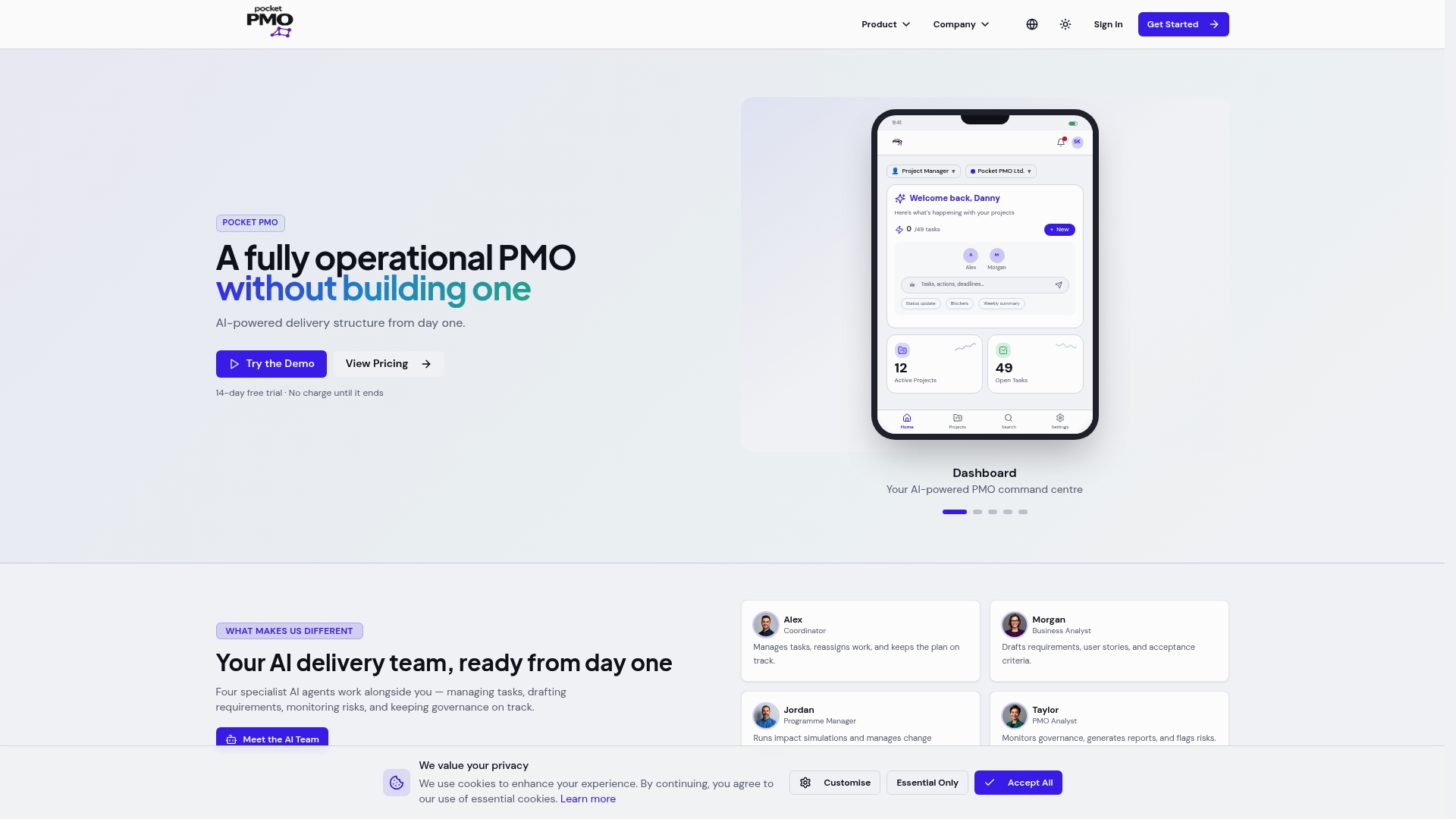
The platform brings together real-time dashboards, AI-driven risk analysis, change request workflows, and portfolio management in one place, directly aligned with the stepwise project planning principles covered in this guide. Whether you are managing a single project or a complex multi-project portfolio, Pocketpmo gives you the visibility and governance structure to stay in control. See how it compares to other tools, or launch your PMO today and start managing projects with confidence from day one.
FAQ
What is step by step project planning?
Step by step project planning is the process of breaking a project into defined stages, each with clear goals, ownership, and deliverables, to manage delivery from initiation through to close. It applies structured methods such as SMART goal setting, WBS decomposition, and RAID logging to reduce risk and maintain control.
How many steps does a project plan typically include?
Most project plans follow six core steps: define objectives, break down work, estimate resources, assign ownership, identify risks, and establish communication and tracking. The number of sub-steps within each stage varies by project complexity and methodology.
Which project management methodology should I use?
Choose your methodology based on how stable your requirements are. Use Waterfall for fixed-scope, regulated projects; use Agile for evolving requirements; and use a Hybrid approach when your project has both fixed governance milestones and iterative delivery phases.
How do I keep a project on track after planning?
Track progress against milestones weekly, review your RAID log fortnightly, and run a structured retrospective at the end of each phase. Assign a named owner and deadline to every action item, and communicate any plan changes to stakeholders before they ask.
What is the most common reason projects fail?
Diffused accountability, where no single person owns a deliverable, is the most common cause of project failure. It outweighs faulty tools and unrealistic deadlines as a root cause, making clear ownership the single most important element of any project plan.