

Effective project delivery steps define the structured process that transforms project intentions into measurable outcomes, covering every stage from initiation through to formal closure. Without this structure, budget waste increases and delivery predictability falls sharply. Frameworks such as PMBOK and methodologies supported by platforms like Pocketpmo and Monday.com give project managers a repeatable system for managing scope, risk, and stakeholder expectations. This article sets out the key phases of project delivery and the specific practices that separate consistently successful projects from those that drift, overspend, or fail to close cleanly.
What are the essential phases in effective project delivery?
Project delivery follows five core phases: initiation, planning, execution, monitoring and controlling, and closure. Each phase has a distinct purpose, and skipping or rushing any one of them creates compounding problems later in the lifecycle.
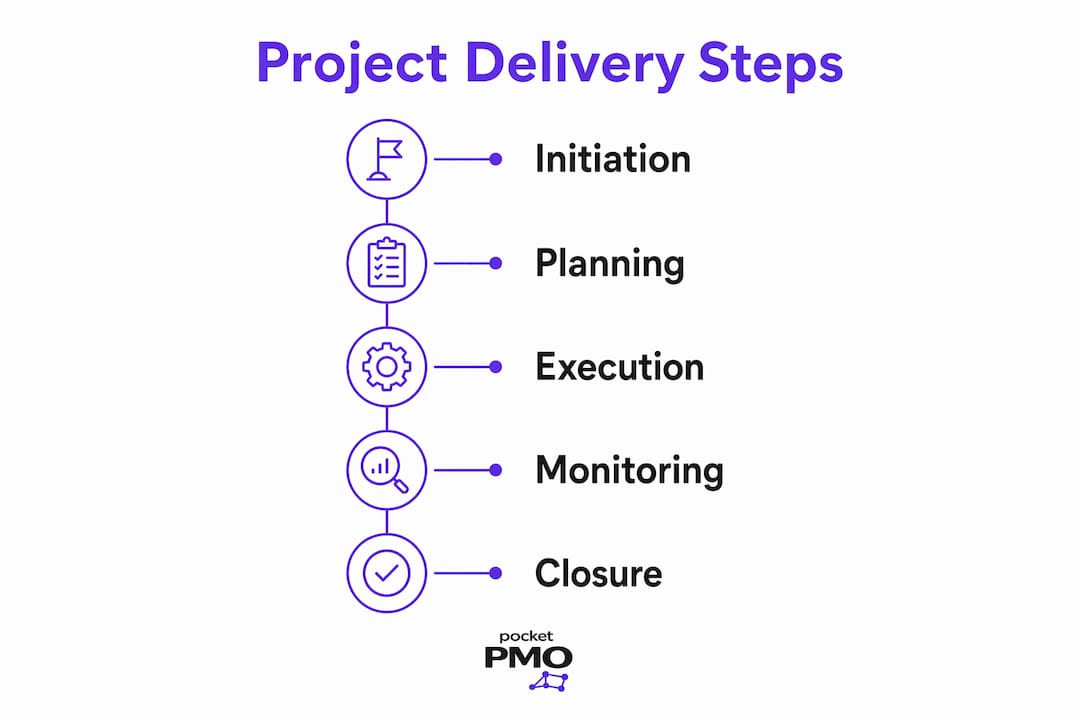
Initiation is where the project is justified and scoped at a high level. The project charter is produced, the sponsor is confirmed, and the business case is validated. Without a clear initiation phase, teams frequently begin work without shared understanding of what success looks like.
Planning is the phase that most directly determines whether a project delivers on time and within budget. Thorough planning correlates with projects finishing closer to their original estimates. This is where the work breakdown structure, schedule, resource plan, risk register, and communication plan are all produced.
Execution is the phase where the actual work is delivered. The project manager coordinates the team, removes blockers, manages dependencies, and keeps delivery momentum going. Quality assurance activities run concurrently to confirm outputs meet agreed standards.

Monitoring and controlling runs in parallel with execution rather than after it. Progress is tracked against baselines, KPIs are reviewed, and issues are escalated before they become crises. This phase includes integrated change control, which protects scope from unplanned expansion.
Closure is the formal end of the project. Deliverables are accepted, contracts are closed, resources are released, and lessons are documented. Formal closure activities reduce costs from unresolved contracts and feed directly into improved performance on future projects.
| Phase | Primary output | Key risk if skipped |
|---|---|---|
| Initiation | Project charter, confirmed sponsor | Undefined scope, misaligned expectations |
| Planning | Schedule, risk register, resource plan | Budget overrun, missed dependencies |
| Execution | Deliverables, quality outputs | Poor coordination, unresolved blockers |
| Monitoring and controlling | Status reports, change log | Scope creep, undetected schedule slippage |
| Closure | Signed acceptance, lessons learned | Repeated mistakes, unresolved contracts |
How to set clear objectives and align stakeholders effectively
Defining success criteria before you define scope is one of the most impactful project management best practices available to any project manager. Pre-scoping success criteria align teams and decision-makers to resist scope creep from the outset. When everyone agrees on what "done" looks like before the detailed planning begins, the scope conversation becomes far more disciplined.
Follow these steps to set objectives and align stakeholders at the start of any project:
- Define success criteria in measurable terms. Use SMART goals: specific, measurable, achievable, relevant, and time-bound. "Deliver a working integration by 30 June 2026 with 99.5% uptime" is a success criterion. "Improve the system" is not.
- Identify all stakeholders and map their influence. Distinguish between those who make decisions, those who are consulted, and those who are simply informed. A RACI matrix is the standard tool for this.
- Clarify decision ownership explicitly. Undefined decision authority is a common cause of timeline derailment. Name the person accountable for each category of decision before the project begins.
- Run a structured kickoff workshop. Bring stakeholders together to review objectives, confirm roles, and surface assumptions. Workshops surface misalignments that email chains never will.
- Document and distribute agreed expectations. A one-page project brief or terms of reference distributed after the kickoff creates a shared reference point that prevents later disputes.
Pro Tip: Record the kickoff meeting and circulate a written summary within 24 hours. Stakeholders who miss the session have no excuse for misalignment, and the document becomes your first line of defence against scope disputes.
Which planning and risk management practices ensure project stability?
Planning is a strategic discipline, not an administrative formality. The difference between a project that holds its schedule and one that drifts by weeks often comes down to the quality of planning decisions made before a single deliverable is produced.
- Build a detailed work breakdown structure (WBS). Decompose the project into specific, assignable tasks. A WBS forces the team to think through every component of the work, which surfaces hidden dependencies and effort estimates that high-level plans miss entirely.
- Build realistic timelines with buffer time. Padding a schedule is not dishonesty. It is professional judgement. Identify your critical path and add contingency at the task level for high-risk activities, not just at the end of the project.
- Conduct active, weekly risk reviews. Weekly risk reviews with named owners dramatically increase risk response effectiveness. A risk register reviewed once at project start and never again is a compliance document, not a management tool. Use Pocketpmo's AI-driven risk analysis to flag emerging risks before they escalate.
- Assign named risk owners. Every risk on the register must have one person responsible for monitoring and responding to it. Shared ownership means no ownership.
- Implement a formal change control process. Formal change management reduces unplanned scope expansions and budget overruns. Every change request should be assessed for impact on scope, schedule, cost, and quality before approval. You can find a practical starting point in Pocketpmo's change control guide.
- Treat communication as a delivery discipline. Proactive communication with sponsors decreases surprises and improves delivery outcomes. Structured weekly updates are not optional extras. They are part of the delivery process.
Pro Tip: When building your risk register, score each risk for both probability and impact, then multiply the two scores to produce a priority ranking. Focus your weekly review time on the top five risks by score, not the longest list.
What execution and monitoring techniques keep projects on track?
Execution is where plans meet reality, and the gap between the two is where most projects lose control. The project manager's role during execution is to coordinate work, remove blockers, and maintain delivery momentum while monitoring performance against the agreed baseline.
- Hold short, focused daily or weekly stand-ups. These are not status meetings. They are blocker-removal sessions. Ask what is done, what is next, and what is in the way.
- Track KPIs against baselines weekly. Monitor schedule variance, cost variance, and quality metrics. A project that is two weeks behind at the midpoint rarely recovers without deliberate intervention.
- Manage dependencies proactively. Identify which tasks cannot start until others are complete, and track those handover points explicitly. Dependency failures are the most common cause of schedule slippage in multi-team projects.
- Use governance forums, not just status updates. Governance forums resolve escalations and provide oversight that status reports alone cannot deliver. A monthly steering committee with decision-making authority is qualitatively different from a weekly email update.
- Document all decisions and changes. Every approved change, every escalation decision, and every agreed exception should be recorded. This protects the project manager and the client when disputes arise.
The table below compares reactive and proactive monitoring approaches:
| Monitoring approach | Trigger | Outcome |
|---|---|---|
| Reactive (issues-only reporting) | Problem already visible | Delayed response, higher cost to fix |
| Proactive (KPI-based tracking) | Variance detected early | Faster correction, lower impact |
| Governance forum with authority | Escalation required | Decision made, project unblocked |
| Status update only | Scheduled reporting cycle | Awareness without resolution |
Platforms like Pocketpmo provide real-time project dashboards that surface variances automatically, reducing the manual effort required to maintain visibility across multiple concurrent projects.
How to effectively close projects and capture lessons for future success
Project closure is the phase most frequently abbreviated or skipped entirely, yet formal closure activities directly reduce costs from unresolved contracts and improve future project success rates. A clean closure protects both the delivering organisation and the client.
- Obtain formal written acceptance of all deliverables. A verbal "that looks fine" is not acceptance. Require a signed document that confirms each deliverable meets the agreed criteria.
- Close all contracts and purchase orders. Confirm that all supplier obligations are fulfilled and that no financial commitments remain open. Unresolved contracts are a common source of post-project disputes.
- Release resources formally. Notify team members, line managers, and resource owners that the project has concluded and that capacity is available for reallocation.
- Archive all project documentation. Store the project charter, plans, risk register, change log, and acceptance documents in a central, accessible location. Future project managers will thank you.
- Conduct a structured retrospective. Bring the team together to identify what worked, what did not, and what should be done differently. Create psychological safety so that honest feedback is possible.
Pro Tip: Send a brief post-project survey to both the client and the delivery team before the retrospective. Anonymous written input surfaces issues that people will not raise in a group setting, and it gives the facilitator specific topics to explore.
Key takeaways
Effective project delivery requires structured phases, clear ownership, active risk management, and formal closure to consistently produce results that meet scope, schedule, and quality targets.
| Point | Details |
|---|---|
| Structure drives predictability | Organisations using lifecycle frameworks waste less budget and deliver more reliably. |
| Define success before scope | Setting measurable criteria upfront prevents scope creep and stakeholder misalignment. |
| Risk management must be active | Weekly reviews with named owners are far more effective than a one-off risk register. |
| Governance beats status updates | Forums with decision-making authority resolve escalations that reports alone cannot. |
| Closure is a delivery discipline | Formal sign-offs, retrospectives, and archived documentation protect future projects. |
Why I think most teams underinvest in the front end of delivery
After working across dozens of projects in professional services and technology, the pattern I see most consistently is this: teams rush the initiation and planning phases because the pressure to "start delivering" is immediate, and then spend twice as long firefighting during execution. The maths never works in their favour.
Treating capacity as a strategic discipline rather than an administrative task is one of the most underrated shifts a project manager can make. When you know which team members are carrying high-intensity deliverables simultaneously, you can redistribute before the overload becomes a missed deadline. Most teams only discover this problem when someone is already burning out.
The other thing I have observed is that decision ownership is treated as obvious when it is anything but. Defining ownership for decisions early in the lifecycle removes the ambiguity that causes weeks of delay mid-project. Write it down. Put it in the charter. Refer to it when the inevitable disagreement arises.
Structure and flexibility are not opposites. The teams that deliver consistently are not the ones with the most rigid processes. They are the ones who know which rules to follow and which to adapt. Invest in the upfront work. It pays back every time.
— Danny
How Pocketpmo supports every stage of project delivery
Pocketpmo gives project managers, PMOs, and consultancies the tools to apply these proven delivery strategies without building a PMO from scratch. The platform's AI-driven risk analysis, real-time dashboards, and automated status reporting cover the monitoring and governance disciplines described in this article. You can access a free risk register template and a change request template to put the planning and change control steps into practice immediately. If you are evaluating delivery platforms, the Pocketpmo vs Monday.com comparison sets out the differences clearly. Start your free trial at Pocketpmo and apply structured delivery from day one.
FAQ
What are the key phases of project delivery?
The five key phases are initiation, planning, execution, monitoring and controlling, and closure. Each phase produces specific outputs and, when completed in sequence, significantly improves budget adherence and delivery predictability.
How do you define success criteria before scoping a project?
Write success criteria as measurable statements tied to specific outcomes, deadlines, and quality standards before any scope document is produced. This approach aligns stakeholders early and reduces the risk of scope creep throughout the project lifecycle.
Why is formal project closure so important?
Formal closure confirms deliverable acceptance, closes contracts, and captures lessons learned. Skipping it leaves financial obligations unresolved and allows the same mistakes to repeat across future projects.
How often should risks be reviewed during a project?
Risks should be reviewed weekly with named owners responsible for each item. One-off risk documentation at project start provides no ongoing protection against emerging threats.
What is the difference between a governance forum and a status update?
A governance forum is a structured meeting with decision-making authority that resolves escalations and provides strategic oversight. A status update communicates progress but cannot unblock a project or approve a change without the right people in the room.