

Decision making in projects is defined as a structured, documented process for selecting between options using pre-agreed criteria, assigned authority, and recorded rationale. Poor project decisions are rarely the result of bad instincts. They result from unclear ownership, missing criteria, and governance forums that receive information rather than recommendations. Frameworks like RACI, weighted scoring matrices, MoSCoW prioritisation, and decision logs exist precisely to remove that ambiguity. When you apply them consistently, your project choices become faster, more defensible, and far easier to audit when things change. This guide gives you the practical steps to make that happen.
What are the core decision-making frameworks used in projects?
The right framework depends on the type of decision you face. Multi-criteria choices, uncertainty-heavy calls, prioritisation backlogs, and authority disputes each demand a different tool. Understanding which to reach for is the first skill of effective project decision making.
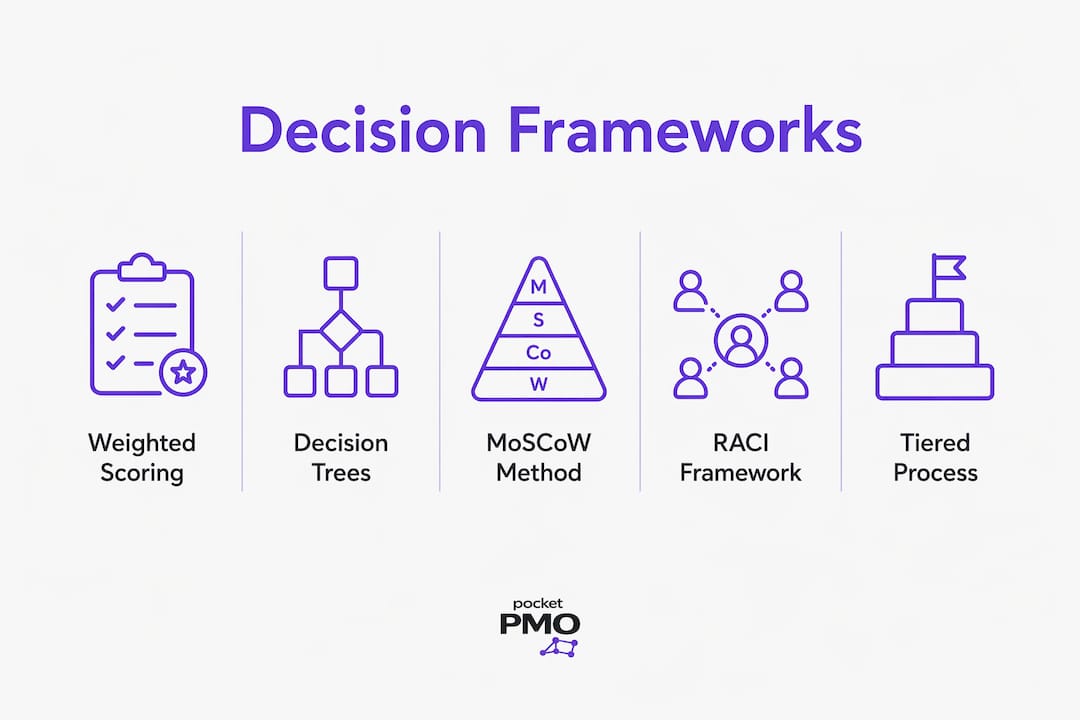
Weighted scoring matrix
A weighted scoring matrix assigns numerical weights to your evaluation criteria, scores each option against those criteria, and produces a ranked total. It is the go-to tool for vendor selection, technology choices, and any decision where multiple stakeholders hold different priorities. The discipline of agreeing weights before scoring prevents the common trap of reverse-engineering criteria to justify a preferred option. Scenario-specific weighted scoring with measurable sub-criteria enables transparent, like-for-like comparisons across options, which is particularly valuable at portfolio level.

Decision trees
Decision trees map out possible choices, their probabilities, and their expected outcomes in a branching diagram. They are most useful when uncertainty is high and the cost of a wrong turn is significant, such as build-versus-buy decisions or phased investment gates. The visual structure forces you to quantify assumptions you might otherwise leave vague.
MoSCoW method
MoSCoW (Must have, Should have, Could have, Won't have) is the standard prioritisation tool for scope and requirements decisions. It is fast, collaborative, and directly translates into delivery planning. Its weakness is that it relies on honest stakeholder input. Without facilitation discipline, everything becomes a Must.
RACI framework
RACI (Responsible, Accountable, Consulted, Informed) does not make decisions for you. It clarifies who has the authority to make them. Tiering decisions by RACI into operational (team level), project-level (project manager), and strategic (steering committee) maps authority to consequence and prevents the paralysis that occurs when nobody is sure who owns a call.
| Framework | Best used for | Key strength |
|---|---|---|
| Weighted scoring matrix | Vendor, technology, or option selection | Removes subjectivity with agreed criteria |
| Decision tree | High-uncertainty, staged investment decisions | Quantifies risk and expected value |
| MoSCoW | Scope and requirements prioritisation | Fast, collaborative, delivery-ready |
| RACI | Authority and accountability assignment | Prevents ownership gaps and escalation failures |
Pro Tip: Build your RACI before your first governance forum, not after the first escalation. Retrofitting authority structures mid-project is significantly harder than establishing them at kick-off.
How to implement a structured project decision process
A repeatable decision process does not require a heavy methodology. It requires four consistent habits applied to every decision above a defined consequence threshold.
-
Define the decision statement clearly. Write the decision as a single sentence that includes context and constraints. "Select a cloud hosting provider for the client portal, within a £50,000 annual budget, by 14 March" is a decision statement. "Discuss hosting options" is not. Clarity at this stage prevents scope creep in the analysis and keeps governance forums focused.
-
Establish evaluation criteria upfront. Criteria set after options are presented invite bias. Agree your criteria and their relative weights before any options are tabled. For financial decisions, net present value is the preferred metric for comparing options; internal rate of return and benefit-cost ratio are supplementary only, particularly when projects are mutually exclusive or budget-constrained.
-
Assign decision roles using RACI. Every decision needs one Accountable owner. Multiple accountable parties produce committee-style indecision. Consulted parties provide input; Informed parties receive the outcome. Keeping these lanes distinct is what prevents governance delays and rework.
-
Document decisions and rationale in a decision log. A decision log records what was decided, why, who decided it, and what alternatives were considered. This is not bureaucracy. It is the single most effective tool for managing scope change, onboarding new stakeholders, and defending project choices during audits or post-project reviews. Free project management templates from Pocketpmo include decision authority and rationale tracking tools you can deploy immediately.
Pro Tip: Tier your decision process by consequence. Operational decisions (daily team choices) need no formal process. Project-level decisions need criteria and a log entry. Strategic decisions need a full options paper with recommendations before any governance forum convenes.
The intensity of your process should match the reversibility of the decision. Distinguishing reversible from irreversible decisions allows you to scale analysis and stakeholder involvement appropriately, which preserves team energy for the calls that genuinely matter.
| Decision tier | Owner | Process required |
|---|---|---|
| Operational | Team member | Verbal, no log required |
| Project-level | Project manager | Criteria, options, log entry |
| Strategic | Steering committee | Full options paper, recommendation, named owner, deadline |
Which data-driven techniques improve decision quality in execution?
Decisions made during project execution are triggered by deviation. When work performance data shows a schedule variance or a cost overrun, you are not choosing freely. You are responding to evidence. The quality of that response depends on how well you have structured your monitoring and your analytical tools.
The following techniques directly improve the quality of execution-phase choices:
-
Real-time performance monitoring. Work performance data in execution feeds monitoring and control processes, driving corrective action decisions and formal change requests. Projects that track earned value, milestone completion rates, and risk exposure in real time make faster, better-calibrated corrections than those relying on weekly status reports alone.
-
Risk-adjusted scenario analysis. Quantifying uncertainty before a decision point, rather than acknowledging it vaguely, changes the quality of the choice. Assign probability and impact scores to each option's downside scenarios. This is not prediction. It is structured realism. Pocketpmo's AI-driven risk analysis tools surface these exposures automatically across your project portfolio.
-
Balanced value-for-money appraisal. The UK Government's Green Book 2026 guidance recommends balancing monetisable and unmonetisable costs and benefits, including risks and distributional effects, rather than selecting options purely on the highest benefit-cost ratio. This principle applies directly to project investment decisions: the option with the best financial return is not always the right choice when reputational, social, or operational factors are in play.
-
Formally set target benefits. Setting clear target benefits and using structured appraisal processes enhances project investment decision quality by reducing ambiguity about what success looks like. Teams that define measurable benefit targets at project initiation make sharper decisions throughout delivery because they have a fixed reference point.
The combination of live performance data, risk quantification, and benefit-anchored appraisal gives you the analytical foundation to make choices that hold up under scrutiny, not just in the moment.
What common decision-making challenges occur in projects?
Even experienced project managers fall into predictable traps. Recognising them is the first step to avoiding them.
-
No named decision owner. When a decision belongs to everyone, it belongs to no one. Governance forums without clear recommendations, named owners, and deadlines produce delays and rework. Every decision brought to a steering committee must arrive with a recommendation, not just a problem statement.
-
Presenting information instead of options. A governance forum is not a briefing session. Its purpose is to make decisions. Presenting data without structured options and a recommended course of action forces the committee to do analytical work they are not positioned to do in a meeting. Prepare decision-ready materials every time.
-
Ignoring information gaps. Admitting "I don't know" when information is genuinely incomplete improves decision quality under volatile conditions by prompting active information-seeking rather than false confidence. The instinct to project certainty in governance forums is understandable but counterproductive.
-
Weak escalation structures. Project governance frameworks set clear decision rights and escalation triggers. Without them, decisions either stall at team level or bypass the project manager entirely and land with senior stakeholders who lack context. Define escalation thresholds at project initiation and review them at each stage gate.
"Governance forums that receive information rather than recommendations are not decision-making bodies. They are reporting sessions with authority attached." This distinction is the most common governance failure in project delivery.
Balancing speed and rigour is the final challenge. Not every decision warrants a full options paper. The tiering approach described earlier resolves this: match process intensity to decision consequence, and you will move fast on low-stakes calls while applying appropriate rigour to the ones that shape delivery outcomes.
Key takeaways
Effective decision making in projects requires structured frameworks, clear authority, documented rationale, and data-informed analysis applied consistently across every decision tier.
| Point | Details |
|---|---|
| Use the right framework | Match weighted scoring, decision trees, MoSCoW, or RACI to the decision type and complexity. |
| Define decisions precisely | Write a single-sentence decision statement with context and constraints before analysis begins. |
| Assign one accountable owner | Every decision needs a named owner; multiple accountable parties produce paralysis and delay. |
| Document rationale always | A decision log is your primary tool for managing change, audits, and stakeholder onboarding. |
| Match process to consequence | Tier decisions by reversibility and impact to preserve team effort for the choices that matter most. |
Why decision discipline is the real differentiator in project delivery
I have reviewed dozens of post-project reports over the years, and the pattern is consistent. Projects that struggled rarely failed because of technical complexity or resource shortages. They failed because nobody was sure who owned a critical call, or because a steering committee spent forty minutes debating an option that should have arrived with a clear recommendation already attached.
The frameworks in this article are not new. RACI has been around for decades. Weighted scoring matrices appear in every project management qualification. What is genuinely rare is the discipline to apply them consistently, especially under delivery pressure when the temptation is to skip the process and just decide. That shortcut costs more time than it saves.
What I have found works in practice is starting small. Pick one decision type, perhaps vendor selection or scope change approval, and build a repeatable template for it. Document the criteria, assign the RACI, log the outcome. Do that ten times and it becomes habitual. Then extend it to the next decision type. Cultural change in governance does not happen through policy documents. It happens through repeated, visible practice.
The other thing worth saying directly: transparency about rationale builds stakeholder trust faster than any status report. When a sponsor can see not just what was decided but why, and what alternatives were considered, their confidence in the project team increases measurably. That trust is what gives you the latitude to move quickly on future decisions without seeking approval at every turn.
For a broader view of how governance structures support this kind of decision culture, the project governance frameworks guide from Pocketpmo is worth reading alongside this article.
— Danny
How Pocketpmo supports structured decision making and governance
Pocketpmo is built for project managers and PMOs who need governance infrastructure without the overhead of building it from scratch. The platform provides decision log templates, RACI assignment tools, and change request workflows that embed structured decision processes directly into your project delivery cycle. Real-time dashboards surface work performance data and risk exposures so your governance forums receive decision-ready intelligence, not raw status updates. AI-driven risk analysis flags escalation triggers before they become critical, giving your steering committees the context they need to act decisively. If you are comparing your options, see how Pocketpmo stacks up in the Pocketpmo vs Microsoft Project comparison, or explore the full platform at Pocketpmo Launch.
FAQ
What is decision making in project management?
Decision making in project management is the structured process of selecting between options using defined criteria, assigned authority, and documented rationale. It applies across all project phases, from initiation through to closure.
Which framework is best for project decision making?
No single framework suits every decision. RACI clarifies authority, weighted scoring matrices handle multi-criteria choices, MoSCoW prioritises scope, and decision trees address uncertainty. The right choice depends on the decision type and consequence level.
How do you avoid decision paralysis in projects?
Decision paralysis is prevented by assigning a single accountable owner to every decision, setting a deadline, and bringing structured options with a recommendation to every governance forum rather than presenting raw information.
Why should projects maintain a decision log?
A decision log records what was decided, why, by whom, and what alternatives were considered. It is the primary tool for managing scope change requests, defending project choices during audits, and onboarding new stakeholders efficiently.
How does data improve decision quality during project execution?
Work performance data in execution triggers corrective action decisions by revealing deviations from baseline. Combining real-time monitoring with risk-adjusted scenario analysis and benefit-anchored appraisal produces choices that are faster and more defensible than those based on periodic reporting alone.