

Project portfolio alignment is the process of continuously linking every project and programme in your organisation to its strategic goals, so that resources focus only on initiatives that deliver real business value. The standard industry term for this practice is strategic portfolio alignment, and it sits at the heart of effective project portfolio management. Without it, organisations fund projects that feel productive but contribute little to what the business actually needs to achieve. The Balanced Scorecard and weighted scoring models are the two most widely used frameworks for making that connection visible and measurable.
What is project portfolio alignment and why does it matter?
Strategic portfolio alignment is defined as the deliberate, ongoing process of selecting, prioritising, and governing projects based on how directly they support organisational strategy. It is not a one-time exercise. Every project in your portfolio must link to at least one strategic objective before it receives approval. Projects that cannot demonstrate that link should not proceed, regardless of their individual merit.
This matters because organisations routinely approve projects based on departmental pressure, seniority of the sponsor, or historical momentum rather than strategic fit. The result is a portfolio that looks busy but delivers fragmented value. Alignment gives decision-makers an objective basis for saying yes, no, or not yet.
The Balanced Scorecard, developed by Robert Kaplan and David Norton, translates high-level strategy into measurable portfolio objectives across four perspectives: financial, customer, internal process, and learning. These frameworks align initiatives with strategy through measurable goals and balanced risk and reward. That measurability is what separates genuine alignment from vague strategic intent.
Why is portfolio alignment critical for organisational success?
Misaligned portfolios create three concrete problems: duplicated effort, resource conflicts, and strategic drift. When projects are approved without a shared strategic filter, two teams often build similar capabilities independently. Resources get pulled in competing directions. And over time, the portfolio drifts away from what leadership actually wants to achieve.
Alignment solves all three by creating a shared decision framework. Consider these specific benefits:
- Resource optimisation. Aligned portfolios direct budget and people toward the highest-value initiatives, reducing waste on low-priority work.
- Faster decision-making. When project selection criteria are agreed in advance, approval decisions take hours rather than weeks.
- Reduced governance risk. Boards and executives can see, at a glance, how the portfolio supports the business plan.
- Improved delivery outcomes. Projects with clear strategic rationale attract stronger sponsorship and stakeholder engagement.
"Portfolio governance focuses on overall strategic alignment and resource trade-offs rather than individual deliverables." This distinction matters because many organisations apply project-level controls to portfolio decisions, which produces the wrong metrics and the wrong conversations at the wrong level.
Effective project management oversight structures reinforce alignment by creating governance gates where strategic fit is assessed before resources are committed. Without those gates, alignment remains aspirational rather than operational.
What strategies and tools achieve effective portfolio alignment?
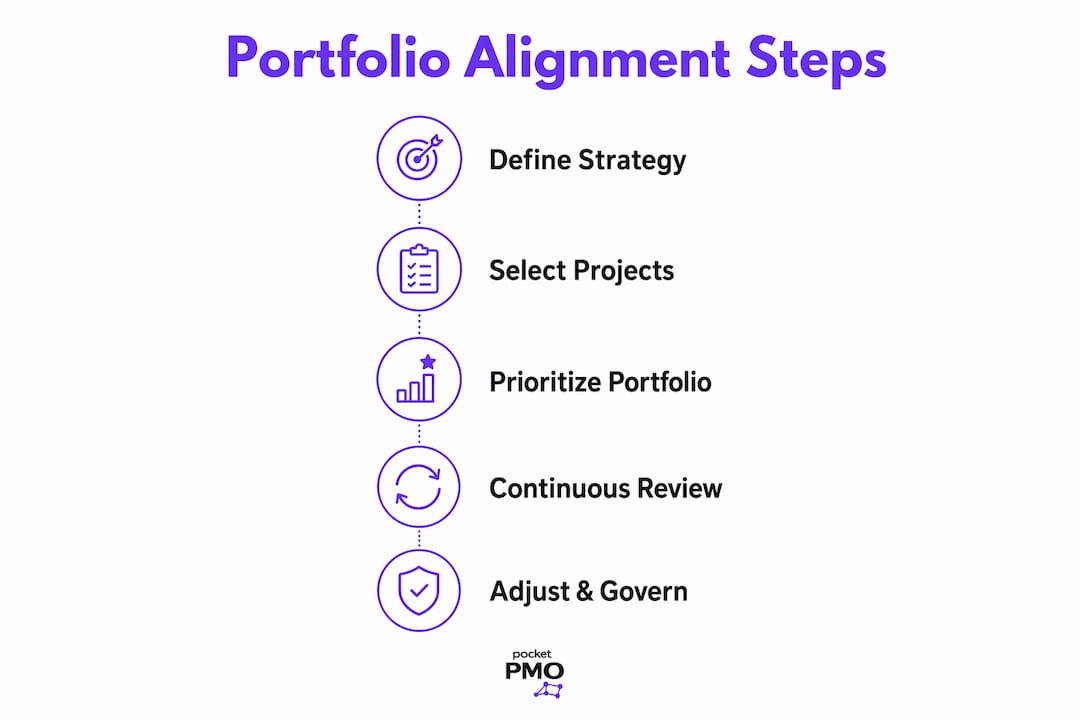
Three methods dominate best practice in 2026: weighted scoring models, the Balanced Scorecard, and portfolio balancing techniques. Each serves a different purpose, and most mature organisations use all three together.
Weighted scoring models
Scoring models assign numerical weights to strategic criteria and score each candidate project against them. Industry standards recommend 5–8 criteria for effective project selection scorecards. That range is deliberate. Fewer than five criteria oversimplify complex trade-offs. More than eight create a model so complex that it becomes difficult to apply consistently and easy to manipulate.

Typical criteria include strategic fit, financial viability, risk level, resource availability, and time to value. Financial benchmarks such as positive Net Present Value and a Benefit-Cost Ratio greater than 1 are standard gates within these models.
Balanced scorecard and portfolio balancing
The Balanced Scorecard translates strategy into measurable portfolio objectives. Portfolio balancing goes further by mapping the entire project mix across dimensions such as risk versus return, short-term versus long-term, and run-the-business versus change-the-business. The goal is a portfolio that is not just aligned but also diversified against strategic risk.
Comparison of common alignment tools
| Tool | Primary Use | Best For |
|---|---|---|
| Weighted Scoring Model | Project selection and prioritisation | Comparing candidate projects objectively |
| Balanced Scorecard | Translating strategy to measurable goals | Linking portfolio KPIs to business strategy |
| Portfolio Balancing Matrix | Visualising risk and return across the mix | Identifying gaps and over-concentration |
| OKR Framework | Tracking strategic outcomes | Measuring delivery against strategic intent |
Pro Tip: Keep your scoring model to no more than six criteria when starting out. A simpler model that your leadership team trusts and uses consistently will outperform a sophisticated one that gets gamed or ignored.
The numbered steps for building a scoring model are straightforward:
- Define 5–8 strategic criteria with your leadership team.
- Assign percentage weights that sum to 100.
- Score each candidate project from 1 to 5 against each criterion.
- Multiply scores by weights and sum the totals.
- Rank projects by total score and review against available resources.
- Apply financial filters (NPV, BCR) as a secondary gate.
How does continuous governance maintain portfolio alignment?
Alignment is not a state you achieve once. Business strategy shifts, market conditions change, and new opportunities emerge. Quarterly or more frequent portfolio reviews are the minimum cadence recommended to keep alignment current. Many organisations with fast-moving strategies review monthly.
The governance activities that sustain alignment include:
- Strategic tagging. Every project is tagged to one or more strategic objectives in your portfolio management system. Tags update when strategy changes.
- Portfolio review meetings. A cross-functional governance board assesses the portfolio against current strategic priorities, not last year's plan.
- Performance measurement. KPIs and OKRs tied to strategy provide the metrics to track whether delivery is producing the intended strategic outcomes.
- Rebalancing decisions. Projects that no longer align are paused, descoped, or cancelled. New opportunities are assessed through the scoring model before being added.
The table below shows how governance cadence maps to portfolio size and strategic volatility:
| Portfolio Size | Strategic Volatility | Recommended Review Cadence |
|---|---|---|
| Small (under 10 projects) | Low | Quarterly |
| Medium (10–30 projects) | Medium | Monthly |
| Large (30+ projects) | High | Fortnightly |
Pro Tip: Connect your portfolio dashboard directly to your strategic objectives register. When a strategic priority changes, you want to see immediately which projects are affected, not discover the misalignment six months later during an annual review.
Real-time dashboards are the practical mechanism for this. Pocketpmo's portfolio management features, for example, provide live visibility across all active projects, with strategic tagging built into the workflow from day one. That kind of live connection to strategy is what separates genuinely aligned portfolios from those that only appear aligned on paper.
What pitfalls should organisations avoid in portfolio alignment?
The most common mistake is treating portfolio alignment as a scaled-up version of project management. Portfolio management requires distinct governance, metrics, and decision-support mechanisms that operate at a strategic level. Applying project-level controls to portfolio decisions produces the wrong conversations and the wrong outcomes.
Watch out for these specific pitfalls:
- Static annual mapping. Producing a portfolio alignment map once a year and filing it away is not alignment. A live, continuously updated connection between projects and strategic objectives is best practice.
- Political manipulation of scoring models. The primary risk in scoring models is their transformation into political tools. When stakeholders control the weighting of criteria, they can engineer scores to favour their preferred projects. Effective scoring models seldom exceed 8 criteria precisely to limit this vulnerability.
- Confusing busyness with alignment. A full project pipeline is not evidence of alignment. Every project must trace back to a named strategic objective.
- Ignoring stakeholder interests entirely. Objectivity does not mean ignoring context. Stakeholder input should inform criteria design, not individual project scores.
- Over-engineering the framework. Complex models with 15 criteria and five-level weighting scales create administrative burden without improving decisions. Simplicity and consistency beat sophistication every time.
Understanding project risk analysis as part of your alignment process also helps you catch misaligned projects before they consume significant resources.
Key takeaways
Effective project portfolio alignment requires a live, governed connection between every project and your organisation's strategic objectives, maintained through regular reviews, objective scoring, and real-time performance measurement.
| Point | Details |
|---|---|
| Alignment is continuous, not annual | Update strategic tags and portfolio maps whenever business priorities shift. |
| Use 5–8 scoring criteria | Keeping models simple reduces political manipulation and improves consistency. |
| Governance gates are non-negotiable | Every project must link to a strategic objective before approval is granted. |
| KPIs and OKRs track strategic delivery | Tie performance metrics to strategy, not just project outputs. |
| Portfolio management is not project management | Apply strategic-level governance and metrics, not delivery-level controls. |
Portfolio alignment: what i have learned the hard way
Most organisations I have worked with believe they have portfolio alignment because they have a prioritised project list. They do not. A ranked list is not alignment. Alignment means every project on that list has a named strategic objective, a measurable outcome, and a governance owner who will notice if it drifts.
The hardest part is not building the scoring model. It is getting leadership to agree on the weights. That conversation is where you discover what the organisation actually values versus what it says it values. I have seen organisations claim innovation is their top priority, then weight financial return at 60% of the scoring model. That gap between stated and revealed priorities is where portfolios go wrong.
My practical advice: run the scoring model exercise with your leadership team before you apply it to any projects. Score three or four hypothetical initiatives together. You will surface disagreements about strategic priorities that no amount of strategy documentation would have revealed. That conversation is more valuable than the model itself.
The other lesson I keep relearning is that governance cadence matters more than governance sophistication. A simple monthly portfolio review with the right people in the room will maintain alignment better than an elaborate quarterly process that nobody takes seriously. Start simple, build discipline, then add complexity only when the simple version stops working.
— Danny
How Pocketpmo keeps your portfolio aligned in real time
Maintaining portfolio alignment manually across multiple projects is where most organisations lose ground. Pocketpmo's AI-powered PMO platform gives you real-time dashboards, strategic tagging, and automated governance workflows built for exactly this challenge.
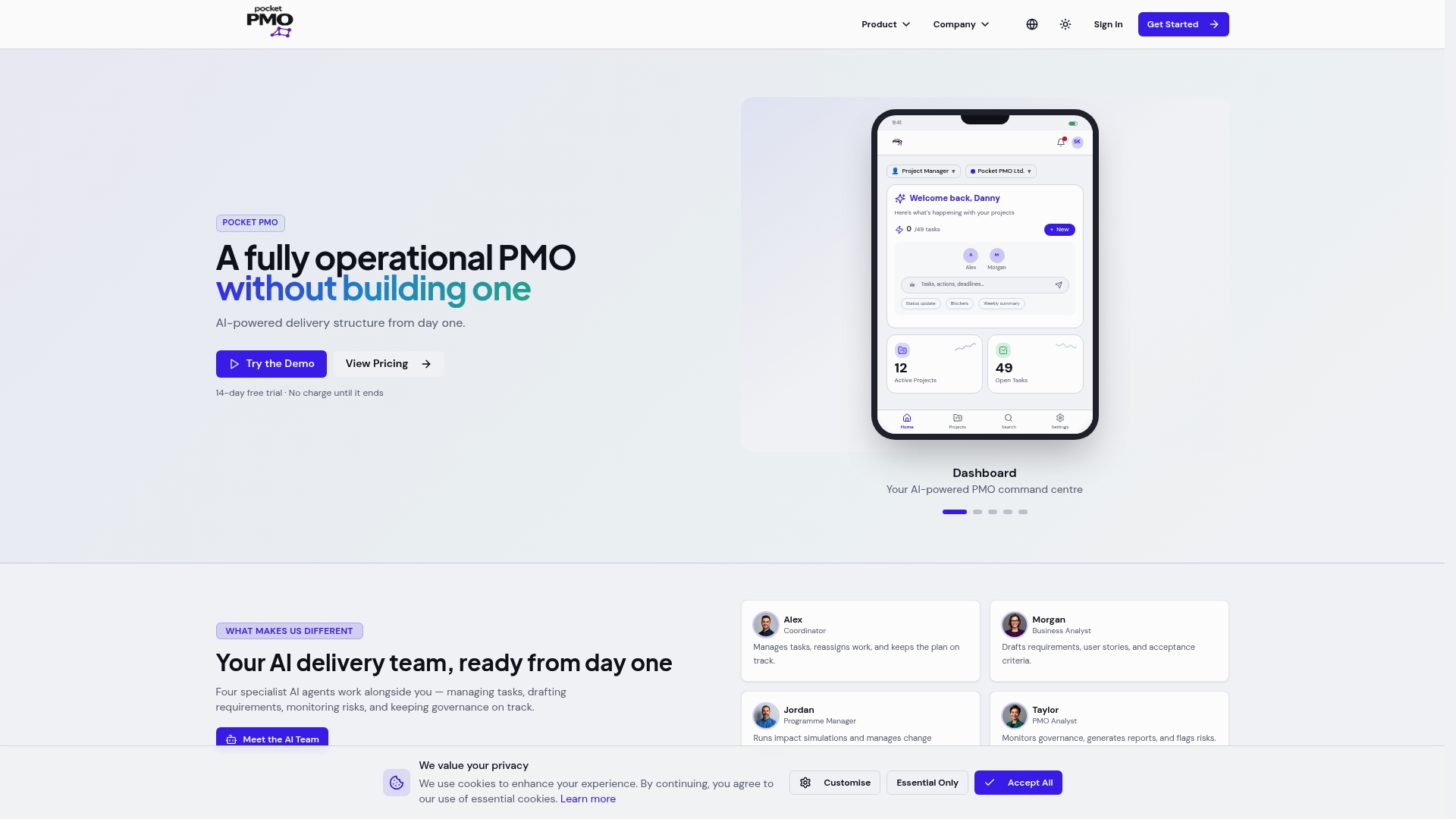
You can tag every project to a strategic objective from day one, track performance against KPIs and OKRs in a live dashboard, and receive AI-driven alerts when a project's trajectory starts to diverge from its strategic intent. For teams evaluating their options, the Pocketpmo vs Microsoft Project comparison shows how purpose-built portfolio governance differs from general project scheduling tools. If you manage multiple projects and need strategic visibility without building a PMO from scratch, Pocketpmo is built for that.
FAQ
What is project portfolio alignment in simple terms?
Project portfolio alignment is the process of making sure every project your organisation runs directly supports at least one strategic goal. Projects that cannot demonstrate that link should not be approved or continued.
How often should portfolio alignment be reviewed?
Quarterly reviews are the minimum recommended cadence, with monthly reviews advised for organisations with fast-changing strategies or large portfolios. Static annual mapping leads to misalignment.
What is the difference between portfolio alignment and project management?
Portfolio management operates at a strategic level, focusing on which projects to fund and how resources are allocated across the mix. Project management focuses on delivering individual projects to scope, time, and budget.
How many criteria should a project scoring model include?
Industry standards recommend 5–8 weighted criteria for effective project selection scorecards. Fewer oversimplify decisions; more create complexity that is vulnerable to political manipulation.
What tools are used for strategic portfolio alignment?
The most widely used tools are weighted scoring models, the Balanced Scorecard, portfolio balancing matrices, and OKR frameworks. Most mature organisations use a combination of all four to maintain objective, measurable alignment.