

Adaptive project management is defined as a flexible, iterative methodology that adjusts scope, timelines, and resources in response to real-time project conditions rather than following a fixed plan. Unlike traditional approaches that lock in requirements upfront, adaptive methods use continuous feedback loops and empirical data to guide decisions at every stage. Frameworks such as Scrum, Kanban, and hybrid PMO models all draw on adaptive principles. The result is a delivery approach that prioritises customer value over process compliance, making it particularly suited to complex, fast-changing environments where predictability is limited and stakeholder needs evolve throughout delivery.
What are the core principles of adaptive project management?
Adaptive project management is built on empirical process control, meaning decisions are grounded in observed data rather than assumptions made at project initiation. This is a fundamental departure from predictive planning, where a detailed roadmap is set at the start and followed regardless of what emerges. Empirical process control requires frequent inspection and adaptation cycles, so teams course-correct based on what is actually happening rather than what was originally forecast.
The core principles that distinguish this approach include:
- Iterative delivery: Work is broken into short cycles, each producing a usable output and generating feedback for the next cycle.
- Continuous learning: Teams inspect outcomes at regular intervals and adapt their approach accordingly.
- Flexible governance: Oversight is calibrated to project risk and complexity rather than applied uniformly across all work.
- Outcome focus: Success is measured by value delivered to customers, not by output metrics or checklists. This aligns directly with PMI's Value Delivery System.
- Transparency: Progress is visible to all stakeholders, enabling faster and better-informed decisions.
Digital tools play a central role in making these principles operational. Tools like Jira provide transparency at team level, while BigPicture extends portfolio views and resource planning, enabling PMOs to connect strategy with execution in real time.
Pro Tip: If your governance model applies the same level of scrutiny to every project regardless of risk, you are not practising adaptive management. Start by segmenting your portfolio by risk and complexity, then calibrate your reporting and checkpoint frequency accordingly.

How does adaptive project management compare to traditional and agile methods?
Understanding where adaptive project management sits relative to waterfall and agile methods helps you choose the right approach for each context. The three models differ most significantly in how they handle change, governance, and planning.
| Dimension | Traditional (waterfall) | Agile (Scrum/Kanban) | Adaptive project management |
|---|---|---|---|
| Planning horizon | Fixed upfront plan | Sprint-by-sprint | Continuous, risk-informed |
| Response to change | Costly and disruptive | Built in by design | Structured and deliberate |
| Governance style | Phase gates, sequential | Team self-organisation | Risk-based, outcomes-focused |
| Best suited for | Stable, well-defined projects | Small, fast-moving teams | Complex, hybrid portfolios |
| Success metric | On-time, on-budget delivery | Working software per sprint | Customer value delivered |
Traditional waterfall governance was binary and rigid. Modern PMOs now establish continuous checkpoints aligned with delivery rhythm to enable faster decision-making. For agile projects, governance may occur quarterly; for hybrid work, monthly; and traditional waterfall still uses phase gates. This spectrum is precisely where adaptive project management operates most effectively.
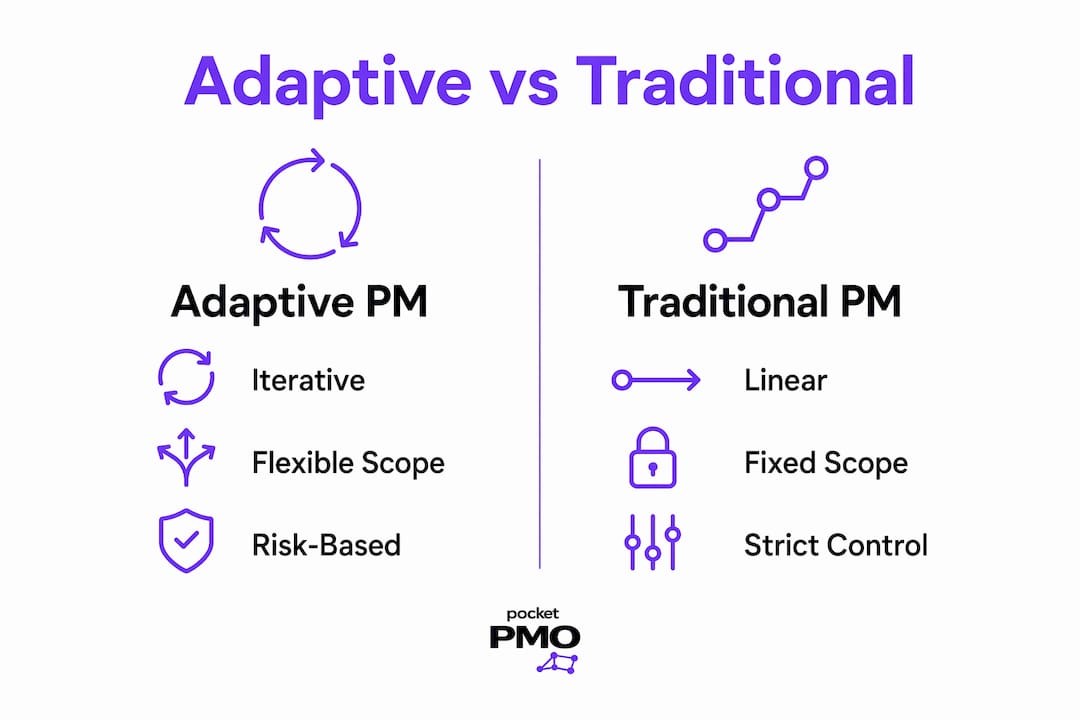
Agile frameworks such as Scrum are a subset of adaptive thinking, but adaptive project management is broader. It accommodates agile, predictive, and iterative methodologies within a single governance model rather than mandating one framework across the board. This is what distinguishes an adaptive PMO from a purely agile one.
Pro Tip: Resist the temptation to rebrand your existing waterfall process as "adaptive" by adding a few sprint ceremonies. True adaptive governance requires you to change how decisions are made and where authority sits, not just how work is scheduled.
What are the key benefits and challenges of adaptive project management?
The benefits of adopting an adaptive approach are well evidenced, but so are the pitfalls. Understanding both sides prepares you to implement change that actually sticks.
Key benefits:
- Faster response to change: Because scope and priorities are reviewed continuously, teams can redirect effort before a wrong direction becomes expensive.
- Improved risk management: Risk-based oversight focuses intense reviews on high-risk initiatives and applies lighter-touch reporting to lower-risk work, concentrating governance where it matters most.
- Better alignment with business outcomes: Adaptive methods keep delivery connected to what customers actually need, reducing the risk of completing a project that no longer serves its original purpose.
- Higher stakeholder confidence: Visible progress and regular checkpoints replace end-of-project surprises with ongoing dialogue.
The challenges are equally real. Adaptive management is not low control. It is a different form of control, based on transparency, visible progress, and empirical data. Many organisations misread this and either abandon governance entirely or apply so little structure that accountability disappears.
A second major pitfall is the one-size-fits-all trap. Successful PMOs support hybrid portfolios with method-neutral governance that adapts to each project rather than enforcing a single framework. Forcing agile ceremonies onto a compliance-driven infrastructure project, or applying waterfall phase gates to a product discovery sprint, undermines both approaches.
The deepest challenge is cultural. The biggest barrier is not technical or methodological. It is the shift required of middle management, from being process enforcers to becoming strategic enablers who use empirical data to make decisions. Adaptive governance succeeds when supported by a culture of trust and openness, where leaders focus on outcomes over outputs rather than equating value delivery with task completion.
How can project managers implement adaptive project management effectively?
Implementation works best when it is phased and grounded in your current portfolio reality rather than treated as a wholesale transformation. The following steps give you a practical sequence to follow.
- Audit your current governance model. Map which projects are high-risk and which are routine. This baseline tells you where adaptive oversight will have the greatest impact and where lighter-touch reporting is sufficient.
- Segment your portfolio by risk and delivery method. Hybrid PMOs must design governance frameworks that permit diverse methodologies to coexist, using risk and complexity as guides to oversight level rather than applying a single standard.
- Redesign your checkpoint cadence. Align governance reviews with actual delivery rhythm. Agile teams may need quarterly portfolio reviews; hybrid projects benefit from monthly check-ins; and high-risk waterfall work still warrants formal phase gates.
- Define decision authority clearly. Adaptive governance demands clear accountability models that prevent bottlenecks and optimise flow, placing decision authority close to the point of action based on project attributes.
- Select tools that support transparency. Jira and BigPicture are widely used for team-level and portfolio-level visibility respectively. For AI-driven risk analysis and real-time reporting across a multi-project environment, platforms such as Pocketpmo provide an integrated layer that connects governance with execution.
- Invest in leadership development. Effective adaptive management shifts leadership focus from enforcing compliance to coaching teams, supporting rapid decision-making, and removing impediments. This requires new competencies that most organisations need to deliberately build.
The governance model that results from this process should reserve detailed oversight for 10 to 20% of projects, those carrying the highest risk or strategic significance, while 80 to 90% are managed with agile-aligned, outcomes-based reporting. This ratio is not a rule but a useful benchmark for calibrating where your governance energy goes.
Pro Tip: Build your adaptive PMO incrementally. Start with one pilot portfolio segment, measure the impact on decision speed and delivery outcomes, then expand. Organisations that attempt full transformation in one cycle typically revert to their previous model within 18 months.
For portfolio management strategies that support both agile and predictive methods within a single governance model, the approach above provides a strong foundation. You can also explore PMO decision-making guidance for frameworks that accelerate adaptive governance in practice.
Key takeaways
Adaptive project management succeeds when governance is calibrated to risk, authority sits close to the point of action, and leadership shifts from enforcing compliance to enabling value delivery.
| Point | Details |
|---|---|
| Definition and scope | Adaptive project management is an iterative, empirically driven methodology that adjusts to real-time conditions rather than fixed plans. |
| Governance calibration | Reserve detailed oversight for the highest-risk 10 to 20% of projects; apply lighter reporting to the remaining 80 to 90%. |
| Cultural shift required | The primary barrier is not technical. Middle management must move from process enforcement to strategic enablement. |
| Method-neutral PMO | Effective adaptive PMOs support agile, predictive, and hybrid projects simultaneously without mandating a single framework. |
| Tools and transparency | Platforms like Jira, BigPicture, and Pocketpmo connect team-level progress to portfolio-level decisions in real time. |
Why adaptive project management is harder than it looks
I have spent years working with PMOs that declared themselves "adaptive" after adopting Scrum ceremonies or switching to a Kanban board. The honest truth is that most of them were not adaptive at all. They had changed their tools and vocabulary without changing how authority was distributed or how leaders responded to uncertainty.
The shift that actually matters is not methodological. It is psychological. When a project surfaces an unexpected risk, the instinct in most organisations is to escalate, convene a committee, and wait for approval. An adaptive PMO is designed so that the person closest to the problem has the authority and information to act. That requires leaders to genuinely relinquish control, not just say they have.
I have also seen the opposite failure: organisations that interpreted "adaptive" as permission to abandon structure entirely. No governance, no accountability, no reporting cadence. That is not adaptive management. As the research consistently shows, adaptive management is disciplined, iterative control that enables faster, better decisions. The discipline is non-negotiable.
The organisations that get this right treat flexibility as a competitive advantage, not a concession to chaos. They build governance that is proportionate, transparent, and genuinely connected to delivery outcomes. That combination is harder to achieve than any specific framework, but it is also far more durable.
— Danny
How Pocketpmo supports adaptive project management
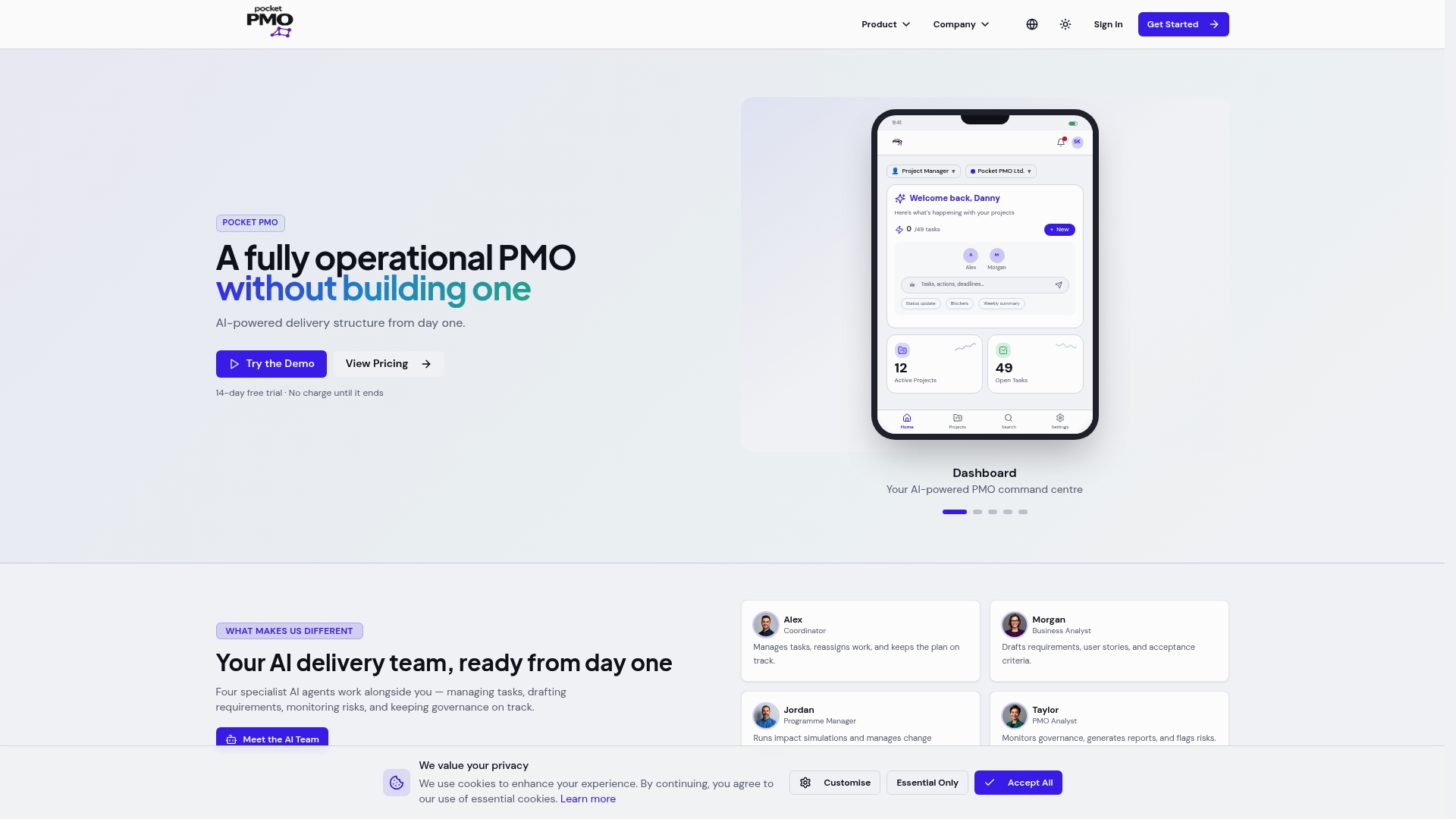
Pocketpmo is built for project managers who need the governance rigour of a PMO without the overhead of building one from scratch. The platform integrates AI-driven risk analysis, real-time dashboards, and portfolio management tools that align directly with adaptive governance principles. Whether your portfolio spans agile sprints, hybrid programmes, or traditional phase-gated delivery, Pocketpmo adapts its reporting and oversight to match your project mix. You get the visibility to make faster decisions and the accountability structures to keep delivery on track. Explore Pocketpmo's full feature set or launch your adaptive PMO today without building one from the ground up.
FAQ
What is the adaptive project management definition?
Adaptive project management is a flexible, iterative delivery methodology that uses empirical data and continuous feedback to adjust scope, priorities, and resources throughout a project rather than following a fixed upfront plan.
How does adaptive project management differ from agile?
Agile frameworks such as Scrum are a subset of adaptive thinking. Adaptive project management is broader, accommodating agile, predictive, and hybrid methods within a single governance model rather than mandating one framework.
What is PMO adaptability and why does it matter?
PMO adaptability refers to a PMO's capacity to tailor its governance, reporting, and oversight to the risk profile and delivery method of each project. It matters because method-neutral governance produces better outcomes across diverse portfolios than enforcing a single approach.
Is adaptive project management effective for large organisations?
Yes, particularly when governance is calibrated by risk. Reserving detailed oversight for the highest-risk 10 to 20% of projects while applying lighter reporting to the rest allows large organisations to maintain control without creating bottlenecks.
What are the biggest challenges in adopting adaptive project management?
The primary challenge is cultural. Middle management must shift from enforcing process compliance to enabling strategic value delivery, which requires new leadership competencies and a genuine organisational commitment to transparency and trust.