

Running multiple projects at once is where good intentions meet hard limits. Finite budgets, overlapping resource demands, and competing stakeholder priorities make it genuinely difficult to know which work deserves investment and which should be paused or dropped. Effective portfolio management strategies give you the decision framework to make those calls with confidence rather than instinct. This article covers the criteria that matter, the quantitative techniques reshaping how organisations select and allocate, the governance practices that keep decisions auditable, and a practical guide to choosing the right approach for your organisation.
Table of Contents
- Key takeaways
- 1. How to evaluate portfolio management strategies effectively
- 2. Quantitative optimisation techniques for portfolio selection
- 3. Portfolio governance and workflow strategies that deliver results
- 4. Comparing portfolio management approaches side by side
- 5. Practical steps for implementing your chosen approach
- My experience with portfolio management: what actually works
- How Pocketpmo supports your portfolio management practice
- FAQ
Key takeaways
| Point | Details |
|---|---|
| Align portfolio to strategy | Every project in your portfolio should map directly to a documented organisational objective. |
| Separate selection from optimisation | Preselecting assets before optimisation reduces wasted allocation and improves risk-adjusted outcomes. |
| Treat resource capacity as an input | Build resource constraints into prioritisation early to avoid costly conflicts later in delivery. |
| Govern iteratively with stakeholders | Cyclical prioritisation and rationalisation with stakeholder feedback produces better portfolio decisions than one-off reviews. |
| Traceability builds leadership trust | Versioning assumptions and portfolio states enables auditable decisions and increases confidence at board level. |
1. How to evaluate portfolio management strategies effectively
Not all portfolio management strategies are created equal, and choosing the wrong one for your organisation's maturity or risk appetite can produce worse outcomes than having no formal approach at all. Before you commit to any framework, assess it against five criteria.
- Strategic alignment. Does the approach force you to connect every investment to organisational objectives? A concise 12 to 24 month strategy document that articulates key objectives and risks is the foundation. Without it, every prioritisation conversation becomes political rather than logical.
- Risk and resource balance. Does the approach address both risk exposure and resource capacity together? These two factors interact directly, and any method that treats them separately will create blind spots.
- Governance and stakeholder engagement. Does it define who makes decisions, on what basis, and when? Good governance is not bureaucracy. It is the mechanism that converts analytical outputs into decisions people trust.
- Adaptability through iterative review. Can the method be re-run as circumstances change? Portfolios are not static. A strategy that works on paper but cannot be revisited quarterly becomes a liability.
- Data-driven transparency. Does it produce outputs that leadership can interrogate? If the logic behind a prioritisation decision cannot be explained and traced, it will not be accepted.
Pro Tip: Write your portfolio strategy document before selecting a framework. When you are clear on objectives and risk appetite first, the right approach becomes much more obvious.
2. Quantitative optimisation techniques for portfolio selection
The most significant development in investment portfolio techniques over the past decade is the separation of asset preselection from mathematical optimisation. Traditionally, optimisation models attempted to evaluate all candidate assets simultaneously. This created computational waste and, more importantly, allocated budget and attention to inherently poor-quality options.
Non-dominated sorting preselection addresses this directly. The approach filters candidates through multi-criteria evaluation before the optimisation stage runs. Research confirms that integrating this step before mean–trend risk optimisation yields higher ex-post profitability and lower risk for risk-averse investors. The logic translates cleanly to project portfolios: screen out projects that fail to meet threshold criteria on strategic value, feasibility, or risk rating before you invest any time optimising their resource allocation.
Machine learning is also reshaping how organisations approach dynamic portfolio management. A combined framework using fuzzy clustering to group similar assets, LSTM forecasting to predict future performance, and mathematical optimisation to allocate resources was tested on Nasdaq stocks from 2017 to 2024 and outperformed benchmarks consistently. For project portfolios, the equivalent would be clustering projects by type and strategic theme, forecasting delivery probability using historical data, and then allocating resources to the highest-confidence cluster first.
The practical implications for organisational leaders are straightforward:
- Run a preselection filter before any prioritisation exercise
- Use historical delivery data to calibrate risk ratings, not just stakeholder estimates
- Group similar projects to simplify decision-making and reveal resource concentration risk
- Revisit allocation decisions at fixed intervals using updated forecasts, not only at portfolio inception
The separation of preselection and optimisation phases also reduces computational burden and prevents investment in dominated options, which matters when you are managing twenty or thirty active projects with limited PMO bandwidth.
3. Portfolio governance and workflow strategies that deliver results

Quantitative methods tell you what the data suggests. Governance tells you how decisions actually get made and who is accountable for them. The two need to work together, and in most organisations, governance is the weaker of the pair.
A functional Portfolio Review Board is the starting point. It should include representation from finance, delivery, and business strategy, with a defined meeting cadence and authority to approve, pause, or stop investments. Without a formal board, prioritisation decisions default to whoever argues most loudly in steering meetings.
Here is a practical governance workflow that works for mid to large organisations:
- Intake and triage. All new project proposals enter a standardised intake process. Each proposal is scored against strategic criteria before it reaches the review board.
- Iterative prioritisation. Stakeholder feedback is gathered on ranked investments before finalising the priority order. This is a cyclical step, not a one-time vote.
- Resource conflict resolution. Resource capacity is treated as a first-class input during prioritisation, not resolved after the portfolio plan is agreed. Late discovery of resource conflicts causes costly project trade-offs that undermine the entire plan.
- Rationalisation. Investments that no longer meet strategic or resource thresholds are formally paused or closed, with a recorded rationale.
- Traceability and version control. Every portfolio decision is logged with the assumptions, data, and ownership at the time it was made. This enables audit and builds leadership confidence over time.
Pro Tip: Do not wait until quarterly reviews to surface resource conflicts. Build a fortnightly resource health check into your portfolio management workflow so problems are visible before they become crises.
The clear distinction of portfolio phases, specifically current state, target state, and trade intent, supports more reliable decision workflows and reduces the confusion that arises when multiple versions of a portfolio exist without a defined owner.
4. Comparing portfolio management approaches side by side
Choosing between a quantitative optimisation model and a governance-centric iterative process is not an either-or decision, but understanding their trade-offs helps you allocate investment appropriately.
| Approach | Best suited for | Strengths | Limitations |
|---|---|---|---|
| Quantitative optimisation | Large portfolios with measurable outcomes | Data-driven, reduces bias, scales well | Requires clean historical data and analytical capability |
| Governance-centric iteration | Organisations with high stakeholder complexity | Builds trust, adapts to politics and change | Can be slow and prone to subjective override |
| Hybrid (preselection plus governance) | Most enterprise environments | Combines rigour with practicality | Requires investment in both tools and process design |
| Active management | High-change environments | Responsive to new information | Resource-intensive and requires strong PMO capability |
| Passive or rules-based | Stable, predictable project pipelines | Low overhead, consistent application | Less responsive to strategic shifts |
The hybrid model is where most mature organisations end up. It uses quantitative filters to remove obviously poor candidates, then applies structured governance to make the final prioritisation decisions with stakeholder visibility. For project managers wondering about multi-project management frameworks, the hybrid approach maps well to environments where both data and politics are real factors.
5. Practical steps for implementing your chosen approach
Once you have selected a direction, implementation discipline matters as much as the method itself. Here is how to move from framework to practice without losing momentum.
- Document strategic objectives first. Before touching a prioritisation tool or governance template, write down the two or three outcomes your portfolio must deliver in the next 12 to 24 months. Every subsequent decision should trace back to these.
- Start with your highest-priority projects. Pilot your chosen approach on a small cluster of high-visibility projects. This builds familiarity and generates evidence of benefit before you roll out organisation-wide.
- Integrate data and stakeholder views together. Neither pure quantitative analysis nor pure stakeholder voting produces reliable results alone. Build a process where data informs the conversation and stakeholders make the final call with full visibility of trade-offs.
- Invest in PMO decision governance. Workflow discipline, documented criteria, and defined ownership are what prevent your portfolio from drifting back to reactive delivery management.
- Track benefits realisation, not just delivery status. Portfolio health is measured by whether planned benefits are being achieved, not whether projects are on time. Build a benefits tracking mechanism into your review cycle from day one.
- Adapt continuously. Traceability to versioned portfolio states means you can compare current performance against past assumptions, identify where the model needs updating, and respond to change without losing the audit trail.
Using AI-driven risk analysis alongside your governance process can accelerate risk identification and improve the quality of data feeding your prioritisation decisions.
My experience with portfolio management: what actually works
I have worked with project leaders who built sophisticated portfolio models in spreadsheets and leaders who relied almost entirely on quarterly steering committee judgement. Both approaches produce poor results in isolation.
What I have consistently seen is that the difference between effective and ineffective portfolios comes down to iteration frequency and stakeholder visibility, not analytical sophistication. A portfolio review that happens once a year with a perfect model produces worse outcomes than a monthly review with an imperfect one. The reason is simple. Projects change. Resources shift. Strategic priorities get updated. A portfolio that cannot be re-evaluated quickly becomes a historical document rather than a management tool.
The invisible cost I see most often is ignoring resource conflicts until they become delivery crises. By the time a project manager escalates a resourcing problem, it has usually already delayed two other projects. Treating capacity as a core input during prioritisation, as the evidence clearly supports, prevents this pattern before it starts.
My honest take on quantitative frameworks is this: they are decision-enablers, not decision-makers. They remove the worst options and clarify the trade-offs. The final call still requires human judgement, stakeholder alignment, and an understanding of organisational dynamics that no algorithm captures.
Transparency is the underrated factor. When leadership can see the logic behind a prioritisation decision, traced back to versioned assumptions and documented criteria, their confidence in the portfolio process increases measurably. That confidence is what gives you the authority to make difficult decisions, pause projects, and redirect resources without constant re-litigation of the rationale.
— Danny
How Pocketpmo supports your portfolio management practice
If you are building or improving your portfolio management approach, the gap between good strategy and consistent execution usually comes down to tooling and visibility.
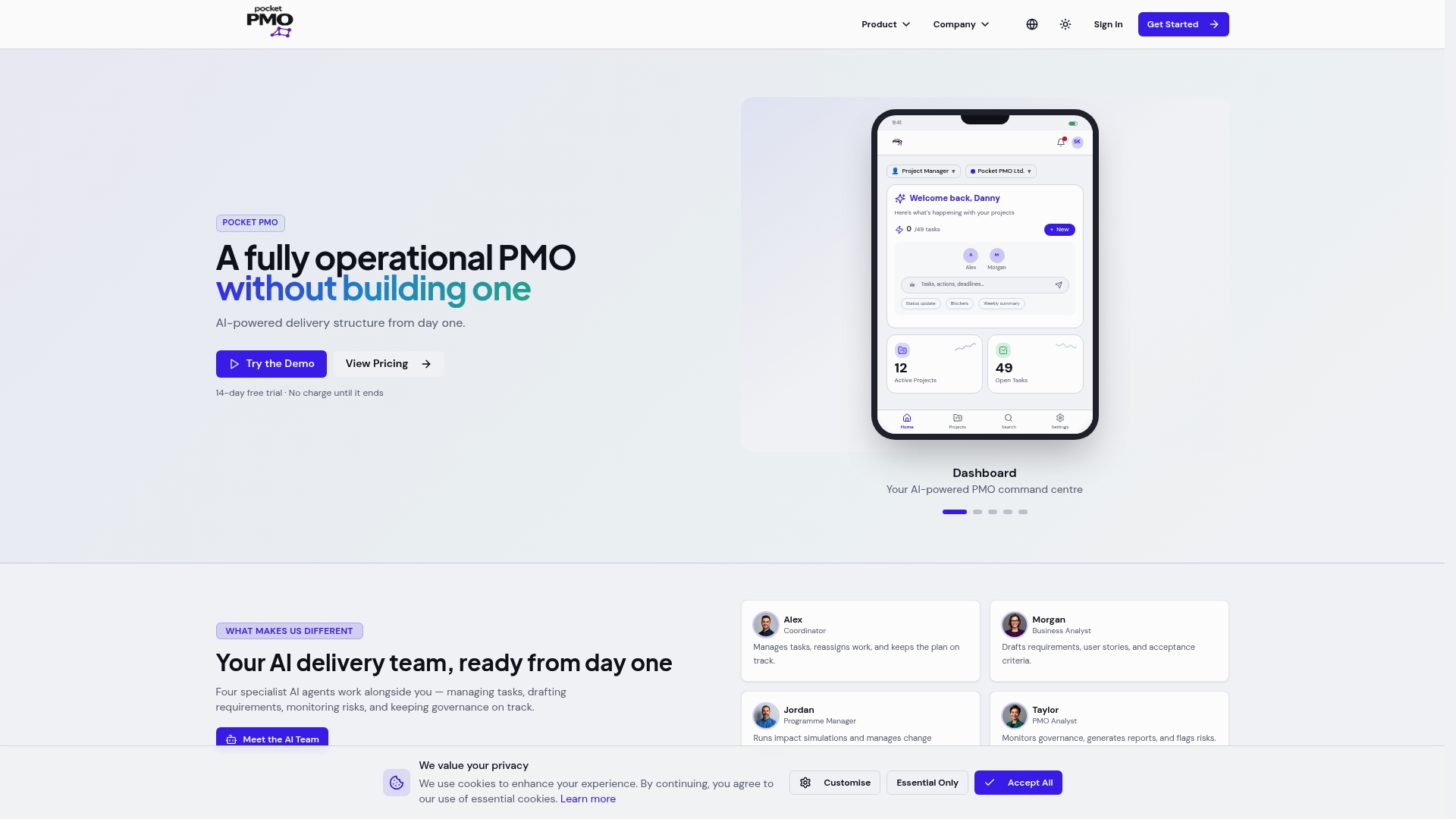
Pocketpmo delivers an AI-powered PMO platform that gives you real-time portfolio health dashboards, structured intake and prioritisation workflows, and automated risk tracking across all active projects. You can run iterative rationalisation cycles with full stakeholder visibility, track benefits realisation, and maintain a complete audit trail of every decision. It connects your governance process to your delivery data without requiring you to build a PMO from scratch. If you want to see how it works in practice, explore Pocketpmo's full PMO platform and try it with your own portfolio.
FAQ
What are the most effective portfolio management strategies?
The most effective strategies combine quantitative preselection to filter poor candidates with iterative, stakeholder-visible governance to make final prioritisation decisions. Hybrid approaches that integrate data rigour with structured review cycles consistently outperform either method used alone.
How do you handle resource conflicts in a project portfolio?
Treat resource capacity as an input to prioritisation, not a problem to resolve after the portfolio plan is agreed. Late resource conflict discovery causes costly trade-offs; building capacity constraints into the intake and scoring process prevents this.
What is the difference between active and passive portfolio management?
Active management responds continuously to new information and strategic shifts, requiring strong PMO capability and higher overhead. Passive or rules-based management applies consistent criteria with lower overhead, making it suitable for stable, predictable project pipelines with limited strategic variation.
How often should a project portfolio be reviewed?
Monthly or fortnightly reviews produce significantly better outcomes than quarterly cycles in dynamic environments. Iterative rationalisation with stakeholder feedback at shorter intervals keeps the portfolio aligned with current strategic priorities and resource availability.
Why is traceability important in portfolio decision-making?
Versioned assumptions and documented decision rationale allow leadership to audit past decisions, compare outcomes against forecasts, and maintain confidence in the prioritisation process over time. Without traceability, every review restarts the political debate from scratch.