

Centralized project tracking is the practice of consolidating all project data, progress updates, and communications into one accessible platform to give every stakeholder a single, reliable source of truth. Poor communication and fragmented tracking cause up to 48% of rework across large-scale initiatives, with preventable rework consuming 5 to 10% of total project costs. That figure alone makes the case for why centralized project management deserves serious attention from any PMO or project manager overseeing multiple workstreams. When your data lives in spreadsheets, email threads, and siloed tools, you are not managing projects. You are managing noise.
What are the main benefits of centralized project tracking?
Centralized project tracking delivers five measurable advantages that directly affect delivery speed, cost, and team performance.
1. Real-time project visibility
Every stakeholder, from delivery teams to executive sponsors, sees the same data at the same time. Project teams lose roughly 13% of their working hours searching for project information when data is not centralized. Recovering that time alone justifies the switch to a unified platform.

2. Reduced rework and duplication
Fragmented tools create version conflicts, duplicate tasks, and contradictory status reports. A centralized system enforces a single record, so teams act on the same facts rather than competing assumptions.
3. Consistent data taxonomy and ownership
Without agreed definitions, "complete" means something different to every team. Centralized tracking lets you establish a shared Definition of Done, assign clear data ownership, and apply consistent project categorisation across the portfolio.
4. Faster decision-making
When risk registers, milestone trackers, and resource logs all feed into one dashboard, you spot blockers in hours rather than days. Centralized platforms reduce costly delays by eliminating manual syncs between siloed tools.
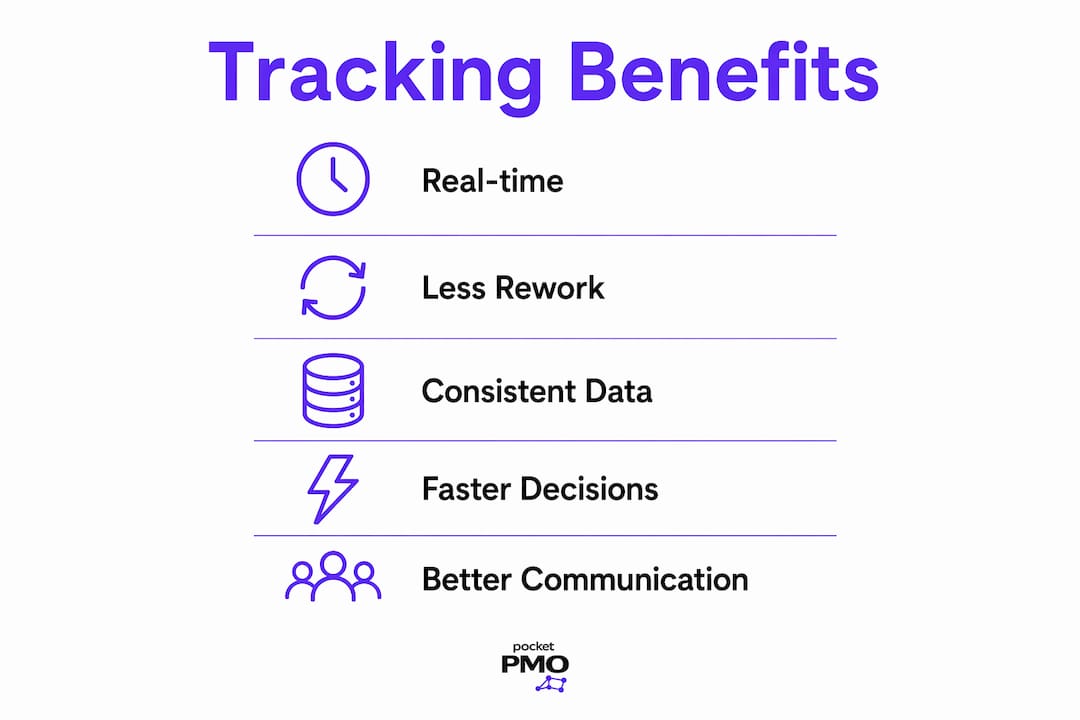
5. Stronger stakeholder communication
Automated status reports replace the weekly scramble to compile updates from five different sources. Stakeholders receive consistent, accurate information, which builds trust and reduces the volume of ad hoc progress queries.
Pro Tip: Before selecting a centralized tracking tool, audit where your teams currently store project data. Map every spreadsheet, shared drive, and messaging thread. The audit reveals integration requirements and prevents you from replicating the same fragmentation inside a new platform.
How does centralized tracking compare to decentralised or manual approaches?
The table below captures the practical differences between fragmented, manual methods and a centralized tracking system.
| Dimension | Decentralised or manual | Centralized tracking |
|---|---|---|
| Data accuracy | Stale, version-conflicted files | Live, single source of truth |
| Reporting effort | Manual consolidation across tools | Auto-generated from one platform |
| Risk visibility | Reactive, discovered late | Proactive, flagged in real time |
| Governance | Inconsistent across teams | Standardised methodology applied portfolio-wide |
| Onboarding speed | Slow, tool-dependent | Faster with shared taxonomy and access controls |
Decentralised approaches are not always wrong. Effective PMOs dynamically choose between centralised and decentralised models based on strategy. A small, co-located team running a single product may function well with lightweight, distributed tools. The problem arises when organisations scale. At that point, decentralised tracking produces data duplication, stale information, and governance gaps that compound with every new project added to the portfolio.
Manual tracking via spreadsheets carries a specific risk that is often underestimated. A spreadsheet is a snapshot, not a live system. By the time a project manager has consolidated updates from five team leads into a master tracker, at least two of those updates are already out of date. The result is that leadership makes resourcing and prioritisation decisions based on a rough approximation of reality rather than actual project status. Centralized tracking systems replace that approximation with verified, event-driven data.
The governance argument for centralisation is equally strong. Standard methodologies, prioritisation frameworks, and PMO governance practices are far easier to enforce when all project data flows through one system. You can audit compliance, identify outliers, and apply lessons learned across the portfolio without manually interrogating each team.
What are the key challenges in implementing centralized project tracking?
Implementation fails most often not because of the technology, but because of the process decisions made before the technology is deployed.
-
Re-engineer workflows before you digitise them. Many organisations fail by digitising inefficient manual processes without redesigning them first. If your current reporting process requires three approval steps that add no value, automating those three steps makes the problem faster, not smaller. Map your workflows, remove waste, then select a tool that supports the improved process.
-
Reduce manual data entry to the absolute minimum. Heavy manual data entry reduces compliance and produces stale data. Integrations that update project status automatically when tasks are completed, risks are logged, or milestones are reached are not a luxury. They are the mechanism that keeps your centralized data trustworthy.
-
Establish taxonomy and ownership from day one. Decide what a project is, what a milestone is, and what "on track" means before you onboard a single team. Assign a named data owner for each project record. Without this, dashboards report a rough mood rather than actual progress, which is worse than having no dashboard at all because it creates false confidence.
-
Build role-based access into the design. Not every stakeholder needs write access to every project record. Delivery teams need task-level detail. Executives need portfolio-level summaries. Designing access by role from the outset prevents data pollution and keeps the system usable for everyone.
-
Prioritise usability over feature completeness. A platform with 40 unused features generates adoption resistance. Start with the core tracking capabilities your teams actually need, such as milestone tracking, risk logging, and status reporting, then add complexity as the team builds confidence with the system.
Pro Tip: Run a 30-day pilot with one project team before rolling out centralized tracking portfolio-wide. Use the pilot to identify integration gaps, taxonomy disagreements, and usability friction. Fixing these on a small scale costs far less than a failed organisation-wide rollout.
How does centralized tracking improve strategic alignment and resource management?
Centralized project data does more than improve day-to-day delivery. It changes how organisations make strategic decisions at the portfolio level.
| Strategic benefit | What it enables |
|---|---|
| Portfolio-level risk visibility | Identify systemic risks across multiple projects before they escalate |
| Resource forecasting | Allocate people and budget based on live capacity data, not estimates |
| Prioritisation | Compare project value and effort across the portfolio using consistent metrics |
| Executive reporting | Generate accurate board-level summaries without manual consolidation |
Centralising project data supports portfolio-level risk identification, resource forecasting, and strategic alignment in ways that no collection of siloed tools can replicate. When a resource constraint on Project A creates a knock-on delay for Project B, a centralized system surfaces that dependency immediately. A decentralised approach surfaces it in the next weekly status meeting, if at all.
Resource management is where the benefits of centralized project data become most tangible for senior stakeholders. When capacity data, project timelines, and skill requirements all live in one place, you can model the impact of a new project request before committing resources. You can see which teams are over-allocated, which projects are at risk due to staffing gaps, and where reallocation would have the greatest effect on delivery. This is the difference between reactive resource management and genuine PMO operational strategy.
Governance also improves materially when tracking is centralised. Standard methodologies, change control processes, and reporting cadences become enforceable rather than aspirational. Accountability is clearer because every project record has a named owner, a defined scope, and a visible status. Stakeholders and executive leadership receive consistent information, which reduces the political friction that often surrounds project prioritisation decisions.
Key takeaways
Centralized project tracking works because it replaces fragmented, stale data with a single, trusted source that supports faster decisions, better governance, and portfolio-wide visibility.
| Point | Details |
|---|---|
| Single source of truth | All project data in one platform eliminates version conflicts and stale status reports. |
| Re-engineer before digitising | Fix broken workflows before adopting a centralized tool to avoid automating inefficiencies. |
| Automate data updates | Event-driven integrations keep records current and reduce manual compliance burden. |
| Establish taxonomy early | Agreed definitions and named data owners prevent dashboards from reporting misleading progress. |
| Portfolio-level impact | Centralized data enables resource forecasting, risk identification, and strategic prioritisation across all projects. |
The case for trusting your data, not just collecting it
I have worked with project managers who had dashboards full of data and still made poor decisions. The dashboards were not the problem. The data feeding them was. Teams were updating statuses to avoid difficult conversations rather than to reflect reality, and no one had defined what "amber" actually meant. The volume of data was impressive. The trustworthiness of it was not.
That experience shaped my view on centralized tracking. The goal is not to collect more data. The goal is to collect honest data. That requires two things most implementations skip: a clear taxonomy that removes ambiguity, and a culture where reporting bad news early is rewarded rather than penalised. A centralized system creates the conditions for honest reporting, but it does not guarantee it. Leadership behaviour does.
The other mistake I see repeatedly is treating centralisation as a destination rather than a starting point. The best PMOs I have encountered adapt their structure to strategy rather than rigidly enforcing one model. They start with a lean central system, prove its value on a handful of projects, and expand deliberately. They resist the urge to add every possible field, workflow, and approval gate in the first month. Complexity added too early kills adoption. Complexity earned through demonstrated need builds a system teams actually use.
Start simple. Be honest about what your data is telling you. Build from there.
— Danny
See centralized tracking in action with Pocketpmo
If you are ready to move beyond spreadsheets and siloed tools, Pocketpmo delivers a fully operational PMO from day one, with real-time dashboards, AI-driven risk analysis, and automated status reporting built in. You do not need to build your own PMO infrastructure or spend months configuring a generic project management tool.
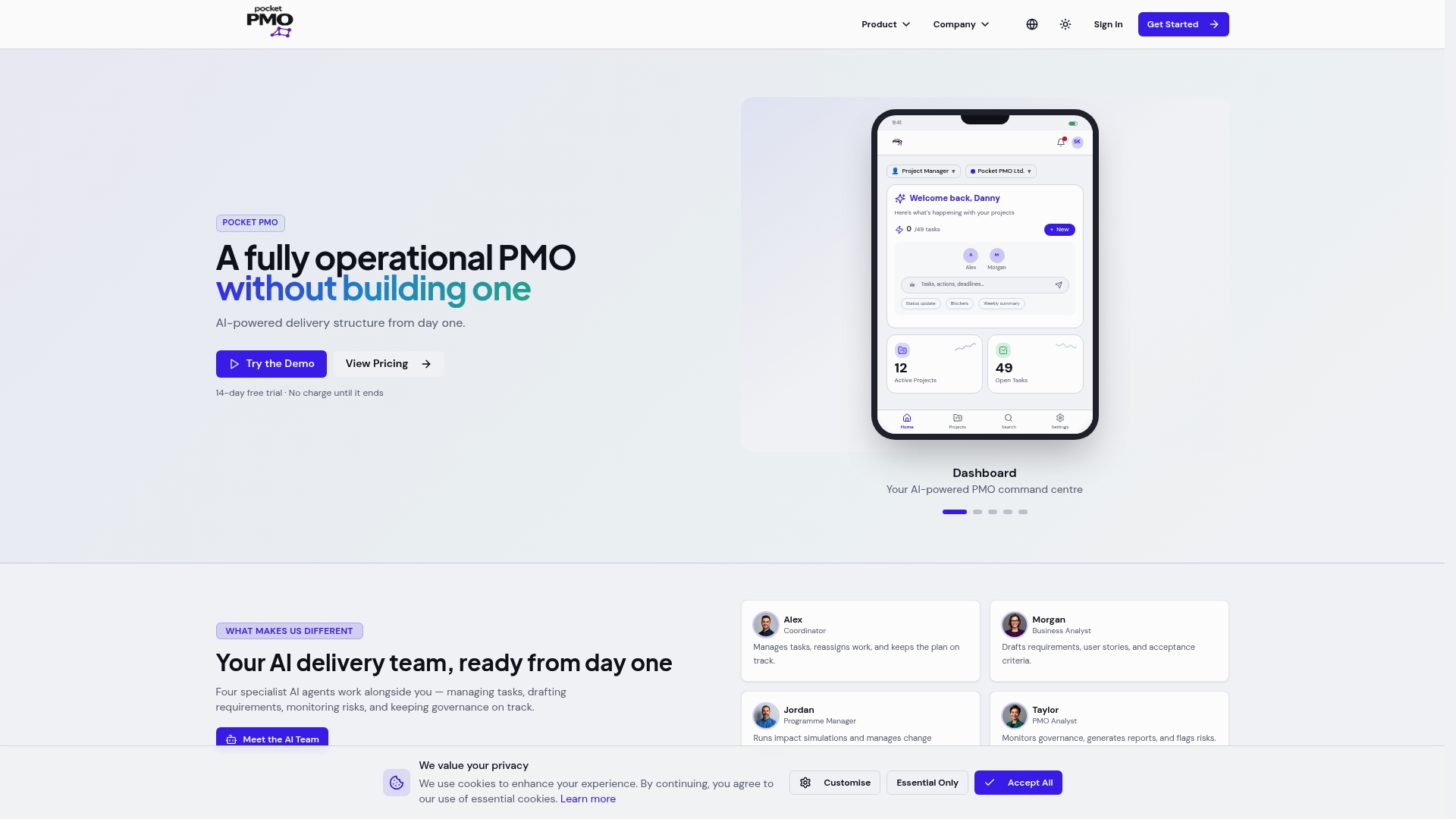
Pocketpmo is designed specifically for project managers, PMOs, and consultancies managing multiple projects simultaneously. If you are evaluating your options, the Pocketpmo vs Microsoft Project comparison gives you an honest, feature-by-feature breakdown to help you decide. You can also explore the Pocketpmo vs Monday.com comparison if you are currently using a task management tool and need to understand the difference a purpose-built PMO platform makes.
FAQ
What is centralized project tracking?
Centralized project tracking is the consolidation of all project data, milestones, risks, and communications into a single platform accessible to all relevant stakeholders. It replaces fragmented tools and manual reporting with one reliable source of project truth.
Why does centralized project management reduce rework?
Fragmented tracking causes up to 48% of rework because teams act on conflicting or outdated information. A centralized system ensures every team works from the same current data, removing the root cause of most duplication and error.
How do you improve project visibility across multiple projects?
Improving project visibility requires a centralized platform with real-time dashboards, consistent data taxonomy, and automated status updates. Role-based access ensures each stakeholder sees the level of detail relevant to their decisions without information overload.
What is the biggest risk when implementing centralized tracking?
The biggest risk is digitising existing inefficient processes without redesigning them first. Automating a broken workflow produces the same poor outcomes faster. Re-engineer your processes before selecting or configuring a centralized tool.
How does centralized tracking support portfolio management?
Centralized data gives portfolio managers live visibility into resource capacity, project dependencies, and risk exposure across all active projects. This supports faster prioritisation decisions and more accurate forecasting at the executive level.