

Unmanaged project risks don't just cause minor delays. They collapse budgets, fracture stakeholder trust, and end careers. Knowing how to manage project risks systematically is what separates project managers who consistently deliver from those who are perpetually firefighting. This guide walks you through every stage of the process, from building governance foundations to keeping your risk register alive throughout the project lifecycle. You'll find practical, PMBOK 8-aligned methods you can apply from day one, whether you're running a single delivery or overseeing a complex programme.
Table of Contents
- Key takeaways
- How to manage project risks: building your governance foundation
- Identifying project risks: a structured approach
- Analysing and prioritising risks
- Planning and implementing risk responses
- Monitoring risks and capturing lessons learned
- My honest take on making risk management work
- How Pocketpmo supports your risk management practice
- FAQ
Key takeaways
| Point | Details |
|---|---|
| Start with governance | Define roles, escalation paths, and probability scales before you identify a single risk. |
| Document threats and opportunities | Risk identification should capture both threats and upsides to give a complete picture. |
| Prioritise with analysis | Use probability-impact matrices to focus your response efforts on the risks that matter most. |
| Assign clear ownership | Every risk needs a named owner with accountability for response actions and monitoring. |
| Treat monitoring as continuous | Regular risk reviews with KRIs keep your register current and your team ahead of issues. |
How to manage project risks: building your governance foundation
Before you log a single risk, you need a risk management plan. Not a document that sits in a shared drive untouched, but a working governance framework that your team actually uses to make decisions.
A solid risk management plan defines the following:
- Roles and responsibilities. Who identifies risks, who owns them, who approves responses, and who has authority to escalate. Vague ownership is the number one reason risk registers become stale.
- Probability and impact scales. Define what "high probability" means numerically for your project. A 70% chance of occurring? Above 60%? Without agreed calibration, your team's assessments are incomparable.
- Risk categories. Group risks by type: technical, schedule, cost, resource, external, regulatory. Categories help you spot systemic patterns later.
- Escalation thresholds. Clear escalation rules prevent delays when a risk materialises during execution. If a risk exceeds a defined impact level, it automatically escalates to the sponsor without debate.
- Reporting frequency. How often will risks be reviewed, and what format will that reporting take?
The risk management plan should align directly with your overall project management plan. Risks don't exist in isolation. A schedule risk becomes a cost risk. A resource risk becomes a quality risk. Your governance framework needs to reflect those interdependencies.
Pro Tip: Involve your key stakeholders and subject matter experts during the planning stage, not just at kick-off. Getting input from the people who understand the technical, commercial, and operational context early means your probability scales and risk categories are grounded in reality from the start.
Identifying project risks: a structured approach
Risk identification is not a one-time workshop. It's an iterative process that runs from initiation to closure, and the quality of your identification directly determines the quality of everything that follows.
Use these methods consistently throughout the project lifecycle:
- Brainstorming sessions. Bring the core team together to surface risks freely. Use structured prompts around each risk category to stop the conversation defaulting only to the obvious.
- Checklists and historical data. Review lessons learned from previous projects, especially those in the same sector or of similar complexity. This is your fastest route to risks you haven't yet imagined.
- Expert interviews. One-to-one conversations with technical leads, procurement specialists, and delivery managers often surface risks that don't emerge in group settings.
- Assumption and constraint analysis. Every project plan contains assumptions. Document them explicitly and then ask: what happens if this assumption is wrong?
- Root cause analysis. Work backwards from potential consequences. If your project overruns by 30%, what chain of events would have caused that? This surfaces causes you might otherwise miss.
Once identified, document each risk using a cause-event-consequence format. For example: "Because the third-party API has not been finalised (cause), there is a risk that integration will be delayed by four weeks (event), resulting in a missed go-live date and contract penalty (consequence)." This format makes the risk tangible and actionable.
Your risk register template should record the risk description, category, owner, current status, probability, impact, and response actions. It's a living document, not a snapshot.
Critically, identification must cover opportunities as well as threats. Focusing only on threats means missing events that could accelerate delivery, reduce cost, or improve quality. Include them with the same rigour.
Pro Tip: When facilitating a risk workshop, assign someone to capture risks without filtering them in the moment. Premature evaluation kills honesty. Let everything surface first, then prioritise. You'll surface risks the team was hesitant to raise in front of the sponsor.
Analysing and prioritising risks
Identifying fifty risks is straightforward. Knowing which five to focus on is where your analytical skill makes the difference.
Qualitative vs quantitative analysis
| Method | Purpose | When to use |
|---|---|---|
| Qualitative (probability-impact matrix) | Prioritise risks quickly using defined scales | All projects, throughout the lifecycle |
| Quantitative (Monte Carlo simulation) | Model numeric impact on cost and schedule | High-priority risks on complex or high-value projects |
| Sensitivity analysis | Identify which risks have the greatest influence on outcomes | During response planning for critical path risks |
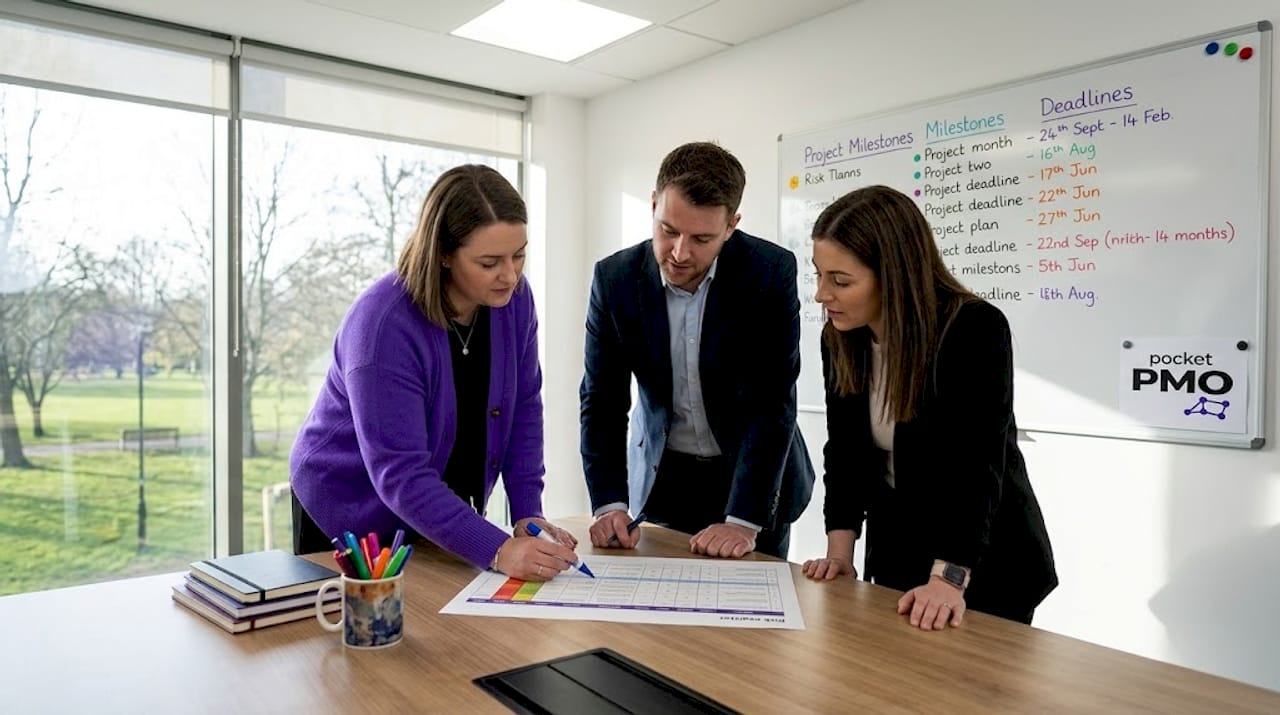
Qualitative analysis comes first. Plot each risk on a probability-impact matrix using your pre-defined scales. Assign a priority of high, medium, or low. This immediately tells you where to focus response planning resources.
Quantitative methods then add precision for the risks that warrant it. Monte Carlo simulation runs thousands of scenarios using your probability and impact ranges to produce a probability distribution for project completion or budget. It's particularly useful when a sponsor asks "what's our 90th percentile cost estimate?" rather than just the point estimate.
Common pitfalls in risk analysis include the following:
- Using inconsistent scales across team members, making comparisons meaningless
- Treating the initial analysis as fixed, when it should be updated at every review cycle
- Rating all risks as medium to avoid difficult conversations
- Ignoring the proximity of a risk, which is how soon it could materialise
For deeper coverage of risk analysis methods including Monte Carlo and AI-assisted scoring, the detail is worth reviewing before your next major analysis cycle.
Planning and implementing risk responses
Analysis without response planning is just documentation. This is where you convert your risk register into action.
Risk response strategies divide into two sets depending on whether you're dealing with a threat or an opportunity:
- Threats: Avoid (remove the cause entirely), Transfer (shift financial consequence to a third party via insurance or contract), Mitigate (reduce probability or impact), Accept (acknowledge and plan a contingency response).
- Opportunities: Exploit (guarantee the opportunity occurs), Enhance (increase probability or impact), Share (partner with someone better placed to capture the opportunity), Accept (take the benefit if it arrives but don't invest in chasing it).
Every response action needs a named owner, a specific action, a target completion date, and a measurable outcome. "Monitor the supplier" is not a response. "Contact supplier weekly to confirm component delivery status, escalate to procurement director if no confirmation received by week four" is a response.
For accepted risks, define trigger conditions. A trigger is a pre-agreed signal that a contingency plan should activate. For example: "If the testing environment is unavailable for more than three consecutive days, activate the remote testing contingency and notify the client." This means your team knows exactly when to act, without waiting for a manager to make the call.
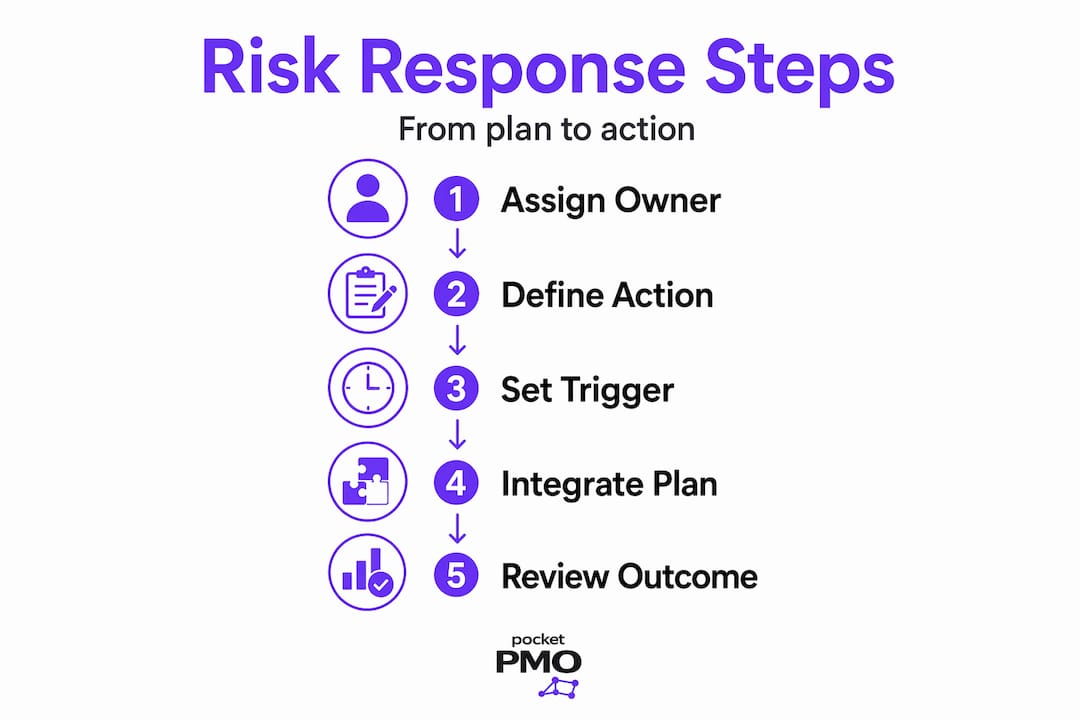
Integrate response actions and reserves formally into your project plan and budget. A risk response that lives only in the risk register will not get done. It needs a task owner, an entry in the schedule, and if it carries cost, a line in the budget.
Pro Tip: When communicating risk responses to stakeholders, lead with the response, not the risk. "We have a tested contingency in place for supplier delays, and it will activate automatically if delivery slips past the trigger date" builds far more confidence than "there's a high-probability supply chain risk we're monitoring."
Monitoring risks and capturing lessons learned
Risk monitoring is a continuous feedback loop, not a periodic checkbox. Treat it as such and your register stays useful. Treat it as compliance and it becomes irrelevant within a fortnight.
Structure your monitoring process around these steps:
- Schedule dedicated risk reviews. Keep them separate from your standard status meetings. Mixing risk reviews with status updates reduces the depth of discussion and signals to the team that risk management is an afterthought.
- Track Key Risk Indicators (KRIs). A KRI is a measurable signal that a risk is moving towards materialisation. KRIs operationalise your mitigation by giving you something observable to track before the risk event actually occurs.
- Update the register at every review. Close risks that have passed, add newly identified risks, update probability and impact scores as circumstances change.
- Move materialised risks to the issue log. Once a risk becomes a problem, it's no longer a risk. It needs a different management track with resolution ownership and a target fix date.
- Capture lessons learned at milestones. Don't wait until project closure. Collecting lessons immediately after a risk materialises or a response succeeds gives you the most accurate and useful record. Download a free lessons learned template to make this consistent across your projects.
Structured risk review meetings with documented decisions and consistent schedules build a predictable control rhythm. That rhythm is what keeps risk management operational rather than theoretical.
Pro Tip: Track whether risk responses are actually being implemented, not just whether they're documented. A weekly sweep of overdue response actions takes five minutes and prevents the most common failure mode in risk management: plans that exist but are never executed.
My honest take on making risk management work
I've worked with enough project teams to know that most risk registers are written once, presented at gate reviews, and never meaningfully updated again. The document looks thorough. The practice is hollow.
What I've found actually makes the difference is governance. Not the governance document, but the genuine clarity it creates. When every person on the team knows exactly who owns each risk, what triggers escalation, and what action they are personally responsible for, risk management stops being an overhead and starts being a control mechanism.
The second thing I've learned is that risk reviews need their own time and space. Every time I've seen risk folded into the weekly status call, it gets two minutes at the end when everyone's tired and nobody challenges the ratings. Dedicate a separate thirty-minute slot. Bring the register. Make decisions. Document them. The discipline compounds over time.
What I'd push back on in conventional advice is the idea that more risks in your register means better risk management. I've seen registers with 200 entries where nothing is genuinely managed. Prioritising five to ten critical risks and responding to them with real accountability beats cataloguing everything and acting on nothing. Selectivity is a sign of maturity, not negligence.
Finally, encourage your team to bring bad news early. A risk-aware culture is not built by tools or templates. It's built by what you do when someone raises an uncomfortable risk in a meeting. Respond with curiosity, not blame, and they'll keep telling you the truth.
— Danny
How Pocketpmo supports your risk management practice
Managing project risks well requires structure, consistency, and the right tools. Pocketpmo gives you all three without the overhead of building a PMO from scratch.
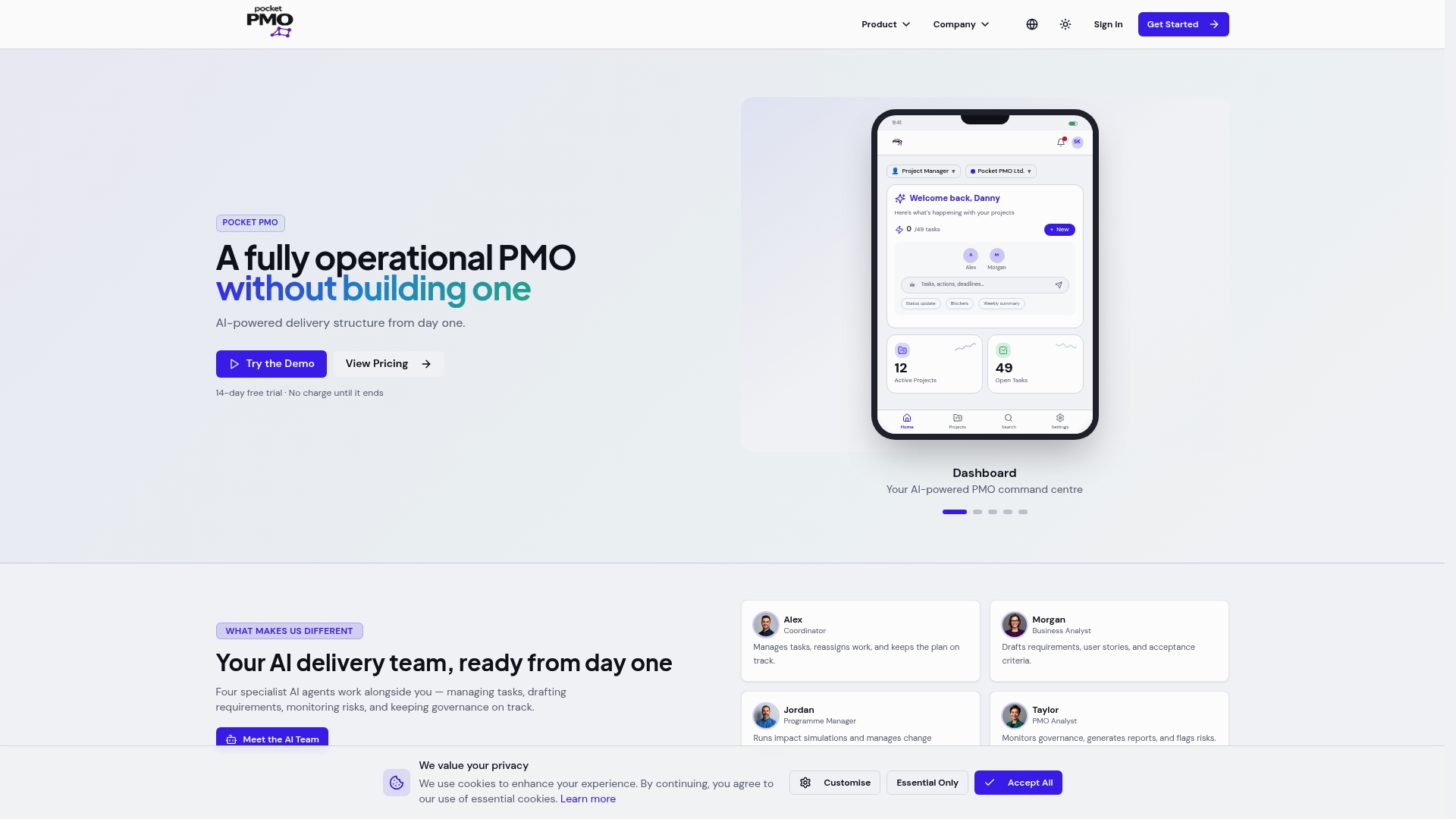
With Pocketpmo, you get AI-driven risk analysis, a built-in risk register, and automated monitoring that flags emerging risks before they materialise. The platform integrates risk responses directly into project plans and tracks ownership and trigger conditions in one place. You can get started immediately with a free risk register template, or explore how Pocketpmo compares to other tools in the Pocketpmo vs Monday.com comparison. If you're ready to run a fully operational PMO without building one, explore the platform and see what's possible.
FAQ
What are the main steps for managing project risks?
Risk management is a continuous cycle covering planning governance, identifying risks, analysing and prioritising them, planning responses, implementing actions, and monitoring throughout the project lifecycle.
How do you identify project risks effectively?
Use a combination of brainstorming sessions, expert interviews, assumption analysis, checklists from previous projects, and root cause analysis. Document every risk in a consistent cause-event-consequence format and update the register iteratively.
What is the difference between qualitative and quantitative risk analysis?
Qualitative analysis uses probability-impact matrices to prioritise all risks quickly. Quantitative methods such as Monte Carlo simulation then model the numeric effect of high-priority risks on schedule and cost.
How often should you review the risk register?
Conduct dedicated risk reviews separately from status meetings, at a minimum aligned to your reporting cycle. Update the register at every review by closing passed risks, adding new ones, and adjusting probability and impact scores.
What is a Key Risk Indicator?
A Key Risk Indicator is a measurable signal that a risk is moving towards materialisation, giving your team an observable metric to act on before the risk event occurs rather than after.