

Poor oversight is one of the most expensive habits in project delivery. 11% of every pound invested in projects is wasted due to poor performance, and that figure does not account for the time, morale, and strategic momentum lost alongside it. This project management oversight guide cuts through the confusion between governing a project and managing one, and gives you a practical framework to apply both with confidence. Whether you are a project manager tightening your governance processes or a stakeholder wanting sharper visibility, you will find concrete strategies here that work in the real world.
Table of Contents
- Key takeaways
- Your project management oversight guide: foundations first
- Executing oversight: processes that actually work
- Common oversight mistakes to avoid
- Measuring and improving your oversight
- My take on project oversight and governance
- Put your oversight into practice with Pocketpmo
- FAQ
Key takeaways
| Point | Details |
|---|---|
| Governance precedes management | Define decision rights, roles, and escalation paths before a project starts, not during a crisis. |
| Stage gates control delivery | Formal review points give steering committees authority to guide, pause, or close projects at defined phases. |
| Risk registers must stay live | Treat your risk register as a working tool reviewed at every governance meeting, not a document filed at project start. |
| Measure beyond delivery | Track benefits realisation for up to three years post-delivery to confirm the project created lasting value. |
| Tailor governance to risk | Calibrate oversight intensity to project scale and complexity to avoid bureaucratic delays on low-risk work. |
Your project management oversight guide: foundations first
Before you can execute effective oversight, you need the right structure underneath it. Governance must separate the directing layer from the performing layer. The directing layer sets strategy, approves budgets, and resolves escalations. The performing layer delivers. When those two roles blur, you get steering committees behaving like project managers and project managers waiting for permission to make routine decisions.
A solid governance structure includes four building blocks.
- Defined decision rights: Who can approve scope changes? Who can authorise additional spend? Who escalates to the board? Document this explicitly. Unclear decision rights are the single most common cause of governance failure, producing endless steering committee meetings where nothing actually gets decided.
- Stakeholder roles and accountability: Sponsors own the business case. Steering committees govern phases. Project managers manage delivery. These are distinct roles, not interchangeable titles.
- Objective alignment: Every project objective should connect directly to a strategic goal. If you cannot draw that line, the project should not proceed.
- Proportionate governance: Federal project oversight thresholds, for example, have been updated to focus on complex projects above £400 million in value, recognising that one-size-fits-all oversight wastes resource on low-risk work. Apply the same logic internally.
The following table shows the tools typically required at each governance layer.
| Governance layer | Typical tools | Primary purpose |
|---|---|---|
| Strategic (board/sponsor) | Business case, benefits register | Approve direction, monitor value |
| Tactical (steering committee) | Stage gate reports, exception reports | Phase decisions, risk escalation |
| Operational (project manager) | Risk register, change log, dashboards | Day-to-day tracking and reporting |
Pro Tip: Before your next project kicks off, run a one-page decision authority map. List every major decision category and name the individual responsible for each. Circulate it to all governance parties and get sign-off. This single document prevents months of ambiguity.
Executing oversight: processes that actually work
Knowing your governance structure is only half the job. The other half is running it consistently without turning every project into a bureaucratic endurance test. Here is a step-by-step approach that balances control with delivery speed.
-
Implement stage gate reviews. Stage gates empower steering committees to formally assess the business case, risks, and readiness before authorising the next phase. This is not a rubber-stamp exercise. Gates should have explicit pass criteria, and a gate that does not pass should delay or redirect the project.
-
Apply manage-by-exception principles. The PRINCE2 principle of exception-based governance means the board only intervenes when tolerances are breached. Define tolerance bands for time, cost, scope, and risk at the start. Project managers operate freely within those bands and escalate only genuine exceptions. This reserves board attention for decisions that genuinely need it.
-
Maintain a live change control process. Scope creep rarely arrives as a single dramatic request. It accumulates in small, unchallenged decisions. Every change to scope, budget, or timeline should pass through a formal change request. Record the business justification, impact, and approval. Link this to your PMO decision-making approach to keep governance decisions traceable.
-
Use dashboards for real-time transparency. Weekly status reports emailed as Word documents are not project monitoring techniques. They are history reports. A live dashboard showing RAG status, milestone progress, budget burn, and open risks gives every governance layer what they need without waiting for the next meeting cycle.
-
Embed regular risk reviews. Risk management must be embedded in your governance rhythm, reviewed at every steering committee, not updated once at project inception and forgotten. Your risk register is a living document. Assign owners to every risk, set review dates, and track mitigation progress against agreed actions.
Pro Tip: Set a hard rule: no steering committee meeting proceeds without an updated risk register circulated 48 hours in advance. This shifts risk conversations from reactive to proactive.
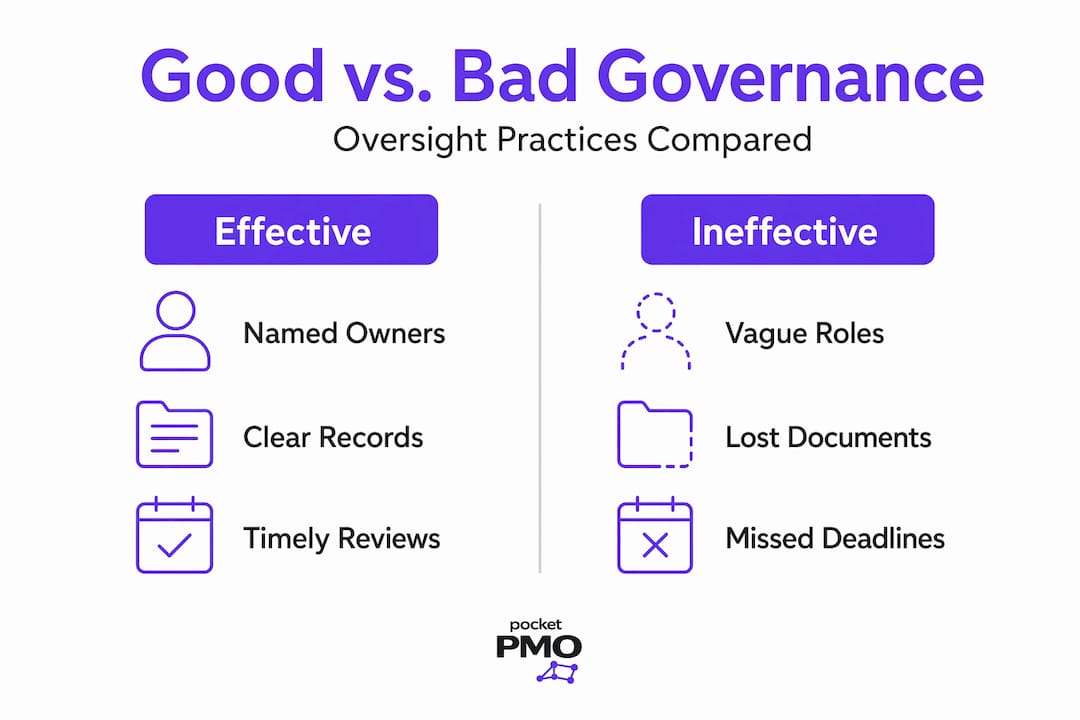
The comparison below illustrates the difference between governance done well and governance done poorly.
| Practice | Effective oversight | Weak oversight |
|---|---|---|
| Decision making | Named owners, documented authority | Decisions deferred or made informally |
| Risk management | Live register, regular review, escalation path | Register created at project start, rarely updated |
| Change control | Formal process with business case justification | Scope changes agreed verbally or via email |
| Reporting | Real-time dashboards, exception-based alerts | Monthly PDFs, reactive status updates |
Common oversight mistakes to avoid
Even experienced project managers fall into predictable traps when it comes to governance. Recognising them early saves significant pain.
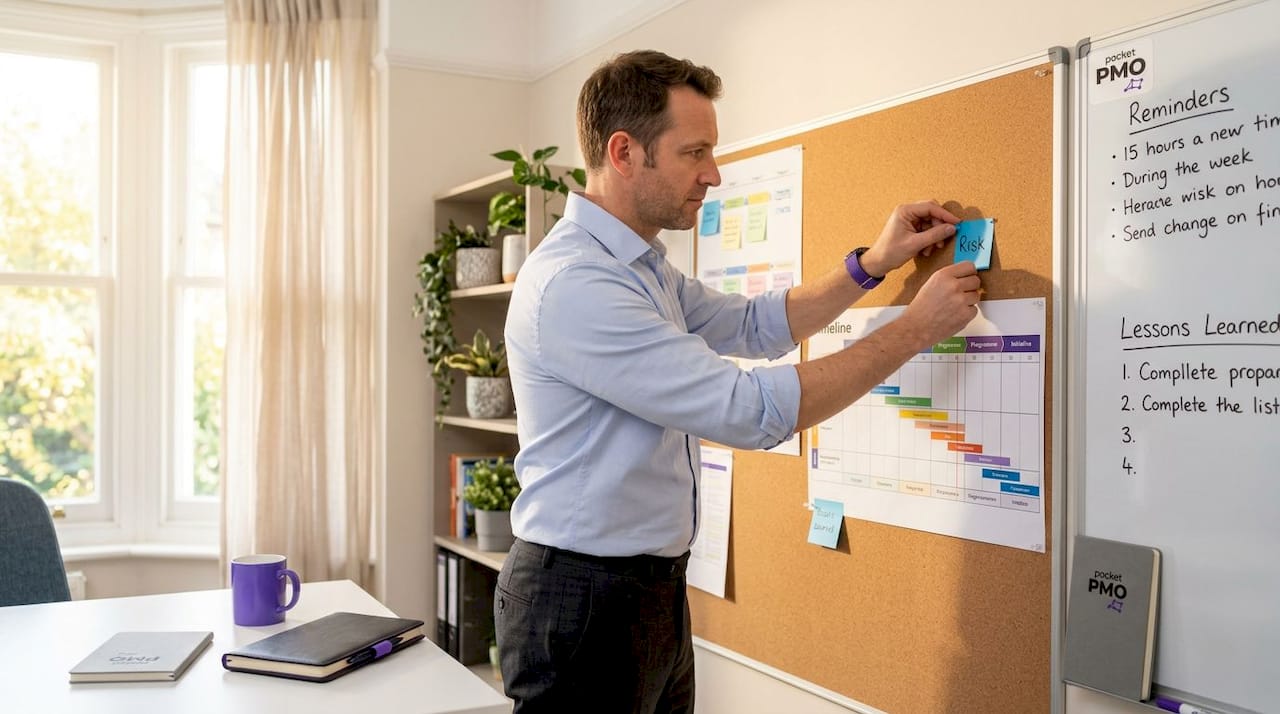
Only 34% of UK government major projects have adequate evaluation plans, representing £456 billion in spending without proper oversight frameworks. That is not a resourcing problem. It is a governance design problem. The same patterns appear in private sector projects at every scale.
Here are the mistakes that appear most often.
- Treating the risk register as a compliance checkbox. Completing a risk register to satisfy an audit requirement is not risk management in projects. Risks that are not actively managed are not controlled. They are simply documented.
- Governance bloat. Adding layers of sign-off, approval gates, and reporting requirements in response to one failed project creates a system that punishes every subsequent project. Minimum viable governance calibrated to risk profile is far more effective than heavy-handed oversight applied uniformly.
- Confusing governance with management. Sponsors who start directing day-to-day tasks undermine the project manager and create conflicting priorities. Steering committees who spend their time reviewing task lists rather than making strategic decisions are operating at the wrong level.
- Delayed problem reporting. Communication failure contributes to 48% of construction rework. Across industries, the pattern is consistent. Problems reported late cost far more to fix than problems escalated early. Your governance culture must make it safe to raise bad news quickly.
- No kill criteria. Boards must be willing to close non-viable projects. A project that has lost its business case but continues because nobody wants to be the one to stop it drains budget, resource, and credibility from everything else in the portfolio.
Pro Tip: At the start of every project, agree the conditions under which the project will be stopped. Document the kill criteria alongside the success criteria. This makes the conversation far less emotionally charged when it matters.
Measuring and improving your oversight
Good oversight is not static. You build it, test it, and improve it continuously. The question is: how do you know it is working?
Start with these key performance indicators for oversight health.
- Budget adherence rate: What percentage of projects close within their approved budget? A healthy portfolio should sit well above the 57% industry average.
- Decision cycle time: How long does it take from an issue being raised to a decision being made and communicated? Long decision cycles are a direct indicator of governance dysfunction.
- Risk reduction rate: Are the number and severity of open risks trending downward as the project progresses? If your risk register is growing at delivery stage, something is wrong.
- Benefits realisation: Effective oversight monitors portfolio benefits for at least three years post-delivery. Build this into your governance framework from day one, not as an afterthought at project close.
The table below shows how oversight maturity typically progresses.
| Maturity level | Characteristics | Improvement focus |
|---|---|---|
| Initial | Ad hoc governance, reactive decisions | Define roles, establish basic reporting |
| Defined | Documented processes, inconsistent use | Embed regular reviews, train teams |
| Managed | Consistent governance, tracked metrics | Reduce decision latency, improve risk quality |
| Optimising | Proactive oversight, benefits tracked post-delivery | Continuous improvement, portfolio-level learning |
Certification frameworks such as PMP and PRINCE2 are worth the investment precisely because they build a shared governance language across your team. When everyone understands what a stage gate means, what an exception report contains, and why change control exists, governance conversations become faster and more productive.
OECD governance principles go further, emphasising that transparency, fiscal discipline, and accountability must extend through the operational phase of a project, not just delivery. Build your oversight framework with that scope in mind.
My take on project oversight and governance
I have seen governance done in every imaginable way. The most common mistake I encounter is treating governance as a protective layer added around a project, rather than as the strategic product it actually is.
The organisations that deliver consistently well do not have more governance. They have clearer governance. They know exactly who decides what, they make those decisions quickly, and they separate assurance from delivery so that project governance frameworks do not become a second management track running alongside the project.
What I have learned about decision fatigue is equally important. When steering committee members are invited to review operational detail they should never see, they disengage. They stop reading reports properly. They approve things they should challenge. The manage-by-exception principle is not just efficient. It is the difference between a board that governs well and a board that turns up.
My honest view is that most governance problems are relationship problems in disguise. Sponsors who do not trust their project managers over-govern. Project managers who fear their sponsors under-report. Building the governance culture requires as much attention as building the governance framework. If your team is not comfortable raising red risks before they turn critical, your risk register is theatre, not protection.
Start with minimum viable governance. Add rigour where the risk profile demands it. And measure whether your oversight is actually working, not just whether it exists.
— Danny
Put your oversight into practice with Pocketpmo
If you are ready to move from governance theory to live delivery, Pocketpmo gives you a fully operational PMO without the cost and time of building one from scratch.
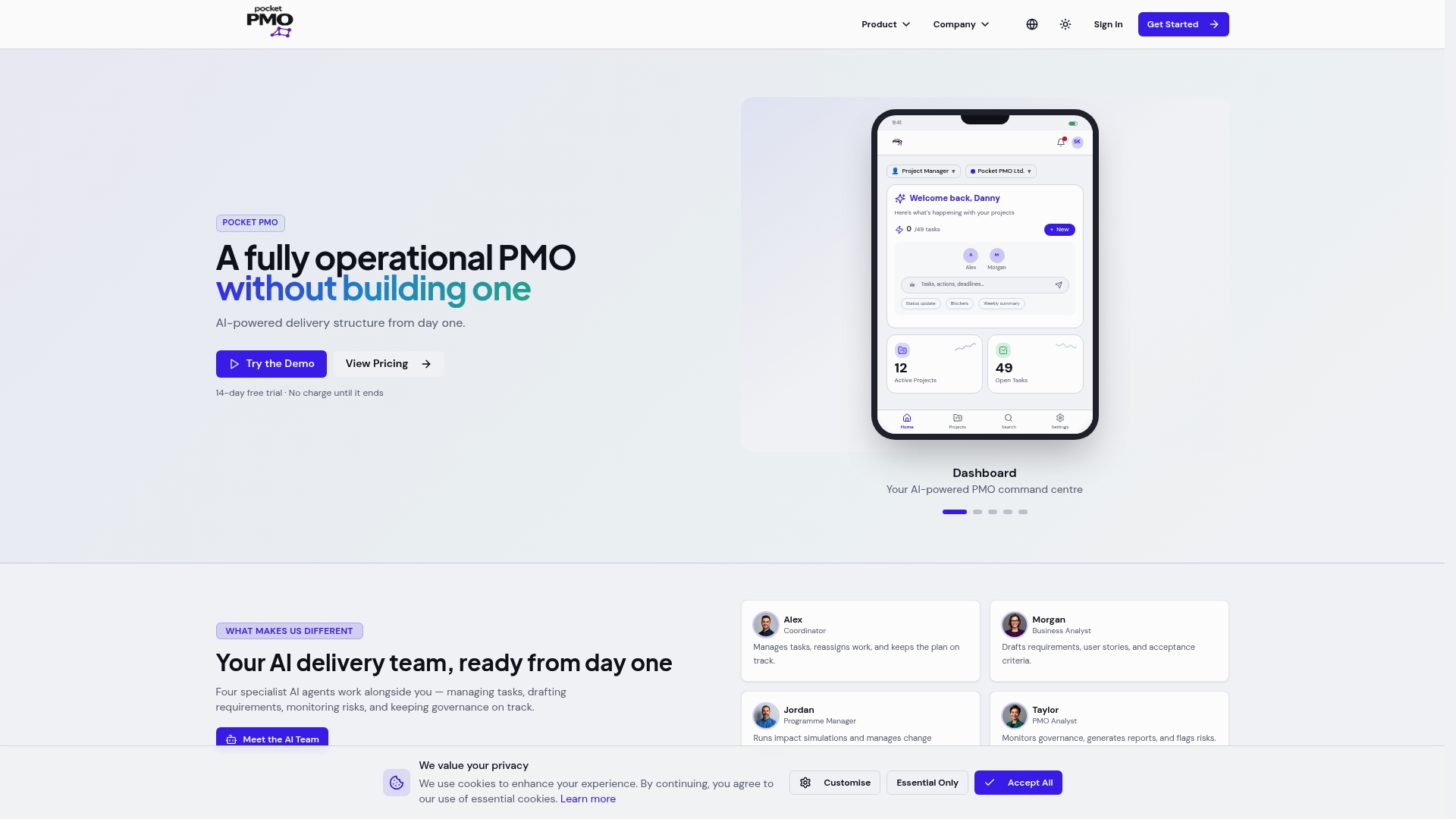
Pocketpmo combines real-time dashboards, AI-driven risk analysis, change request workflows, and structured stage gate reporting in a single platform. You get the governance infrastructure described throughout this guide. It is ready to use from day one, without the overhead of configuring a generic project tool and hoping it holds up under pressure. If you are evaluating your options, the honest comparisons against Microsoft Project and Monday.com will show you exactly where the differences lie. Explore the platform features or book an AI team demo to see it working on a live project environment.
FAQ
What is project management oversight?
Project management oversight is the structured process of monitoring, governing, and controlling a project to confirm it stays aligned with its objectives, budget, and timeline. It sits above day-to-day management and focuses on strategic direction, risk escalation, and accountability.
How does project governance differ from project management?
Governance sets the rules, decision rights, and accountability framework. Management executes within those rules. Governance is about directing; management is about performing. Mixing the two creates conflicting authority and slows delivery.
What are the most effective project oversight strategies?
Stage gate reviews, exception-based reporting, live risk registers, and clear change control processes are the most consistently effective project oversight strategies. Together they maintain control without micromanaging delivery teams.
How do you measure whether oversight is working?
Track budget adherence rate, decision cycle time, risk reduction trends, and benefits realisation at least three years post-delivery. If any of these metrics are static or deteriorating, your governance framework needs adjustment.
Why do governance frameworks fail in practice?
Most governance failures trace back to unclear decision rights, governance bloat that slows delivery, or a culture where bad news travels too slowly. Addressing these three root causes resolves the majority of oversight problems in project delivery.