

AI-powered project insights are intelligent analytics capabilities that apply machine learning, natural language processing, and predictive modelling to project data, producing forecasts, risk alerts, and plain-language summaries that help project managers make faster, better-informed decisions. The industry term for this discipline is "AI-driven project analytics," and it sits at the heart of modern project management practice. Where traditional reporting tells you what happened, AI-powered project insights tell you what is likely to happen next. Pocketpmo is built around this principle, combining real-time dashboards with predictive analytics to give project managers the visibility they need before problems escalate.
What is AI-powered project insights and how does the technology work?
AI-powered project insights operate through three core functions: pattern recognition, predictive modelling, and natural language generation. Each function addresses a different layer of the project management challenge.
Pattern recognition scans historical project data to surface recurring risk signals, such as late task completions that precede budget overruns, or resource conflicts that precede missed milestones. Predictive modelling takes those patterns and calculates outcome probabilities. A system might estimate, for example, a 68% delay probability on a specific workstream based on current velocity and historical comparators. Natural language generation then converts those probability scores and data points into readable summaries that a project sponsor can act on without needing a data analyst.

The underlying pipeline follows a multi-stage process: data ingestion from project tools, deterministic rule-based evaluation against thresholds, and large language model synthesis to produce the final narrative output. The technologies involved include machine learning for pattern detection, natural language processing for query handling, and large language models for report generation.
Pro Tip: The pipeline is only as reliable as the data entering it. Incomplete task logs, inconsistent status updates, or missing milestone dates will produce misleading outputs. Audit your data hygiene before deploying any AI analytics capability.
| Core capability | What it does |
|---|---|
| Pattern recognition | Identifies recurring risk signals across historical project data |
| Predictive modelling | Estimates outcome probabilities such as delay likelihood or budget risk |
| Natural language generation | Converts data and scores into readable, plain-English summaries |
| Multi-stage pipeline | Ingests data, applies rules, and synthesises narrative via large language models |
| Natural language querying | Lets project managers ask questions in plain language without SQL knowledge |
What are the key benefits of AI insights for project managers?
The business case for AI-driven project analytics is grounded in measurable outcomes. Organisations using generative AI report average revenue growth of 15.8% and cost savings of 15.2%, with EBITDA uplift ranging from 10% to 25%. Those figures reflect the compounding effect of faster decisions, fewer rework cycles, and reduced manual effort across delivery teams.
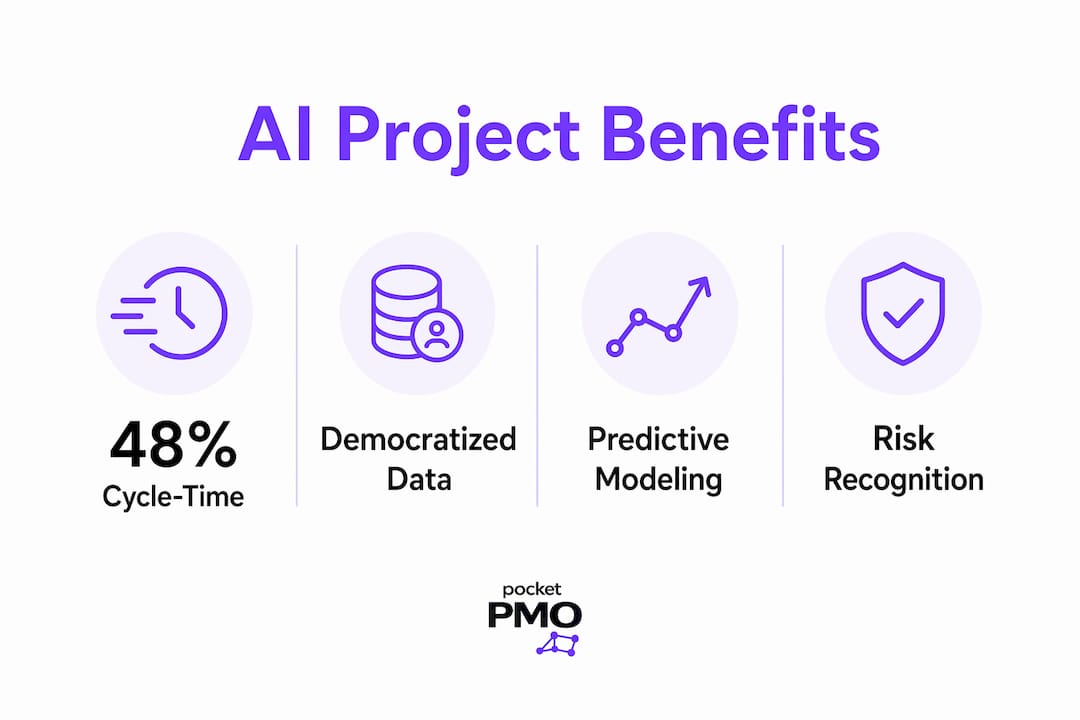
Cycle-time reduction is the most cited benefit among finance leaders, with 48% prioritising it as the primary gain from AI adoption. That translates directly to project delivery: status reports that previously took hours to compile now generate in minutes, and project health metrics update continuously rather than weekly.
A less obvious but equally significant benefit is the democratisation of data. AI analytics enables non-technical users to retrieve project health metrics by asking questions in plain language, removing the dependency on data teams for routine reporting. A project sponsor can ask "Which workstreams are at risk this sprint?" and receive a structured answer without raising a ticket.
Pro Tip: Bain & Company's research is clear: AI value is maximised only when organisations redesign workflows and workforce roles alongside the technology. Deploying AI insights into an unchanged reporting process captures a fraction of the potential gain.
The practical benefits for project managers include:
- Proactive risk identification before issues become blockers
- Capacity forecasting based on current team velocity and upcoming demand
- Consistent, bias-free status reporting across multiple projects
- Improved resource allocation through workload visibility
- Faster escalation of decisions that require human judgement
How are AI insights applied across a project delivery lifecycle?
AI-driven project analytics are not a single feature. They apply at multiple points across the delivery lifecycle, each addressing a distinct management challenge. For project managers overseeing complex multi-project environments, the sequencing of these applications matters.
- Project initiation: AI analyses historical data from comparable projects to generate baseline risk scores and realistic schedule estimates before work begins.
- Sprint and milestone planning: Predictive scheduling models flag capacity constraints and dependency conflicts before they affect delivery dates.
- In-flight monitoring: Real-time dashboards surface bottlenecks, track burn rates, and trigger automated alerts when thresholds are breached.
- Status reporting: Natural language generation produces draft reports for project managers to review, cutting preparation time from hours to minutes.
- Risk escalation: Agentic workflows draft mitigation plans or update risk logs autonomously when a risk score crosses a defined threshold.
- Portfolio review: AI aggregates project health data across a portfolio, enabling PMO leaders to prioritise interventions based on impact and urgency.
- Post-delivery analysis: Pattern recognition identifies what drove outcomes, feeding that learning back into future project estimates.
The shift from reactive to forward-looking reporting is the most tangible change project managers notice. AI tools reduce manual status updates from hours to minutes and reframe the project manager's role from data gatherer to decision maker. Pocketpmo applies this model through its AI-powered delivery team, which manages tasks, requirements, and risk logs from day one.
What are the limitations of AI-powered project insights?
AI-driven project analytics carry real limitations that project managers must understand before relying on them. The most common failure mode is not a technology problem. It is a data problem.
Garbage in, garbage out applies directly here. Reliable AI outputs depend entirely on the statistical quality of input data. Projects with inconsistent logging, missing milestones, or ad-hoc status updates will produce AI summaries that sound authoritative but reflect poor underlying data. The confidence interval on a 68% delay probability is meaningless if the task completion data feeding it is two weeks out of date.
The second risk is "AI-washing." Many tools rebrand basic automation as AI. Genuine AI project insights include predictive capabilities and agentic workflows, not just automated email reminders or templated dashboards. When evaluating any platform, ask specifically whether it produces probabilistic forecasts and whether it can act autonomously on defined triggers.
The third risk is automation complacency. Combining AI insights with human expertise produces the best results. Project managers must validate AI risk scores against their contextual knowledge of team dynamics, stakeholder behaviour, and external dependencies that no dataset fully captures. For a practical framework on managing AI governance risks in enterprise settings, the AI governance playbook from Heights Consulting Group offers a structured starting point.
Best practices for effective adoption include:
- Audit and clean project data before connecting it to any AI analytics tool
- Define clear thresholds for when AI alerts require human review
- Train project managers to interpret probability scores, not just act on them
- Redesign reporting workflows to embed AI outputs rather than add them as a parallel process
- Measure the business impact of AI adoption quarterly and adjust accordingly
Pro Tip: Treat AI insights as a second set of eyes, not a replacement for judgement. The technology surfaces what the data suggests. You supply the context that the data cannot.
Key takeaways
AI-powered project insights deliver measurable value only when project managers combine high-quality data, redesigned workflows, and human validation with the technology.
| Point | Details |
|---|---|
| Core functions | Pattern recognition, predictive modelling, and natural language generation drive AI project insights. |
| Business impact | Organisations report up to 15.8% revenue growth and 15.2% cost savings from generative AI adoption. |
| Data quality is critical | Unreliable input data produces misleading AI outputs regardless of the technology's sophistication. |
| Human validation required | AI risk scores must be validated against project context to avoid automation complacency. |
| Workflow redesign unlocks value | Embedding AI outputs into existing workflows captures far more value than running them in parallel. |
Why AI insights are worth the effort, but not the hype
The honest truth about AI-powered project insights is that they work best for project managers who were already disciplined about data. I have seen teams deploy AI analytics platforms and immediately expose years of inconsistent logging, missing baselines, and status updates that were more optimistic than accurate. The AI did not create those problems. It made them visible, which is actually the first useful thing it did.
The projects where I have seen the clearest improvement are those where the team committed to structured data entry from the start, treated AI-generated risk scores as a prompt for conversation rather than a verdict, and used natural language summaries to free up meeting time for actual problem-solving. The role of AI in consultancy is evolving fast, and the project managers who will benefit most are those who engage critically rather than deferring to the output.
The future of AI in project delivery is genuinely exciting. Agentic workflows that update risk logs, draft escalation emails, and flag capacity conflicts before a project manager has even opened their dashboard are already available in platforms like Pocketpmo. But the practitioners I respect most treat those capabilities with healthy scepticism, verify the outputs, and keep their own judgement firmly in the loop. That balance is not a limitation of the technology. It is what good project management has always looked like.
— Danny
How Pocketpmo puts AI project insights to work
Pocketpmo is an AI-first project management platform that delivers a fully operational PMO without requiring organisations to build one from scratch. Its AI-powered delivery features include predictive analytics, natural language status summaries, automated risk scoring, and portfolio-level dashboards that give project managers real-time visibility across every workstream.
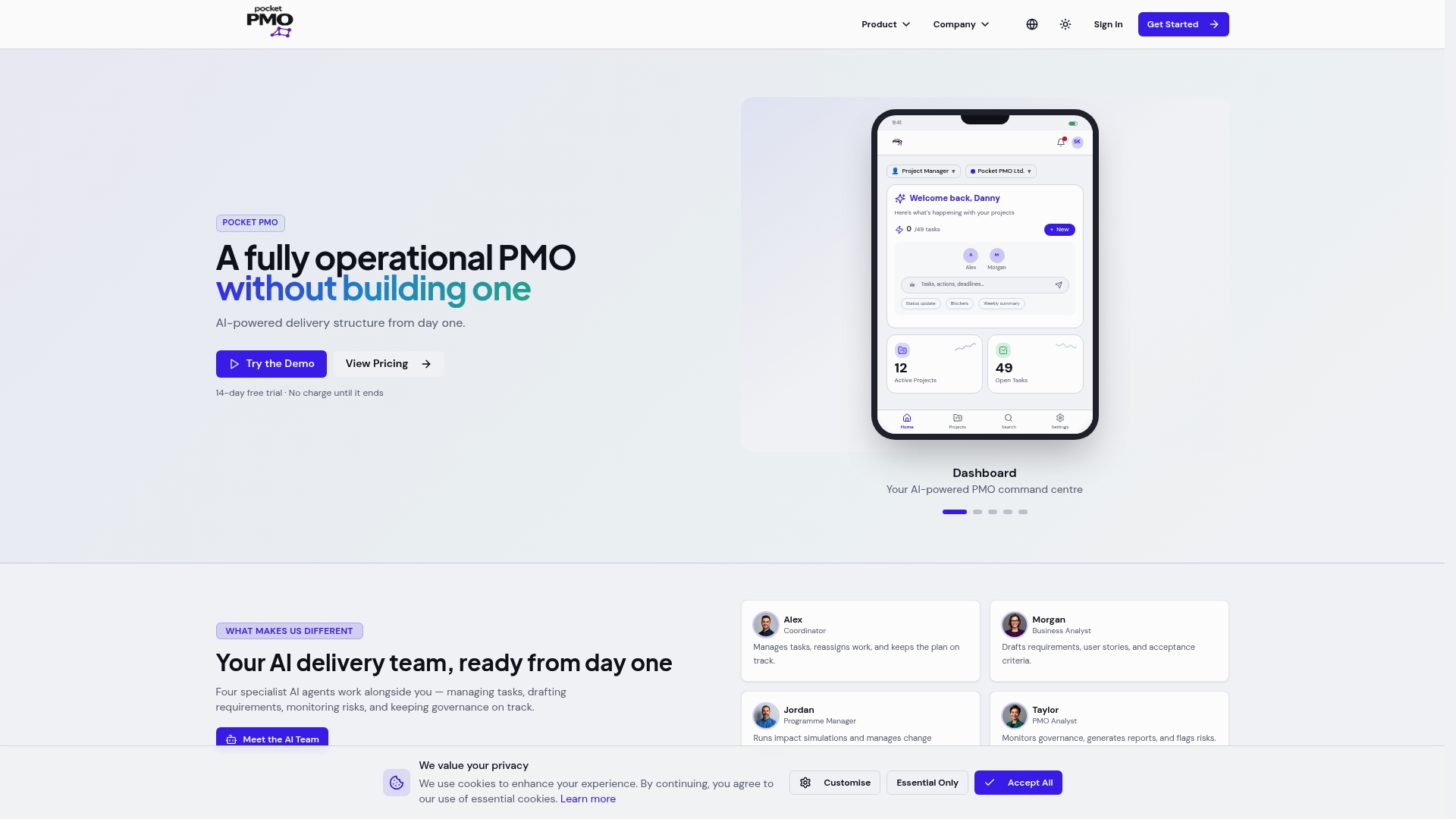
Project managers who want to see AI-driven project analytics in action can book an AI team demo to explore how Pocketpmo handles risk forecasting, automated reporting, and multi-project coordination. The platform is designed to be operational from day one, with no lengthy configuration or specialist data team required.
FAQ
What is AI-powered project insights in simple terms?
AI-powered project insights are analytics capabilities that use machine learning and natural language processing to analyse project data, forecast risks, and generate plain-language summaries. They help project managers shift from reactive reporting to proactive decision-making.
How do AI insights differ from standard project reporting?
Standard reporting describes what has happened. AI-driven project analytics calculate what is likely to happen next, including delay probabilities, budget risk scores, and resource conflicts, before they affect delivery.
What data do AI project insights tools need to work reliably?
AI project insights require structured, consistently updated project data including task completions, milestone dates, resource logs, and budget actuals. Poor data quality produces unreliable outputs regardless of the AI technology used.
How do I avoid being misled by "AI-washing" in project tools?
Ask whether the platform produces probabilistic forecasts and whether it can act autonomously on defined triggers. Genuine AI project management tools include agentic workflows, not just automated notifications or templated dashboards.
By when will AI significantly influence project decision-making?
By 2027, AI is forecast to augment or automate 50% of business-related decisions. Project managers who build familiarity with AI-driven project analytics now will be better positioned to manage that transition effectively.