

The role of AI in consultancy is defined by one shift: embedding human expert judgement directly into autonomous systems that deliver measurable outcomes. This is not incremental improvement. AI in business consulting is replacing the traditional time-and-materials model with a fundamentally different value proposition, one where expertise is encoded into software and delivery is measured in minutes, not weeks. BCG, IBM, and a growing number of boutique firms are already operating this way. The question for you is not whether to engage with this shift, but how quickly you can position yourself to lead it.
How AI transforms consultancy project delivery
The consulting industry is shifting toward what researchers at Berkeley Haas call 'Service as Software', where domain judgement is encoded into autonomous systems that compress delivery time from days to minutes. That compression changes everything about how you scope, price, and execute client work.
Routine tasks that once consumed junior analyst hours, including market research, data aggregation, and first-draft reporting, are now handled by AI tools. Consultants are freed to focus on interpretation, supervision, and strategic recommendation. The practical result is that a team of five can now deliver what previously required fifteen, without sacrificing quality.
Pricing models are changing in parallel. BCG reports that 75% of their largest AI-driven consulting projects now use variable-fee arrangements tied to client business outcomes. That figure signals a structural shift. Clients no longer pay for effort. They pay for results, and they expect consultancies to bear a share of the risk.
Pro Tip: Before pitching an outcome-based engagement, build a data baseline with the client in week one. Without it, you cannot prove the P&L impact that justifies your fee.
| Dimension | Traditional Consultancy | AI-Enabled Consultancy |
|---|---|---|
| Pricing model | Billable hours or day rates | Variable fees tied to outcomes |
| Delivery speed | Days to weeks per deliverable | Minutes to hours via automation |
| Team composition | Analyst-heavy pyramid | Smaller, senior-led teams |
| Value driver | Labour and methodology | Encoded expertise and AI execution |
| Risk profile | Client bears delivery risk | Shared risk between firm and client |
What are the biggest challenges in embedding AI into consultancy?
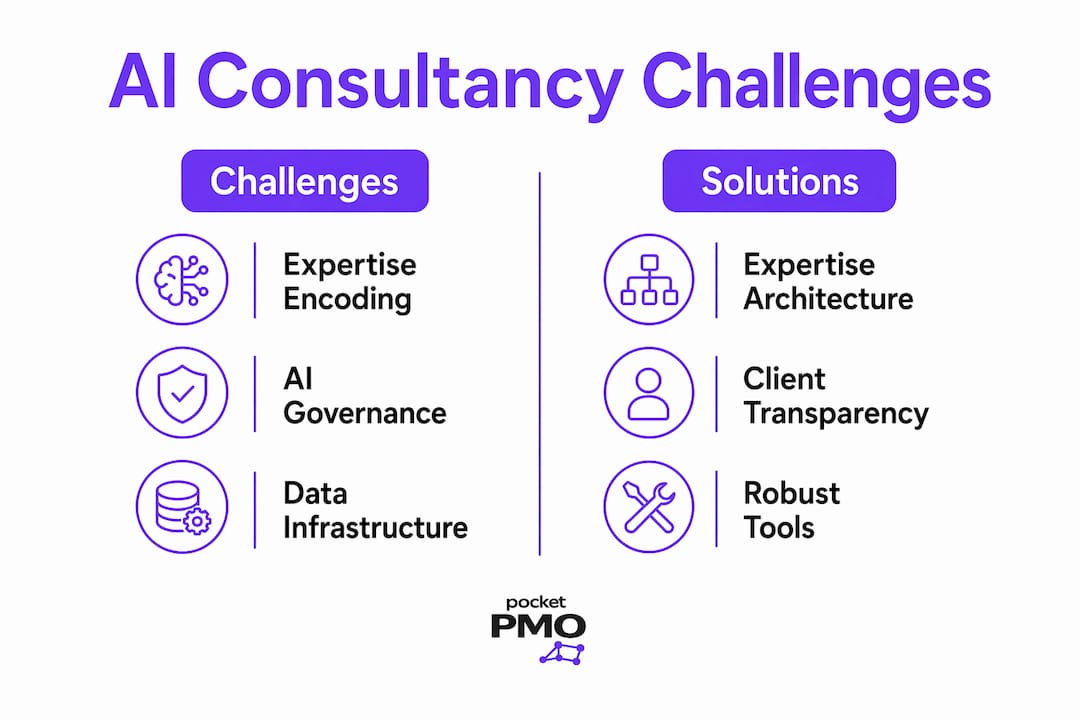
The primary barrier is not access to AI tools. The critical challenge is the Expertise Encoding Problem: converting human expert judgement into machine-executable reasoning. Technical AI capability is commoditising rapidly. The firms that win are those that can translate what their best consultants know into repeatable, auditable logic that an AI system can act on.
This requires a discipline called Expertise Architecture. It goes well beyond prompt engineering or selecting the right large language model. It means mapping decision trees, defining edge cases, and building governance layers that keep AI outputs within acceptable bounds. Most consultancies have not yet built this capability.
IBM's experience illustrates the scale of the challenge. The firm embedded AI across nearly 400 workflows to generate $4.5 billion in productivity gains. That result required governance frameworks, workforce training, and an Agent Management Platform to manage oversight at scale. It was not a technology project. It was an organisational transformation.
Talent is also under pressure. Junior-level recruitment is falling as AI automates the research and analytical tasks that once trained new consultants. Consultancies must now rethink how they develop the next generation of senior advisers when the traditional apprenticeship model no longer applies.
Key success factors for embedding AI effectively:
- Define the expertise first. Map the judgement calls your best consultants make before selecting any AI tool.
- Build governance into the architecture. AI outputs must be auditable and explainable to clients.
- Invest in change management. AI adoption fails when teams treat it as a software rollout rather than a shift in working practice.
- Protect client trust. Transparency about where AI is used and where human judgement applies is non-negotiable.
Pro Tip: Treat AI governance as a client-facing asset, not an internal compliance task. Showing clients your oversight framework builds confidence and differentiates your firm.
How is the consultant's role changing in an ai-driven environment?
AI does not make consultants obsolete. BCG CEO Christoph Schweizer states directly that AI increases demand for AI transformation capacity rather than reducing it. BCG's revenue grew 7% to $14.4 billion in their latest fiscal year, driven by that demand. The market is expanding, but the skills required to compete within it are changing significantly.

The consultant's role is shifting from execution to supervision and from analysis to judgement. You are no longer valued for your ability to build a model or synthesise a report. You are valued for knowing which questions to ask, which AI outputs to trust, and which recommendations carry genuine strategic weight.
Junior roles are the most disrupted. Tasks that once occupied analysts for two days, such as competitor benchmarking, regulatory scanning, and financial modelling, are now completed by AI in under an hour. This does not eliminate entry-level positions, but it does change what those positions require from day one.
New competencies that consultants need in 2026:
- AI fluency: Understanding how large language models, generative AI, and agent-based systems work well enough to supervise their outputs critically.
- Expertise Architecture: The ability to convert tacit professional knowledge into structured, machine-readable logic.
- Outcome measurement: Designing engagements with clear, data-backed metrics that prove client value.
- AI ethics and governance: Knowing where AI should and should not be used, and communicating that clearly to clients.
- Client trust management: Maintaining the human relationship layer that AI cannot replicate.
Firms like BCG and IBM are investing heavily in upskilling programmes to build these competencies at scale. If your firm is not doing the same, you are already behind.
What AI tools do consultants actually use?
AI tools for consultants fall into three practical categories: research and synthesis, project and risk management, and client-facing delivery. The right tool depends on the workflow you are trying to transform, not on which platform has the most features.
IBM's Agent Management Platform represents the enterprise end of the spectrum. It manages AI agents across complex, multi-workflow environments with governance and audit trails built in. For most consultancies, the more immediate opportunity lies in AI-driven project tracking and automated status reporting, which reduce administrative overhead and give clients real-time visibility.
Outcome-based pricing requires robust data infrastructure. You need tools that capture project performance metrics continuously, not just at milestone reviews. That is where AI-powered PMO platforms become directly relevant to consulting practice.
Pro Tip: When selecting AI tools, prioritise those with explainable outputs over those with the highest accuracy scores. Clients and regulators need to understand how a recommendation was reached, not just what it was.
| AI Tool Category | Example Platforms | Consulting Function |
|---|---|---|
| Research and synthesis | Perplexity, ChatGPT, Claude | Market research, regulatory scanning, first-draft reports |
| Project and risk management | Pocketpmo, IBM Agent Management Platform | Project tracking, risk analysis, governance reporting |
| Data analysis | Microsoft Copilot, Tableau AI | Financial modelling, performance benchmarking |
| Client reporting | Pocketpmo, Power BI | Automated status reports, portfolio dashboards |
| Workflow automation | Zapier AI, Make | Repeatable process execution, data routing |
For a practical overview of how AI tools manage multi-project environments, the architecture decisions matter as much as the tool selection itself.
In-house AI capability vs ai-enabled consulting firms: which wins?
Clients are increasingly bypassing traditional consultancies by building AI capabilities in-house or engaging boutique firms for more cost-effective, outcome-focused delivery. This is the most significant competitive pressure the consulting industry faces right now.
Large consultancies like BCG and McKinsey are responding by embedding AI at scale and shifting to outcome-based contracts. Boutique firms are competing on specialisation, offering deep AI expertise in narrow domains at lower cost. Clients sit between these two options, weighing speed, cost, and capability.
Factors clients consider when choosing between in-house and outsourced AI consultancy:
- Speed to value: Can an external firm deliver faster than an internal build?
- Domain expertise: Does the consultancy understand the client's sector deeply enough to encode relevant judgement?
- Cost and risk: Is the fee structure tied to outcomes, or is the client absorbing all delivery risk?
- Knowledge transfer: Will the engagement build internal capability, or create dependency?
| Factor | In-House AI Team | AI-Enabled Consultancy |
|---|---|---|
| Upfront cost | High (recruitment, infrastructure) | Lower (project-based fees) |
| Speed to deployment | Slow (6–18 months typically) | Fast (weeks with established platforms) |
| Domain expertise | Depends on hiring success | Pre-built in consultancy methodology |
| Ongoing capability | Retained internally | Requires continued engagement |
| Risk | Client bears all risk | Shared or outcome-linked |
For clients exploring this decision, the Pocketpmo blog covers practical frameworks for evaluating AI adoption strategies across both models.
Key takeaways
Transforming consultancy with AI requires encoding human expertise into governed systems, not simply adding AI tools to existing workflows.
| Point | Details |
|---|---|
| Expertise encoding is the differentiator | Firms that convert consultant judgement into machine-executable logic gain the most durable competitive advantage. |
| Outcome-based pricing is now standard | BCG ties 75% of its largest AI projects to variable fees linked to measurable client outcomes. |
| IBM proves governance is non-negotiable | Embedding AI across 400 workflows required oversight frameworks, not just technology deployment. |
| Junior roles are being restructured | AI automation of research tasks is forcing consultancies to redesign hiring and development pipelines. |
| In-house vs outsourced is a strategic choice | Clients must weigh speed, cost, domain expertise, and risk before deciding how to access AI consultancy capability. |
Where i think most consultancies are getting this wrong
I have watched firms invest heavily in AI tools and see almost no change in client outcomes. The pattern is consistent. They automate the visible tasks, the reports, the research summaries, the slide decks, and then wonder why clients are not paying more or renewing faster.
The uncomfortable truth is that encoding expertise into AI systems is the only move that creates lasting value. Everything else is efficiency theatre. Clients notice when a report arrives faster but contains the same generic recommendations. They do not notice the hours you saved producing it.
The firms I respect most are treating Expertise Architecture as a core discipline, not a side project. They are mapping the decisions their best people make, building governance around those decisions, and then letting AI execute at scale. That is a fundamentally different operating model, and it takes two to three years to build properly.
The talent question keeps me up at night more than the technology question. When AI handles the work that used to train junior consultants, you lose the pipeline that produces senior advisers in ten years. The firms solving this problem now, through structured supervision roles and AI-augmented apprenticeships, will have a significant advantage by 2030.
My advice: stop asking which AI tools to buy and start asking which expertise you need to encode first. The answer to that question is your actual strategy.
— Danny
Put ai-powered project delivery to work for your consultancy
If you are ready to move beyond manual project tracking and disconnected reporting, Pocketpmo gives you a fully operational AI-powered PMO from day one. The platform automates status reporting, tracks risks in real time, and gives you portfolio-level visibility across every client engagement.
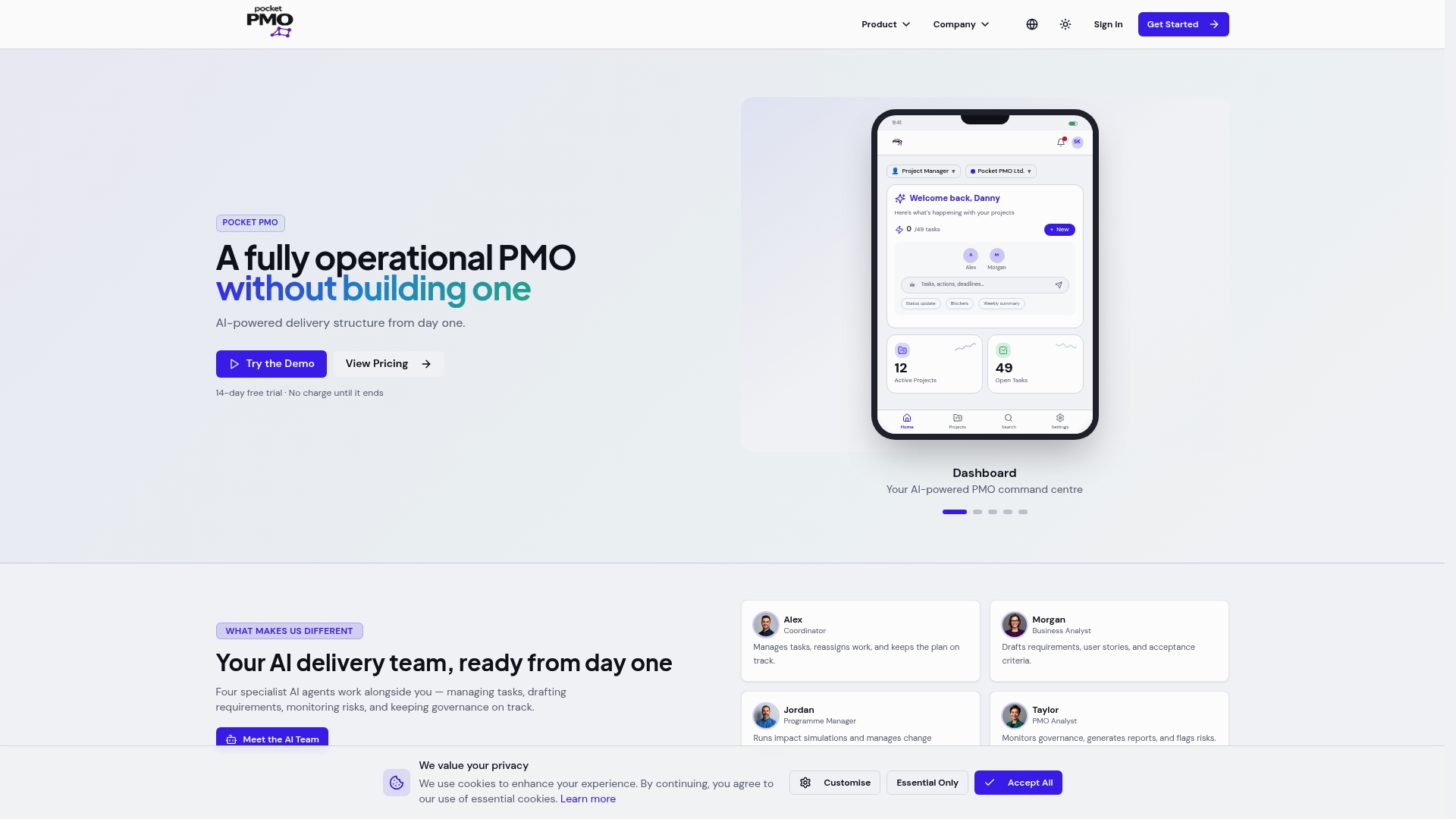
You do not need to build your own PMO infrastructure or hire a dedicated delivery team. Pocketpmo deploys an AI-powered delivery team that manages tasks, requirements, and risks on your behalf. See how it compares to the tools you are already using and explore Pocketpmo's full platform to start delivering smarter, faster, and with greater confidence.
FAQ
What is the role of AI in consultancy?
The role of AI in consultancy is to encode expert judgement into autonomous systems that deliver measurable client outcomes faster and at lower cost than traditional labour-based models. AI handles routine research, analysis, and reporting while consultants focus on supervision and strategic decisions.
How does AI change consultancy pricing models?
AI enables outcome-based and variable-fee pricing, where consultants are paid for measurable client results rather than hours worked. BCG reports that 75% of their largest AI-driven projects now use this model.
What is the expertise encoding problem in consulting?
The Expertise Encoding Problem is the challenge of converting tacit human expert judgement into structured, machine-executable reasoning that AI systems can act on reliably. It is the primary barrier to effective AI adoption in consultancy, not access to AI technology itself.
Will AI replace consultants?
AI does not replace consultants. BCG CEO Christoph Schweizer confirms that AI increases demand for transformation expertise rather than reducing it. The consultant's role shifts from execution to supervision, judgement, and Expertise Architecture.
How should consultants choose AI tools?
Consultants should prioritise AI tools with explainable outputs, strong governance features, and direct integration into project delivery workflows. Tools like IBM's Agent Management Platform and Pocketpmo address both execution and oversight needs within consulting environments.