

Most project teams assume a business analyst is there to write requirements and move on. That assumption quietly kills AI projects. A business analyst does far more than capture what stakeholders say they want. According to Coursera, business analysts are data-driven decision-makers who help organisations achieve goals by recommending changes that improve outcomes and efficiency. In AI-powered project environments, that capability is not a nice-to-have. It is the connective tissue between technology investment and measurable business value. This article covers what the role actually involves, the skills that matter, and how to apply BA capability effectively in your AI-driven projects.
Table of Contents
- What is a business analyst and why does the role matter?
- Key responsibilities and skills of a modern business analyst
- Understanding functional vs non-functional requirements in projects
- The business analyst's role in agile and AI-powered project environments
- Why treating business analysis as an operating model capability boosts AI project success
- How Pocket PMO enhances business analyst impact in AI-driven projects
- Frequently asked questions
Key Takeaways
| Point | Details |
|---|---|
| Beyond documentation | Business analysts enable organisational change by defining needs and delivering measurable value, not just writing requirements. |
| Dual skill set | Successful business analysts combine technical skills in analytics and AI with leadership and communication capabilities. |
| Requirement types | Understanding and managing both functional and non-functional requirements is critical for project success. |
| Agile integration | Business analysts in agile teams translate requirements into user stories and continuously validate outcomes each sprint. |
| Strategic capability | Embedding business analysis as an operating model capability maximises AI project management effectiveness and value delivery. |
What is a business analyst and why does the role matter?
The simplest, most accurate definition comes from the practice itself. Business analysis is enabling change in an organisational context by defining needs and recommending solutions that deliver value to stakeholders. Not documenting change. Not reporting change. Enabling it.
That distinction matters enormously in AI-powered project management. An AI dashboard can surface patterns, flag risks, and predict delays. But none of that insight translates to action without someone who understands the business well enough to interpret it, communicate it, and drive the right response. That is the business analyst.
There is a persistent misconception that the business analyst job description revolves around writing requirements documents. In practice, BAs spend significant time on stakeholder alignment, process redesign, and proving that delivered solutions actually produce the expected outcomes. They are change management success enablers, not just specification writers.
Why does this matter for your organisation right now? Because AI project management tools generate more data, faster, than most teams can act on. A skilled BA provides the interpretive layer that turns raw project data into prioritised decisions. Without that layer, you risk a very well-monitored project that still delivers the wrong thing.
Key contributions a business analyst makes in AI-powered environments:
- Translating business goals into measurable project outcomes
- Identifying gaps between current processes and desired future states
- Defining requirements that AI tools can track and surface accurately
- Facilitating stakeholder workshops to surface hidden assumptions
- Validating that delivered solutions actually meet the original need
- Supporting adoption so that change delivers lasting value, not temporary compliance
Explore the full scope of the business analyst career guide to understand how the role has evolved in practice.
Key responsibilities and skills of a modern business analyst
Understanding what a business analyst does day-to-day requires separating responsibilities from skills. These are related but distinct. Responsibilities are what the BA is accountable for delivering. Skills are the capabilities that make delivery possible.
Core responsibilities of a business analyst in 2026:
- Analysing problems to identify root causes, not just surface symptoms
- Collecting and validating data from multiple stakeholder sources
- Designing or redesigning processes to close identified performance gaps
- Defining functional and non-functional requirements clearly and completely
- Supporting implementation by liaising between business and technical teams
- Communicating progress, blockers, and outcomes to project leadership
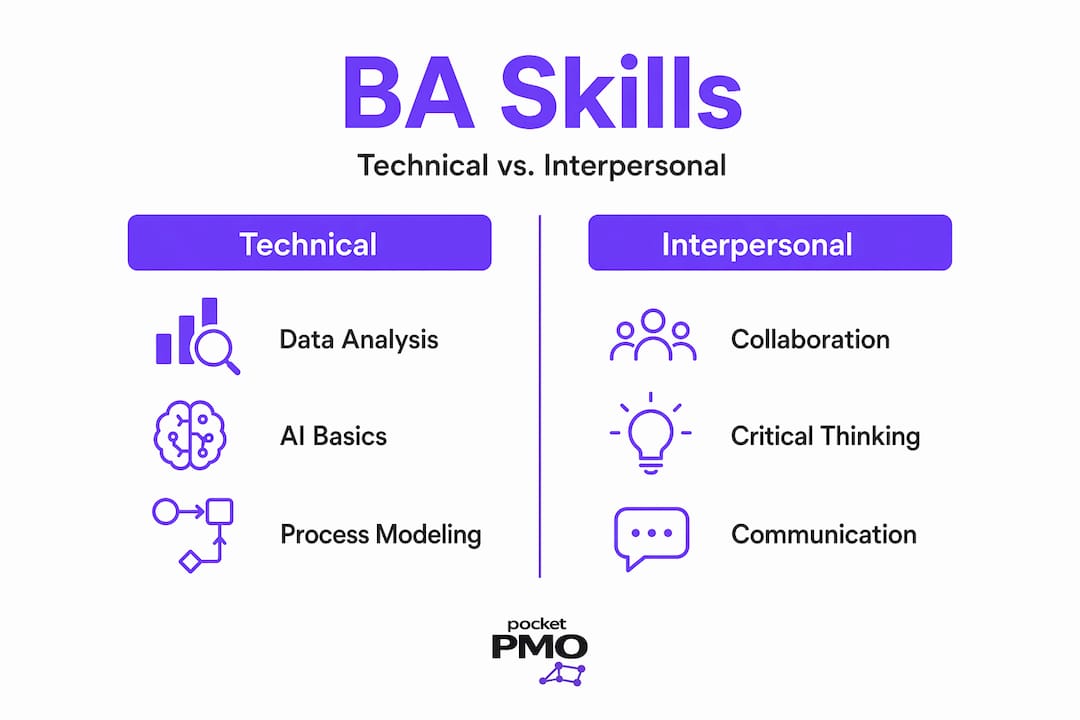
Technical skills that matter:
- SQL and Python for querying and analysing project and operational data
- Power BI or Tableau for building and interpreting performance dashboards
- Process modelling using BPMN or similar notations
- Foundational AI knowledge to work confidently with AI-powered tools
- Requirements management tools and agile platforms such as JIRA or Azure DevOps
Soft skills that are equally critical:
- Communication that works across technical and non-technical audiences
- Negotiation to manage competing stakeholder priorities without losing focus
- Critical thinking to evaluate options rather than default to the loudest voice
- Change management to support teams through process and technology transitions
Technical and interpersonal skills combined are what separate a BA who documents requirements from one who drives outcomes. The difference shows up in whether your AI project actually delivers ROI, or simply generates reports.
In 2026, core BA skills include analytical thinking, business acumen, critical thinking, collaboration, risk management, and technical writing. That breadth reflects how the role has matured.
Understanding which PMO models support AI success is also valuable context for BAs working within structured project governance. The BA's work feeds directly into how the PMO reports on value and risk.
Pro Tip: The most influential BAs treat technical capability as a credibility tool, not an end in itself. You do not need to be the best SQL writer in the room. You need to be fluent enough to ask the right questions of the data and confident enough to challenge outputs that do not make sense. That combination of analytical literacy and strategic change management thinking is what earns a BA a seat at the decision-making table.
Understanding functional vs non-functional requirements in projects
Requirements are the backbone of every project, and getting them right is one of the most practical contributions a business analyst makes. Functional and non-functional requirements are both critical to project success, but they describe fundamentally different things and demand different documentation approaches.

Functional requirements describe what a system or process must do. Examples include: the system must allow users to upload documents in PDF format, or the reporting module must display live project status by portfolio.
Non-functional requirements describe how a system or process must perform. Examples include: the system must load within two seconds under peak load, or data must be encrypted at rest and in transit.
Both types matter. An AI-powered project management platform that does everything stakeholders asked for but runs too slowly to be usable has failed on non-functional grounds. A fast, reliable system that solves the wrong problem has failed on functional grounds.
| Requirement type | What it defines | Common documentation format | Example |
|---|---|---|---|
| Functional | What the system does | User stories, use cases, BRD | "System sends automated status report weekly" |
| Non-functional | How the system performs | NFR specification, quality attributes | "Report generation must complete within 30 seconds" |
| Both | Traceability to business goals | Requirements traceability matrix | Links each requirement to a business objective |
Business analysts use several standard artefacts to capture and manage these requirements:
- User stories: Short, role-based descriptions of what a user needs and why
- Use cases: Step-by-step scenarios showing how users interact with a system
- Business requirements documents (BRDs): Formal documents capturing agreed scope and objectives
- Requirements traceability matrices (RTMs): Mapping each requirement back to a business goal and forward to a test case
For AI project management, traceability is particularly important. When your AI dashboard surfaces a risk or flags a milestone as off-track, you need to trace that flag back to a defined requirement and forward to an acceptance criterion. Without that traceability, you cannot verify whether the AI is surfacing the right signals. Knowing how to manage project requirements effectively is therefore not just a BA concern, it is a governance concern for the whole PMO.
You can see how requirements use cases apply across different project contexts on the Pocket PMO platform.
The business analyst's role in agile and AI-powered project environments
Agile changed how business analysts work, and AI has changed it further. In traditional project delivery, a BA might complete a requirements phase and hand off to a development team. In agile, the BA is continuously active across the entire delivery lifecycle.
In a typical agile sprint cycle, a junior BA is responsible for:
- Gathering requirements through stakeholder interviews, surveys, and workshops
- Conducting gap analysis between current and desired process states
- Writing clear, testable user stories for the development backlog
- Supporting user acceptance testing (UAT) and documenting outcomes
- Participating in sprint reviews to validate that delivered functionality meets the stated need
Junior BAs gather requirements and author user stories in agile and scrum teams, using tools such as JIRA and SQL as standard practice. This operational reality is worth understanding if you are building a BA function or integrating one into an existing PMO.
BA work in agile maps requirements and evaluates solutions continuously through backlogs, sprint reviews, and demos rather than through one-off documentation events. That continuous engagement is what keeps AI dashboards accurate. If requirements change mid-sprint but the BA does not update the traceability artefacts, the AI platform is tracking against outdated criteria.
The BA also serves as the bridge between business stakeholders and technical teams. That bridge role becomes even more critical when AI tools are generating insights that non-technical stakeholders need to act on. The BA translates AI outputs into business language, challenges outputs that do not align with known context, and ensures that decisions made on the back of AI recommendations are grounded in validated requirements.
Pro Tip: Invest in BA planning before elicitation begins. Most teams rush to start gathering requirements, but the BAs who produce the highest quality inputs for AI platforms spend time upfront defining what they need to discover, from whom, and how they will validate what they hear. That planning pays dividends in AI project tracking accuracy and reduces the costly rework that comes from misaligned assumptions. Consider also how you can automate PMO tasks with AI to give your BAs more time for high-value analysis rather than administrative overhead.
Why treating business analysis as an operating model capability boosts AI project success
Most organisations treat business analysis as a project-level resource. Assign a BA to the project, collect the requirements, move on. That approach undercuts the return on every AI investment you make in project management.
Business analysts must be treated as an operating model capability, not merely as project artefact creators, to ensure AI project outputs are trustworthy and valuable. That is not a theoretical position. It reflects the practical reality that AI tools are only as reliable as the requirements and context fed into them.
When BA capability sits at the operating model level, a few things happen that do not happen when it is treated as a per-project assignment. Requirements quality becomes consistent across the portfolio. Traceability becomes an organisational standard rather than a per-BA habit. And the link between stakeholder intent and delivered outcomes becomes auditable.
BA work is the content backbone connecting stakeholder intent with outcomes. The linkages from needs to acceptance criteria to metrics are vital for AI project success. Without those linkages, an AI platform can tell you a project is green when it is actually delivering the wrong thing on time and on budget.
There is also a compounding benefit that most organisations miss. When BA capability is embedded in the operating model, BAs develop institutional knowledge about how the business works, what past projects delivered, and where recurring requirements patterns emerge. That institutional knowledge makes AI recommendations dramatically more accurate over time because the context layer improves with every project.
The practical implication for PMOs and project managers is clear. Embed your BA function, invest in PMO governance that includes BA standards, and treat requirements quality as a governance metric, not just a project deliverable. That shift is what separates organisations that extract sustained value from AI-powered project tracking strategies from those that generate impressive dashboards with questionable data underneath.
How Pocket PMO enhances business analyst impact in AI-driven projects
Having seen how business analysis functions strategically, the next question is practical: how do you operationalise BA best practices without building a separate infrastructure layer?
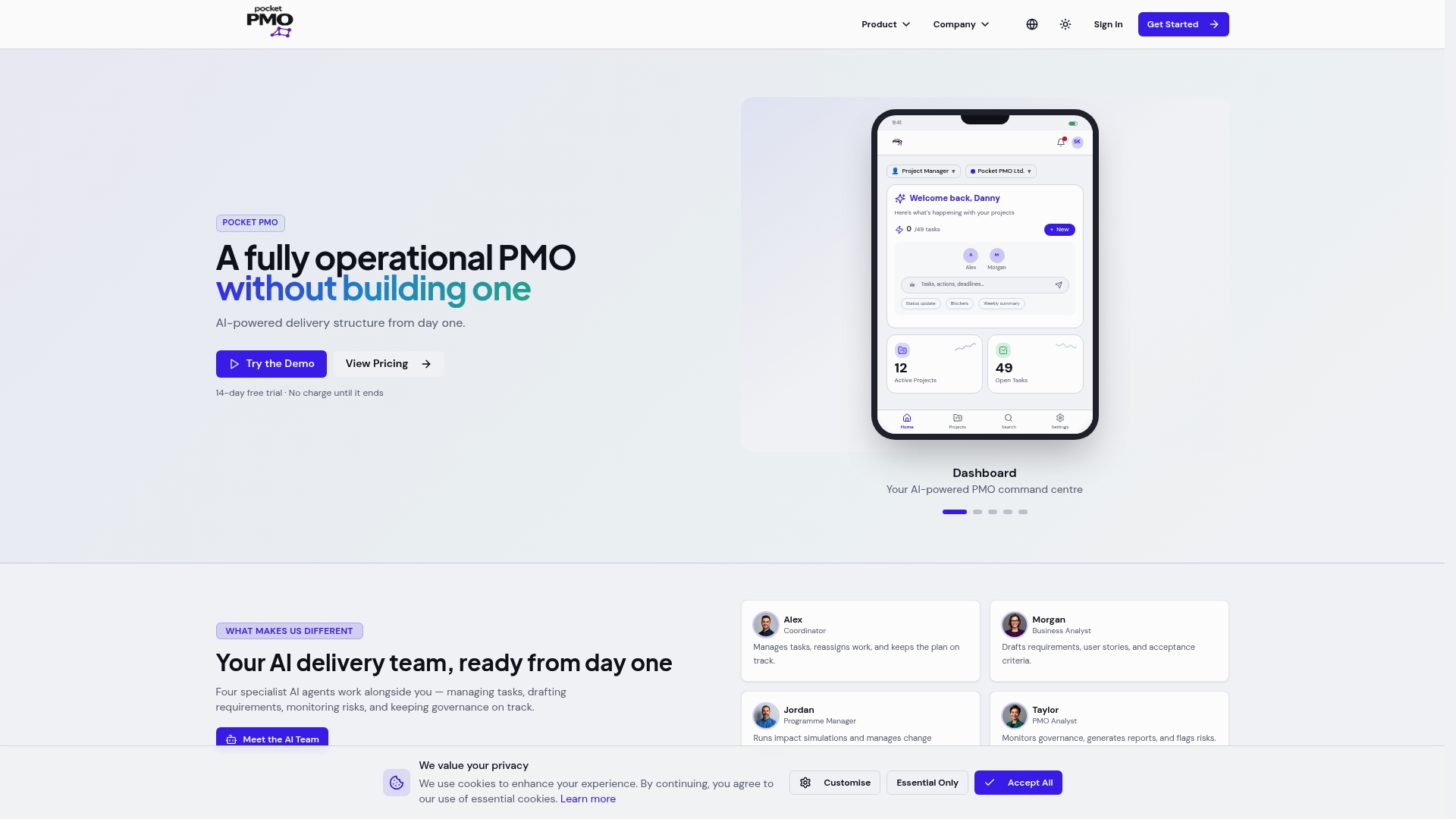
Pocket PMO is built to support exactly this. The platform integrates BA best practices directly into the project delivery workflow, so your teams capture requirements clearly, trace them to outcomes, and maintain visibility on value delivery without manual overhead.
Key features that support BA and PMO roles:
- Requirements capture and traceability: Link every requirement to a business objective and track its status through delivery
- AI-driven risk analysis: Surface risks tied to specific requirements or delivery milestones before they escalate
- Change request workflows: Manage scope changes with full audit trails and stakeholder sign-off
- Real-time dashboards: Give project managers and PMOs live visibility on progress against defined outcomes
- Agile collaboration tools: Support sprint planning, backlog management, and team communication in one place
You can launch your operational PMO and see how the platform supports your BA and PMO functions from day one. If you are evaluating options, compare Pocket PMO with Monday.com or review Pocket PMO against Microsoft Project to see where the AI-powered capabilities make the clearest difference for your team.
Frequently asked questions
What does a business analyst do in AI-powered project management?
A business analyst gathers and analyses data to identify business needs, defines requirements, and works with teams to deliver AI-driven solutions that improve operational efficiency and project visibility. Business analysts use data to develop insights and recommend organisational changes that enhance efficiency.
What skills should a business analyst develop to succeed in 2026?
Key skills include data analysis using SQL and Python, process modelling, foundational AI knowledge, communication, negotiation, change management, and business acumen. Excelling as a BA requires a combination of technical, strategic, and interpersonal capabilities, including working confidence with AI tools.
How do business analysts handle functional and non-functional requirements?
They distinguish and document functional requirements, which define what a system does, alongside non-functional requirements, which define how it performs. Functional and non-functional requirements are documented through artefacts such as user stories, use cases, and requirements traceability matrices.
Why is early planning important for business analysis?
Early BA planning prevents ad-hoc requirements gathering, reduces costly rework, and ensures AI-powered project management dashboards reflect accurate progress tied to genuine business value. BA planning before elicitation is vital to avoid drift and keep AI-driven project visibility trustworthy throughout delivery.