

PMO demand management strategies are systematic processes that regulate project requests, prioritise initiatives based on value and capacity, and govern execution to align with organisational goals. Without them, projects compete internally for the same resources, causing delays and eroding strategic momentum. The PMI framework and recognised best practices confirm that effective demand management combines intake, triage, capacity planning, prioritisation, and governance into a single, disciplined system. Each layer builds on the last, and full implementation typically takes about one year to reach advanced maturity.
What are the core PMO demand management strategies?
Demand management in a PMO is not a single process. It is a layered system where each component must stabilise before the next can function well. Each layer takes 2–3 months to bed in, which means rushing implementation produces fragile results.
The four core components are:
-
Intake and triage. A single intake system captures every project request in one place, eliminates duplication, and creates a clear queue for evaluation. Without it, requests arrive through informal channels and bypass governance entirely.
-
Capacity planning. Capacity models must forecast available hours by skill type, month by month, for at least 18 months. This horizon lets you spot overallocation peaks early and defer lower-priority work before commitments are made. Critically, plan for 70–80% of theoretical capacity to account for holidays, training, and natural workflow inefficiencies. That adjustment factor prevents chronic overloading and produces realistic delivery schedules.
-
Prioritisation frameworks. Score every initiative against weighted criteria: strategic alignment, ROI, risk, and resource fit. Scoring removes the politics from prioritisation and gives you a defensible rationale for every decision.
-
Governance and decision-making. Portfolio steering committees hold funding decisions and maintain discipline over demand flow. Without a formal governance layer, approved projects quietly expand and new requests bypass the queue.
Pro Tip: Build your intake form to capture skill requirements at submission, not after approval. This single change cuts triage time significantly and feeds directly into your capacity model.
How AI-powered demand forecasting improves PMO resource allocation

Traditional resource planning relies on human estimation, which works well for familiar project types but fails at scale. AI forecasting models, including time series analysis and regression techniques, surface patterns that manual planning misses entirely.
The most striking example is testing phases. AI identifies demand surges such as QA cycles that require triple the usual resources, weeks before the spike appears on a Gantt chart. That lead time is the difference between a managed ramp-up and an emergency hire.
AI forecasting also improves PMO credibility. When you can show sponsors a quantified uncertainty range rather than a single-point estimate, conversations shift from "can we do this?" to "what do we defer to make room?" That is a more productive dialogue. The role of AI in demand forecasting for PMO leaders is expanding rapidly, and the PMOs adopting it now are building a measurable advantage.
Practical steps for adopting AI forecasting alongside human judgement:
- Start with historical project data. Feed at least two years of actuals into your forecasting model before trusting its outputs.
- Run AI forecasts in parallel with manual estimates for one quarter. Compare the gaps and investigate the causes.
- Use AI outputs to flag anomalies, not to replace planner decisions. Human context still matters for new project types.
- Integrate forecast outputs into your capacity model so resource bottlenecks appear automatically in your planning dashboard.
- Review forecast accuracy monthly and retrain models when project mix changes significantly.
Service-fit resource models take this further. Matching demand type to specific competencies, for example assigning maintenance work to skilled support teams rather than innovation-focused staff, improves both throughput and staff satisfaction. AI can identify these mismatches at scale, which no manual process can replicate efficiently.
What are the best prioritisation and decision-making strategies?
Prioritisation fails when it is treated as a one-off exercise rather than a continuous governance function. The PMOs that manage demand well run scoring reviews at every portfolio steering committee meeting, not just at annual planning.
Key strategies for balancing demand and capacity:
- Use weighted scoring. Align criteria weights to your organisation's current strategic goals. A company in growth mode weights market opportunity heavily. One in cost-reduction mode weights ROI and payback period. Weights should change as strategy changes.
- Visualise trade-offs. Showing sponsors the impact of adding a new project, including which existing projects slip and by how much, shifts the conversation from resource requests to value-based decisions. Executives make better choices when the cost of "yes" is visible.
- Integrate with OKRs. Scoring initiatives by strategic alignment and ROI against your OKRs creates a closed loop between strategy and execution. Projects that do not map to a measurable outcome should not enter the queue.
- Establish a portfolio steering committee. This body holds the authority to approve, defer, or cancel projects. Without it, prioritisation decisions get made informally and inconsistently.
High utilisation rates do not equate to effectiveness. PMI-PMOCP guidance is clear: when service quality declines despite full team capacity, the problem is workflow friction, not resource shortage. The fix is to redesign assignments and processes, not add headcount.
This insight matters because most PMOs measure success by how busy their teams are. Busyness is not delivery. Reviewing throughput and outcome quality gives you a far more accurate picture of whether your capacity is being used well. For a deeper look at PMO governance decisions, the principles of consistent portfolio prioritisation apply directly here.
How to build a culture of continuous demand management improvement
Demand management processes decay without active maintenance. Quarterly pipeline resets and continuous monitoring prevent strategic drift and keep your portfolio aligned to current priorities rather than last year's plan.
The metrics that matter most are cycle time from request to approval, forecast accuracy versus actuals, and portfolio alignment score against OKRs. Track these monthly and share them with stakeholders. Transparency builds trust and surfaces problems before they become crises.
Stakeholder communication is where many PMOs underinvest. Project requestors who understand why their initiative was deferred are far more likely to resubmit with better information next time. A brief, structured feedback note after every triage decision costs little and pays back in submission quality over time.
Pro Tip: Run a quarterly "demand health" review with your steering committee. Present three metrics: intake volume, approval rate, and average time to decision. These three numbers tell you whether your process is working or accumulating backlog.
Phased implementation is the most reliable path to maturity. Start with intake and triage, stabilise for two to three months, then add capacity planning. Add prioritisation scoring next, and governance last. Trying to implement all layers simultaneously produces confusion and low adoption. The PMO project intake process is the right place to begin, because everything downstream depends on clean data entering the system.
Training matters more than most PMO leaders expect. Teams that understand the scoring criteria submit better requests. Sponsors who understand trade-off visualisation make faster decisions. Invest in a short onboarding session for every new stakeholder group, and repeat it annually as criteria evolve.
Key takeaways
Effective PMO demand management requires layered implementation across intake, capacity planning, prioritisation, and governance, with each component stabilising before the next is added.
| Point | Details |
|---|---|
| Layer your implementation | Each demand management component needs 2–3 months to stabilise before you build the next layer. |
| Plan for 70–80% capacity | Adjust theoretical capacity downward to account for holidays, training, and workflow inefficiencies. |
| AI forecasting adds precision | AI models surface demand surges and skill-specific peaks that manual planning consistently misses. |
| Visualise trade-offs | Showing sponsors the cost of adding a project shifts decisions from resource requests to value comparisons. |
| Continuous governance prevents drift | Quarterly pipeline resets and OKR-aligned scoring keep your portfolio aligned to current strategy. |
The uncomfortable truth about PMO demand management
I have worked with PMO leaders who have built technically sound demand management systems and still struggled. The intake form was clean, the scoring model was weighted correctly, and the steering committee met every fortnight. Yet projects still slipped, and teams still felt overloaded. The problem was never the process. It was the culture around it.
The most common failure mode I see is what I call "approval theatre." Requests go through the intake system, get scored, and receive formal approval, but then the real negotiation happens in the corridor. Senior stakeholders call in favours, priorities shift informally, and the governance layer becomes a bureaucratic formality rather than a genuine control mechanism. No scoring model survives that environment.
The fix is not a better spreadsheet. It is leadership commitment to the process, even when it produces uncomfortable answers. When a steering committee defers a director's pet project because capacity is genuinely full, and the decision holds, that is when demand management becomes real. That moment builds more credibility for the PMO than any dashboard ever will.
I also think the industry underestimates how much skill-fit matters in capacity planning. Assigning the right type of work to the right type of team is not a nice-to-have. It is the difference between a team that delivers consistently and one that burns out despite appearing fully utilised. Strategic alignment in PMO starts with honest conversations about what your teams are actually good at, not just what they are available for.
My honest advice: start smaller than you think you need to. One clean intake process, one honest capacity model, and one governance meeting that people actually respect will outperform a complex system that nobody trusts.
— Danny
How Pocketpmo supports your demand management process
Pocketpmo gives PMO leaders a fully operational AI-powered delivery environment without the overhead of building one from scratch. The platform's portfolio management features handle demand intake, prioritisation scoring, and capacity visibility in a single workspace.
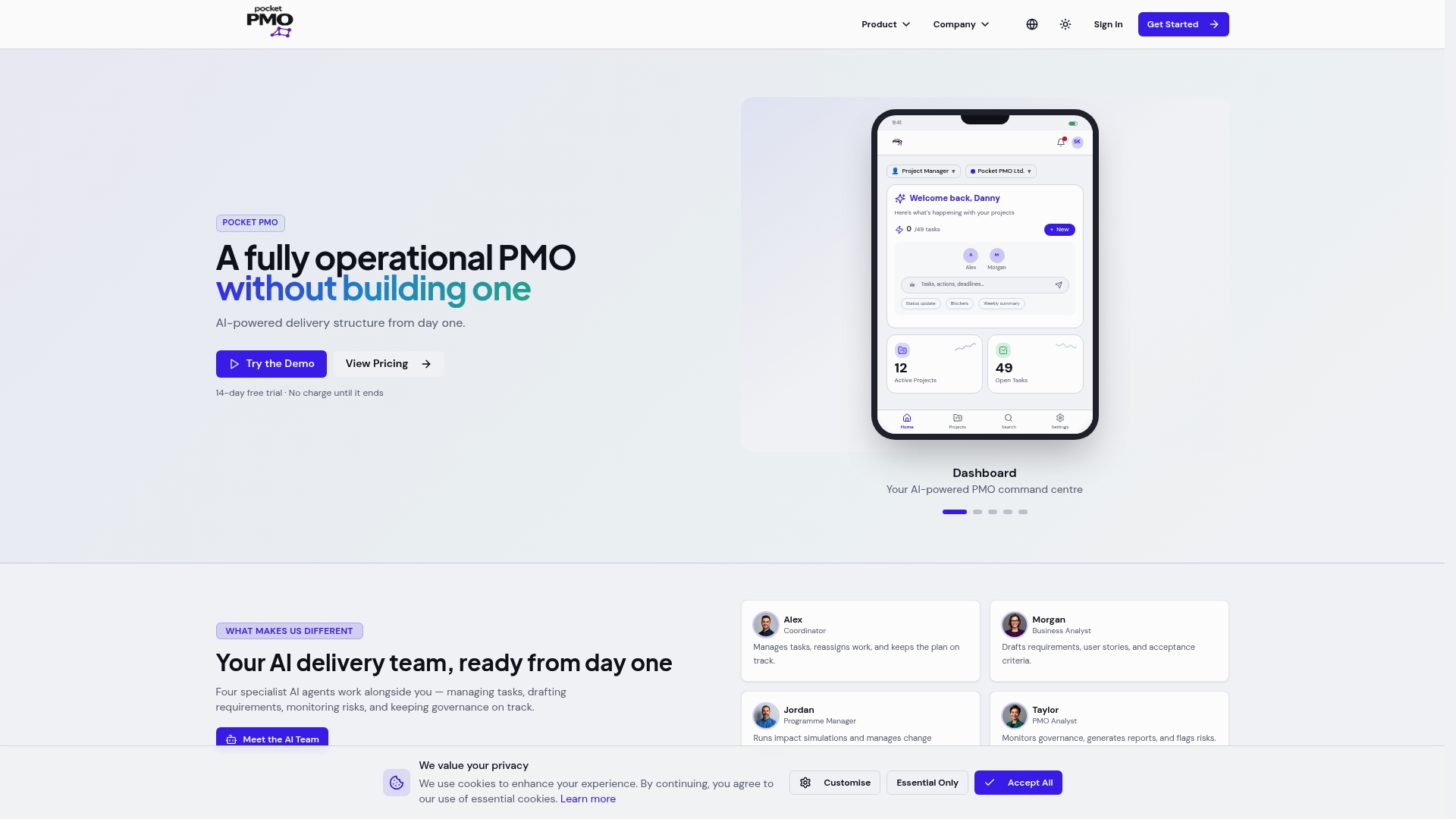
AI-driven risk analysis and predictive analytics surface the demand peaks and resource conflicts that traditional planning misses. Real-time dashboards give your steering committee the trade-off visibility they need to make faster, better-informed decisions. If you are comparing your options, the Pocketpmo features page shows exactly how the platform supports each layer of demand management, from intake through to governance. You can also see how it compares on portfolio prioritisation against other tools in the market.
FAQ
What is PMO demand management?
PMO demand management is the structured process of capturing, evaluating, prioritising, and governing project requests to align portfolio execution with organisational capacity and strategic goals.
How long does it take to implement a demand management system?
Full implementation across intake, capacity planning, prioritisation, and governance typically takes about one year to reach advanced maturity, with each layer requiring 2–3 months to stabilise.
What capacity percentage should a PMO plan for?
PMOs should plan for 70–80% of theoretical team capacity. This adjustment accounts for holidays, training, and natural workflow inefficiencies, producing realistic delivery schedules.
How does AI improve demand forecasting in a PMO?
AI forecasting models identify demand surges and skill-specific peaks, such as testing phases requiring triple QA resources, that manual planning consistently misses, improving both accuracy and planning lead time.
Why does high utilisation not mean high performance?
PMI-PMOCP guidance confirms that high utilisation combined with declining service quality signals workflow friction, not resource shortage. The solution is to redesign assignments and processes rather than increase workload.