

A PMO project intake process is a structured sequence of steps that captures, evaluates, prioritises, and approves project requests to align with strategic goals and resource capacity. Without it, projects enter the portfolio through informal channels, bypassing governance and consuming resources that should go elsewhere. The PMO intake framework described here covers six essential steps: standardised submission, initial triage, scoring, governance review, decision communication, and portfolio onboarding. Each step removes subjectivity, improves transparency, and ties every approved project to measurable organisational objectives.
What are the key PMO project intake process steps?
A well-run intake process treats every project request the same way, regardless of who submits it. The six steps below form the backbone of an effective PMO intake framework used by high-performing teams in 2026.
1. Standardised project submission
Every project request enters through a single intake form. This "front door" approach prevents informal submissions via email, hallway conversations, or direct executive requests. A single channel creates a fair, auditable record of all demand entering the portfolio. Without it, your prioritisation decisions are only as good as who shouts loudest.

The intake form captures the project name, business justification, scope, required resources, and known risks. These five fields give the PMO enough information to triage the request without asking for a full business case upfront.
2. Initial triage and classification
Once submitted, the PMO checks each request for completeness within 24–48 hours. Incomplete submissions are returned immediately with clear guidance on what is missing. This step prevents half-formed ideas from clogging the governance pipeline.
Triage also classifies the request by type: compliance, strategic initiative, or operational improvement. Classification matters because each type follows a different approval pathway and competes for different resource pools. A compliance project, for example, may bypass scoring and go straight to governance because it is non-discretionary.
Pro Tip: Create a short triage checklist with five yes/no questions. If any answer is "no," return the form before it moves forward. This saves governance committee time and sets clear expectations with requestors.
3. Scoring against a standardised rubric
Objective scoring is the most important step in the project selection process. A standardised scoring rubric evaluates each request across four dimensions: strategic alignment, business value, resource feasibility, and risk level. Each dimension is scored on a 1–5 scale. Projects that score below a 2.5 composite threshold are filtered out before they reach the governance committee.
That threshold matters. It removes the need for committee members to debate obviously weak proposals and focuses governance time on genuinely competitive requests. The rubric also creates a defensible, documented record of why a project was or was not advanced.
4. Governance review and decision-making
Governance is where the real decisions happen. A multi-tiered governance approach routes small, low-risk projects to departmental heads and cross-functional projects to a portfolio committee. This prevents bottlenecks and keeps the right people making the right calls.
The committee has three options: approve, defer, or reject. Deferral is not a soft rejection. It comes with documented conditions, such as "revisit when Q3 capacity is confirmed" or "resubmit with a revised resource plan." Rejection also requires written rationale. Governance without documentation is just opinion.
- Approve: Project moves to portfolio onboarding with an assigned owner.
- Defer: Project is held with specific revisit conditions recorded.
- Reject: Project is closed with written rationale returned to the requestor.
"Governance decisions must be more than a rubber stamp. Every outcome, whether approval, deferral, or rejection, requires a documented rationale that the requestor can act on."
5. Decision communication within five business days
Speed of feedback is a governance quality indicator. Written decisions must reach requestors within five business days of the governance review. That standard prevents the frustration that drives people to bypass the intake process entirely.
The communication should include the decision, the scoring outcome, and, where relevant, the conditions for resubmission. Requestors who receive clear, timely feedback are far more likely to engage constructively with the process next time. Closing the feedback loop builds trust in the PMO as a fair and transparent function.
6. Portfolio onboarding and OKR alignment
Approved projects do not simply appear in the portfolio. They are formally onboarded with an assigned project owner, a defined start date, and explicit links to the organisation's Objectives and Key Results (OKRs). Integrating intake with OKRs ensures every approved project supports a measurable strategic goal.
This step also triggers the creation of the project's RAID log, initial Gantt chart, and status reporting cadence. Onboarding is the handover point between the intake process and active project delivery. Getting it right sets the tone for everything that follows.
How to design an effective intake form and scoring rubric
The intake form is the first impression your process makes on requestors. A form that takes too long or asks the wrong questions will produce poor data or, worse, drive people to bypass the process altogether.
Effective intake forms take approximately 12 minutes to complete. That constraint forces the PMO to include only what is genuinely necessary. Longer forms produce rushed, low-quality responses that make scoring unreliable.
The five fields every intake form needs:
- Project name and sponsor: Identifies ownership from the outset.
- Business justification: A plain-English explanation of why this project matters now.
- Scope summary: What is included and, critically, what is not.
- Resource estimate: Headcount, budget, and duration at a high level.
- Known risks: Any constraints or dependencies the PMO should factor into scoring.
The scoring rubric should use a consistent 1–5 scale across all four dimensions. A score of 1 means the project fails that criterion entirely; a score of 5 means it excels. The composite score is the average across all four dimensions. Projects below 2.5 do not proceed to governance. That threshold is not arbitrary. It represents the minimum bar for a project to be worth committee time.
Pro Tip: Write your intake form for a busy executive with five minutes to spare. If a field requires specialist knowledge to answer, remove it or move it to a later stage in the process.
PMO playbooks written in plain English focus on justification, success metrics, and risk rather than jargon. That principle applies directly to intake form design.
How governance and decision-making fit into the project intake process
Governance is not a single committee meeting. It is a structured decision-making system that matches the scale of each decision to the right level of authority. A multi-tiered governance structure prevents two common failures: bottlenecks caused by routing everything to senior leadership, and weak decisions caused by routing complex projects to people without the authority to commit resources.
Good PMO governance at the intake stage delivers four specific outcomes:
- Consistency: Every project is evaluated using the same criteria.
- Accountability: Every decision is owned by a named individual or committee.
- Transparency: Every requestor receives a written outcome with rationale.
- Continuous improvement: Every deviation from the standard process is recorded.
The Process Deviations Log is a governance tool that most PMOs overlook. Tracking every deviation from the standard intake procedure, such as projects approved without a complete form or decisions made outside the governance window, gives leadership the data to identify systemic weaknesses. Reviewing deviations quarterly is the mechanism that turns individual failures into process improvements.
"Most intake failures arise from poor transparency on process deviations. Tracking these formally is the only way to identify and correct systemic issues before they undermine portfolio governance."
How to integrate project intake with strategic goals and portfolio management
Project intake is not just a filtering mechanism. It is the primary tool for translating organisational strategy into funded, resourced work. Every request that passes through intake should connect to a measurable objective.
| Intake pathway | Project type | Approval route | OKR link required? |
|---|---|---|---|
| Compliance | Regulatory or legal obligation | Direct to governance | No |
| Strategic initiative | Advances a key organisational goal | Full scoring and governance | Yes |
| Operational improvement | Efficiency or cost reduction | Departmental head | Yes |
| Innovation | New capability or market opportunity | Portfolio committee | Yes |
Publishing realistic capacity, such as the number of projects deliverable per quarter, manages demand before it reaches governance. Requestors who know the PMO can onboard six new projects in Q2 will self-select more carefully. That visibility prevents the overcommitment that causes delivery failures downstream.
Separate intake pathways for different project types also prevent compliance work from competing with strategic initiatives for the same governance slot. Each pathway has its own scoring weight and approval threshold, reflecting the different nature of the work.
Common pitfalls to avoid in the PMO project intake process
Even well-designed intake procedures fail when teams cut corners or lose discipline over time. The most damaging pitfalls are predictable and preventable.
- Bypassing the intake form: Informal submissions create an unauditable shadow portfolio. Enforce the single channel without exceptions.
- Overly complex forms: Complex intake forms produce incomplete submissions. Keep the form to 12 minutes and five core fields.
- Slow decision communication: Delays beyond five business days erode trust and encourage people to work around the process.
- Ignoring the Process Deviations Log: Without formal deviation tracking, the same governance failures repeat quarter after quarter.
- Treating intake as capacity planning only: Intake must assess strategic fit, not just resource availability. A project can be feasible and still be wrong for the portfolio.
- No feedback loop: Requestors who never learn why their project was rejected will not improve future submissions.
Pro Tip: Run a quarterly intake health check. Review your deviations log, measure average decision turnaround time, and survey requestors on form clarity. Three metrics, 30 minutes, and you will know exactly where the process is breaking down.
Key takeaways
A structured PMO intake process is the single most effective mechanism for aligning project demand with strategic capacity and governance accountability.
| Point | Details |
|---|---|
| Use a single intake channel | All project requests must enter through one standardised form to maintain fairness and auditability. |
| Score objectively with a rubric | Apply a 1–5 scale across four dimensions and filter out projects below a 2.5 composite score before governance. |
| Communicate decisions in five days | Return written outcomes with rationale within five business days to maintain stakeholder trust. |
| Link every project to OKRs | Approved projects must connect to measurable strategic objectives to prevent non-aligned work entering the portfolio. |
| Track and review deviations | Maintain a Process Deviations Log and review it quarterly to identify and fix systemic intake failures. |
Why the intake process is the PMO's most underrated tool
Most PMO professionals I speak with treat project intake as administrative overhead. They are wrong. The intake process is where portfolio strategy is either enforced or abandoned.
The single intake channel rule is the one I enforce most strictly. The moment a senior stakeholder bypasses the form because they "know the right people," the process loses credibility for everyone else. Fairness is not just a value. It is a functional requirement for a PMO that wants to be taken seriously.
Plain English documentation is equally non-negotiable. I have seen intake forms with 40 fields and drop-down menus that require a project management qualification to navigate. They produce terrible data and frustrated requestors. A form that a finance director can complete in 12 minutes, without help, is a form that gets completed honestly.
The Process Deviations Log is the tool most PMOs skip and then wonder why the same problems keep appearing. Quarterly leadership reviews of that log are not a bureaucratic exercise. They are the mechanism that turns a static process into one that actually improves. Pair that with a feedback loop that tells every requestor, approved or not, exactly what happened to their submission, and you have a process that earns trust over time.
The intake process is also where you protect your delivery teams from overcommitment. Publishing capacity transparently and linking every approval to an OKR forces the organisation to make real trade-offs rather than pretending everything is a priority. That is the PMO's most valuable contribution to the business.
— Danny
How Pocketpmo supports your project intake process
Pocketpmo gives PMO professionals a ready-built intake and governance framework without the months of setup that building one from scratch requires.
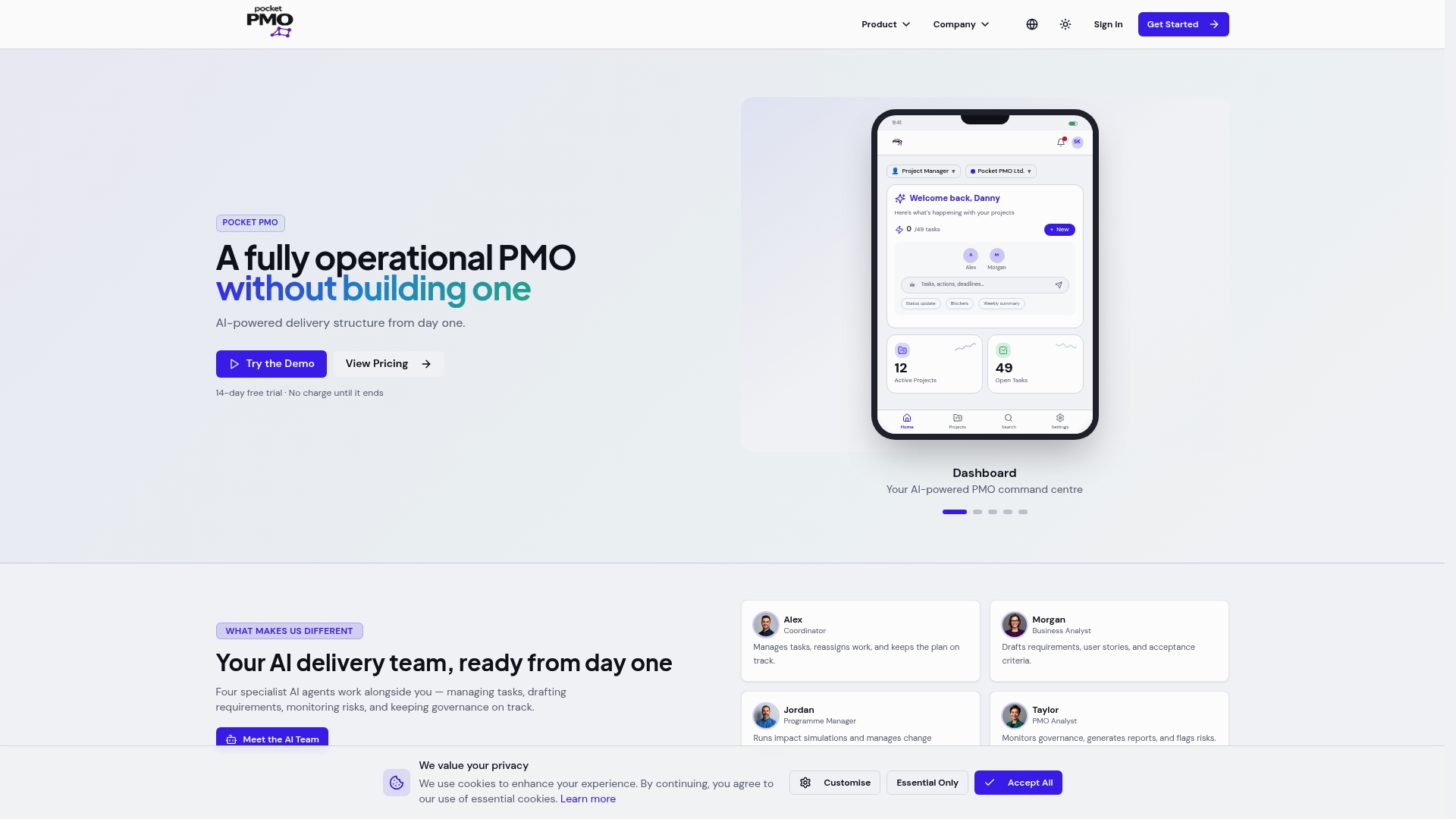
The platform includes customisable intake forms, automated scoring rubrics linked directly to your strategic objectives, and governance workflows that record every decision with full written rationale. Portfolio dashboards connect approved projects to assigned owners and OKRs from day one. If you want to see how Pocketpmo handles intake, scoring, and portfolio governance in a live environment, the platform is available to explore without a lengthy onboarding process. For teams comparing options, the Pocketpmo vs Microsoft Project page sets out exactly where the two approaches differ on intake and portfolio management.
FAQ
What is a PMO project intake process?
A PMO project intake process is a structured set of steps for capturing, evaluating, and approving project requests before they enter the active portfolio. It typically includes standardised submission, triage, scoring, governance review, decision communication, and portfolio onboarding.
How many steps are in a typical PMO intake process?
Most effective PMO intake frameworks use six steps: submission, triage, scoring, governance review, decision communication, and portfolio onboarding. Each step serves a distinct purpose in filtering and prioritising demand.
What scoring rubric should a PMO use for project intake?
A 1–5 scale rubric across four dimensions, strategic alignment, business value, resource feasibility, and risk level, is the standard approach. Projects scoring below 2.5 on the composite are filtered before governance review.
How long should a project intake form take to complete?
Intake forms should take approximately 12 minutes to complete. Longer forms produce lower-quality responses and discourage requestors from engaging with the process properly.
How quickly should the PMO communicate intake decisions?
Written decisions should reach requestors within five business days of the governance review. This standard maintains stakeholder trust and reduces the temptation to bypass the formal intake process.