

A project management office (PMO) is the organisational entity that defines, implements, and oversees project governance, ensuring synchronised execution across projects and portfolios. The three classical types of project management offices are Supportive, Controlling, and Directive PMOs, each representing a distinct level of authority and control. Beyond these, structural variants such as Departmental, Enterprise, and hybrid PMOs address different scales of organisational complexity. 89% of organisations now operate at least one PMO, and those that do deliver projects 2.5 times faster whilst wasting 38% less budget. Choosing the right model is not a technical formality. It is a governance decision with direct consequences for project outcomes.
1. The three classical types of project management offices
The PMO framework recognised by the PMBOK Guide classifies offices into three governance tiers: Supportive, Controlling, and Directive. Each tier reflects a different relationship between the PMO and the project teams it serves. Understanding these distinctions is the starting point for any governance decision.
Supportive PMO

A Supportive PMO operates as an internal consultancy. It provides templates, training, access to best practices, and lessons learned, but it does not enforce compliance. Project managers retain full autonomy. This model suits organisations with mature project cultures where teams already follow consistent practices and simply need a resource hub to draw from.
Controlling PMO
A Controlling PMO introduces moderate authority. It requires project managers to adopt specific methodologies, tools, and reporting formats. Compliance is monitored, and the PMO has the standing to intervene when standards are not met. This model works well in organisations managing 40 or more concurrent projects where resource conflicts and inconsistent reporting create governance risk.
Directive PMO
A Directive PMO takes direct ownership of projects. PMO-assigned project managers run delivery, and the office holds full accountability for outcomes. This model is most common in highly regulated industries and large enterprises. Roughly 32% of organisations operate Directive PMOs, reflecting the prevalence of sectors where consistency and compliance are non-negotiable.
Pro Tip: If your organisation is debating between Controlling and Directive models, audit your current project failure rate first. High failure rates caused by inconsistent execution point to Directive; failures caused by poor visibility point to Controlling.
2. PMO structures by organisational level and scope
Beyond governance style, PMOs are also classified by where they sit in the organisational hierarchy and how broad their remit is. These structural classifications determine reporting lines, budget authority, and portfolio scope.
| PMO structure | Scope | Reporting line | Typical authority |
|---|---|---|---|
| Individual/project PMO | Single project or programme | Project sponsor | Temporary, project-specific |
| Departmental PMO | Business unit or division | Division head | Moderate, unit-level standards |
| Enterprise PMO | Organisation-wide portfolio | C-suite or board | High, strategic alignment |
An Individual PMO is typically temporary, established to govern a single large programme and disbanded on completion. It provides dedicated oversight without creating permanent overhead. A Departmental PMO serves a defined business unit, such as IT or finance, and enforces standards within that division without influencing the wider organisation. The Enterprise PMO sits at the top of this hierarchy, overseeing the full project portfolio and reporting directly to senior leadership.
Enterprise PMOs rose from 29% prevalence in 2020 to 38% in 2024, reflecting growing demand for strategic portfolio visibility at board level. This shift signals that organisations are no longer treating the PMO as a back-office function. It is becoming a strategic governance instrument. For project managers, this means the Enterprise PMO increasingly shapes which projects get funded, prioritised, and resourced.
3. What is a project management office in hybrid form?
Hybrid PMOs blend elements of Supportive, Controlling, and Directive models to match the specific governance needs of different project types within the same organisation. Rather than applying a single governance style across all projects, a hybrid model calibrates authority to project risk, complexity, and strategic importance.
A technology firm might run a Supportive PMO for internal improvement initiatives whilst applying a Directive model to client-facing regulatory projects. This is not inconsistency. It is deliberate governance design. Hybrid PMO models combine coaching, controlling, and strategic portfolio alignment functions based on what each project cluster actually requires.
- Strategic PMOs actively shape project portfolios according to business strategy, not just project execution. They sit closest to the Directive model but focus on portfolio-level decisions rather than day-to-day delivery management.
- Community of practice PMOs prioritise knowledge sharing and capability building across project teams. They function like an advanced Supportive PMO, creating forums, shared libraries, and cross-project learning without enforcing compliance.
- Centre of excellence PMOs define and own the organisation's project management methodology, training standards, and tooling decisions. They combine elements of Controlling and Supportive models.
Modern PMOs are evaluated by value delivery to stakeholders rather than by compliance enforcement alone. This shift, codified in the PMBOK Guide 8th Edition, means that even Directive PMOs are expected to demonstrate measurable business outcomes, not just procedural adherence.
Pro Tip: Before labelling your PMO as "hybrid," map each project type in your portfolio to a governance need. If the mapping produces three or more distinct profiles, a hybrid model is justified. If it produces one, you are adding complexity without benefit.
4. How PMO models have evolved beyond fixed categories
PMO structures are not permanent. The most mature PMOs evolve their governance levels as project portfolios expand, and those that fail to adapt become irrelevant. This is one of the most underappreciated risks in PMO design. An organisation that establishes a Supportive PMO and never revisits the model as its project volume triples will find the office increasingly marginalised.
The PRINCE2 framework and the Project Management Formula both document this pattern. Organisations that select PMO models based on current complexity, governance needs, and maturity, then shift from Supportive to Controlling or Directive as those factors change, consistently outperform those that treat the initial choice as permanent.
Rigid, early imposition of a Directive PMO is equally problematic. Organisations that impose high-control models before project teams have the maturity to accept them generate resistance that undermines the PMO's authority. Gradual adoption, starting with Supportive or Controlling and building towards Directive, increases acceptance and long-term effectiveness. For leaders seeking PMO best practices aligned to AI-driven delivery, the principle of phased governance adoption applies directly.
5. How to choose the right PMO type for your organisation
Matching a PMO model to your organisation requires an honest assessment of four factors: project portfolio size, project interdependence, organisational culture, and governance maturity. The table below maps common organisational scenarios to appropriate PMO types.
| Organisational scenario | Recommended PMO type |
|---|---|
| 5 to 10 independent projects, mature PM culture | Supportive PMO |
| 40+ projects with shared resources and reporting gaps | Controlling PMO |
| Regulated industry or primary project focus | Directive PMO |
| Mixed portfolio with varying risk profiles | Hybrid PMO |
| Organisation-wide strategic alignment needed | Enterprise PMO |
Supportive PMOs suit organisations with 5 to 10 independent projects. Controlling PMOs are appropriate when 40 or more projects compete for shared resources. Complexity drives the governance level required, and that relationship is direct, not approximate.
Organisational culture matters as much as portfolio size. A highly autonomous engineering culture will resist a Directive PMO regardless of project volume. In those contexts, a Controlling model with clear escalation paths often achieves better compliance than a Directive model that triggers political resistance. The goal is governance that actually functions, not governance that looks correct on paper.
For organisations at an early maturity stage, the most practical starting point is a Controlling PMO with a defined pathway to Directive. This gives project teams enough structure to build consistent habits whilst preserving the flexibility to adapt. You can explore scaling PMO structures as your portfolio grows for detailed transition guidance.
Key takeaways
The right type of project management office is determined by portfolio complexity, organisational maturity, and governance culture, not by convention or industry default.
| Point | Details |
|---|---|
| Three classical PMO types | Supportive, Controlling, and Directive PMOs represent low, moderate, and high governance control respectively. |
| Structural scope matters | Individual, Departmental, and Enterprise PMOs differ in reporting lines, authority, and portfolio breadth. |
| Hybrid models are deliberate | Blending PMO types across project clusters is a governance strategy, not a compromise. |
| PMOs must evolve | A PMO that does not adapt its governance level as project volume grows will lose relevance and authority. |
| Choose by complexity | Portfolio size and project interdependence are the primary drivers for selecting your PMO governance model. |
Why I think most organisations get their PMO choice wrong
Most organisations I have observed pick a PMO type based on what a peer organisation is running, or what a consultant recommended three years ago. That is the wrong starting point. The right question is not "what type of PMO do successful organisations use?" It is "what governance problem are we actually trying to solve right now?"
I have seen Directive PMOs imposed on organisations with fewer than 20 projects and watched the resulting resistance consume more management time than the projects themselves. Conversely, I have seen Supportive PMOs persist in organisations running 80-project portfolios, providing templates whilst delivery chaos continued unchecked. Both failures share the same root cause: the PMO type was chosen without reference to the actual governance gap.
The most effective PMOs I have encountered treat their model as a working hypothesis, not a fixed structure. They review governance fit annually, track whether the PMO is reducing delivery risk or simply adding process, and adjust accordingly. Technology platforms that provide real-time portfolio visibility make this kind of adaptive governance far more practical than it was five years ago. The PMO's role in governance is not to enforce a model. It is to make projects succeed.
— Danny
Get a fully operational PMO without building one from scratch
If you have identified the right PMO type for your organisation but lack the infrastructure to implement it, Pocketpmo delivers a ready-to-use AI-powered PMO from day one.
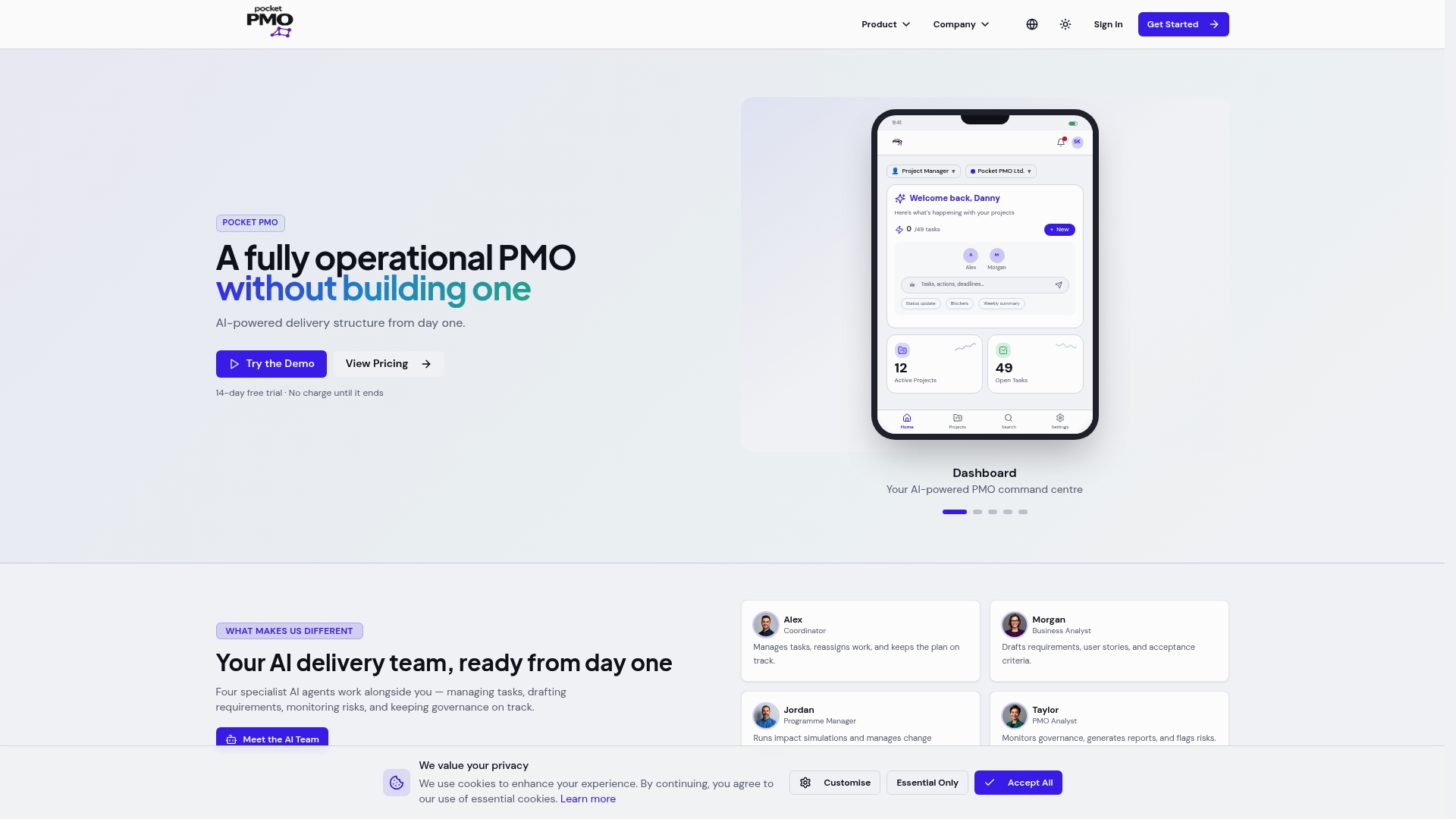
Pocketpmo supports Supportive, Controlling, and Directive PMO functions through real-time dashboards, AI-driven risk analysis, change request workflows, and portfolio management tools. You do not need to build governance infrastructure from scratch. The platform adapts to your current maturity level and scales as your project portfolio grows. Whether you are managing 10 projects or 100, Pocketpmo's PMO platform gives you the visibility and control your governance model requires, without the setup overhead of a traditional PMO build.
FAQ
What are the main types of PMOs?
The three classical types are Supportive, Controlling, and Directive PMOs, each representing a different level of governance authority. Structural variants including Departmental, Enterprise, and hybrid PMOs extend this classification by organisational scope.
How do I know which PMO type my organisation needs?
Assess your portfolio size and project interdependence first. Organisations with 5 to 10 independent projects suit a Supportive PMO; those managing 40 or more projects with shared resources typically require a Controlling or Directive model.
What is an Enterprise PMO?
An Enterprise PMO oversees the full organisational project portfolio and reports directly to C-suite leadership. Its prevalence grew from 29% in 2020 to 38% in 2024, reflecting increased demand for strategic portfolio governance.
Can a PMO change its type over time?
Yes, and it should. PMO structures must evolve as project portfolios expand and organisational maturity increases. Failure to adapt governance levels as complexity grows is a primary cause of PMO irrelevance.
What is a hybrid PMO?
A hybrid PMO combines elements of Supportive, Controlling, and Directive models, applying different governance levels to different project types within the same organisation. It is most effective when a portfolio contains projects with significantly different risk and complexity profiles.