

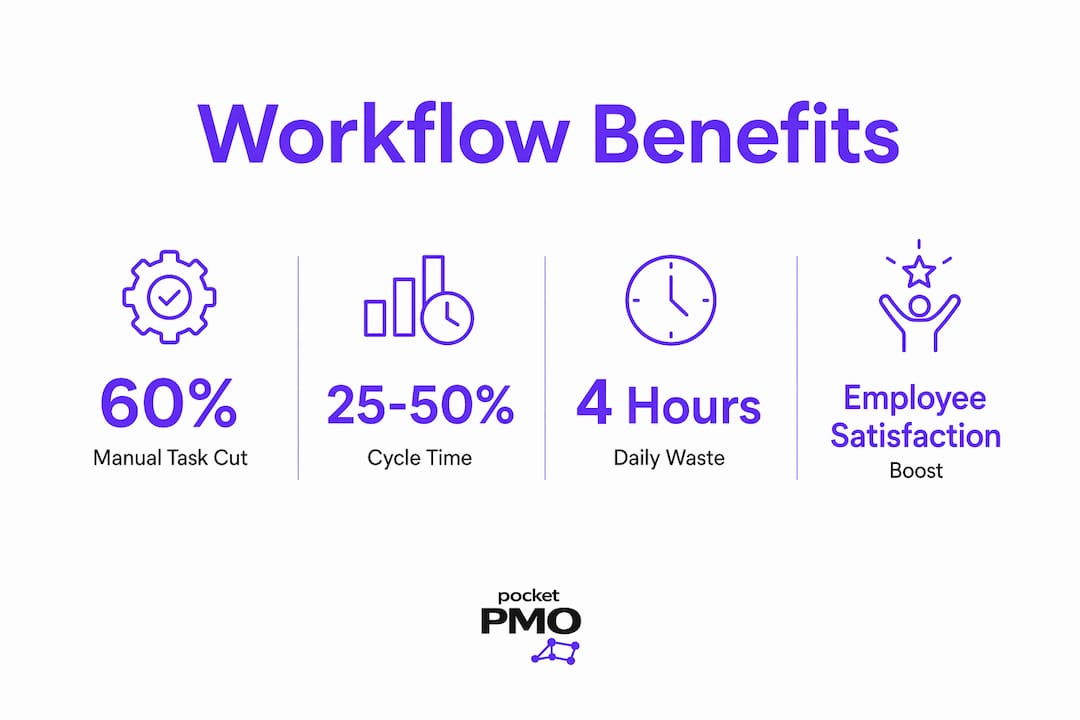
Efficient project workflows are defined as structured sequences of tasks, approvals, and handoffs that eliminate waste, reduce delays, and direct team effort towards outcomes that matter. Understanding why efficient project workflows determine project success is no longer optional for professionals managing complex delivery environments. Structured workflow automation can reduce administrative time by 30%, cut cycle times by 25–50%, and save up to 30% in costs. These are not marginal gains. They represent the difference between a project that delivers value and one that consumes resource without return.
What are the measurable benefits of efficient project workflows?
The business case for workflow efficiency is grounded in hard numbers. Workers without optimised workflows waste up to 40% of their day on non-value-adding activities. That figure represents nearly half a working day lost to tasks that contribute nothing to project outcomes.
Automation addresses this directly. Workflow automation platforms can reduce repetitive manual tasks by 60–95%, freeing teams to focus on decisions that require human judgement. By 2026, 30% of enterprises are expected to automate more than half of their operations. That shift reflects a broad recognition that manual process management cannot scale with project complexity.
The financial returns are equally compelling:
- Cycle time reductions of 25–50% across project phases
- Administrative time savings of 30%, releasing capacity for strategic work
- Cost savings of up to 30% through process automation
- Error reduction from eliminating manual data entry and inconsistent handoffs
- ROI within 12 months for nearly 60% of businesses implementing automation
Beyond cost and speed, workflow efficiency directly affects employee satisfaction. Teams freed from repetitive, low-value tasks report higher engagement and lower burnout rates. That matters for retention, and it matters for the quality of work produced under pressure.
Pro Tip: Before investing in automation tools, map your current workflow manually. You will almost certainly find that 20–30% of steps can be eliminated entirely before any technology is introduced.
How do efficient workflows improve resource allocation and delivery?
Resource allocation is where workflow efficiency produces its most visible impact. The goal is not to keep every team member at 100% utilisation. True project efficiency requires maintaining slack to absorb unforeseen risks and variability. A team running at full capacity has no buffer when a dependency slips or a stakeholder request arrives unexpectedly.

Workflow visibility tools solve this by giving project managers a real-time picture of capacity against demand. Without that visibility, managers default to reactive firefighting, shifting resource from one crisis to the next rather than preventing problems upstream. Workflow efficiency, used correctly, functions as a command centre for proactive decision-making rather than a record of what already went wrong.
There is also a distinction worth understanding between two related but separate concepts:
- Project efficiency focuses on internal processes: how economically inputs are converted to outputs within the project team.
- Delivery efficiency centres on customer impact: whether the project produces outcomes that the end user values.
Both must be balanced for genuine project success. A team can run an internally efficient process that delivers the wrong thing on time. Equally, a team can produce a product users love while haemorrhaging budget and missing every milestone. The most effective project workflow strategies address both dimensions simultaneously.
Practical resource optimisation through workflow design includes:
- Matching team capacity to demand with deliberate slack built in
- Using real-time dashboards to identify bottlenecks before they become blockers
- Assigning tasks based on skill fit rather than availability alone
- Reviewing resource allocation at regular intervals rather than only at project gates
Pro Tip: If your team is consistently at 100% utilisation, you are not running efficiently. You are running at risk. Build 15–20% slack into resource plans to absorb the variability that every project encounters.
What strategies help to improve project workflows effectively?
Improving project workflows follows a logical sequence. The starting point is always mapping what currently exists. You cannot identify waste in a process you have not documented. Once the current state is visible, four levers drive improvement.
- Elimination — Remove steps that add no value. Approval chains, status meetings, and reporting cycles are common candidates. Ask whether each step changes a decision or outcome. If not, remove it.
- Synchronisation — Align dependent activities so handoffs happen without delay. Misaligned sequencing is one of the most common causes of cycle time inflation.
- Standardisation — Replace ad hoc approaches with repeatable templates and defined processes. Consistency reduces errors and speeds onboarding for new team members.
- Automation — Apply technology to standardised, high-volume tasks. Automated workflows ensure every step happens identically every time, reducing risk and improving compliance.
This four-lever framework, drawn from established process improvement practice, applies equally to software delivery, infrastructure projects, and professional services engagements. The sequence matters. Automating a broken process makes it break faster. Eliminate and standardise first.
| Lever | Primary benefit | Common application |
|---|---|---|
| Elimination | Reduces wasted effort | Approval chains, redundant reporting |
| Synchronisation | Cuts handoff delays | Dependency mapping, sprint planning |
| Standardisation | Reduces errors | Templates, defined workflows |
| Automation | Scales capacity | Status updates, data entry, notifications |
Workflow optimisation is not a one-time project. Treating it as an evolving system with regular retrospectives is what sustains the gains. Teams that review their processes quarterly consistently outperform those that treat optimisation as a completed task. Retrospectives surface friction points that metrics alone do not capture, particularly around team communication and cross-functional handoffs.
Explore the types of project management workflows to identify which model fits your delivery environment before selecting your tools.
Adaptive vs traditional workflows: why does the difference matter?
The evidence against rigid, plan-driven project management is stark. Fewer than 1% of major capital projects meet all original deadlines and deliver their promised value under traditional rigid planning models. That figure, from BCG research on large capital projects, reflects a structural failure in how complex work is managed when plans are treated as fixed rather than as living documents.
Adaptive delivery models address this by building flexibility into the workflow itself. Key features of adaptive workflows include:
- Modular design — Breaking work into smaller, independently deliverable components that reduce the cost of change
- Cross-functional teams — Placing all necessary skills within a single team to eliminate inter-departmental handoff delays
- Continuous value delivery — Releasing outcomes incrementally rather than waiting for a single final delivery
- Dynamic governance — Adjusting oversight and decision-making processes as the project evolves rather than following a fixed governance calendar
Adaptive delivery methods improve speed, transparency, autonomy, and trust across project teams. These are not soft benefits. Transparency reduces the political friction that slows decisions. Autonomy increases the speed at which teams respond to change. Trust reduces the overhead of excessive reporting and approval cycles.
AI augmentation adds a further dimension. AI-assisted workflows can flag risks before they materialise, recommend resource reallocation based on project data, and generate status reports automatically. For project managers overseeing multiple concurrent workstreams, that capability shifts the role from data gatherer to decision-maker. Read more about adaptive project management in 2026 to understand how these models are being applied across industries.
Key takeaways
Efficient project workflows are the single most reliable lever for improving both project speed and delivery quality across complex environments.
| Point | Details |
|---|---|
| Automation delivers measurable returns | Workflow automation reduces manual tasks by 60–95% and delivers ROI within 12 months for nearly 60% of businesses. |
| Slack is a feature, not a flaw | Maintaining 15–20% resource slack prevents project stalls and protects team performance under pressure. |
| Use the four-lever framework | Eliminate, synchronise, standardise, and automate in sequence to avoid embedding inefficiency into automated processes. |
| Adaptive models outperform rigid plans | Fewer than 1% of major projects succeed under traditional rigid planning; modular, adaptive workflows change that outcome. |
| Optimisation is continuous | Regular retrospectives sustain workflow gains; treating efficiency as a completed project causes regression. |
My view on workflow efficiency in 2026
Working across project environments over many years, I have noticed one consistent pattern. The teams that struggle most are rarely under-resourced. They are under-organised. Their workflows have grown organically, accumulating steps, approvals, and meetings that once served a purpose but now exist purely out of habit.
The instinct when projects fall behind is to add more process, more governance, more reporting. That instinct is almost always wrong. The right response is to strip the workflow back, identify where time is genuinely being consumed, and remove the friction before adding anything new.
What I find most encouraging about the direction of project management in 2026 is the shift towards adaptive, AI-assisted delivery. Not because AI replaces professional judgement, but because it handles the data-gathering and pattern-recognition tasks that consume disproportionate time. When a platform can flag a risk trend before it becomes a blocker, the project manager can focus on the response rather than the detection.
The one caution I would offer is this: workflow efficiency is not a technology problem. It is a management discipline. The best tools in the world will not compensate for a team that has not agreed on how work flows between them. Start with the process. Then choose the technology that supports it.
— Danny
How Pocketpmo supports efficient project workflows from day one
Pocketpmo delivers an AI-powered PMO without the overhead of building one internally. If you are looking to put the strategies in this article into practice, Pocketpmo gives you real-time dashboards, intelligent automation, and predictive risk analysis across your entire project portfolio from the moment you start.
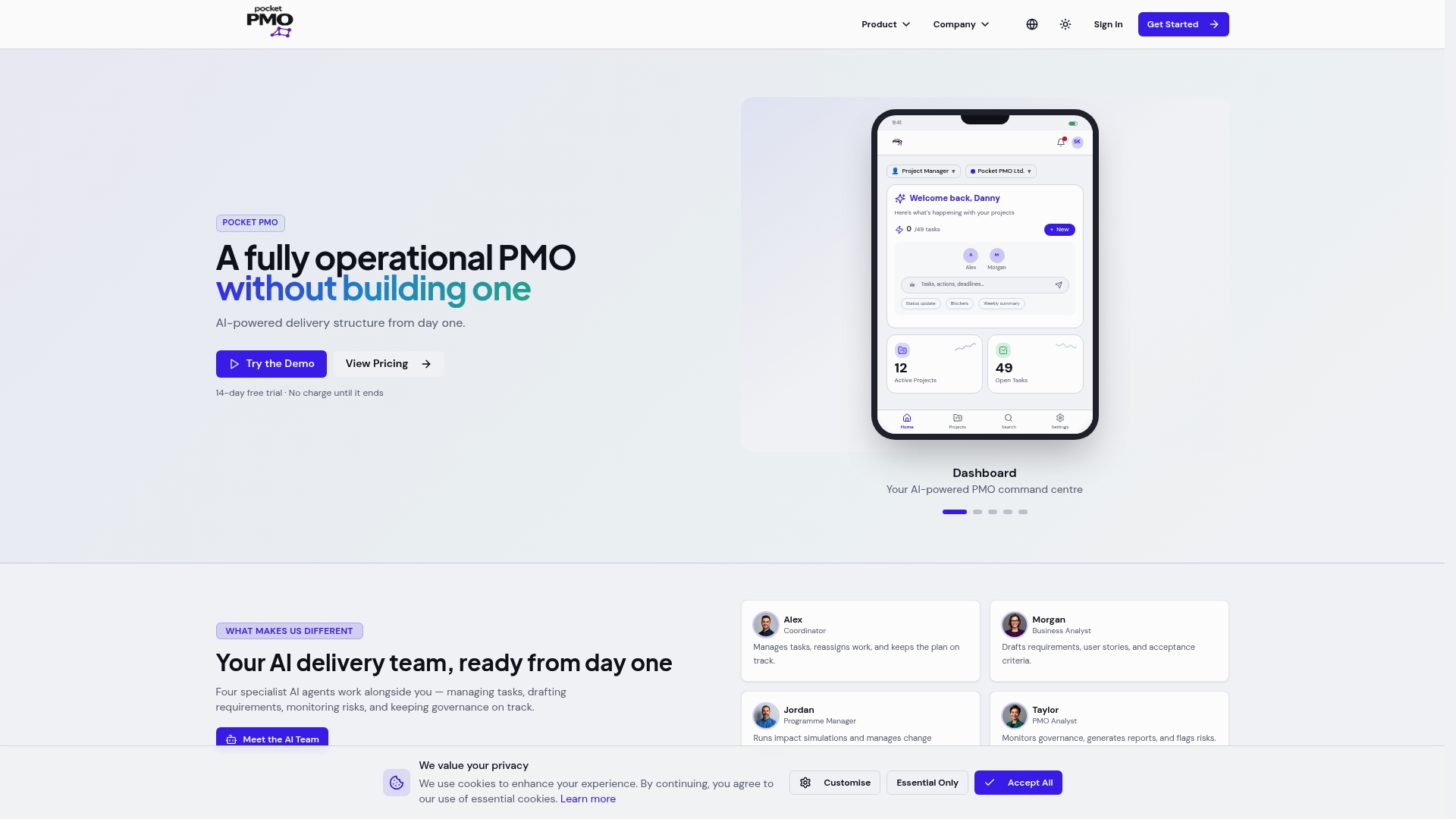
The platform handles status reporting, change request workflows, RAID management, and resource visibility automatically. That means your team spends time on delivery, not administration. See how Pocketpmo compares to traditional tools in the Pocketpmo vs Monday.com comparison, or explore the full AI-powered PMO platform to understand what an efficient workflow looks like when it is built in from the start.
FAQ
What is an efficient project workflow?
An efficient project workflow is a structured sequence of tasks and handoffs that eliminates waste, reduces delays, and directs team effort towards defined project outcomes. It combines clear process design with appropriate automation to maximise output relative to resource invested.
How much time can workflow automation save?
Structured workflow automation reduces administrative time by 30% and cycle times by 25–50%. Automation also cuts repetitive manual tasks by 60–95%, releasing significant capacity for higher-value work.
Why do rigid project plans fail so often?
Fewer than 1% of major capital projects meet all original deadlines under traditional rigid planning. Rigid plans cannot absorb the variability inherent in complex projects, making adaptive, modular delivery models significantly more reliable.
What is the difference between project efficiency and delivery efficiency?
Project efficiency measures how economically a team converts inputs to outputs internally. Delivery efficiency measures the value and quality of outcomes from the customer's perspective. Both must be managed together for a project to be considered genuinely successful.
How do I start improving my team's project workflows?
Begin by mapping your current workflow in full, then apply the four-lever framework: eliminate non-value-adding steps, synchronise dependent activities, standardise repeatable processes, and automate high-volume tasks. Review the results through regular retrospectives to sustain improvement over time.