

Project management methodologies are structured frameworks that guide how teams plan, execute, and deliver projects efficiently. Choosing the wrong one costs real money. Organisations with standard PM practices waste 28 times less on failed projects, yet only 58% of teams fully understand the frameworks they use. The types of project management methodologies available today range from rigid sequential models like Waterfall to flexible iterative ones like Scrum and Kanban, with hybrid blends increasingly dominating real-world delivery. This guide cuts through the noise and tells you exactly which method fits which situation.
What are the main types of project management methodologies?
Every project management framework belongs to one of three families: Predictive, Adaptive, or Hybrid. Understanding these families is the fastest way to narrow your options before comparing individual methods.
Predictive methodologies define the full scope, schedule, and budget before work begins. Waterfall is the defining example. These suit projects with stable, well-understood requirements, such as construction, manufacturing, or regulatory compliance work. Predictive methods like Waterfall are used by 43.9% of organisations for projects with fixed scope and clear requirements.

Adaptive methodologies embrace change. Scrum, Kanban, and other Agile frameworks fall here. Teams work in short cycles, review progress frequently, and adjust course based on feedback. Agile methods are preferred when requirements evolve frequently, which is why they dominate software development and product teams.
Hybrid methodologies combine elements from both families. A team might use PRINCE2 for governance and reporting while running Scrum sprints for daily delivery. Hybrid approaches are now the dominant reality, combining structured governance with iterative execution. Mature organisations use predictive models for oversight and adaptive ones for day-to-day work.
- Predictive: best for fixed scope, regulated industries, and sequential dependencies
- Adaptive: best for evolving requirements, fast-moving markets, and cross-functional teams
- Hybrid: best for complex programmes needing both governance and flexibility
Pro Tip: If your project has a fixed budget and a regulatory sign-off requirement but the technical solution is still unclear, a hybrid model is almost certainly your best starting point.
1. Waterfall
Waterfall is a sequential, phase-gated methodology where each stage must be completed before the next begins. Phases typically run in this order: requirements, design, build, test, deploy. There is no going back to a previous phase without significant cost and rescheduling.
Waterfall works best when requirements are fully defined at the outset and change is unlikely. Construction projects, hardware manufacturing, and government contracts are classic fits. Waterfall remains at 76% adoption in construction and regulated industries, which reflects how well it suits environments where deviation from plan carries legal or safety consequences.
The main risk is that defects or requirement gaps discovered late in the process are expensive to fix. Teams that choose Waterfall must invest heavily in upfront requirements gathering to avoid costly rework downstream.
2. Scrum
Scrum is the most widely used Agile framework. It organises work into fixed-length iterations called sprints, typically lasting two weeks. Each sprint produces a working increment of the product. Three core roles define Scrum: the Product Owner, the Scrum Master, and the development team.
Scrum is used by 87% of Agile teams, making it the dominant choice in software development. Agile projects overall report a 75.4% success rate. That performance record explains why Scrum has spread beyond software into marketing, finance, and operations teams.
Scrum requires genuine commitment to its ceremonies: sprint planning, daily stand-ups, sprint reviews, and retrospectives. Teams that skip ceremonies or ignore the Product Owner's prioritisation quickly lose the benefits. Scrum is not a good fit for teams with highly interdependent tasks that cannot be broken into two-week increments.
3. Kanban
Kanban is a flow-based methodology that visualises work on a board and limits the number of tasks in progress at any one time. Unlike Scrum, Kanban has no sprints or fixed roles. Work items move through columns (typically To Do, In Progress, Done) as capacity allows.
Kanban is used by 56% of Agile teams, making it the second most popular Agile method after Scrum. Its strength is reducing bottlenecks. By capping work-in-progress limits, teams are forced to finish tasks before starting new ones, which cuts context-switching and improves throughput.
Kanban suits support teams, maintenance work, and any environment where requests arrive continuously rather than in planned batches. A simple Kanban board can outperform a complex Scrum implementation if the team actually uses it consistently.
Pro Tip: Start with a three-column Kanban board and a work-in-progress limit of two items per person. Add complexity only when you have evidence that the simple version is insufficient.
4. PRINCE2
PRINCE2 (Projects IN Controlled Environments) is a process-based governance framework widely used in the UK public sector, financial services, and large enterprise programmes. It defines seven principles, seven themes, and seven processes that structure every stage of project delivery.
PRINCE2 is not an execution methodology in the same way Scrum or Kanban is. It is a governance layer. It tells you who is accountable, how decisions are escalated, and how projects are formally initiated and closed. Teams often combine PRINCE2 governance with Agile execution methods, a combination formally recognised as PRINCE2 Agile.
The framework suits organisations that need clear audit trails, defined roles, and formal stage-gate approvals. It is less suited to small teams or projects where the overhead of documentation and governance would outweigh the benefit.
5. SAFe (Scaled Agile Framework)
SAFe is designed for large organisations that need to coordinate multiple Agile teams working on the same product or programme. It adds layers of planning above the team level, including the Programme Increment (PI) planning event, which aligns all teams to a shared 10-week delivery cadence.
SAFe suits enterprises with 50 or more people working across interdependent workstreams. It is common in financial services, defence, and large technology companies. The trade-off is complexity. SAFe requires significant investment in training and facilitation to run effectively.
Teams considering SAFe should first ask whether their coordination problems genuinely require a scaled framework or whether better communication practices would solve the same issues at lower cost.
6. Lean project management
Lean project management applies the principles of the Toyota Production System to knowledge work. The core goal is to eliminate waste, defined as any activity that consumes resources without adding value to the customer. The five Lean principles are: define value, map the value stream, create flow, establish pull, and pursue perfection.
Lean is not a prescriptive methodology with fixed roles and ceremonies. It is a thinking system. Teams use tools like value stream mapping and root cause analysis to identify and remove inefficiencies. Lean pairs well with Kanban, which is itself a Lean tool.
Manufacturing, logistics, and healthcare operations have used Lean for decades. Software teams increasingly apply Lean thinking to reduce handoff delays, unnecessary meetings, and rework cycles.
7. Scrumban
Scrumban is a hybrid methodology that blends Scrum's structure with Kanban's flow-based approach. Teams retain Scrum's sprint cadence and planning events but add Kanban's work-in-progress limits and continuous flow principles. It emerged as a transition path for Scrum teams that needed more flexibility.
Scrumban suits teams that find pure Scrum too rigid but need more structure than Kanban provides. It is particularly effective for product teams managing both planned feature development and unplanned support requests simultaneously.
The hybrid nature of Scrumban reflects a broader trend. Hybrid project management approaches increased from 20% in 2020 to 31% in 2023, showing that practitioners are moving away from pure-play methodologies towards pragmatic blends.
8. Hybrid Waterfall-Agile (Water-Scrum-Fall)
Water-Scrum-Fall is an informal but widely practised hybrid where teams use Waterfall for upfront planning and final deployment, and Scrum for the development phase in the middle. The name reflects the reality of many enterprise projects: fixed budgets and regulatory requirements demand Waterfall discipline at the boundaries, but development teams need Agile flexibility in the middle.
This approach is common in financial services and healthcare IT, where procurement and compliance processes are sequential but software development benefits from iteration. The risk is that the Waterfall phases constrain the Agile middle, particularly if requirements are locked too early.
| Methodology | Best for | Key risk |
|---|---|---|
| Waterfall | Fixed scope, regulated projects | Late-stage defect discovery |
| Scrum | Evolving software products | Ceremony overhead if poorly run |
| Kanban | Continuous flow, support work | Lack of cadence for planning |
| PRINCE2 | Governance-heavy programmes | Documentation overhead |
| Scrumban | Mixed planned and unplanned work | Inconsistent application |
| Water-Scrum-Fall | Enterprise IT with compliance needs | Requirements locked too early |
9. OKRs as a goal-setting overlay
OKRs (Objectives and Key Results) are not a project management methodology in the traditional sense. They are a goal-setting framework used by organisations including Google and Intel to align teams around measurable outcomes. OKRs sit above execution methodologies rather than replacing them.
A team might run Scrum sprints to deliver features while using OKRs to track whether those features are actually moving the business metric they care about. This combination addresses a common failure mode: teams deliver on time and on budget but the project does not produce the intended business outcome.
OKRs work best when paired with an execution methodology that has clear delivery cadences, such as Scrum or SAFe, so that OKR progress can be reviewed at regular intervals.
10. How to choose the right project management methodology
Methodology selection should match work type and requirement predictability rather than industry trends. The following diagnostic questions narrow the choice quickly.
- Are your requirements stable or likely to change? Well-defined, stable requirements point to Waterfall or PRINCE2. Frequently changing requirements point to Scrum, Kanban, or a hybrid.
- How large is your team and how interdependent is the work? Small, co-located teams suit Scrum or Kanban. Large, distributed programmes with multiple teams need SAFe or a hybrid governance model.
- Does your industry require formal audit trails and stage-gate approvals? If yes, PRINCE2 or a Waterfall-based hybrid is likely necessary.
- What is your team's current experience level? Introducing new methodologies carries hidden costs including training, tooling, and temporary productivity losses. Teams often succeed by refining what they already know rather than switching frameworks entirely.
- What does success look like? If success means delivering a defined output, Waterfall suits. If success means achieving a business outcome through iteration, Agile or a hybrid is the better fit.
Experts advise choosing methodology strictly based on work type, team size, and requirement predictability. Incorrect assumptions about Scrum's universal applicability in software projects are one of the most common pitfalls. Use the decision-making framework that matches your project's actual constraints, not the one your industry currently favours.
Pro Tip: Run a two-week pilot of your chosen methodology on a low-stakes internal project before committing to it on a client-facing or high-budget delivery.
Key takeaways
The most effective project management methodology is the one your team actually follows with discipline, not the one that is theoretically perfect for your industry.
| Point | Details |
|---|---|
| Three methodology families | Every framework is Predictive, Adaptive, or Hybrid. Match the family to your requirements stability first. |
| Hybrid approaches dominate | Hybrid adoption rose from 20% to 31% between 2020 and 2023. Pure-play methods are increasingly the exception. |
| Scrum leads Agile adoption | Scrum is used by 87% of Agile teams. It works best when teams commit fully to its ceremonies and roles. |
| Hidden costs of switching | Changing methodology mid-programme carries training and productivity costs. Refine before you replace. |
| Diagnostic questions matter | Requirement stability, team size, and regulatory context are the three most reliable selection criteria. |
Why I think most teams pick the wrong methodology for the wrong reasons
The most common mistake I see is teams choosing a methodology because it is fashionable rather than because it fits the work. A team adopts Scrum because every conference talk mentions it, then spends six months fighting the framework instead of delivering. The methodology becomes the project.
The most effective methodology is the one the team actually follows rather than the theoretically perfect one. I have watched a straightforward Kanban board outperform a meticulously configured Scrum implementation because the team understood and trusted the simpler system. Theoretical elegance does not ship products.
The other pattern I see regularly is organisations switching methodologies every 18 months in search of a silver bullet. Each switch brings hidden costs in training, tooling, and lost productivity. The teams that consistently deliver well are not the ones with the most sophisticated frameworks. They are the ones that picked something reasonable and got very good at it.
My honest advice: start with the diagnostic questions in section 10, pick the simplest methodology that genuinely fits your constraints, and invest the time you would have spent evaluating alternatives into actually mastering your chosen approach. Hybrid models are now standard practice for good reason, but they require more discipline to run well than either pure Waterfall or pure Agile. Do not adopt a hybrid because it sounds flexible. Adopt it because your project genuinely needs both governance and iteration.
— Danny
How Pocketpmo supports teams across project management frameworks
Pocketpmo is built to work with the methodology your team already uses, whether that is Waterfall, Scrum, a hybrid blend, or something in between. Its AI-powered PMO layer handles governance, risk tracking, and status reporting without forcing you into a fixed delivery model.
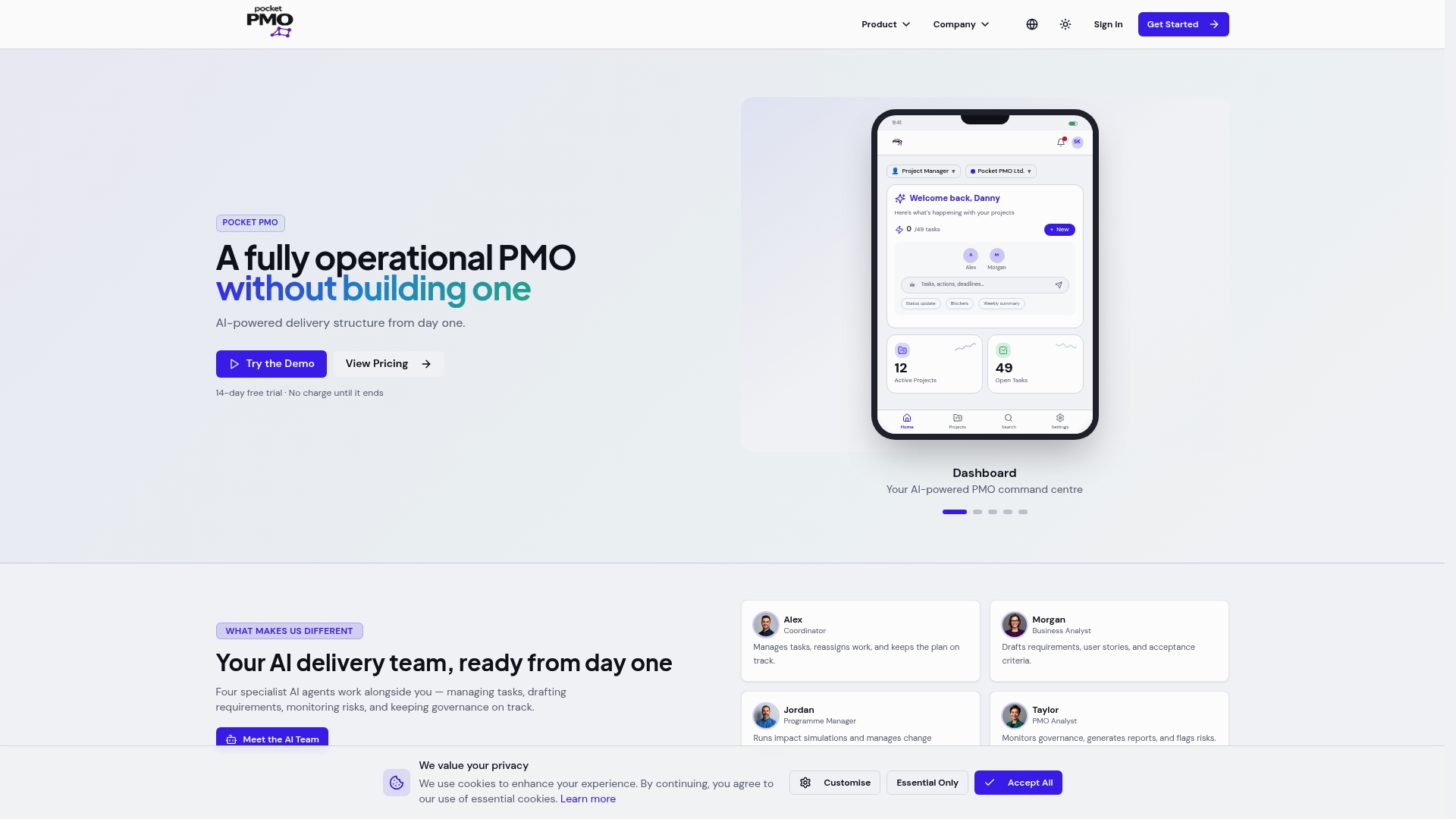
Teams transitioning between frameworks or running hybrid programmes use Pocketpmo to maintain visibility across all workstreams without rebuilding their processes from scratch. The platform's AI-driven risk analysis and portfolio dashboards work alongside your chosen methodology rather than replacing it. If you are evaluating tools that support hybrid delivery, the Pocketpmo vs Microsoft Project comparison shows exactly where each platform fits different methodology types. You can also download a free risk register template to get started immediately, regardless of which framework you choose.
FAQ
What are the main types of project management methodologies?
The main types are Predictive (e.g. Waterfall, PRINCE2), Adaptive (e.g. Scrum, Kanban), and Hybrid (e.g. Scrumban, Water-Scrum-Fall). Each family suits a different level of requirements stability and organisational context.
What is the difference between Agile and Waterfall?
Waterfall delivers projects in fixed sequential phases with scope defined upfront. Agile delivers in short iterative cycles that accommodate changing requirements. Waterfall suits fixed-scope regulated projects; Agile suits evolving product development.
Which project management methodology is most widely used?
Scrum is the most popular Agile framework, used by 87% of Agile teams. Waterfall remains dominant in construction and regulated industries at 76% adoption.
How do I choose the right methodology for my project?
Start with three questions: are your requirements stable, how large is your team, and does your industry require formal governance? Well-defined requirements suggest Waterfall; frequently changing requirements point to Agile or a hybrid approach.
Are hybrid project management approaches becoming more common?
Yes. Hybrid adoption increased from 20% in 2020 to 31% in 2023, reflecting a shift towards combining structured governance with iterative execution in real-world programmes.