

A project change request is a formal proposal to alter the agreed scope, schedule, cost, or quality baseline of a project. The four primary types recognised across industry frameworks are standard, normal, major, and emergency. Each type is defined by its risk level, urgency, and potential impact on project delivery. Knowing the difference between them is not a procedural nicety. It is the foundation of effective scope control and the primary defence against uncontrolled project drift. PMBOK 8 and ITSM frameworks both use this four-category model, and understanding it will sharpen how you assess, approve, and document every change request your project receives.
1. What are the types of project change requests?
Four accepted categories define the project change request landscape in 2026: standard, normal, major, and emergency. This categorisation balances risk, efficiency, and governance requirements across different project environments. Each category determines the approval path, the documentation required, and the speed at which a change can be implemented. Misclassifying a change request is one of the most common causes of scope creep and governance failure. Getting the classification right from the start protects your project baseline and keeps stakeholders aligned.

Beyond these four types, change requests also fall into functional categories. Corrective actions, preventive actions, defect repairs, and updates each reflect a different reason for requesting a change. Corrective actions realign performance that has drifted from plan. Preventive actions address future risks before they materialise. Defect repairs fix identified quality failures. Updates revise documentation or process records. These functional categories often sit within the four primary types, adding a second layer of classification that helps project managers route requests accurately.
2. Standard change requests: pre-approved and low-risk
A standard change is a pre-approved, low-risk modification that follows a defined and repeatable process. No individual approval is required each time because the risk profile is already understood and accepted. Well-defined standard change templates enable rapid execution without individual approval, which is the core advantage of this category.
Typical examples include:
- Routine software updates to a pre-approved version
- Adding a new user account following an established onboarding process
- Replacing hardware with an identical model
- Applying a standard configuration change to a tested environment
The benefit is speed. Standard changes remove governance overhead for tasks that carry no meaningful risk. The caution is overuse. Attempting to template every minor change increases administrative burden rather than reducing it. Standard changes should focus on high-frequency, truly repeatable tasks where the process is fully understood and the outcome is predictable.
Pro Tip: Before classifying a change as standard, ask whether it has been executed successfully at least five times with consistent outcomes. If the answer is no, route it through the normal change process instead.
3. Normal change requests: governance and formal assessment
A normal change request covers modifications with moderate to high risk that require formal assessment and approval before implementation. These are the most common type of project modification in complex environments. They are not urgent, and they are not pre-approved. They require structured review.
The typical process for a normal change request follows these steps:
- Submit the request with a full description, reason, and initial impact estimate.
- Conduct an impact assessment covering time, cost, scope, and risk.
- Route the request to the appropriate approver, which may be a project manager, a change advisory board, or a senior stakeholder depending on the scale.
- Record the decision, including the rationale if the request is rejected.
- Schedule and implement the approved change within the agreed window.
- Update the project baseline and notify affected parties.
Formal lead times of around 48 hours or more are standard for processing normal changes. That window exists to allow proper impact analysis, not to create delay for its own sake. The change control process for normal requests is where most scope creep is either caught or missed.
Pro Tip: Set a clear service level agreement for normal change decisions. Clear SLAs for decisions accelerate the process and prevent paralysis in agile environments. A 48-hour decision window is a reasonable starting point for most project teams.
4. Major change requests: scope, budget, and senior approval
A major change request involves significant alterations to project scope, budget, or delivery timeline. These changes carry high risk and require senior stakeholder involvement before any action is taken. They are not routine, and they cannot be approved at project manager level alone.
Characteristics of a major change request include:
- A material increase or reduction in project scope
- Budget adjustments that exceed the project manager's delegated authority
- Changes to key deliverables or acceptance criteria
- Alterations that affect contractual obligations or regulatory compliance
- Modifications that shift the critical path by a significant margin
Examples include adding an entirely new workstream to a programme, replacing a core technology platform mid-delivery, or renegotiating the project's end date with the client. Each of these carries consequences that ripple across cost, resource, and risk.
The governance requirement for major changes is proportionally higher. A formal business case or change impact report is typically required. Senior leadership, programme boards, or steering committees must review and approve the request before work proceeds. Thorough documentation and review are not optional at this level. Failing to justify a major change with adequate evidence is one of the fastest routes to project failure.
5. Emergency change requests: urgent action with mandatory review
An emergency change request is triggered when an immediate risk to project delivery, system stability, or business continuity requires action that cannot wait for the standard approval cycle. These changes are high-risk by definition and are approved through an accelerated workflow.
Common triggers for emergency changes include:
- A critical security vulnerability requiring an immediate patch
- A production system failure blocking project delivery
- A regulatory deadline that has moved without warning
- A data integrity issue threatening project outputs
Emergency changes require pre-approval from a manager, a clear justification for urgency, and skip the regular approval stages to allow prompt action. The speed of execution is the point. But speed without accountability creates a different kind of risk.
Emergency changes bypass standard governance steps, but post-implementation reviews are mandatory to ensure accountability and capture learnings for future incidents.
This mandatory review is not a formality. It is the mechanism that prevents emergency changes from becoming a habitual workaround for poor planning. Every emergency change must be logged, reviewed, and used to improve the standard change catalogue or the risk register. Monitor and document emergency changes thoroughly to maintain traceability across the project record.
6. How to assess and manage different change request categories
Effective management of any change request begins with impact analysis before approval. Impact analysis before approving any change is critical to prevent scope creep, because even minor changes can cascade and affect the critical path or resource availability. This is the "death by a thousand cuts" problem. Each small, unreviewed change appears harmless in isolation. Collectively, they derail projects.
Conducting a thorough impact assessment before committing to any change is the single most effective way to protect your project baseline. A consistent form structure improves clarity and traceability across all change types. Change requests should contain a description, reason, impact evaluation, risk analysis, priority level, and approval status as standard fields.
The table below shows how governance requirements scale with change type:
| Change type | Risk level | Approval required | Typical lead time |
|---|---|---|---|
| Standard | Low | Pre-approved | Immediate |
| Normal | Moderate to high | Project manager or board | 48 hours or more |
| Major | High | Senior stakeholders | Days to weeks |
| Emergency | Critical | Manager pre-approval | Hours |
Right-sizing governance to risk level is the governing principle here. Over-governing low-risk changes creates bottlenecks. Under-governing high-risk changes creates failures. The goal is proportionality. Use a free change request template to standardise submissions across all four categories and reduce the time spent on formatting rather than analysis.
Rejections must be documented with rationale to prevent repeated unnecessary requests. A rejected change that is not recorded will be resubmitted. Documenting the reason closes that loop and builds a reference library that improves future decision-making.
Pro Tip: Use project risk analysis methods to score the impact of each change request before it reaches the approval stage. A simple high, medium, low scoring matrix applied consistently will cut approval time and improve decision quality.
Key takeaways
Classifying change requests correctly by type is the most reliable way to protect project scope, control costs, and maintain governance without creating unnecessary delays.
| Point | Details |
|---|---|
| Four primary types exist | Standard, normal, major, and emergency cover all change scenarios across PMBOK 8 and ITSM frameworks. |
| Classification drives governance | The change type determines the approval path, lead time, and documentation required before action. |
| Impact analysis is non-negotiable | Every change, regardless of size, must be assessed for its effect on scope, cost, and the critical path. |
| Emergency changes need post-review | Accelerated approval does not remove accountability; a mandatory review must follow every emergency change. |
| Document rejections as well as approvals | Recording why a change was refused prevents repeated requests and builds a stronger change history. |
Why I think most teams get change classification wrong
Most project teams treat change request classification as an administrative task rather than a risk management decision. That is the root of most governance failures I have seen. Teams default to "normal" for everything because it feels safe, and then wonder why their approval queues are backed up and their project managers are drowning in paperwork.
The real skill is in the edges. Knowing when a change is genuinely standard and can be executed immediately, versus when it looks routine but carries a hidden dependency that pushes it into normal territory. That judgement comes from experience, but it also comes from having a clear classification framework written down and agreed before the project starts. Not after the first contentious change request lands.
Emergency changes are where I see the most damage done. Teams use the emergency category to bypass governance when they are under pressure, and then skip the post-implementation review because the crisis has passed. That review is where the learning lives. Without it, the same emergency recurs, and the team is surprised every time.
Right-sizing governance is not about reducing rigour. It is about applying the right level of rigour to the right type of change. A standard change that goes through a full board review is a waste of everyone's time. A major change that gets waved through without a business case is a project risk waiting to materialise. The four-category model exists precisely to prevent both of those outcomes.
— Danny
Pocketpmo: built for teams managing complex change requests
Managing multiple change request types across a live project is genuinely difficult without the right structure behind you. Pocketpmo gives project managers a purpose-built platform with change request workflows, AI-driven risk analysis, and real-time dashboards that surface the impact of every proposed change before it reaches the approval stage.
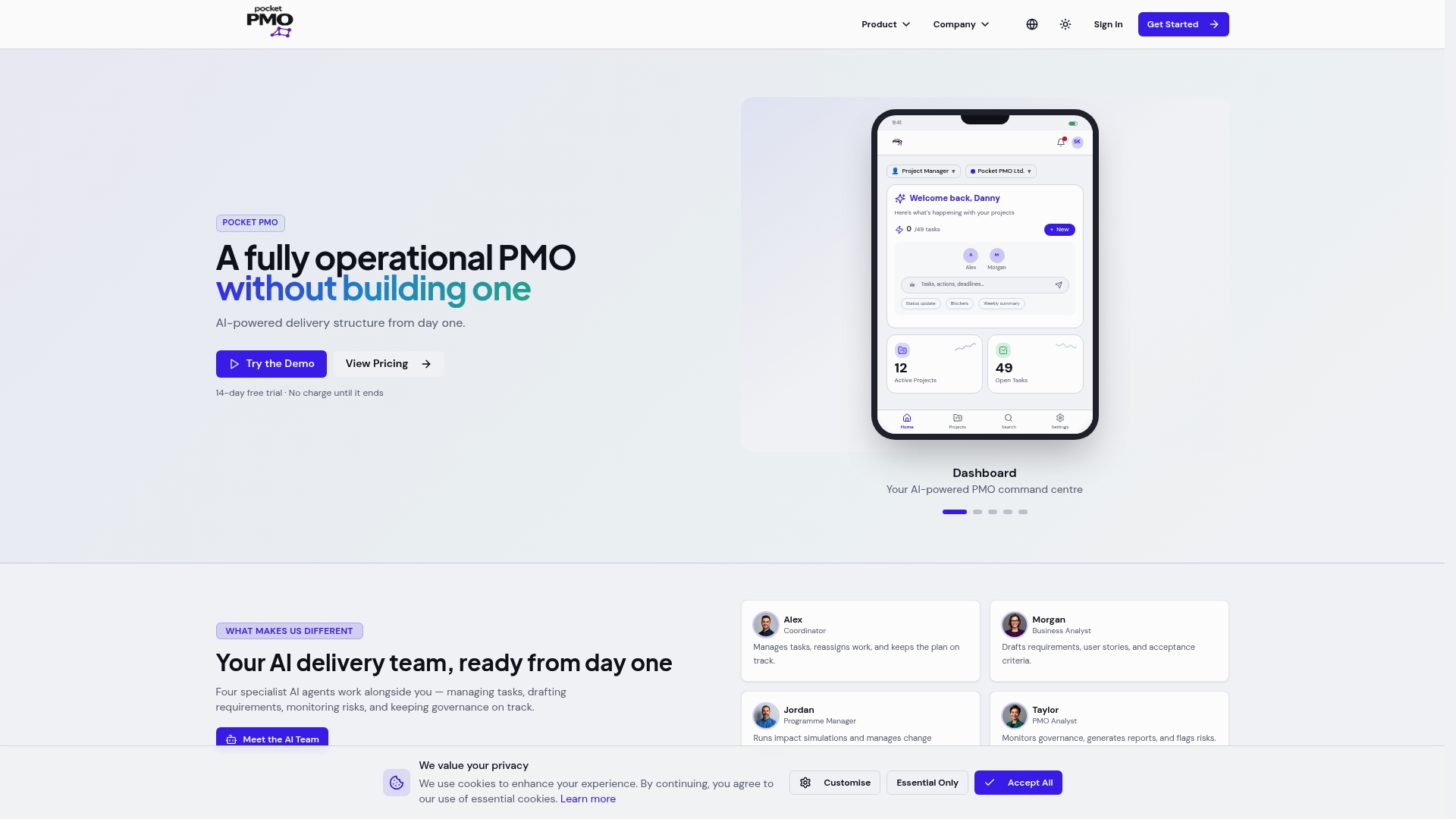
The platform integrates change request tracking with your risk register and project baseline, so you can see the knock-on effects of any modification immediately. Free templates, including a risk register template, are available to get your governance structure in place from day one. If you are managing a portfolio of projects and need consistent change control without building a PMO from scratch, Pocketpmo is worth a closer look.
FAQ
What are the four types of project change requests?
The four primary types are standard, normal, major, and emergency. Each is defined by its risk level, urgency, and the approval process required before implementation.
What is the difference between a normal and a major change request?
A normal change request covers moderate to high-risk modifications requiring formal assessment and approval, typically within 48 hours or more. A major change involves significant scope or budget alterations and requires senior stakeholder or board approval, often taking days to weeks.
When should an emergency change request be used?
An emergency change request is used when an immediate risk to project delivery or business continuity cannot wait for the standard approval cycle. It requires manager pre-approval and must be followed by a mandatory post-implementation review.
How do change requests prevent scope creep?
Change requests serve as the primary defence against scope creep by requiring formal documentation and impact analysis for every proposed modification. Even minor changes that are logged and assessed prevent the unnoticed accumulation of alterations that derail projects.
What should a change request always include?
A change request should always include a description, reason, impact evaluation, risk analysis, priority level, and approval status. Consistent form structure improves clarity and traceability across all change types.